 | Dave’s Faves:My Album Collection in 1986 |
By year’s end, this was what my collection looked like. Albums acquired in 1986 are marked with an asterisk.

Resources and Related Links:
First posted 8/31/2021. |

DavesMusicDatabase.com is devoted to ranking, rating, and reviewing music of all genres and eras. The DMDB blog serves up album and song reviews, best-of lists, music history snapshots, and music-related essays.

|

|

|

|

|

|

|

|

|

|

|

|
|
| Dave’s Faves:My Album Collection in 1986 |
By year’s end, this was what my collection looked like. Albums acquired in 1986 are marked with an asterisk.
Resources and Related Links:
First posted 8/31/2021. |
 | Bob Shannon & John Javna:Behind the Hits |
From the back book jacket: “Here they are…the most amazing stories of rock and roll’s first thirty years, the stories behind the classic songs and the aritsts who made them famous.” The book doesn’t present songs in a ranked, chronological, or alphabetized order. Instead, songs are grouped by categories such as “Accidental Hits,” “False Impressions,” “Mistaken Identity,” and “Spontaneous Combustion.” The songs (just shy of 350 titles) are presented here in alphabetical order by artist. Click here to see other lists from critics and individuals and here to see other lists from publications and/or organizations.
Resources/Related Links:
First posted 4/1/2023. |
 | Pop Memories:Top 100 Songs, 1890-1954 |
Billboard magazine has long been the music chart industry leader with its flagship Hot 100 chart, which launched in 1958. Prior to that, Billboard did other charts, but the farther back one dips into recorded history, the more difficult it is to find music charts from Billboard or any other source. Pop Memories 1890-1954 taps multiple sources from the pre-rock era to create music charts. This particular webpage takes the list from that book of the top 100 songs from 1890 to 1954, as determined first by the most weeks spent at #1, tne by total weeks on the chart. Check other lists based on charts, sales, and airplay here.
17 weeks:
1. Francis Craig with Bob Lamm “Near You” (1947) 14 weeks:
2. Bing Crosby with the Ken Darby Singers “White Christmas” (1942) 13 weeks:
3. Artie Shaw “Frenesi” (1940) 12 weeks:
11. The Mills Brothers “Paper Doll” (1942) 11 weeks:
18. Les Paul with Mary Ford “Vaya Con Dios (May God Be with You)” (1953)
21. Johnnie Ray & the Four Lads “Cry” (1951)
31. Arthur Collins “The Preacher and the Bear” (1905) 10 weeks:
33. Tony Bennett “Because of You” (1951)
41. Rudy Vallee & His Connecticut Yankees “Stein Song (University of Maine)” (1930)
51. Eileen Barton “If I Knew You Were Comin’ I’d’ve Baked a Cake” (1950) 9 weeks:
60. Les Brown with Doris Day “Sentimental Journey” (1945)
71. Glenn Miller “Tuxedo Junction” (1940)
81. Billy Murray “Harrigan” (1907) 8 weeks:
86. Al Dexter & His Troopers “Pistol Packin’ Mama” (1943)
91. Tony Bennett “Rags to Riches” (1953) Resources/Related Links:
First posted 12/21/2022. |
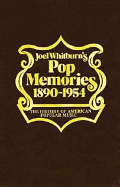 | Pop Memories:1890-1954 |
My personal book shelves are loaded with more than a hundred books devoted to music. This one, however, is the most important of them all. The book was published by Record Research, a company started by Joel Whitburn which became the go-to resource for books on the Billboard charts. The book also features invaluable research from Steve Sullivan, who has become the individual most responsible for sparking my interest in music of the pre-rock era.
 I became a chart fanatic in the 1980s because of American Top 40, a weekly radio countdown show based on Billboard’s pop charts. The magazine was founded in 1894 as a trade publication for, well, billboards. However, it expanded in the early years of the 20th century to cover the entertainment industry in general and then later keying in on the music industry. Their first music charts in 1913 focused on sheet music. Over the years, they’ve developed multiple charts focused on music, but the Billboard Hot 100, which tracks the most popular songs in the United States on a weekly basis, has become the industry standard.

However, other charts have existed over the years and Pop Memories serves as an invaluable resource to early Billboard charts as well as other chart sources. Here are some of the sources cited on page 7 of the 1986 edition:
Dave’s Music Database lists based on Pop Memories:


Resources/Related Links:
First posted 12/21/2022. |
|
| Pop Memories: Top 100 Artists:1890-1954 |
This list is taken from page 623 of Joel Whitburn’s Pop Memories 1890-1954. That book was designed as a companion to the Billboard books which tracked the songs which charted on the Hot 100 from 1955 to the present. The book lists acts alphabetically and all their hits, including peak position and date first charted. This list was created by totaling each act’s chart points. See other best-of lists from publications/organizations.
1. Bing Crosby
11. Ben Selvin
21. Freddy Martin
31. Jo Stafford
41. The Mills Brothers
51. Albert Campbell
61. Marion Harris
71. Dan Quinn
81. Doris Day
91. Lewis James Resources/Related Links:
Last updated 3/3/2026. |
 | Walk Like an EgyptianThe Bangles |
This post has been moved here. |
 | You Gotta Fight for Your Right to PartyBeastie Boys |
Writer(s): Adam Yauch, Rick Rubin, Adam Horovitz (see lyrics here) First Charted: December 20, 1986 Peak: 7 US, 3 CB, 12 RR, 1 CO, 11 UK, 7 CN, 37 AU, 7 DF (Click for codes to charts.) Sales (in millions): -- US, 0.2 UK Airplay/Streaming (in millions): -- radio, 81.7 video, 192.70 streaming |
Awards:Click on award for more details.


|
About the Song:The fourth single from the Beastie Boys’ debut album made them a household name. Their goofy wit and party atmosphere endured them to millions – millions who flocked to buy the parent album, Licensed to Ill and give the Beasties the distinction of being the first rap group in U.S. history to hit #1 on the Billboard album chart. The song – and the success of the album – owed much to the Beasties’ combination of metal and rap. The Beastie Boys were “just three kids from rich New York families who liked black culture.” TC With the help of producer Rick Rubin, they merged the sounds of Led Zeppelin with the style of old school rap. It wasn’t the first time rock and rap had found chart success – just months earlier, Rubin helped Run-D.M.C. get a top 5 U.S. pop hit with their remake of Aerosmith’s “Walk This Way” – aided by Aerosmith’s own Steven Tyler and Joe Perry. “Fight for Your Right” was intended as a parody of the kind of “beer-soaked, panty-raiding rock jam that ruled fraternity houses and dingy bars alike.” TB The video, which depicted “the party that is every suburban parent’s worst nightmare” TB played up the parody and garnered it plenty of spins on MTV. Unfortunately, as member Mike D said, “There were tons of guys singing along to ‘Fight for Your Right’ who were oblivious to the fact it was a total goof on them.” WK In fact, the song was reportedly cut just as a joke. Once the group became superstars thanks to their new frat-boy fanbase, they played up the roles until, according to Beastie Boy Adam “MCA” Yauch, they had become their own joke. SF In time, the group would come to be very respected for their experimental music and ability to merge different genres. Rap group Public Enemy was on board early, even sampling the song for their own 1988 “Party for Your Right to Fight.” Resources:
Related Links:

First posted 12/20/2011; last updated 6/18/2023. |

 | The Way It IsBruce Hornsby & the Range |
Writer(s): Bruce Hornsby (see lyrics here) First Charted: August 2, 1986 Peak: 12 US, 11 CB, 12 RR, 12 AC, 3 AR, 15 UK, 13 CN, 12 AU, 1 DF (Click for codes to singles charts.) Sales (in millions): -- Airplay/Streaming (in millions): -- radio, 38.89 video, 160.19 streaming |
Awards:Click on award for more details. 


|
About the Song:Hornsby was born in Williamsburg, Virginia. His father was a former musician and oil exec who became a successful housing developer. As a former musician, he kept a Steinway piano which Bruce learned to play. When Michael McDonald heard him while on tour with the Doobie Brothers, he encouraged Hornsby to go to Los Angeles. Bruce and his brother John went to LA in 1980 and became staff songwriters at 20th Century Fox. Bruce played keyboards with Ambrosia and with Sheena Easton’s band before forming his own band, The Range, in 1984. He recorded a four-song demo of his own music after becoming frustrated with trying to write hits for others. One of the songs was “The Way It Is.” The song started as lyrics first and then he added a lick he liked. He thought the melody was strange, but kept playing it over and over. FB After shopping it around, he was signed to RCA. The first single, “Every Little Kiss,” only reached #72 on the Billboard Hot 100, although it would get reissued and go to #14. The second single – “the gentle and florid soft-rock jam” SG “The Way It Is” – went all the way to #1. It “is unambiguously a song about racism and about people with money doing everything in their power to keep their place atop the societal pyramid.” SG The chorus suggests pessism with the lines, “That’s just the way it is / Some things will never change.” However, when Hornsby adds the line, “But don’t you believe them” it implores “the need to resist complacency and never resign yourself to racial injustice as the status quo.” SF The song had “a consistent tempo and a jazz-inflected sound” SF and lacked the elements of conventional chart-toppers such as “a big chorus, shifts in momentum, [and] catchy hooks.” SF “Hornsby sings in a warm, smooth white-soul yarl. The drums echo just right, and the guitars noodle with processed precision, like they were soundtracking a cop show.” SG “That piano is something else…Hornsby keeps circling that main figure, dancing around it. He orbits the main melody, ducking in and out when it makes sense, never losing the melodic thread even when he’s playing solos.” SG Resources:
First posted 10/27/2022. |


