Showing posts with label Moody Blues. Show all posts

Friday, July 3, 2026

Top 30 Progressive Rock Acts

Progressive Rock:

Top 30 Acts

Progressive rock is one of the most beloved and ridiculed of rock music’s sub genres. As a hilarious piece at Cracked.com says, it is “categorized by a sacking of traditional song structure, complex rhythms, odd time signatures,” and insane song lengths betraying the creators’ lack of awareness of when to stop a song.

The players tend to be average singers and extremely skilled musicians, often working with wacky instruments. As the piece amusingly states, it is “the only rock genre in which the term ‘flute solo’ has any meaning.”

Also prevalent are a propensity toward concept albums built on half-baked themes and philosophy. There tends to be plenty of drug inspiration and “a sense of inherent superiority over other rock genres.”

All kidding aside, it is a difficult genre to absorb. The stereotypes detailed at Cracked.com lean toward the truth more often than not, but prog rock is largely defined by not being definable. It is an experimental form which doesn’t play by the rules.

16 lists focused on progressive rock acts were aggregated to create this list. The top 15 were determined by which acts appeared on the most lists. The next fifteen were determined by looking at all acts reaching 4 to 9 lists and then ordering them by overall status in Dave’s Music Database.

See other lists of Acts/Music Makers by Genre.


Pink Floyd

1. Pink Floyd
2. Yes
3. Rush
4. Genesis
5. Jethro Tull
6. Emerson, Lake & Palmer
7. King Crimson
8. Tool
9. The Moody Blues
10. Porcupine Tree

11. Gentle Giant
12. The Alan Parsons Project
13. Kansas
14. Dream Theater
15. The Mars Volta
16. Styx
17. Supertramp
18. Asia
19. Electric Light Orchestra
20. Marillion

21. Frank Zappa
22. Queensrÿche
23. Procol Harum
24. Can
25. Mike Oldfield
26. Manfred Mann
27. Hawkwind
28. Soft Machine
29. Opeth
30. Tangerine Dream


Resources/Related Links:


First posted 7/3/2026.

Friday, November 10, 2017

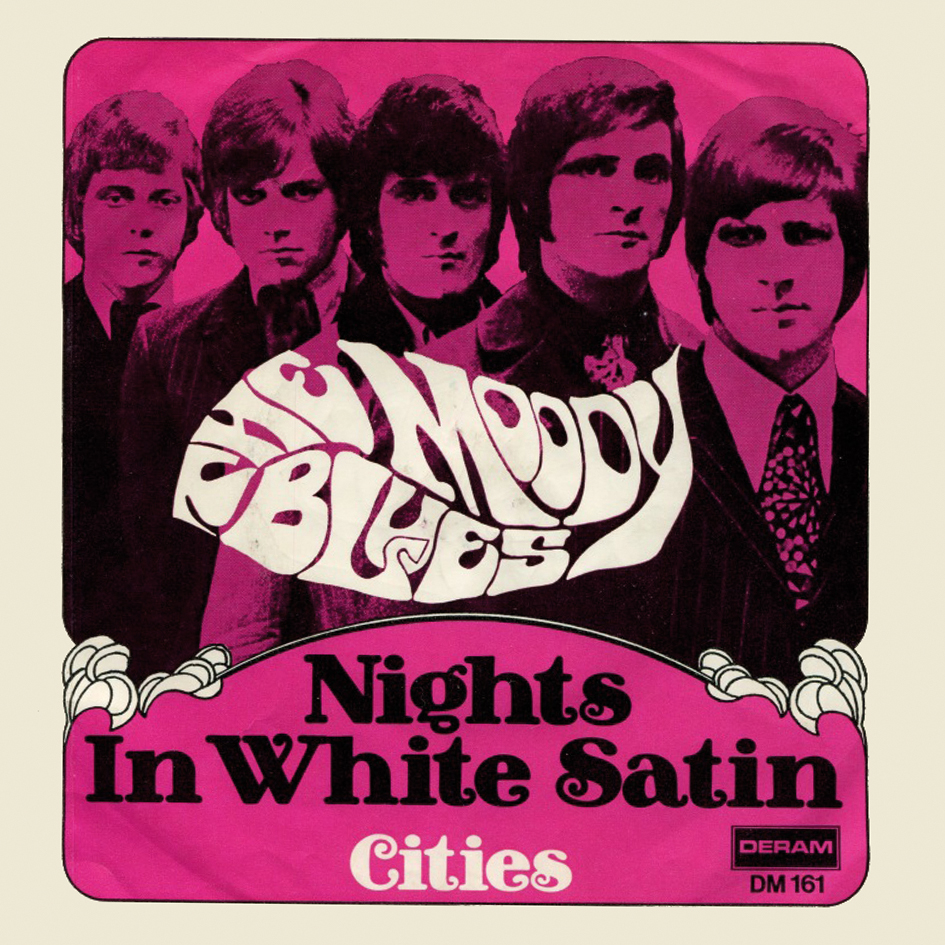
Today in Music (1967): The Moody Blues charted with “Nights in White Satin”

Nights in White Satin

The Moody Blues

Writer(s): Justin Hayward (see lyrics here)


Released: November 10, 1967


First Charted: February 10, 1968


Peak: 2 US, 11 CB, 11 GR, 12 HR, 37 AC, 1 CL, 9 UK, 11 CN, 8 AU, 1 DF (Click for codes to charts.)


Sales (in millions): 1.0 US, -- UK


Airplay/Streaming (in millions): -- radio, 108.3 video, 211.55 streaming

Awards:

Click on award for more details.

About the Song:

Things looked bleak for the Moody Blues in 1966 when Justin Hayward and John Lodge arrived. TB The group’s “Go Now” went to #1 in the UK in 1964 and they’d had nothing hit the top 20 since. They were “back to playing gigs for small change.” TB In an effort to showcase its new “enhanced stereo sound technology,” SF the group’s record label, Deram, approached the group about recording a modern version of Dvorak’s “New World Symphony.” BBC Instead, the band sold the label on a suite of newly-composed songs woven together by orchestral links TB and thematically focused on the passing of a day. BBC

Although the Moodies were among the first rock bands to integrate classical, KX the so-called London Festival Orchestra, with which they supposedly recorded, never existed. It was simply the banner under which the musicians behind the Days of Future Passed album gathered. SF As the album’s centerpiece, “Nights in White Satin” “was an early example of progressive – or art – rock.” DJ Hayward got the idea for this “yearning love song” BBC after receiving a gift of white satin sheets. SF As he told the Daily Express in 2008, “It was a series of random thoughts and was quite autobiographical. It was a very emotional time as I was at the end of one big love affair and the start of another. A lot of that came out in the song.” SF

The song “was drenched in what would be come the Moodys’ signature sound – the synthetic strings of the Mellotron.” BBC The song peaked at a modest #19 in December of 1967, BBC but after songs like “Hey Jude” and “Layla” broke radio’s four-minute-singles barrier, the song became a hit in the United States. SF It then re-charted in the U.K., this time hitting #9, and in 1979 went top 20 in the U.K. for a third time, this time peaking at #14.


Resources:


Related Links:


First posted 11/10/2011; updated 9/17/2023.

Thursday, May 25, 2017

50 years ago: Procol Harum’s “A Whiter Shade of Pale” charted

A Whiter Shade of Pale

Procol Harum

Writer(s): Gary Brooker/Keith Reid/Matthew Fisher (see lyrics here)


First Charted: May 25, 1967


Peak: 5 US, 5 CB, 2 GR, 3 HR, 1 CL, 16 UK, 11 CN, 13 AU, 1 DF (Click for codes to charts.)


Sales (in millions): 1.0 US, 0.76 UK, 10.0 world (includes US + UK)


Airplay/Streaming (in millions): -- radio, 172.44 video, 161.50 streaming

Awards:

Click on award for more details.

About the Song:

With lyrics about vestal virgins and skipping the light fandango, this song has become a “favorite for university theses.” KL-131 “The song nobody understands” BBC managed to simultaneously sound literary with its allusions to Chaucer while also capturing “what most people thought was going on at these LSD parties.” TC While mostly sounding like a drunk trying to hit on a girl at a party, the words quite possibly mean nothing at all. HL “Even the writer Keith Reid couldn’t explain it” BBC saying it was just “’a lot of abstract phrases.’” TC “Ultimately, it’s probably no more or less than a love song packed full of intentionally bewildered nautical metaphors.” TB

The song resembled nothing else on 1967 radio, RS500 which helped it to top the charts in several countries and has made it a popular cover song, with some 800 known recordings. WK It has also become the go-to song when television and films, such as The Big Chill, are looking to capture the spirit of 1960s counterculture. WK Additionally, the song birthed a fusion of classical and rock music, which gave rise to groups like the Moody Blues. RS500http://www.rollingstone.com/news/story/6595902/whiter_shade_of_pale While commonly believed to be paraphrased or even directly copied from Johann Sebastian Bach, WK the song is merely inspired by his “Sleeper’s Awake” and “Air on a G String” works. WK

Astonishingly, this is the only track recorded by the band’s original lineup RS500 with writing credits originally given only to Brooker and Reid. However, organist Matthew Fisher won a 2006 court case which was supposed to give him a co-writing credit as well. With the case upheld on appeals, his royalties remain under dispute. WK


Resources:


First posted 5/25/2011; last updated 7/11/2023.