Showing posts with label Dvorak. Show all posts

Monday, February 23, 2026

Concertos: The Top 25

Concertos:

The Top 25

A concerto is a solo instrument accompanied by an orchestra. These are the top 25 ranked concertos according to Dave’s Music Database.

Check out other best-of-genre/category lists here.


Composer Name of Work (year composition was finished)
1. Antonio Vivaldi The Four Seasons (1725)
2. Pyotr Il’yich Tchaikovsky Piano Concerto No. 1 (1875)
3. Johann Sebastian Bach Brandenburg Concertos (6) (1719-21)
4. Ludwig van Beethoven Piano Concerto No. 5 “Emperor” (1811)
5. Wolfgang Amadeus Mozart Piano Concerto No. 21 (1785)

6. Wolfgang Amadeus Mozart Piano Concerto No. 20 (1785)
7. Ludwig van Beethoven Violin Concerto in D Major (1806)
8. Wolfgang Amadeus Mozart Clarinet Concerto in A Major (1791)
9. Sergei Rachmaninov Piano Concerto No. 2 in C minor (1901)
10. Béla Bartók Concerto for Orchestra (1944)

11. Wolfgang Amadeus Mozart Piano Concerto No. 24 in C minor (1786)
12. Wolfgang Amadeus Mozart Piano Concerto No. 23 in C minor (1786)
13. Johannes Brahms Violin Concerto in D major (1879)
14. Felix Mendelssohn Violin Concerto in E minor (1845)
15. Edvard Grieg Piano Concerto in A minor (1868)

16. Antonin Dvorák Cello Concerto in B minor (1895)
17. Sergei Rachmaninov Piano Concerto No. 3 in D minor (1909)
18. Wolfgang Amadeus Mozart Piano Concerto No. 27 in B flat major (1791)
19. Wolfgang Amadeus Mozart Piano Concerto No. 14 in E flat major (1784)
20. Wolfgang Amadeus Mozart Piano Concerto No. 25 in C major (1786)

21. Wolfgang Amadeus Mozart Piano Concerto No. 19 in F major (1784)
22. Wolfgang Amadeus Mozart Piano Concerto No. 9 in E flat major (1777)
23. Ludwig van Beethoven Piano Concerto No. 4 in G major (1806)
24. Wolfgang Amadeus Mozart Piano Concerto No. 17 in G major (1784)
25. Johann Sebastian Bach Violin Concerto No. 2 in E major (1723)


Resources and Related Links:


First posted 10/3/2023; last updated 2/23/2026.

Sunday, February 22, 2026

Top 25 Chamber Music Works

Chamber Music:

Top 25 Works

Chamber music is a form of classical music composed for a small group of instruments, traditionally a group which could fit in a palace chamber. This list was comprised by taking the top 25 chamber music works as determined by their overall ranking in the Dave’s Music Database. Most of these are album-length works and therefore qualify for album lists with the exception of those works marked with an asterisk (*).

Check out other best-of-genre/category lists here.


Composer Name of Work (year composition was finished)
1. Franz Schubert Piano Quintet in A Major (“Trout”) (1814)
2. Ludwig van Beethoven String Quartet No. 14 (1826)
3. Ludwig van Beethoven String Quartet No. 13 (1825)
4. Johann Pachelbel “Canon in D major” (1694) *
5. Ludwig van Beethoven String Quartet No. 15 (1825)

6. Franz Josef Haydn String Quartet No. 5 in D major (Largo) (1797)
7. Felix Mendelssohn Octet for Strings in E flat major (1825)
8. Franz Josef Haydn String Quartet No. 3 in C major (Emperor) (1797)
9. Johann Sebastian Bach Sonatas and Partitas for Violin (1720)
10. Wolfgang Amadeus Mozart Clarinet Quintet in A Major (Stadler) (1789)

11. Claudio Monteverdi Madrigals of Love and War (Madrigali Guerrieri ed Amorosi) (1638)
12. Giovanni Gabrieli “Canzon Noni Toni a 12, CH 183 (Brass Choir)” (1597) *
13. Ludwig van Beethoven String Quartet No. 16 (1826)
14. Ludwig van Beethoven String Quartet No. 7 (1806)
15. Ludwig van Beethoven String Quartet No. 9 (Hero) (1806)

16. Franz Schubert String Quintet in C major (1828)
17. Ludwig van Beethoven String Quartet No. 8 (1806)
18. Ludwig van Beethoven String Quartet No. 10 (Harp) (1809)
19. Ludwig van Beethoven String Quartet No. 12 (1824)
20. Franz Josef Haydn String Quartet No. 2 in D minor (1797)

21. Ludwig van Beethoven String Quartet No. 2 (1801)
22. Ludwig van Beethoven String Quartet No. 4 (1801)
23. Franz Schubert String Quartet No. 14 in D minor (Death and the Maiden) (1824)
24. Johann Sebastian Bach Musikalisches Opfer (The Musical Offering) (1747)
25. Johann Sebastian Bach The Art of the Fugue (Die Kunst der Fuge) (1750)


Resources and Related Links:


First posted 10/4/2023; last updated 2/22/2026.

Tuesday, October 3, 2023

Symphonies: Top 25

Symphonies:

The Top 25

This list is devoted to the top symphonies of all time as determined by their overall ranking in Dave’s Music Database. A symphony is generally large in scale, written for an orchestra, and made up of four individual movements.

Check out other best-of-genre/category lists here.


Composer Name of Work (year composition was finished)
1. Ludwig van Beethoven Symphony No. 5 (1808)
2. Ludwig van Beethoven Symphony No. 9 (1824)
3. Ludwig van Beethoven Symphony No. 7 (1812)
4. Ludwig van Beethoven Symphony No. 3 in E-flat “Sinfonia Eroica” (1804)
5. Hector Berlioz Symphonie Fantastique (1830)

6. Ludwig van Beethoven Symphony No. 6 “Pastorale” (1808)
7. Wolfgang Amadeus Mozart Symphony No. 40 in G minor (1788)
8. Antonin Dvorák Symphony No. 9 in E minor (“From the New World”) (1893)
9. Wolfgang Amadeus Mozart Symphony No. 41 “Jupiter” (1788)
10. Johannes Brahms Symphony No. 4 (1885)

11. Pyotr Il’yich Tchaikovsky Symphony No. 6 in B minor (“Pathetique”) (1893)
12. Franz Schubert Symphony No. 8 “Unfinished”) (1822)
13. Wolfgang Amadeus Mozart Symphony No. 38 in D major (1787)
14. Gustav Mahler Symphony No. 2 in C minor “Resurrection” (1894)
15. Gustav Mahler Symphony No. 5 in C sharp minor (1902)

16. Wolfgang Amadeus Mozart Symphony No. 35 in D major (1782)
17. Ludwig van Beethoven Symphony No. 8 in F major (1812)
18. Wolfgang Amadeus Mozart Symphony No. 39 in E flat major (1788)
19. Ludwig van Beethoven Symphony No. 4 in B flat major (1806)
20. Franz Josef Haydn Symphony No. 104 in D major (1795)

21. Franz Schubert Symphony No. 9 in C major (1828)
22. Gustav Mahler Symphony No. 1 in D major (“Titan”) (1884-88)
23. Dmitri Shostakovich Symphony No. 5 in D minor (1937)
24. Gustav Mahler Symphony No. 9 in D major “Farewell” (1912)
25. Johannes Brahms Symphony NO. 1 in C minor (1876)


Resources and Related Links:


First posted 10/3/2023.

Friday, November 10, 2017

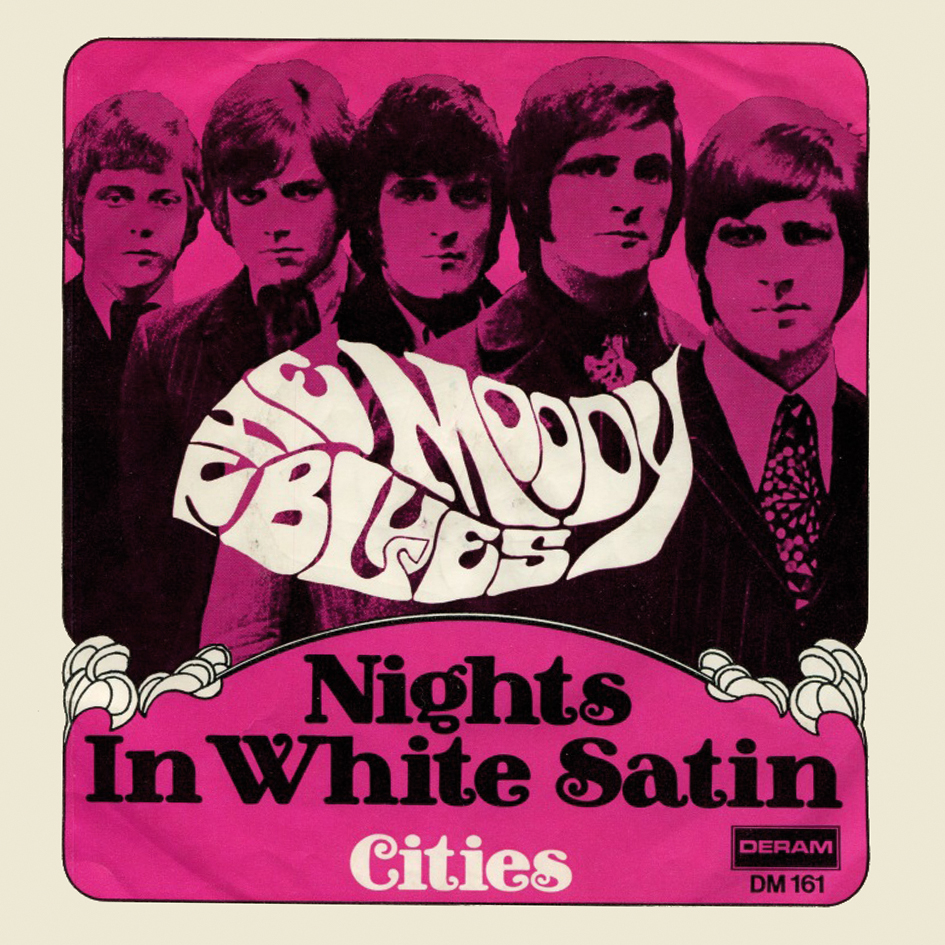
Today in Music (1967): The Moody Blues charted with “Nights in White Satin”

Nights in White Satin

The Moody Blues

Writer(s): Justin Hayward (see lyrics here)


Released: November 10, 1967


First Charted: February 10, 1968


Peak: 2 US, 11 CB, 11 GR, 12 HR, 37 AC, 1 CL, 9 UK, 11 CN, 8 AU, 1 DF (Click for codes to charts.)


Sales (in millions): 1.0 US, -- UK


Airplay/Streaming (in millions): -- radio, 108.3 video, 211.55 streaming

Awards:

Click on award for more details.

About the Song:

Things looked bleak for the Moody Blues in 1966 when Justin Hayward and John Lodge arrived. TB The group’s “Go Now” went to #1 in the UK in 1964 and they’d had nothing hit the top 20 since. They were “back to playing gigs for small change.” TB In an effort to showcase its new “enhanced stereo sound technology,” SF the group’s record label, Deram, approached the group about recording a modern version of Dvorak’s “New World Symphony.” BBC Instead, the band sold the label on a suite of newly-composed songs woven together by orchestral links TB and thematically focused on the passing of a day. BBC

Although the Moodies were among the first rock bands to integrate classical, KX the so-called London Festival Orchestra, with which they supposedly recorded, never existed. It was simply the banner under which the musicians behind the Days of Future Passed album gathered. SF As the album’s centerpiece, “Nights in White Satin” “was an early example of progressive – or art – rock.” DJ Hayward got the idea for this “yearning love song” BBC after receiving a gift of white satin sheets. SF As he told the Daily Express in 2008, “It was a series of random thoughts and was quite autobiographical. It was a very emotional time as I was at the end of one big love affair and the start of another. A lot of that came out in the song.” SF

The song “was drenched in what would be come the Moodys’ signature sound – the synthetic strings of the Mellotron.” BBC The song peaked at a modest #19 in December of 1967, BBC but after songs like “Hey Jude” and “Layla” broke radio’s four-minute-singles barrier, the song became a hit in the United States. SF It then re-charted in the U.K., this time hitting #9, and in 1979 went top 20 in the U.K. for a third time, this time peaking at #14.


Resources:


Related Links:


First posted 11/10/2011; updated 9/17/2023.