Showing posts with label progressive rock. Show all posts

Friday, July 3, 2026

Top 30 Progressive Rock Acts

Progressive Rock:

Top 30 Acts

Progressive rock is one of the most beloved and ridiculed of rock music’s sub genres. As a hilarious piece at Cracked.com says, it is “categorized by a sacking of traditional song structure, complex rhythms, odd time signatures,” and insane song lengths betraying the creators’ lack of awareness of when to stop a song.

The players tend to be average singers and extremely skilled musicians, often working with wacky instruments. As the piece amusingly states, it is “the only rock genre in which the term ‘flute solo’ has any meaning.”

Also prevalent are a propensity toward concept albums built on half-baked themes and philosophy. There tends to be plenty of drug inspiration and “a sense of inherent superiority over other rock genres.”

All kidding aside, it is a difficult genre to absorb. The stereotypes detailed at Cracked.com lean toward the truth more often than not, but prog rock is largely defined by not being definable. It is an experimental form which doesn’t play by the rules.

16 lists focused on progressive rock acts were aggregated to create this list. The top 15 were determined by which acts appeared on the most lists. The next fifteen were determined by looking at all acts reaching 4 to 9 lists and then ordering them by overall status in Dave’s Music Database.

See other lists of Acts/Music Makers by Genre.


Pink Floyd

1. Pink Floyd
2. Yes
3. Rush
4. Genesis
5. Jethro Tull
6. Emerson, Lake & Palmer
7. King Crimson
8. Tool
9. The Moody Blues
10. Porcupine Tree

11. Gentle Giant
12. The Alan Parsons Project
13. Kansas
14. Dream Theater
15. The Mars Volta
16. Styx
17. Supertramp
18. Asia
19. Electric Light Orchestra
20. Marillion

21. Frank Zappa
22. Queensrÿche
23. Procol Harum
24. Can
25. Mike Oldfield
26. Manfred Mann
27. Hawkwind
28. Soft Machine
29. Opeth
30. Tangerine Dream


Resources/Related Links:


First posted 7/3/2026.

Wednesday, August 28, 2024

The Top 50 Progressive Rock Albums

Progressive Rock:

The Top 50 Albums

Progressive rock is one of the most beloved and ridiculed of rock music’s sub genres. As a hilarious piece at Cracked.com says, it is “categorized by a sacking of traditional song structure, complex rhythms, odd time signatures,” and insane song lengths betraying the creators’ lack of awareness of when to stop a song.

The players tend to be average singers and extremely skilled musicians, often working with wacky instruments. As the piece amusingly states, it is “the only rock genre in which the term ‘flute solo’ has any meaning.”

Also prevalent are a propensity toward concept albums built on half-baked themes and philosophy. There tends to be plenty of drug inspiration and “a sense of inherent superiority over other rock genres.”

All kidding aside, it is a difficult genre to absorb. The stereotypes detailed at Cracked.com lean toward the truth more often than not, but prog rock is largely defined by not being definable. It is an experimental form which doesn’t play by the rules.

Depending on where you fall on the spectrum of loving or hating prog rock, you can use this list either as a guide to what should be in your collection or what to avoid at all costs. Either way, here’s hoping you get something out of the list. Note: this list was created by compiling more than 25 prog-rock lists into one aggregate.

Check out other best-of-genre/category lists here.

1. Yes Close to the Edge (1972)
2. King Crimson In the Court of the Crimson King (1969)
3. Jethro Tull Thick As a Brick (1972)
4. Pink Floyd Dark Side of the Moon (1973)
5. Genesis The Lamb Lies Down on Broadway (1974)
6. Genesis Selling England by the Pound (1973)
7. Pink Floyd Wish You Were Here (1975)
8. Yes Fragile (1971)
9. Van Der Graaf Generator Pawn Hearts (1971)
10. Rush Moving Pictures (1981)

11. Emerson, Lake & Palmer Brain Salad Surgery (1973)
12. Jethro Tull Aqualung (1971)
13. Genesis Foxtrot (1972)
14. Rush Hemispheres (1978)
15. Yes The Yes Album (1971)
16. King Crimson Larks’ Tongues in Aspic (1973)
17. King Crimson Red (1974)
18. Rush 2112 (1976)
19. Gentle Giant Octopus (1972)
20. Rush A Farewell to Kings (1977)

21. Caravan In the Land of Gray and Pink (1971)
22. Pink Floyd The Wall (1979)
23. Kansas Leftoverture (1976)
24. Marillion Misplaced Childhood (1985)
25. Mike Oldfield Tubular Bells (1973)
26. Dream Theater Scenes from a Memory (Metropolis Part 2) (1999)
27. Pink Floyd Animals (1977)
28. Soft Machine Third (1970)
29. Tool Lateralus (2001)
30. Pink Floyd Meddle (1971)

31. Camel Mirage (1974)
32. Camel The Snow Goose (1973)
33. Magma Mëkanïk Dëstruktïẁ Kömmandöh (1973)
34. The Moody Blues Days of Future Passed (1967)
35. Can Future Days (1973)
36. King Crimson Discipline (1981)
37. Emerson, Lake & Palmer Tarkus (1971)
38. Porcupine Tree Fear of a Blank Planet (2007)
39. Rush Permanent Waves (1980)
40. Premiata Forneria Marconi (PFM) Per Un Amico (1972)

41. Emerson, Lake & Palmer Emerson, Lake & Palmer (1970)
42. Dream Theater Images and Words (1992)
43. Gong You (Radio Gnome Invisible Pt. 3) (1974)
44. U.K. U.K. (1978)
45. Yes Tales from Topographic Oceans (1973)
46. Supertramp Crime of the Century (1974)
47. The Mars Volta De-Loused in the Comatorium (2003)
48. Marillion Clutching at Straws (1987)
49. Porcupine Tree In Absentia (2002)
50. The Moody Blues On the Threshold of a Dream (1969)


Resources and Related Links:


First posted 7/2/2011; last updated 6/17/2025.

Thursday, July 25, 2019

50 years ago: Yes’ debut album released

Yes

Yes


Released: July 25, 1969


Peak: -- US, -- UK, -- CN, 38 AU


Sales (in millions): --


Genre: progressive rock


Tracks:

Song Title (Writers) [time] (date of single release, chart peaks) Click for codes to singles charts.

  1. Beyond and Before (Squire, Clive Bailey) [4:52]
  2. I See You (Jim McGuinn, David Crosby) [6:47]
  3. Yesterday and Today (Anderson) [2:49]
  4. Looking Around (Anderson, Squire) [3:58] (11/3/69, --)
  5. Harold Land (Anderson, Squire, Bruford) [5:40]
  6. Every Little Thing (John Lennon, Paul McCartney) [5:41]
  7. Sweetness (Anderson, Squire, Bailey) [4:31] (9/29/69, --)
  8. Survival (Anderson) [6:18]


Total Running Time: 40:36


The Players:

  • Jon Anderson (vocals, percussion)
  • Peter Banks (guitar, backing vocals)
  • Chris Squire (bass, backing vocals)
  • Tony Kaye (keyboards)
  • Bill Bruford (drums, vibraphone)

Rating:

2.242 out of 5.00 (average of 8 ratings)

About the Album:

Yes formed in mid-1968 and released this, their first album, a year later. Among the tracks are two covers (The Beatles Every Little Thing and The Byrds’ I See You). The lead singer Jon Anderson wrote or co-wrote five of the other six songs. Bassist Chris Squire was a co-writer on four songs.

The opening cut, Beyond and Before, was written by Squire and Clive Bailey, who were in the psychedelic rock group Mabel Greer’s Toyshop. The group, active from 1966 to 1968, also included Peter Banks and later Jon Anderson, making it a precursor to Yes. Squire described the song as “one of those acide rock ind of songs.” WK

Sweetness marked the first time Anderson and Squire collaborated on a song together. That song and Looking Around were both released as singles, but failed to chart.

The Post-Crescent’s David Wagner described Yes as a “very promising” group. WK Rolling Stone’s Lester Bang said it was “the kind of album that sometimes insinuates itself into your routine with a totally unexpected thrust of musical power.” WK


Notes: The 2003 remastered edition of the album added two versions each of “Everydays,” “Dear Father,” and “Something’s Coming.” The latter, the B-side to “Sweetness,” was from West Side Story. “Dear Father” was a B-side to the 1970 single “Sweet Dreams.”

Resources and Related Links:

First posted 7/25/2021.

Sunday, March 4, 2018

50 years ago: The Mothers of Invention released We’re Only in It for the Money

First posted 3/16/2012; updated 12/20/2019.

We’re Only in It for the Money

The Mothers of the Invention


Released: March 4, 1968


Peak: #30 US, #32 UK


Sales (in millions): -- US, -- UK, -- world (includes US and UK)


Genre: experimental rock


Quotable: “A milestone of studio mischief and a merciless satire of anything that pissed Zappa off during flower power’s heyday.” – Rolling Stone


Tracks: (Click for codes to singles charts.)

  1. Are You Hung Up?
  2. Who Needs the Peace Corps?
  3. Concentration Moon
  4. Mom & Dad
  5. Telephone Conversation
  6. Bow Tie Daddy
  7. Harry, You’re a Beast
  8. What’s the Ugliest Part of Your Body?
  9. Absolutely Free
  10. Flower Punk
  11. Hot Poop
  12. Nasal Retentive Calliope Music
  13. Let’s Make the Water Turn Black
  14. The Idiot Bastard Son
  15. Lonely Little Girl
  16. Take You Clothes Off When You Dance
  17. What’s the Ugliest Part of Your Body? (Reprise)
  18. Mother People
  19. The Chrome Plated Megaphone of Destiny

Review:

We’re Only in It for the Money is “a milestone of studio mischief and a merciless satire of anything that pissed Zappa off during flower power’s heyday.” RS It “views the summer of love through the cynical eyes of surrealist rocker Frank Zappa,” RV who’d “cultivated a role as voice of the freaks – imaginative outsiders who didn’t fit comfortably into any group.” AMG With The Mothers of Invention he serves up “a satirical masterpiece” AMG on Money which offered “a unique political stance, both anti-conservative and anti-counterculture” NRR as it “simultaneously skewered the hippies and the straights as prisoners of the same narrow-minded, superficial phoniness.” AMG

This was “the most deeply wounding of Zappa’s satirical thrusts, right down to the cover art (with its barbed parody of the Sgt. Pepper sleeve.” WR He “deals with harsh subject matter in a seemingly glib and light-hearted fashion (eventually a Zappa trademark), sparing no targets.” AZ The “barbs were vicious and perceptive, and not just humorously so: his seemingly paranoid vision of authoritarian violence against the counterculture was borne out two years later by the Kent State killings.” AMG In essence, Zappa and The Mothers of Invention “answer the sentiments of the suits, the suburb dwellers, and flower children of the ‘60s with a big fat raspberry.” AZ

“There’s a pervasively surreal, whimsical flavor to the music, sort of like Sgt. Pepper as a creepy nightmare.” AMG Zappa uses the same “radical audio editing and production techniques” NRR “he did on Lumpy Gravy, creating a jarring collage” AZ “that still sounds avant-garde today.” AZ Zappa mixes “catchy melodies and high-pitched vocals” AZ with “virtuoso instrumental performances, verbal asides and sound effects that somehow combine into a cohesive work.” NRR “Some of the instruments and most of the vocals have been manipulated to produce odd textures and cartoonish voices; most songs are abbreviated, segue into others through edited snippets of music and dialogue, or are broken into fragments by more snippets, consistently interrupting the album’s continuity.” AMG

Like Freak Out, Money essentially devotes its first half to “wickedly funny” AMG satire “which gives the album worth; the affectionate parodies of fledgling ‘50s pop styles, and the curiosity of displacement, throwing Varese-style peculiars and other avantist classical asides into what was supposedly only a rock album.” WR “The second half shows where his sympathies lie.” AMG as Zappa presents “character sketches of…[his] real-life freak acquaintances, a carefree utopia in Take Your Clothes Off When You Dance, and the strident, unironic protest Mother People.” AMG

Other “highlights from this flawless album…include the hippie bashing Who Needs the Peace Corps, the bedroom science of Let’s Make the Water Turn Black…and the perfect payoff of What’s the Ugliest Part of Your Body?AZ The latter “attacks both the hippie generation and its parents as Zappa proclaims, ‘All your children are poor unfortunate victims of lies you believe.’” RV

We're Only in It for the Money “may be Zappa’s most definitive musical statement” NRR and is “quite simply one of the best rock albums of all time.” AZ


Review Source(s):


Awards:


Friday, November 10, 2017

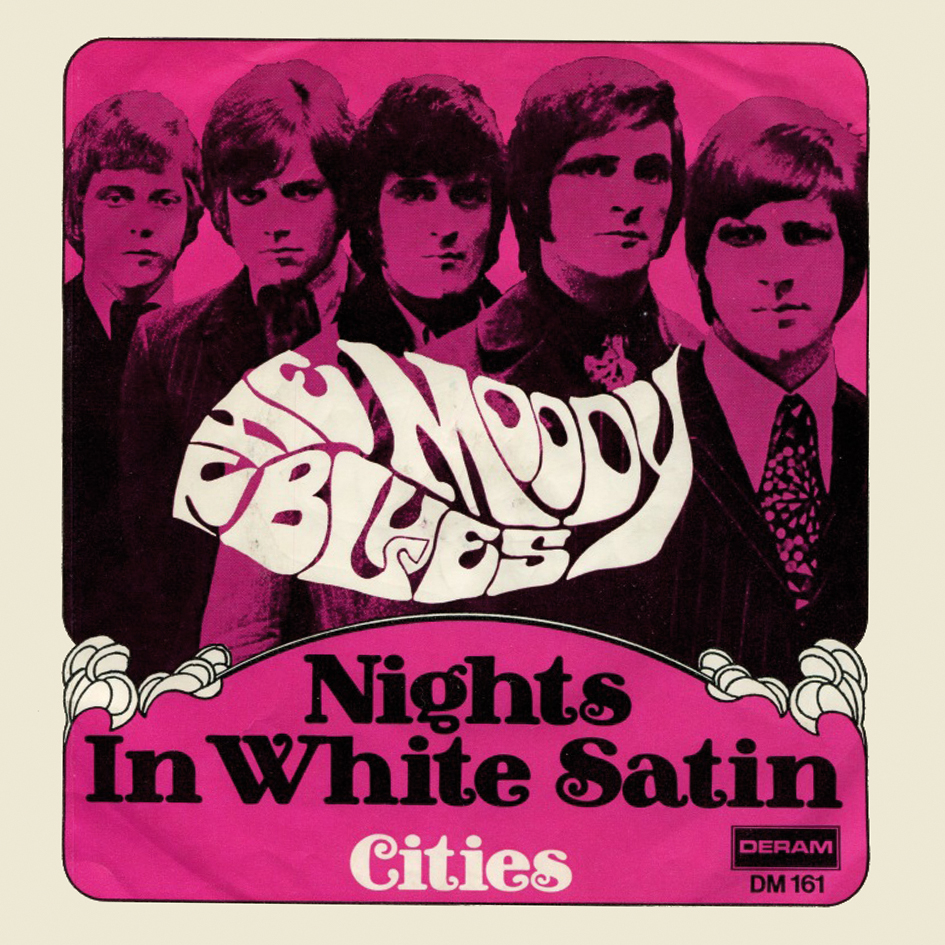
Today in Music (1967): The Moody Blues charted with “Nights in White Satin”

Nights in White Satin

The Moody Blues

Writer(s): Justin Hayward (see lyrics here)


Released: November 10, 1967


First Charted: February 10, 1968


Peak: 2 US, 11 CB, 11 GR, 12 HR, 37 AC, 1 CL, 9 UK, 11 CN, 8 AU, 1 DF (Click for codes to charts.)


Sales (in millions): 1.0 US, -- UK


Airplay/Streaming (in millions): -- radio, 108.3 video, 211.55 streaming

Awards:

Click on award for more details.

About the Song:

Things looked bleak for the Moody Blues in 1966 when Justin Hayward and John Lodge arrived. TB The group’s “Go Now” went to #1 in the UK in 1964 and they’d had nothing hit the top 20 since. They were “back to playing gigs for small change.” TB In an effort to showcase its new “enhanced stereo sound technology,” SF the group’s record label, Deram, approached the group about recording a modern version of Dvorak’s “New World Symphony.” BBC Instead, the band sold the label on a suite of newly-composed songs woven together by orchestral links TB and thematically focused on the passing of a day. BBC

Although the Moodies were among the first rock bands to integrate classical, KX the so-called London Festival Orchestra, with which they supposedly recorded, never existed. It was simply the banner under which the musicians behind the Days of Future Passed album gathered. SF As the album’s centerpiece, “Nights in White Satin” “was an early example of progressive – or art – rock.” DJ Hayward got the idea for this “yearning love song” BBC after receiving a gift of white satin sheets. SF As he told the Daily Express in 2008, “It was a series of random thoughts and was quite autobiographical. It was a very emotional time as I was at the end of one big love affair and the start of another. A lot of that came out in the song.” SF

The song “was drenched in what would be come the Moodys’ signature sound – the synthetic strings of the Mellotron.” BBC The song peaked at a modest #19 in December of 1967, BBC but after songs like “Hey Jude” and “Layla” broke radio’s four-minute-singles barrier, the song became a hit in the United States. SF It then re-charted in the U.K., this time hitting #9, and in 1979 went top 20 in the U.K. for a third time, this time peaking at #14.


Resources:


Related Links:


First posted 11/10/2011; updated 9/17/2023.

Wednesday, July 15, 2009

The Steve Howe Show

After watching Steve Howe & Co. perform for three hours at Kansas City’s Uptown Theater, I know two things – Steve Howe is neither the centerpiece of Asia nor Yes. He may have been the most technically proficient performer of the night – he certainly has the most impressive resume – but rather than trolling the stage like any good classic rock axeman should, he stood guard over a square foot patch left of center. He occasionally bent his knees or lifted a leg in the air; hell, I think he jumped in the air once; but mostly his frail frame looked in need of a walker to prop him up. I swear he was leaning against the wall during the encore.

Okay, okay, I shouldn’t go to an Asia and Yes concert if I’m looking for young, energetic performances. Oh, wait, there was that, too – however sadly out of place. Unfortunately, Yes’ longtime frontman Jon Anderson was laid up by a respiratory illness and, in true dinosaur band fashion these days, the other members perused YouTube videos scouting out lead singers for Yes tribute bands until they found a guy young enough to date their granddaughters. In this case, Canadian Benoit David drew the lucky lottery ticket and figured if he pranced about enough on stage, the audience might forget he was a nobody. Let’s face it, though, other than Queen’s Freddie Mercury, no other rock singer has ever pulled off prancing. On top of that, David sported a mostly white outfit that certainly recalled the ‘70s – it just had the misfortunate of reminding one of Saturday Night Fever more than Yes’ dinosaur prog-rock.

Based on my tirades against Howe and David, one might think that I was dragged to this show against my will. Not the case. I went eager to appreciate these Gods of Prog. They kickstarted the genre forty years ago. They are the grand masters at stripping a record of every last bit of commercialism and leaving ten minutes of instrumental prowess behind. Howe’s guitar is still at the forefront of every memorable Yes song – and was highlighted midway through Yes’ set with a two-song solo – although Howe still wasn’t physically center stage.

And for all of David’s gyrations, give props to anyone who can tackle Jon Anderson’s vocal gymnastics. Add Howe and Chris Squire as a triple threat on the mike for gems like “I’ve Seen All Good People.” Speaking of Squire, he made a great case, at least in Anderson’s absence, for being the true heart of Yes (he is, after all, the only member to survive every incarnation of the band). His hulking figure towered over Benoit and, despite what seemed a perpetual fan blowing his wispy white hair, he appeared to be the only performer to break a sweat, drenching his shirt by the end of the night.

Anyone looking for Yes music from the last 25 years was out of luck. Their only post-1980 song was “Owner of a Lonely Heart” and, judging by the lukewarm response, they could have jettisoned it. In fact, other than “Owner” and a pair of songs from 1980’s Drama, perhaps the band’s low point yet well received in this concert, this could have been a tour to support 1972’s Close to the Edge album.

While Yes represented the original prog rockers, opening act Asia symbolized the next wave. Exploding on the scene in 1982, the members’ resumes included Yes; King Crimson; and Emerson, Lake & Palmer, but instead of the second coming of prog rock, Asia delivered their brand of ‘80s corporate rock – slick, commercial, and arena ready. Here’s where my musical roots reveal themselves and I commit sacrilege – I enjoyed Asia more than Yes. Trot out all the 40 Year Old Virgin jokes you want, but there’s no denying one’s first musical love. I was born in 1967 and after surviving disco, was just grateful for pop radio hits that actually featured guitar solos. I would later become a classic rock junkie, but bands like Asia were still my gateway drug.

Seeing the original Asia lineup of John Wetton (vocals, bass), Steve Howe (guitar), Carl Palmer (drums), and Geoff Downes (keyboards) was more satisfying than a Jon-Anderson-copycat-fronted Yes lineup. And if we’re going to have a drum-off, Palmer would embarrass Yes’ Alan White, as the solo on “Fanfare for the Common Man” would attest. Then there’s the matter of keyboards. As the only man to play on every Asia album, Downes deservedly took his place near mid-stage. Rick Wakeman was featured as the keyboardist on nearly every Yes album, but his son Oliver takes the reigns here – and promptly fades into the background so much that they could have just put up a cardboard cut-out of Pops and piped in the music over the speakers.

Since the original Asia lineup lasted for only two albums (and last year’s 2008 reunion album Phoenix), they mixed in songs from the various members’ pre-Asia days. Palmer delivered the show’s highlight with the aforementioned “Fanfare,” which he’d previously done with Emerson, Lake & Palmer. Downes got a showcase with “Video Killed the Radio Star,” which he’d done with the Buggles. Wetton whetted the prog-rock crowd’s appetite with “In the Court of the Crimson King,” a 1969 gem from King Crimson, who Wetton joined four years later.

That may well have been the theme for the night – songs that had been made famous long before some of tonight’s players got their hands on them. Still, even with Jon Anderson and Rick Wakeman stand-ins, Yes championed the durability of their catalog. And even if Asia was largely forgotten a quarter century ago, they earned their title of super group, proving that sometimes the same players, such as a Steve Howe, can figure prominently in the story of two genres of rock and roll.

Tuesday, March 22, 1994

Yes Talk released

Talk

Yes


Released: March 22, 1994


Peak: 33 US, 20 UK, 47 CN, -- AU


Sales (in millions): --


Genre: progressive rock


Tracks:

Song Title (Writers) [time] (date of single release, chart peaks) Click for codes to singles charts.

  1. The Calling (Rabin, Anderson, Squire) [6:52] (3/12/94, 3 AR)
  2. I Am Waiting (Rabin, Anderson) [7:22]
  3. Real Love (Rabin, Squire, Anderson) [8:42]
  4. State of Play (Rabin, Anderson) [4:56] (1994, --)
  5. Walls (Rabin, Anderson, Roger Hodgson) [4:47] (6/11/94, 24 AR)
  6. Where Will You Be (Rabin, Anderson) [6:12]
  7. Endless Dream: a. Silent Spring [instrumental] (Rabin) [1:55]
  8. Endless Dream: b. Talk (Rabin, Anderson) [11:54]
  9. Endless Dream: c. Endless Dream (Rabin, Anderson) [1:50]


Total Running Time: 55:02


The Players:

  • Jon Anderson (vocals)
  • Trevor Rabin (guitar, keyboards, vocals)
  • Chris Squire (bass, backing vocals)
  • Alan White (drums, percussion)
  • Tony Kaye (keyboards)

Rating:

2.946 out of 5.00 (average of 8 ratings)

About the Album:

Talk marked the third full-length album featuring the Cinema lineup. That lineup launched in 1981 when Yes’ members Chris Squire (bass) and Alan White (drums) were looking to form a new band (initially called Cinema) in the wake of the official demise of Yes. They brought South African guitarist Trevor Rabin on board and then ex-Yes members Jon Anderson (vocals) and Tony Kaye (keyboards) came into the fold, effectively creating a new incarnation of Yes. That collective recorded the biggest album of the group’s career with 1983’s 90125, followed it up with 1987’s Big Generator, and then contributed four cuts to Union, which merged the two versions of Yes that existed at the time.

This is officially the fifteenth studio album for Yes. WKTalk makes some effort to get away from the group's indulgent art rock pretensions, at least to the extent of using a spare, spacious production full of closely miked drums and sharp guitars. No wonder, since guitarist Trevor Rabin produced the record.” WK “With Rabin taking the lead…he attempted to re-introduce Yes to the 1990s with a lean, guitar-oriented sound. In taking such a strong role, he ensured he had a hand in writing every song, even overdubbing some of Chris Squire’s bass parts (to Squire’s minor annoyance).” WK

“Roger Hodgson, formerly of fellow progressive rock band Supertramp, wrote Walls with Anderson and Rabin. A demo of this song was recorded in 1990 and included on the Trevor Rabin demo album 90124.” WK

Guitarist Billy Sherwood toured with the band following the album’s release. Rabin and Kaye left in 1995, 12 years after first teaming up with Anderson, Squire, and White. Sherwood became an official member in 1997 after Rick Wakeman re-joined and left again. WK


Notes: On the 2002 Spitfire Records reissue, “Endless Dream” was released as a single track and a special version of “The Calling” was added.

Resources and Related Links:

First posted 6/7/2011; updated 7/25/2021.