Showing posts with label Nights in White Satin. Show all posts

Saturday, November 11, 2017

Today in Music (1967): The Moody Blues Days of Future Passed

Days of Future Passed

The Moody Blues


Released: November 11, 1967


Peak: 3 US, 27 UK, 3 CN, 10 AU Click for codes to charts.


Sales (in millions): 1.0 US, 0.06 UK, 1.16 world (includes US and UK)


Genre: progressive rock


Tracks:

Song Title [time] (date of single release, chart peaks)

  1. The Day Begins:
    The Day Begins [4:08]
    Morning Glory (unlisted) [1:42]
  2. Dawn: Dawn Is a Feeling [3:48]
  3. The Morning: Another Morning [3:55]
  4. Lunch Break: Peak Hour [5:33]
  5. The Afternoon:
    Forever Afternoon (Tuesday?) [5:06] (7/20/1968, #24 BB)
    (Evening) Time to Get Away [3:17]
  6. Evening:
    The Sunset [3:17]
    Twilight Time [3:23]
  7. The Night:
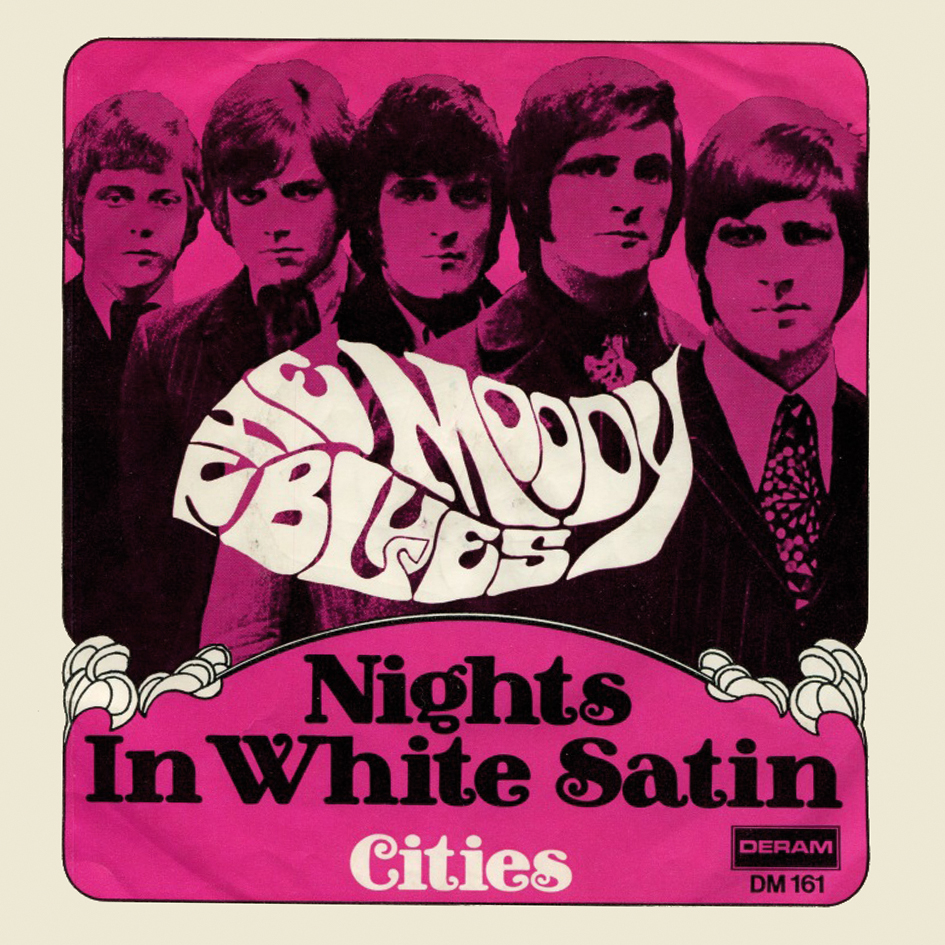
    Nights in White Satin [5:58] (11/10/1967, #2 BB, 9 UK, 37 AC, sales: 1 million)
    Late Lament / Resolvement (unlisted) [1:46]


Total Running Time: 41:34


The Players:

  • Justin Hayward (vocals, guitar)
  • John Lodge (bass, vocals)
  • Mike Pinder (Mellotron, vocals, spoken word on “Late Lament”)
  • Ray Thomas (flute, vocals)
  • Graeme Edge (drums)

Rating:

4.344 out of 5.00 (average of 20 ratings)


Awards:

(Click on award to learn more).

The Moodies’ Early Years

The Moody Blues formed in Birmingham, England, in 1964. They were part of the British beat and R&B scene, finding #1 success in the UK and top-ten success in the U.S. with the song “Go Now,” a cover of an R&B classic by Bessie Banks. Despite that early success, the Moodies struggled to have more hits over the next couple of years. When original members Denny Laine and Clint Warwick left the band, the group found themselves looking for “a new musical direction.” TB They brought in singer/guitarist Justin Hayward and bassist/singer John Lodge. They gave “the band an infusion of new songwriting talent and…material with a ‘cosmic’ edge to it.” CRS

At the Forefront of Progressive Rock

The new lineup recorded a pair of singles before launching into the “bolder and more ambitious” AM Days of Future Passed. The band had “passed through their fascination with American blues…and sought to emphasize rock’s European roots that had been forgotten by English bands who bowed down to Muddy Waters and Robert Johnson.” CS The band became known as “a sophisticated orchestral rock band, combining lush symphonic instrumentation…with heady lyrics and a whisper of their blues background to create an overwhelming…psychedelic experience for the listener.” CS

Days of Future Passed “marked the formal debut of the psychedelic-era Moody Blues” AM and it “became one of the defining documents of the blossoming psychedelic era, and one of the most enduringly popular albums of its era.” AM It is “probably the most successful integration of orchestra and rock band.” CRS “The album flutters back and forth between English psychedelica, buttery smooth vocal harmonies, and symphonic arrangements to propel rock into a whole new territory.” CS

It “paved the way for a host of English progressive bands to experiment with sophisticated studio technology and elaborate stage productions, popularizing progressive rock to become one of the hottest genres of the 1970s in the United States, bringing stardom to bands like Yes, Procol Harum, Jethro Tull, the Electric Light Orchestra, and Emerson, Laked & Palmer.” CS

Recording the Album

Interestingly, the “album was created out of deceit.” CRS Eager to showcase their new stereo sound system, Decca Records approached the band about recording a rock version of Dvorak’s “New World Symphony.” The Moody Blues agreed, but once in the studio they convinced producer Tony Clarke to let them record a “symphonic song cycle” they’d been working on. Conductor/arranger Peter Knight added inventive orchestral arrangements by the London Festival Orchestra, who were actually “a hastily cobble assortment of studio musicians.” CS

How to Promote?

The record company was at a loss for how to promote the album, “fearing rock fans would not buy it, and classical fans would be incensed by this aberration.” CS However, the album “seemed to satisfy the appetites whetted by the Beatles’ Sgt. Pepper’s Lonely Hearts Club Band…a thickly textured departure from amplified, blues-based rock.” CS The album was “one of the first pieces of heavily orchestrated, album-length psychedelic rock to come out of England.” AM

Theme Album

In the wake of Sgt. Pepper’s there was much greater interest in conceptual works and the Moody Blues delivered “with the strongest, most cohesive body of songs in their history.” AM Days succeeded because it “was refreshingly original, rather than an attempt to mimic the Beatles.” AM It also benefited from being “one of the earlier theme albums, a loose story told of a man’s journey over the course of a day (a metaphor for the course of a life).” CS

The Songs

Even the best of themes, however, don’t work without strong songs. Days gave the group the most memorable song of their career with “the wildly romantic” TB “Nights in White Satin.” The song originally missed the Billboard Hot 100, but went all the way to #2 upon a 1972 re-release. It would also become a staple at classic rock radio.

The album produced another classic rock staple with “Tuesday Afternoon,” the single version of the awkwardly titled “Forever Afternoon (Tuesday?).” Although it didn’t chart in the UK, it reached the top 25 in the United States, “glorious Mellotron-driven pop for the ‘Summer of Love.’” TB

“Much of the orchestration is MOR, with the ‘morning music’ resembling the busy-busy scores once featured on travel documentaries. ‘Dawn Is a Feeling’ is the highlight of the first side.” TB “Sandwiched among the playful lyricism of ‘Another Morning’ and the mysticism of ‘The Sunset,’ songs like ‘Tuesday Afternoon’ and ‘Twilight Time’ (which remained in their concert repertory for three years) were pounding rockers within the British psychedelic milieu, and the harmony singing (another new attribute for the group) made the band’s sound unique.” AM

Reissue

A 2008 reissue added some alternate tracks (“Tuesday Afternoon,” “Dawn Is a Feeling,” “The Sun Set,” “Twilight Time”) and pre-Days singles (“Fly Me High,” “I Really Haven’t Got the Time,” “Love and Beauty,” “Leave This Man Alone,” and “Cities”), as well as the Moodies rendition of “Don’t Let Me Be Misunderstood,” by the Animals.

Reviews:


Related DMDB Links:


First posted 11/17/2008; last updated 9/5/2025.

Friday, November 10, 2017

Today in Music (1967): The Moody Blues charted with “Nights in White Satin”

Nights in White Satin

The Moody Blues

Writer(s): Justin Hayward (see lyrics here)


Released: November 10, 1967


First Charted: February 10, 1968


Peak: 2 US, 11 CB, 11 GR, 12 HR, 37 AC, 1 CL, 9 UK, 11 CN, 8 AU, 1 DF (Click for codes to charts.)


Sales (in millions): 1.0 US, -- UK


Airplay/Streaming (in millions): -- radio, 108.3 video, 211.55 streaming

Awards:

Click on award for more details.

About the Song:

Things looked bleak for the Moody Blues in 1966 when Justin Hayward and John Lodge arrived. TB The group’s “Go Now” went to #1 in the UK in 1964 and they’d had nothing hit the top 20 since. They were “back to playing gigs for small change.” TB In an effort to showcase its new “enhanced stereo sound technology,” SF the group’s record label, Deram, approached the group about recording a modern version of Dvorak’s “New World Symphony.” BBC Instead, the band sold the label on a suite of newly-composed songs woven together by orchestral links TB and thematically focused on the passing of a day. BBC

Although the Moodies were among the first rock bands to integrate classical, KX the so-called London Festival Orchestra, with which they supposedly recorded, never existed. It was simply the banner under which the musicians behind the Days of Future Passed album gathered. SF As the album’s centerpiece, “Nights in White Satin” “was an early example of progressive – or art – rock.” DJ Hayward got the idea for this “yearning love song” BBC after receiving a gift of white satin sheets. SF As he told the Daily Express in 2008, “It was a series of random thoughts and was quite autobiographical. It was a very emotional time as I was at the end of one big love affair and the start of another. A lot of that came out in the song.” SF

The song “was drenched in what would be come the Moodys’ signature sound – the synthetic strings of the Mellotron.” BBC The song peaked at a modest #19 in December of 1967, BBC but after songs like “Hey Jude” and “Layla” broke radio’s four-minute-singles barrier, the song became a hit in the United States. SF It then re-charted in the U.K., this time hitting #9, and in 1979 went top 20 in the U.K. for a third time, this time peaking at #14.


Resources:


Related Links:


First posted 11/10/2011; updated 9/17/2023.

Tuesday, October 28, 2003

The Moody Blues: A Retrospective (1964-2003)

The Moody Blues

A Retrospective: 1964-2003

Overview:

The Moody Blues formed in Birmingham, England in 1964. They were originally part of the British beat and R&B scene, rising to prominence with the hit song “Go Now” (#1 UK, #10 US). When founding guitarist Denny Laine and bassist Clint Warwick left in 1966, the band added singer/guitarist Justin Hayward and bassist John Lodge. The new version of the Moodies embraced psychedelia and became a prominent band at the forefront of the progressive rock movement which incorporated rock with classical music.

During the ‘70s, the Moody Blues became a consistent presence at classic rock with hits including “Nights in White Satin,” “Tuesday Afternoon,” “Ride My See Saw,” “Question,” “The Story in Your Eyes,” and “I’m Just a Singer in a Rock and Roll Band.”

In the ‘80s, the band maintained a core audience at album rock radio with more synth-driven fare including “The Voice,” “Gemini Dream,” “Your Wildest Dreams,” and “I Know You’re Out There Somewhere.” They only released two albums in the ‘90s and only one more after that, 2003’s December. They have sold 70 million albums worldwide.


The Players

  • Rodney Clarke (bass/vocals: 1966). Died 2025.
  • Graeme Edge (drums: 1964-2018). Died 2021.
  • Justin Hayward (vocals/guitar: 1966-2018)
  • Denny Laine (guitar/vocals: 1964-66). Died 2023.
  • John Lodge (bass/guitar/vocals: 1966-2018). Died 2025.
  • Patrick Moraz (keyboards: 1978-91)
  • Mike Pinder (keyboards/vocals: 1964-78). Died 2024.
  • Ray Thomas (flute/harmonica/sax/percussion: 1964-2002). Died 2018.
  • Clint Warwick (bass/vocals: 1964-66). Died 2004.


Links

Awards

Compilations


Under each album snapshot, songs featured on the anthologies are noted. If the song charted, the date of the song’s release or first chart appearance and its chart peaks are noted in parentheses. Click for codes to charts.


Spotify Playlist

Check out my Spotify playlist The Moody Blues 1964-2003 which includes all of the songs from the above collections plus additional material.

The Magnificent Moodies/Go Now (1965):

  • Steal Your Heart Away *** (Sept. ’64, 48 CL)
  • Go Now (Nov. ’64, 10 BB, 6 CB, 6 GR, 8 HR, 4 Cl, 11 UK, 2 CN, 12 AU, 20 DF) VB, AN
  • I Don’t Want to Go on Without You ** (3/6/65, 43 CL, 33 UK)
  • From the Bottom of My Heart I Love You ** (6/5/65, 93 BB, 70 CB, 82 HR, 35 CL, 22 UK, 23 CN)
  • Everyday *** (11/20/65, 44 CL, 44 UK)
  • Stop! * (2/12/66, 98 BB, 93 CB, 89 HR, 45 CL, 88 CN)
  • This Is My House But Nobody Calls *** (9/5/66)
  • Life’s Not Life *** (1/13/67)

* only on The Magnificent Moodies
** only on Go Now
*** only on the 50th anniversary edition of The Magnificent Moodies

The original album, The Magnificent Moodies, was released in the UK. A reworked version was released in the U.S. as Go Now. A 50th anniversary reissue included all of the songs from both versions plus additional material.


Days of Future Passed (deluxe version, 1967/2017):

  • Fly Me High (5/5/67) PR
  • I Really Haven’t Got the Time (B-side of “Fly Me High,” 5/5/67) PR
  • Long Summer Days * (recorded 5/19/67) PR
  • Please Think About It * (recorded 6/29/67) PR
  • Love and Beauty (10/1/67) PR
  • Leave This Man Alone (B-side of “Love and Beauty,” 10/1/67) PR
  • Cities (B-side of “Nights in White Satin,” 11/10/67) PR

These songs were added to the 2017, 3-disc 50th anniversary edition of Days of Future Passed. They were also all featured on the 1987 Prelude archival collection.

* First appeared on Caught Live + 5 (1977).


Days of Future Passed (1967):

  • Nights in White Satin (11/10/67, 2 BB, 1 CB, 1 GR, 1 HR, 37 AC, 1 CL, 9 UK, 1 CN, 8 AU, 1 DF) TM, OW, V-UK, V-US, GH, VB, AN
  • Tuesday Afternoon (6/29/68, 24 BB, 26 CB, 7 GR, 27 HR, 5 CL, 12 CN, 4 DF) TM, OW, GH, VB, AN
  • Late Lament (19 DF) PR, TM, AN
Check out the DMDB page for this album here.


In Search of the Lost Chord (1968):

  • King and Queen * (recorded 2/13/68) PR
  • Gimme a Little Somethin’ * (recorded 3/17/68) PR
  • Voices in the Sky (6/28/68, 43 CL, 27 UK) OW, VB, AN
  • Ride My See Saw (12/12/68, 61 BB, 50 CB, 21 GR, 46 HR, 6 CL, 42 UK, 33 CN, 5 DF) TM, OW, V-UK, V-US, GH, VB, AN
  • Legend of a Mind (10 CL, 22 DF) TM, AN
  • Dr. Livingstone, I Presume
  • The Actor TM
  • The Word TM
  • A Simple Game * (B-side of “Ride My See Saw,” 10/12/68) PR, TM
  • What Am I Doing Here? * (recorded 11/17/68) PR

* These songs were first featured on Caught Live + 5 (1977), later added to the archival collection Prelude (1987), and included on the 50th anniversary edition of In Search of the Lost Chord.

Prelude

The Moody Blues


Recorded: 1967-1968


Released: October 26, 1987

Peak: --


Sales (in millions): --


Genre: progressive rock

Tracks:

(1) Fly Me High (2) I Really Haven’t Got the Time (3) Leave This Man Alone (4) Love and Beauty (5) Cities (6) A Simple Game (7) Gimme a Little Somethin’ (8) Please Think About It (9) Long Summer Days (10) King and Queen (11) What Am I Doing Here? (12) Late Lament


About the Album:

This archival collection gathers songs never released on a studio album before except “Late Lament” from Days of Future Passed. Four of the songs are singles and B-sides from before that album was released. Five cuts originally appeared on the 1977 Caught Live + 5 album. “Cities” and “A Simple Game” were B-sides for “Nights in White Satin” and “Ride My See Saw” respectively.

On the Threshold of a Dream (1969):

  • Never Comes the Day (4/2/69, 91 BB, 90 CB, 89 HR, 25 CL, 74 CN) TM, V-UK, AN
  • Dear Diary TM
  • In the Beginning TM
  • Lovely to See You TM, OW, AN
  • The Dream TM
  • Have You Ever Heard, Part 1 TM
  • The Voyage TM
  • Have You Ever Heard, Part 2 TM


To Our Children’s Children’s Children (1969):

  • Eyes of a Child (20 CL, 31 DF) TM, OW
  • Watching and Waiting (10/31/69) TM, AN
  • Floating OW
  • Gypsy (Of a Strange and Distant Time) (26 CL) AN
  • Candle of Life AN


A Question of Balance (1970):

  • Question (4/24/70, 21 BB, 19 CB, 14 GR, 19 HR, 4 CL, 2 UK, ,8 CN, 36 AU, 5 DF) TM, OW, V-UK, V-US, GH, VB, AN
  • Melancholy Man (26 DF) TM, OW, AN
  • And the Tide Rushes In (36 DF) TM


Every Good Boy Deserve Favor (1971):

  • The Story in Your Eyes (Aug. ’71, 23 BB, 14 CB, 10 GR, 16 HR, 6 CL, 7 CN, 68 AU, 11 DF) TM, OW, GH, VB, AN
  • After You Came V-UK


Seventh Sojourn (1972):

  • Isn’t Life Strange (4/15/72, 29 BB, 20 CB, 24 GR, 23 HR, 8 CL, 13 UK, 9 CN, 39 AU, 5 DF) TM, OW, V-UK, V-US, GH, VB, AN
  • I’m Just a Singer in a Rock and Roll Band (1/20/73, 12 BB, 8 CB, 12 GR, 10 HR, 6 CL, 36 UK, 39 AU, 4 DF) TM, OW, V-UK, V-US, GH, VB, AN
  • New Horizons TM, OW
  • For My Lady TM
  • Lost in a Lost World AN


Blue Jays (Justin Hayward & John Lodge, 1975):

  • Remember Me, My Friends AN
  • Blue Guitar (Sept. ’75) VB, AN
  • Forever Autumn (July ’78) VB, AN
Only “Remember Me, My Friends” was on the Blue Jays album. “Blue Guitar” was just released as a single but later added to reissues of the album. “Forever Autumn” is a solo song from Justin Hayward which was featured on Jeff Wayne’s War of the Worlds (1978).

This Is the Moody Blues

The Moody Blues


Recorded: 1967-1972


Released: October 8, 1974

Peak: 11 US, 14 UK, 2 CN, -- AU, 14 DF


Sales (in millions): 0.5 US, 0.1 UK, 0.6 world (includes US and UK)


Genre: progressive rock


Rating:

4.460 out of 5.00 (average of 11 ratings)

Awards:

(Click on award to learn more).

Tracks, Disc 1:

(1) Question (2) The Actor (3) The Word (4) Eyes of a Child (5) Dear Diary (6) Legend of a Mind (7) In the Beginning (8) Lovely to See You (9) Never Comes the Day (10) Isn’t Life Strange (11) The Dream (12) Have You Heard? (Part 1) (13) The Voyage (14) Have You Heard? (Part 2)

Tracks, Disc 2:

(1) Ride My See Saw (2) Tuesday Afternoon (3) And the Tide Rushes In (4) New Horizons (5) A Simple Game (6) Watching and Waiting (7) I’m Just a Singer in a Rock and Roll Band (8) For My Lady (9) The Story in Your Eyes (10) Melancholy Man (11) Nights in White Satin (12) Late Lament


About the Album:

After releasing seven studio albums from 1967 to 1972, the Moody Blues went on hiatus for six years. During that time, they released this two-disc anthology.

Octave (1978):

  • Steppin’ in a Slide Zone (May ’78, 39 BB, 46 CB, 52 HR, 16 CL, 41 CN, 78 AU) OW, VB, AN
  • Driftwood (Oct. ’78, 59 BB, 68 CB, 85 HR, 38 AC, 19 CL, 60 CN, 11 DF) OW, V-UK, V-US, AN

Out of This World

The Moody Blues


Recorded: 1967-1978


Released: October 22, 1979

Peak: -- US, 15 UK, -- CN, -- AU


Sales (in millions): -- US, 0.10 UK


Genre: progressive rock


Rating:

3.165 out of 5.00 (average of 7 ratings)

Tracks:

(1) Nights in White Satin (2) Question (3) Ride My See-Saw (4) Tuesday Afternoon (5) The Story in Your Eyes (6) Isn’t Life Strange (7) Steppin’ in a Slide Zone (8) I’m Just a Singer in a Rock and Roll Band (9) Voices in the Sky (10) Floating (11) Eyes of a Child (12) New Horizons (13) Driftwood (14) Lovely to See You (15) Melancholy Man


About the Album:

This was a UK-only release. It isn’t a bad collection, but Greatest Hits or Very Best of are better choices.

Long Distance Voyager (1981):

  • Gemini Dream (May ’81, 12 BB, 13 CB, 6 GR, 14 HR, 6 RR, 13 AR, 1 CN, 36 AU, 24 DF) V-UK, V-US, GH, VB, AN
  • The Voice (6/6/81, 15 BB, 15 CB, 7 GR, 16 HR, 6 RR, 16 AC, 1 AR, 9 CN, 91 AU, 2 DF) V-UK, V-US, GH, VB, AN
  • Talking Out of Turn (Nov. ’81, 35 CL, 27 CN, 39 DF) V-UK, AN
  • Veteran Cosmic Rocker (48 CL, 29 DF) V-UK, V-US


The Present (1983):

  • Blue World (8/20/83, 62 BB, 32 AR, 35 UK, 40 CN) VB, AN
  • Sitting at the Wheel (9/2/83, 27 BB, 30 CB, 19 GR, 22 RR, 3 AR, 18 CN, 16 DF) V-US, AN
  • Running Water (Mar. ’84)

Voices in the Sky

The Moody Blues


Recorded: 1967-1983


Released: 11/21/84 (UK), 6/21/85 (US)

Peak: 132 US, -- UK, 91 CN, -- AU, 3 DF


Sales (in millions): -- US, -- UK, -- world (includes US and UK)


Genre: progressive rock


Rating:

4.037 out of 5.00 (average of 11 ratings)

Tracks (UK version):

(1) Ride My See-Saw (2) Talking Out of Turn (3) Driftwood (4) Never Comes the Day (5) I’m Just a Singer in a Rock and Roll Band (6) Gemini Dream (7) The Voice (8) After You Came (9) Question (10) Veteran Cosmic Rocker (11) Isn’t Life Strange (12) Nights in White Satin

Tracks (U.S. version):

(1) The Voice (2) Question (3) Veteran Cosmic Rocker (4) Isn’t Life Strange (5) Nights in White Satin (6) Ride My See-Saw (7) Driftwood (8) Sitting at the Wheel (9) I’m Just a Singer in a Rock and Roll Band (10) Gemini Dream


About the Album:

This was the first Moodies’ collection to dip into the band’s ‘80s output, covering songs from 1981’s Long Distance Voyager and, on the U.S. version, 1983’s The Present.

The Other Side of Life (1986):

  • Your Wildest Dreams (4/19/86, 9 BB, 10 CB, 14 GR, 11 RR, 1 AC, 2 AR, 55 CN, 20 AU, 1 DF) GH, VB, AN
  • The Other Side of Life (6/7/86, 58 BB, 18 AC, 11 AR, 80 AU, 8 DF) GH, AN
  • Rock and Roll Over You (9 DF)


Sur La Mer (1988):

  • I Know You’re Out There Somewhere (6/4/88, 30 BB, 40 CB, 32 GR, 36 RR, 9 AC, 2 AR, 52 UK, 15 CN, 37 AU, 9 DF) GH, VB, AN
  • Here Comes the Weekend (9/3/88, 50 AR)
  • No More Lies (10/29/88, 15 AC)

Greatest Hits

The Moody Blues


Recorded: 1967-1988


Released: November 21, 1989

Peak: 113 US, 71 UK, -- CN, -- AU


Sales (in millions): 0.5 US, -- UK


Genre: progressive rock


Rating:

4.228 out of 5.00 (average of 11 ratings)

Tracks:

(1) Your Wildest Dreams (2) The Voice (3) Gemini Dream (4) The Story in Your Eyes (5) Tuesday Afternoon (6) Isn’t Life Strange (7) Nights in White Satin / Late Lament (8) I Know You’re Out There Somewhere (9) The Other Side of Life (10) Ride My See-Saw (11) I’m Just a Singer in a Rock and Roll Band (12) Question (1988 version)


About the Album:

This is a seemingly unnecessary collection given the glut of compilations from Moody Blues up to this point. However, this is the first set to feature “Your Wildest Dreams” and “I Know You’re Out There Somewhere.” Still, one is better going with 1996’s The Very Best of if, for no other reason, it features the original version of “Question” instead of the 1988 re-recording featured here.

The Very Best of

The Moody Blues


Recorded: 1964-1988


Released: September 3, 1996

Peak: -- US, 13 UK, -- CN, -- AU


Sales (in millions): -- US, 0.30 UK


Genre: progressive rock


Rating:

4.238 out of 5.00 (average of 14 ratings)

Tracks:

(1) Go Now (2) Tuesday Afternoon (3) Nights in White Satin (4) Ride My See-Saw (5) Voices in the Sky (6) Question (7) The Story in Your Eyes (8) Isn’t Life Strange (9) I’m Just a Singer in a Rock and Roll Band (10) Blue Guitar (11) Steppin’ in a Slide Zone (12) Forever Autumn (13) The Voice (14) Gemini Dream (15) Blue World (16) Your Wildest Dreams (17) I Know You’re Out There Somewhere


About the Album:

This was also released as The Best of. Of the single-disc anthologies highlighted on this page, this one is the best bet with 17 cuts covering the widest swath of the band’s career. It also is presented chronologically, which is important for a group who changed their sound enough over the years to make non-chronological sets more jarring.

Keys of the Kingdom (1991):

  • Say It with Love (6/22/91, 31 AC, 22 AR, 36 CN, 26 DF) AN
  • Bless the Wings That Bring You Back (Aug. ’91) AN
  • Highway * AN

* recorded during the sessions for Keys of the Kingdom but not released until 1994 on the Time Traveller box set.

Anthology

The Moody Blues


Recorded: 1964-1991


Released: October 20, 1998

Peak: --


Sales (in millions): --


Genre: progressive rock


Rating:

3.928 out of 5.00 (average of 10 ratings)

Tracks, Disc 1:

(1) Go Now (2) Tuesday Afternoon (3) Nights in White Satin / Late Lament (4) Ride My See-Saw (5) Legend of a Mind (6) Voices in the Sky (7) Lovely to See You (8) Never Comes the Day (9) Gypsy (Of a Strange and Distant Time) (10) Candle of Life (11) Watching and Waiting (12) Question (13) Melancholy Man (14) The Story in Your Eyes (15) Lost in a Lost World (16) Isn’t Life Strange (17) I’m Just a Singer in a Rock and Roll Band

Tracks, Disc 2:

(1) Remember Me My Friend (2) Blue Guitar (3) Steppin’ in a Slide Zone (4) Driftwood (5) Forever Autumn (6) The Voice (7) Talking Out of Turn (8) Gemini Dream (9) Blue World (10) Sitting at the Wheel (11) Your Wildest Dreams (12) The Other Side of Life (13) I Know You’re Out There Somewhere (14) Say It with Love (15) Bless the Wings That Bring You Back (16) Highway


About the Album:

For fans looking for more than a single-disc anthology, this is absolutely the way to go. The selection and chronological presentation is well done.

Strange Times (1999):

  • English Sunset (8/17/99)


December (2003):

  • December Snow (Nov. ’03)

Resources/References:


Related DMDB Links:


First posted 5/11/2026.