Showing posts with label George M. Cohan. Show all posts

Saturday, April 17, 2021

Tin Pan Alley: Top 100 Songs

Tin Pan Alley:

Top 100 Songs

Tin Pan Alley is a reference to a collection of late 19th century and early 20th century music publishers and songwriters in New York City, specifically West 28th Street between Fifth and Sixth Avenues in Manhattan. The era is generally marked as starting in 1885 when a number of music publishers first set up shop in the area. Some consider the start of the Great Depression in the 1930s to mark the ending – a time when sheet music was no longer the driving force for American popular music, but a time when the phonograph, radio, and movies had more influence. Others consider the movement to have lasted into the 1950s when it was upstated by the rise of rock & roll and the subsequent influence of writers from the Brill Building. Some of the the most significant Tin Pan Alley writers were Harold Arlen, Irving Berlin, George M. Cohan, George Gershwin, Ira Gershwin, Oscar Hammerstein II, Jerome Kern, Frank Loesser, Cole Porter, Richard Rodgers, and Albert Von Tilzer. The phrase, however, has come to be associated more broadly with commercially successful music of the early 20th century.

This list was creating by aggregating 18 lists and giving extra weight to songs which fell between 1885 and 1933 and were written by one of the significant songwriters specifically associated with the Tin Pan Alley era. Songs are listed with the songwriters and first year the song emerged. These songs have largely become standards; more than half of them appear on the DMDB list of the top 100 American Songbook Standards .

Click here to see other genre-specific song lists.

1. Irving Berlin “Alexander’s Ragtime Band” (1911)
2. Jack Norworth and Albert von Tilzer “Take Me Out to the Ball Game” (1908)
3. Jack Norworth and Nora Bayes “Shine on, Harvest Moon” (1908)
4. Shelton Brooks “Some of These Days” (1910)
5. Milton Ager and Jack Yellen “Ain’t She Sweet?” (1927)
6. Leo Friedman and Beth Slater Whitson “Let Me Call You Sweetheart” (1910)
7. Shelton Brooks “Darktown Strutters’ Ball” (1917)
8. Ren Shields and George Evans “In the Good Old Summertime” (1902)
9. Irving Berlin “God Bless America” (1939)
10. Charles K. Harris “After the Ball” (1892)

11. George M. Cohan “Give My Regards to Broadway” (1904)
12. Edward Madden and Gus Edwards “By the Light of the Silvery Moon” (1909)
13. Joseph E. Howard and Ida Emerson “Hello Ma Baby” (1899)
14. Alfred Bryan and Fred Fisher “Peg O’ My Heart” (1913)
15. George Gershwin and Irving Caesar “Swanee” (1920)
16. George M. Cohan “Over There” (1917)
17. John Schonberger, Richard Coburn, and Vincent Rose “Whispering” (1920)
18. Milton Ager and Jack Yellen “Happy Days Are Here Again” (1930)
19. Hughie Cannon and Johnnie Queen “Bill Bailey, Won’t You Please Come Home” (1902)
20. Harry Von Tilzer and William Dillon “I Want a Girl Just Like the Girl Who Married Dear Old Dad” (1911)

21. Seymour Simons and Gerald Marks “All of Me” (1931)
22. Walter Donaldson and George A. Whiting “My Blue Heaven” (1927)
23. Edward Madden and Percy Wenrich “Moonlight Bay” (1912)
24. Jimmy McHugh and Dorothy Fields “On the Sunny Side of the Street” (1930)
25. Spencer Williams and Jack Palmer “Everybody Loves My Baby” (1924)
26. Jimmy Monaco and Joseph McCarthy “You Made Me Love You (I Didn't Want to Do It)” (1913)
27. Irving Berlin “Cheek to Cheek” (1935)
28. Hoagy Carmichael and Mitchell Parish “Stardust” (1927)
29. W.C. Handy “St. Louis Blues” (1914)
30. Theodore August Metz and Joe Hayden “A Hot Time in the Old Town” (1896)

31. Ben Bernie, Kenneth Casey, and Maceo Pinkard “Sweet Georgia Brown” (1925)
32. Hoagy Carmichael and Stuart Gorrell “Georgia on My Mind” (1930)
33. Irving Berlin “Always” (1926)
34. Harry Akst, Sam M. Lewis, and Joe Young “Dinah” (1932)
35. Ray Henderson and Mort Dixon “Bye Bye Blackbird” (1926)
36. Joseph E. Howard, Harold Orlob, Frank R. Adams, and Will M. Hough “I Wonder Who’s Kissing Her Now” (1909)
37. Fred Fisher and Alfred Bryan “Come Josephine in My Flying Machine” (1910)
38. Jimmy McHugh and Dorothy Fields “I Can’t Give You Anything But Love” (1928)
39. Nat D. Ayer and Seymour Brown “Oh You Beautiful Doll” (1911)
40. George Meyer, Edgar Leslie, and E. Ray Goetz “For Me and My Gal” (1917)

41. Harry Von Tilzer and Andrew B. Sterling “Wait Till the Sun Shines, Nellie” (1905)
42. Chris Smith and Jim (James Henry) Burris “Ballin’ the Jack” (1913)
43. Scott Joplin “The Entertainer” (1902)
44. Harry Von Tilzer and Arthur J. Lamb “A Bird in a Gilded Cage” (1900)
45. Cole Porter “Night and Day” (1932)
46. George and Ira Gershwin “I Got Rhythm” (1930)
47. Charles B. Lawlor and James W. Blake “The Sidewalks of New York” (1894)
48. Johnny Green, Eddie Heyman, Robert Sour, and Frank Eyton “Body and Soul” (1930)
49. Gus Kahn and Walter Donaldson “Carolina in the Morning” (1923)
50. Paul Dresser “On the Banks of the Wabash” (1897)

51. Harold Arlen and Ted Koehler “Stormy Weather (Keeps Rainin' All the Time)” (1933)
52. Frank Silver and Irving Cohn “Yes! We Have No Bananas” (1923)
53. Turner Layton and Henry Creamer “After You’ve Gone” (1918)
54. W.C. Handy, George A. Norton, Charles Tobias, and Peter DeRose “The Memphis Blues” (1912)
55. Alfred Bryan and Al Piantadosi “I Didn’t Raise My Boy to Be a Soldier” (1915)
56. Ray Henderson, Sam Lewis, and Joe Young “Five Foot Two, Eyes of Blue” (1926)
57. Turner Layton and Henry Creamer “Way Down Yonder in New Orleans” (1922)
58. Gus Edwards and Will D. Cobb “School Days (When We Were a Couple of Kids)” (1907)
59. Buddy DeSylva and Louis Silvers “April Showers” (1922)
60. Tell Taylor “Down by the Old Mill Stream” (1910)

61. Joe Burke and Al Dubin “Tip Toe Through the Tulips” (1929)
62. Walter Donaldson and Gus Kahn “Yes Sir! That’s My Baby” (1925)
63. Cole Porter “I’ve Got You Under My Skin” (1936)
64. The Original Dixieland Jazz Band, Harry DeCosta “Tiger Rag” (1918)
65. George M. Cohan “You’re a Grand Old Flag (aka “The Grand Old Rag”)” (1906)
66. Isham Jones and Gus Kahn “I’ll See You in My Dreams” (1925)
67. Arthur B Sterling and Kerry Mills “Meet Me in St. Louis, Louis” (1904)
68. Cole Porter “I Get a Kick Out of You” (1934)
69. Mark Fisher, Joe Goodwin, and Larry Shay “When You’re Smiling, the Whole World Smiles with You” (1928)
70. Gus Edwards and Vincent Bryan “In My Merry Oldsmobile” (1902)

71. Victor Young and Will Harris “Sweet Sue, Just You” (1928)
72. George M. Cohan “Yankee Doodle Boy” (1905)
73. Fred Fisher “Chicago (That Toddlin’ Town)” (1922)
74. Johnny S. Black “Paper Doll” (1942)
75. Vincent Youmans and Irving Caesar “Tea for Two” (1925)
76. Walter Donaldson and Gus Kahn “Makin’ Whoopee” (1928)
77. Richard Rodgers and Lorenz Hart “Blue Moon” (1935)
78. Arthur Johnson and Johnny Burke “Pennies from Heaven” (1936)
79. Irving Berlin “White Christmas” (1942)
80. Jean Kenbrovin and John William Kellette “I’m Forever Blowing Bubbles” (1919)

81. Richard H. Gerard and Harry Armstrong “Sweet Adeline (You’re the Flower of My Heart)” (1903)
82. Isham Jones and Gus Kahn “It Had to Be You” (1924)
83. Jerome Kern and Otto Harbach “Smoke Gets in Your Eyes” (1933)
84. Irving Berlin “Puttin’ on the Ritz” (1930)
85. Henry J. Sayers “Ta-Ra-Ra Boom-De-Ay” (1891)
86. Scott Joplin “Maple Leaf Rag” (1899)
87. Herman Hupfield “As Time Goes By” (1931)
88. Daniel Decatur Emmett “Dixie” (1860)
89. Euday L. Bowman “Twelfth Street Rag” (1916)
90. George & Ira Gershwin “Summertime” (1935)

91. Jerome Kern and Oscar Hammerstein II “Ol’ Man River” (1927)
92. Cole Porter “Begin the Beguine” (1935)
93. Sam M. Lewis, Joe Young, and Jean Schwartz “Rock-a-Bye Your Baby with a Dixie Melody” (1918)
94. Irving Berlin “Blue Skies” (1927)
95. Gus Kahn, Ernie Erdman, and Dan Russo “Toot Toot Tootsie (Goo-Bye!)” (1922)
96. Harry M. Woods “Side by Side” (1927)
97. Richard Rodgers and Lorenz Hart “My Funny Valentine” (1937)
98. George & Ira Gershwin “They Can’t Take That Away from Me” (1937)
99. Harold Arlen and E.Y. “Yip” Harburg “Over the Rainbow” (1939)
100. Hoagy Carmichael and Sidney Arodin “Lazy River” (1931)


Resources and Related Links:

First posted 4/17/2021.

Wednesday, August 17, 2011

Billy Murray, the biggest selling sensation of the pioneer era, dies: August 17, 1954


Check the Dave’s Music Database Facebook page for daily music-related posts. Also check out books by Dave Whitaker, including the collection of past blog entries, No One Needs 21 Versions of “Purple Haze”…And Other Essays from a Musical Obsessive.


He was born in Philadelphia, Pennysylvania on May 25, 1877 and raised in Denver, Colorado. His death on August 17, 1954, marked a last hurrah for the pre-1920s pioneer era of music. He has been called the most sensational record seller of that time. At a time before radio ruled the waves and recording technology remained primitive, Billy Murray’s success gave the fledgling recording industry the credibility to develop into a popular form of entertainment. “In an era dominated by the operatically-influenced singing style, he helped to popularize a more natural approach. He was an incredibly versatile artist” JL whose “records serve as excellent representatives of the music and events of American culture.” DN The recording careers of other 20th century musical giants such as Bing Crosby, Elvis Presley, Frank Sinatra, and the Beatles pale in comparison.

He charted more than 200 hits and 30 number ones are songs as a solo artist and as lead with the Haydn Quartet, the American Quartet, the Columbia Comedy Trio, and the Heidelberg Quintet. He also recorded numerous duets with Ada Jones. Among those songs are a number of classics which make the Dave’s Music Database list of the top 1000 songs of the 20th century. These include “Meet Me in St. Louis, Louis” (1904), “In My Merry Oldsmobile” (1905), “Take Me Out to the Ball Game” (with the Haydn Quartet, 1908), “By the Light of the Silvery Moon” (with the Haydn Quartet, 1910), “Casey Jones” (with the American Quartet, 1910), “Come, Josephine, in My Flying Machine” (with the American Quartet & Ada Jones, 1911), “Oh, You Beautiful Doll” (with the American Quartet, 1911), and “K-K-K-Katy (The Stammering Song)” (1918).

He recorded many of the definitive versions of songs from famed songwriter George M. Cohan. Among them are five which make the Dave’s Music Database list of the top 1000 songs of the 20th century. Those are “Yankee Doodle Boy” (1905), “Give My Regards to Broadway” (1905), “You’re a Grand Old Flag” (1906), “Harrigan” (1907), and “Over There” (with the American Quartet, 1917). The first two are also in the Grammy Hall of Fame while “Flag” is also in the Library of Congress’ National Recording Registry.


Murray’s highest-ranked song according to the DMDB


Resources and Related Links:


Friday, September 21, 2007

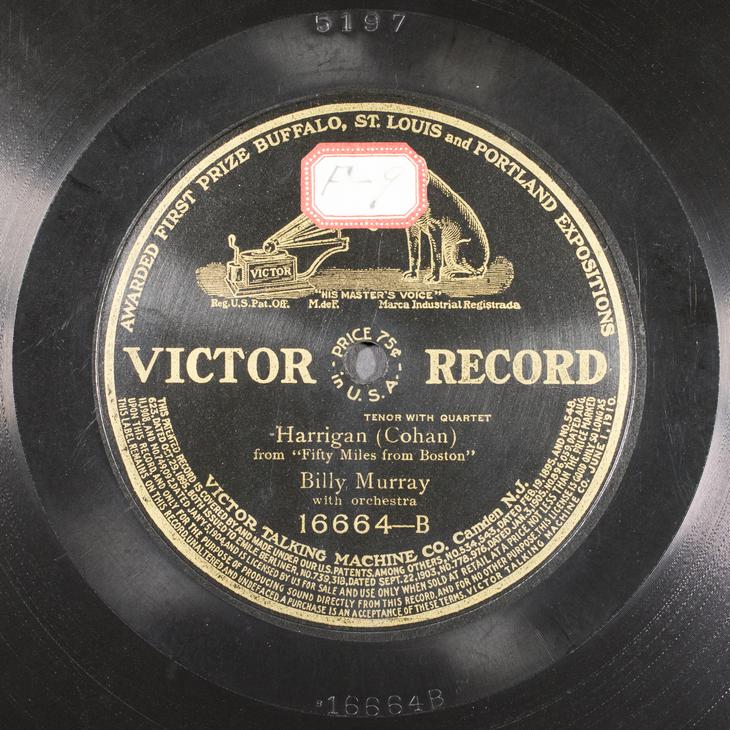
100 years ago: “Harrigan” hit #1

Harrigan

Billly Murray

Writer(s): George M. Cohan (see lyrics here)


First Charted: September 14, 1907


Peak: 19 US, 12 GA, 16 SM, 5 DF (Click for codes to singles charts.)


Sales (in millions): -- US, -- UK, -- world (includes US + UK)


Airplay/Streaming (in millions): -- radio, -- video, -- streaming

Awards:

Click on award for more details.

About the Song:

George M. Cohan wrote this as a tribute to Ed Harrigan, who was another Irish American who made important contributions to American musical theater. WK He was a “theatre empresario…who was an actor, singer, dancer, playwright, lyricist and producer, one of the founding fathers of modern American musical theatre in the 19th century.” SM In the song, the Irishman is “extremely proud of all his Irish blood. He dares anybody to ‘say a word agin’ me’ and claims proudly that no shame has ever been connected with his name.” TY2 However, Cohan didn’t just use the song to celebrate his own Irish heritage, but poke some fun at it as well. WK

It was performed in the show Fifty Miles from Boston by James C. Marlowe in 1908. However, in a move that was unusual for the time, it was actually recorded by several artists before being featured in the show. Billy Murray and Edward Meeker both recorded versions which charted in September 1907. Murray’s recording preceded Meeker’s on the charts by two weeks and went to #1 for nine weeks. Meeker’s version reached #8. Murray was born in Philadelphia and spent most of his life in Denver, so the strong Irish accent in the song was “obviously put on.” SM He did, however, claim he had Irish blood in his family. SM

The spelling part of the song led to it being adapted for other purposes. In his bid for the Prsidential nomination in 1956, Averell Harriman used a variation which sang “H, A, double-R, I, M, A, N. During John F. Kennedy’s campaign a version of “High Hopes” was recorded by Frank Sinatra that also featured the lyrics “K, E, double-N, E, D, Y.” It was also used in an episode of Gilligan’s Island with Gilligan’s name spelled out. There have also been parodies adapting it as a children’s song and Allan Sherman did a version of it about pianist Vladimir Horowitz. WK

The song was featured in the Cohan biopic Yankee Doodle Dandy in 1942 starring James Cagney, who performed the song with Joan Leslie. The film suggested it was an early work of Cohan’s that he had to shop around, but in real ife Cohan had already landed some major Broadway hits when he wrote “Harrigan.” WK Joel Grey sang it in the 1968 Broadway show George M!


Resources:


Related Links:


First posted 12/8/2022; last updated 12/15/2022.

Friday, May 12, 2006

100 years ago: Billy Murray hit #1 with “You’re a Grand Old Flag” for the first of 10 weeks

You’re a Grand Old Flag” (aka “Grand Old Rag”)

Billy Murray

Writer(s): George M. Cohan -- (see lyrics here)


First Charted: May 5, 1906


Peak: 110 US, 12 GA, 13 SM, 1 DF (Click for codes to singles charts.)


Sales (in millions): 1.0 (sheet music)


Airplay/Streaming (in millions): -- radio, 0.67 video, -- streaming

Awards:

Click on award for more details.

About the Song:

“Perhaps no other American popular song composer did more to popularize the patriotic song than George M. Cohan.” PS He claimed to be born on the 4th of July, although he was actually born the day before. As part of a vaudeville family, he toured New England and the Midwest during his boyhood. By 1904, he wrote and starred in his first musical, Little Johnny Jones. Two years later, he wrote George Washington, Jr., another Broadway show he wrote, produced and starred in as the character of George Belgrave. The show featured “Grand Old Flag,” the song which arguably made him a superstar. PS

It isn’t too surprising it became so popular. It was “a patriotic song in a snappy tempo sung by a vigorous and enthusiastic performer to an audience that loves America.” RA The song also drew on other beloved hits such as “Dixie” and “Auld Lang Syne.” SS When performing it during the musical, Cohan marched and down the stage waving an American flag. PS He also performed the song in 1932 in his first talking picture, The Phantom President. TY2

Still, the song wasn’t without controversy. Cohan originally called it “The Grand Old Rag,” inspired by a Civil War veteran who fought at Gettysburg. The man held a carefully folded, but tattered flag and said to Cohan, “She’s a grand old rag.” WK Cohan replicated the scene for the musical, but “despite the song’s clear patriotic message, ‘rag’ was considered by many to be an undignified and inappropriate way to refer to the American flag” NRR so Cohan changed the title to “You’re a Grand Old Flag.”

Billy Murray, who has been called “the definitive interpreter of Cohan on record,” SS recorded the song under its original title, despite Cohan’s efforts to pull it. WK The controversy didn’t hurt the song; it became the first from a musical to sell more than a million copies of sheet music. SB Murray made it the biggest hit of 1906 WHC and the biggest-selling record of the first decade for Victor Records. DJ


Resources:


Related Links:


First posted 5/5/2014; last updated 12/15/2022.

Friday, July 15, 2005

100 years ago: “Give My Regards to Broadway” went to #1

Give My Regards to Broadway

Billy Murray

Writer(s): George M. Cohan (see lyrics here)


First Charted: June 17, 1905


Peak: 15 US, 3 GA (Click for codes to singles charts.)


Sales (in millions): --


Airplay/Streaming (in millions): -- radio, 0.11 video, -- streaming

Awards:

Click on award for more details.

About the Song:

George M. Cohan was an untrained musician who “professed to write only simple songs with simple harmonies and limited ranges” PS “and a melody line that rarely exceeded four beats.” LW “His brilliance was in making them attractive and memorable.” LW He became one of the most multi-talented men in musical theater. In nearly all his productions, he was “composer, lyricist, librettist, playwright, actor, director, and producer.” TY2

After two flops on Broadway, Cohan found success with Little Johnny Jones, which was inspired by real-life jockey Tod Sloan. Johnny Jones travels to Britain to ride his horse in the English Debry and is accused of throwing the race. It turns out he was framed by an American gambler and his name is cleared. Johnny sings “Give My Regards to Broadway” in a mournful tone as he watches his family leaving by boat but he has to stay behind to clear his name. Once his name has been cleared, Johnny performs it in “an exuberant song-and-dance style.” TY2 It “could only have been sung by an opinionated, cocky young man with a very high opinion of his own worth.” LW Cohan was a natural.

With “music and melody [that] seem to fit any era and transcend fads and styles” PS “Regards” is “arguably…the most memorable and greatest hit from the 1900 – 1910 decade.” PS It has proved to be “one of those enduring favorites that never gets old or outdated.” PS It “has become one of the unofficial anthems of the American theatrical industry.” TY2 Billy Murray and S.H. Dudley both charted with the song in 1905, taking it to #1 and 4 respectively.

Eddie Buzzell sang the song in its first screen appearance for the 1929 film version of Little Johnny Jones. It was also used in Yankee Doodle Dandy (1941), Give My Regards to Broadway (1948), Jolson Sings Again (1948) and With a Song in My Heart (1952). The 1968 play George M! featured Joel Grey singing it in his portrayal of Cohan.


Resources:


Related Links:


First posted 7/15/2014; last updated 12/13/2022.