Showing posts with label Dave Brubeck. Show all posts

Thursday, August 29, 2024

The Top 50 Albums of the 1950s

1950-1959:

Top 50 Albums

The 1950s was an interesting transitional era in the history of music. While it is most associated with rock and roll now, the decade was also marked by plenty of classic showtunes and jazz collections. Crooners and big bands were on their way out, but that didn’t stop Frank Sinatra from releasing some of the most impactful music to shape the development of the album. This list reflects the diversity of the decade. Note: there are compilations included in this list, as long as they didn’t go past the 1950s.

You can check out the top albums of all time or for other decades by clicking here.

  1. Miles Davis Kind of Blue (1959)
  2. Richard Rodgers (music) & Oscar Hammerstein II (lyrics) South Pacific (soundtrack, 1958)
  3. Elvis Presley The Sun Sessions (archives, recorded 1954-55, released 3/76)
  4. Alan Jay Lerner/Frederick Loewe (composers) My Fair Lady (cast album, 1956)
  5. Elvis Presley Elvis Presley (aka Rock ‘N’ Roll) (1956)
  6. Leonard Bernstein/Stephen Sondheim (composers) West Side Story (cast, 1957)
  7. Richard Rodgers (music) & Oscar Hammerstein II (lyrics) The Sound of Music (cast album, 1959)
  8. Frank Sinatra Songs for Swingin’ Lovers! (1956)
  9. Hank Williams 40 Greatest Hits (compilation: 1947-53, released 1978)
  10. Richard Rodgers (music) & Oscar Hammerstein II (lyrics) The King and I (soundtrack, 1956)

  11. Elvis Presley Golden Records (compilation: 1956-58)
  12. Harry Belafonte Calypso (1956)
  13. Dave Brubeck Time Out (1959)
  14. Meredith Willson (composer) The Music Man (cast, 1957)
  15. Frank Sinatra In the Wee Small Hours (1955)
  16. Pyotor Il’yich Tchaikovsky’s Piano Concerto No. 1 (1958)
  17. Richard Rodgers (music) & Oscar Hammerstein II (lyrics) Oklahoma! (soundtrack, 1955)
  18. Bing Crosby The Definitive Collection (compilation: 1931-57, released 2006)
  19. Mario Lanza The Student Prince (soundtrack, 1954)
  20. George & Ira Gershwin (composers) An American in Paris (classical, soundtrack released 1951)

  21. Henry Mancini The Music from Peter Gunn (soundtrack, 1959)
  22. Howlin’ Wolf Moanin’ in the Moonlight (compilation: 1951-59, released in 1959)
  23. Duke Ellington At Newport (live, 1956)
  24. Little Richard Here’s Little Richard (1957)
  25. Ornette Coleman The Shape of Jazz to Come (1959)
  26. Buddy Holly & the Crickets 20 Golden Greats (compilation: 1956-58, released 1978)
  27. Charles Mingus Ah Um (1959)
  28. Miles Davis Birth of the Cool (recorded 1950, released 1957)
  29. John Coltrane Giant Steps (recorded 1959, released 1960)
  30. Guy Lombardo The Band Played On (compilation: 1927-50, released 2002)

  31. Jerome Kern (music) & Oscar Hammerstein II (lyrics) Show Boat (soundtrack, 1951)
  32. Elvis Presley Elvis’ Christmas Album (1957)
  33. Buddy Holly & the Crickets The Chirping Crickets (1957)
  34. Sonny Rollins Saxophone Colossus (1956)
  35. Alan Lerner & Frederick Loewe (composers) Gigi (soundtrack, 1958)
  36. Various Artists The First Rock and Roll Record (box set: 1916-56, released 2011)
  37. Jane Froman With a Song in My Heart (soundtrack, 1952)
  38. Elvis Presley The King of Rock and Roll: The Complete ‘50s Masters (box set: 1953-58, released 1992)
  39. Ella Fitzgerald Sings the Cole Porter Songbook (1956)
  40. Jackie Gleason Music for Lovers Only (1952)

  41. The Kingston Trio At Large (1959)
  42. Richard Rodgers (music) & Oscar Hammerstein II (lyrics) The King and I (cast, 1951)
  43. Frank Loesser (composer) Guys and Dolls (cast, 1950)
  44. Johnny Mathis Johnny’s Greatest Hits (1958)
  45. Richard Rodgers (music) & Oscar Hammerstein II (lyrics) Carousel (soundtrack, 1956)
  46. Elvis Presley Loving You (soundtrack, 1957)
  47. Irving Berlin (music & lyrics) Annie Get Your Gun (soundtrack, 1950)
  48. Jule Styne (music) & Stephen Sondheim (lyrics) Gypsy (cast album, 1959)
  49. Nacio Herb Brown & Arthur Freed Singin’ in the Rain (soundtrack, 1952)
  50. John Coltrane Blue Train (1957)

Resources and Related Links:


First posted 3/8/2013; last updated 8/29/2024.

Friday, March 15, 2024

The Top 50 Jazz Albums of All Time

Jazz:

The Top 50 Albums

24 lists focused on jazz albums were aggregated to create this list. Those albums featured on 2 or more lists were then sorted by overall points in Dave’s Music Database. Other jazz albums not appearing on the lists were factored in as well.

Check out other best-of-genre/category lists here.

1. Miles Davis Kind of Blue (1959)
2. Norah Jones Come Away with Me (2002)
3. John Coltrane A Love Supreme (1965)
4. Miles Davis Bitches Brew (1970)
5. George Gershwin, Ira Gershwin, & Dubose Heyward Porgy and Bess (1935)
6. Frank Sinatra Songs for Swingin’ Lovers! (1956)
7. Bessie Smith The Essential (compilation: 1923-33, released 1997)
8. Louis Armstrong The Complete Hot Five and Hot Seven Recordings (box set, recorded 1925-28, released 2000)
9. Glenn Miller Glenn Miller (aka “Glenn Miller & His Orchestra”) (compilation: 1939-42, released 1945)
10. Dave Brubeck Time Out (1959)

11. Norah Jones Feels Like Home (2004)
12. Stan Getz & João Gilberto Getz/Gilberto (recorded 1963, released 1964)
13. Henry Mancini The Music from Peter Gunn (soundtrack, 1959)
14. Duke Ellington The Blanton-Webster Band (box set: 1939-42, released 1990)
15. Benny Goodman The Complete Legendary Carnegie Hall Concert (live, recorded 1938)
16. Ornette Coleman The Shape of Jazz to Come (1959)
17. Herbie Hancock Head Hunters (1973)
18. Miles Davis & Gil Evans Sketches of Spain (1960)
19. Miles Davis Birth of the Cool (recorded 1949-50, released 1957)
20. Charles Mingus Ah Um (1959)

21. Sonny Rollins Saxophone Colossus (1956)
22. Eric Dolphy Out to Lunch! (1964)
23. Bill Evans Trio Sunday at the Village Vanguard (1961)
24. Miles Davis In a Silent Way (1969)
25. John Coltrane Giant Steps (recorded 1959, released 1960)
26. Duke Ellington At Newport (live, 1956)
27. Ella Fitzgerald Sings the Cole Porter Songbook (1956)
28. Henry Mancini Breakfast at Tiffany’s (soundtrack, 1961)
29. Bill Evans Trio Waltz for Debbie (live, 1961)
30. Charlie Parker The Complete Savoy & Dial Studio Recordings (box: 1944-48, released 2000)

31. Weather Report Heavy Weather (1977)
32. Charles Mingus The Black Saint and the Sinner Lady (1963)
33. Erroll Garner Concert by the Sea (live, 1955)
34. Thelonious Monk Genius of Modern Music, Vol. 1 (recorded 1947, released 1951)
35. Mahavishnu Orchestra The Inner Mounting Flame (1971)
36. Thelonious Monk Brilliant Corners (1956)
37. The Quintet (Charlie Parker, Dizzy Gillespie, Bud Powell, Charles Mingus, & Max Roach) Jazz at Massey Hall (live, 1953)
38. Jamiroquai Travelling Without Moving (1996)
39. Miles Davis & Gil Evans Miles Ahead (1957)
40. Louis Armstrong & Earl Hines Louis Armstrong and Earl Hines (compilation: 1928-29, released 1989)

41. Oliver Nelson Blues and the Abstract Truth (1961)
42. George Benson Breezin’ (1976)
43. Norah Jones Not Too Late (2007)
44. Duke Ellington Far East Suite (1966)
45. Ornette Coleman Free Jazz: A Collective Improvisation (1960)
46. John Coltrane Blue Train (1957)
47. Herbie Hancock Maiden Voyage (1964)
48. Keith Jarrett The Köln Concert (live, 1975)
49. Wayne Shorter <9>Speak No Evil (1964)
50. Dizzy Gillespie The Complete RCA Victor Recordings (compilation: 1937-49, released 1995)


Resources and Related Links:


First posted 4/13/2011; last updated 3/15/2024.

Wednesday, January 26, 2022

The Top100 Keyboardists/Pianists of All Time

Keyboardists/Pianists:

Top 100

This is one of the DMDB’s most diverse best-of lists, with everything from classical (Beethoven, Mozart) to jazz (Dave Brubeck, Herbie Hancock) to R&B (Ray Charles, Stevie Wonder) to pop/rock (Billy Joel, Elton John) to progressive rock (Keith Emerson, Rick Wakeman). As always, DMDB lists are determined by an aggregation of multiple lists.

See other lists of Acts/Music Makers by Categories.

1. Franz Liszt
2. Art Tatum
3. Vladimir Horowitz
4. Chick Corea
5. Thelonious Monk
6. Bill Evans
7. Frederic Chopin
8. Sergei Rachmaninoff
9. Ludwig van Beethoven
10. Oscar Peterson

11. Dave Brubeck
12. Duke Ellington
13. Ray Manzarek
14. Josef Hoffman
15. Keith Emerson
16. Herbie Hancock
17. Wolfgang Amadeus Mozart
18. McCoy Tyner
19. Ahmad Jamal
20. Earl Hines

21. Billy Joel
22. Count Basie
23. Keith Jarrett
24. Erroll Garner
25. Richard Wright
26. Glenn Gould
27. Sviatoslav Richter
28. Tommy Flanagan
29. Red Garland
30. Horace Silver

31. Fats Waller
32. Bud Powell
33. Jelly Roll Morton
34. Wynton Kelly
35. Jon Lord
36. Gene Harris
37. Jordan Rudess
38. Rick Wakeman
39. Arthur Rubenstein
40. Gregg Rolie

41. Stevie Wonder
42. Alfred Cortot
43. Elton John
44. Steve Winwood
45. Jonathan Cain
46. Claudio Arrau
47. Teddy Wilson
48. George Shearing
49. Al Kooper
50. Martha Argerich

51. Alfred Brendel
52. James P. Johnson
53. John Paul Jones
54. Ray Charles
55. Billy Taylor
56. Nicky Hopkins
57. Andre Previn
58. Arturo Bendetti Michelangeli
59. Jan Hammer
60. Henry “Hank” Jones

61. Willie “The Lion” Smith
62. Nat “King” Cole
63. Billy Powell
64. Hampton Hawes
65. Ron “Pigpen” McKernan
66. Patrick Moraz
67. Bobby Timmons
68. Neal Doughty
69. Janne Warman
70. Tony Banks

71. Walter Gleseking
72. Robert Schumann
73. Sonny Clark
74. Billy Preston
75. Liberace
76. Phineas Newborn Jr.
77. Brian Eno
78. Gregg Allman
79. Evgeny Kissin
80. George Duke

81. Eubie Blake
82. Mose Alison
83. Mary Lou Williams
84. Rod Argent
85. Dennis DeYoung
86. Michael Petrucciani
87. Paul Bley
88. Kerry Livgren
89. Kenny Drew
90. Richard Tandy

91. Brad Mehldau
92. Don Airey
93. Geoff Downes
94. Alicia Delarrocha
95. Marc-Andre Hamelin
96. Roy Bittan
97. Mike Pinder
98. Robert Lamm
99. Vince Guaraldi
100. Joe Sample


Resources/Related Links:


First posted 5/14/2017; last updated 1/26/2022.

Saturday, May 22, 2021

Dave's Music Database Hall of Fame: Albums (May 2021)

Originally posted 5/22/2021.

January 22, 2019 marked the 10-year anniversary of the DMDB blog. To honor that, Dave’s Music Database announced its own Hall of Fame. This month marks the tenth group of album inductees. These are the among the top twenty jazz albums of all time, excluding previous inductees Miles Davis’ A Kind of Blue, Gershwin’s Porgy and Bess, Bessie Smith’s The Essential, Louis Armstrong’s Complete Hot Five and Hot Seven Recordings, Glenn Miller’s Glenn Miller, Henry Mancini’s Music from Peter Gunn, Duke Ellington’s The Blanton Webster Band 1939-1942, and Benny Goodman’s Carnegie Hall Jazz Concert.

See the full list of album inductees here.

Frank Sinatra Songs for Swingin’ Lovers (1956)

Inducted May 2021 as “Top Jazz Albums.”

“Sinatra’s albums for Capitol introduced the singer’s album, the concept album and the grown-up album all at once.” RC On this album, the focus from Ol’ Blue Eyes and conductor/arranger Nelson Riddle was “on churning out up-tempo dance versions of standards.” SHS Read more.

Duke Ellington At Newport (1956)

Inducted May 2021 as “Top Jazz Albums.”

After an unsuccessful stint at Capitol Records, Duke Ellington re-established himself “as a vitally popular jazz artist” AMG with At Newport, a recorded of his appearance at the Newport Jazz Festival in 1956. The original album release was “almost fully manufactured, recorded in a studio with crowd madness dubbed in” AB but four decades later, a tape of the original Newport set saw the light of day, reviving the “set in its organic glory.” AB Read more.

Charles Mingus Ah Um (1959)

Inducted May 2021 as “Top Jazz Albums.”

Ah Um “is a stunning summation of the bassist’s talents and probably the best reference point for beginners…Mingus’ compositions and arrangements were always extremely focused, assimilating individual spontaneity into a firm consistency of mood, and that approach reaches an ultra-tight zenith” AMG on Mingus’ debut for Columbia, a Grammy Hall of Fame and National Recording Registry inductee. Read more.

Ornette Coleman The Shape of Jazz to Come (1959)

Inducted May 2021 as “Top Jazz Albums.”

This “was a watershed event in the genesis of avant-garde jazz, profoundly steering its future course and throwing down a gauntlet that some still haven’t come to grips with. The record shattered traditional concepts of harmony in jazz, getting rid of not only the piano player but the whole idea of concretely outlined chord changes.” AMG The album was Coleman’s debut with Atlantic and has been inducted into the Grammy Hall of Fame and National Recording Registry. Read more.

Dave Brubeck Time Out (1959)

Inducted May 2021 as “Top Jazz Albums.”

“Dave Brubeck’s defining masterpiece, Time Out is one of the most rhythmically innovative albums in jazz history…Brubeck’s record company wasn’t keen on releasing such an arty project, and many critics initially roasted him for tampering with jazz’s rhythmic foundation. But for once, public taste was more advanced than that of the critics.” SH Read more.

Stan Getz with João Gilberto Getz/Gilberto (1963)

Inducted May 2021 as “Top Jazz Albums.”

“One of the biggest-selling jazz albums of all time, not to mention bossa nova’s finest moment.” AMG “It’s one of those rare jazz records about which the purist elite and the buying public are in total agreement.” AMG Getz/Gilberto brought “two of bossa nova’s greatest innovators – guitarist/ singer João Gilberto and composer/ pianist Antonio Carlos Jobim – to New York to record with Stan Getz. The results were magic.” AMG The Grammy winner for Album of the Year featured The Girl from Ipanema, “one of the biggest smash hit singles in jazz history.” AMG Read more.

John Coltrane A Love Supreme (1965)

Inducted May 2021 as “Top Jazz Albums.”

John Coltrane’s A Love Supreme is “widely considered his masterpiece.” WK Jazz critic Tom Hull called it “the most perfectly plotted single piece of jazz ever recorded.” WK It is also “easily one of the most important records ever made” JI in any genre. Techno-DJ Moby said it “is probably oe of the most beautiful and sublime recordings of the twentieth century.” AK-xvi Read more.

Miles Davis Bitches Brew (1970)

Inducted May 2021 as “Top Jazz Albums.”

“Inspired by the visionary work of James Brown, Jimi Hendrix, and Sly Stone, Miles Davis began incorporating funk grooves and electronic instruments into his music – first with the languid, contemplative In a Silent Way…and then on…Bitches Brew.” TL The latter is “thought by many to be the most revolutionary album in jazz history, having virtually created the genre known as jazz-rock fusion.” TJ Read more.

Herbie Hancock Head Hunters (1973)

Inducted May 2021 as “Top Jazz Albums.”

“Perhaps the defining moment of the jazz-fusion movement (or perhaps even the spearhead of the Jazz-funk style of the fusion genre), the album made jazz listeners out of rhythm and blues fans, and vice versa.” WK “Hancock had pushed avant-garde boundaries on his own albums and with Miles Davis, but he had never devoted himself to the groove as he did on Head Hunters,” STE an inductee into the Grammy Hall of Fame and National Recording Registry. Read more.

Norah Jones Come Away with Me (2002)

Inducted May 2021 as “Top Jazz Albums.”

In 2003, Norah Jones won Grammys for Best New Artist, Album of the Year for Come Away with Me, and Record and Song of the Year for the album’s lead single, “Don’t Know Why.” The album topped the Billboard album chart and sold 27 million worldwide. “Though its surprising success…overwhelmed it, this seductively modest little record is a marvel of mood and invention. The songwriting and arrangements are sophisticated, often jazzy, yet full of catchy hooks. And Jones’ vocals are silken and perfectly turned, setting a seamless mood that could soundtrack high-end restaurants and low-rent make-out sessions alike.” RS’11 Read more.

Thursday, April 22, 2021

Jazz: Top 100 Songs of All Time

Jazz:

Top 100 Songs

This is an aggregate of 30 lists (see sources at the bottom of the page) focused on the best jazz songs of all time. Many of these were not originally jazz compositions and have higher-ranked versions in Dave’s Music Database. As such, the listings here are not necessarily the most popular versions of the song, but the one attributed specifically to a jazz artist.

Click here to see other genre-specific song lists.

1. Ella Fitzgerald & Louis Armstrong “Summertime” (1957)
2. Dave Brubeck “Take Five” (1961)
3. Duke Ellington “Take the ‘A’ Train” (1941)
4. Coleman Hawkins “Body and Soul” (1940)
5. Thelonious Monk “‘Round Midnight” (1947)
6. Miles Davis “So What” (1959)
7. Louis Armstrong “What a Wonderful World” (1967)
8. Stan Getz with Joao Gilberto “The Girl from Ipanema” (1964)
9. Dizzy Gillespie “A Night in Tunisia” (1946)
10. Cannonball Adderley “Autumn Leaves” (1958)

11. Benny Goodman “Sing, Sing, Sing (With a Swing)” (1938)
12. Billie Holiday “Strange Fruit” (1939)
13. Frank Sinatra “Fly Me to the Moon (In Other Words)” (1964)
14. Ray Charles “Georgia on My Mind” (1960)
15. Erroll Garner Trio “Misty” (1954)
16. Glenn Miller “In the Mood” (1939)
17. Miles Davis “All Blues” (1959)
18. John Coltrane “Acknowledgement (A Love Supreme, Part I)” (1965)
19. John Coltrane “My Favorite Things” (1960)
20. Miles Davis “Blue in Green” (1959)

21. Weather Report “Birdland” (1977)
22. Fats Waller “Ain’t Misbehavin’” (1929)
23. Duke Ellington “Sophisticated Lady” (1933)
24. Duke Ellington & John Coltrane “In a Sentimental Mood” (1962)
25. Bessie Smith & Louis Armstrong “St. Louis Blues” (1925)
26. Duke Ellington “Mood Indigo“ (1931)
27. Louis Armstrong “West End Blues” (1928)
28. Count Basie Orchestra “One O’Clock Jump” (1937)
29. Art Blakey & the Jazz Messengers “Moanin’” (1958)
30. Etta James “At Last” (1961)

31. Benny Goodman “Stompin’ at the Savoy” (1936)
32. Duke Ellington “Satin Doll” (1953)
33. John Coltrane “Giant Steps” (1959)
34. Dizzy Gillespie “All the Things You Are” (1945)
35. Louis Armstrong “On the Sunny Side of the Street” (1933)
36. Artie Shaw “Stardust” (1941)
37. Dizzy Gillespie “Salt Peanuts” (1945)
38. Duke Ellington “It Don’t Mean a Thing if It Ain’t Got That Swing” (1932)
39. Glenn Miller “Moonlight Serenade” (1939)
40. Louis Armstrong “I Got Rhythm” (1932)

41. Dizzy Gillespie “Manteca” (1947)
42. Peggy Lee “Fever” (1957)
43. Cab Calloway “Minnie the Moocher” (1931)
44. Ella Fitzgerald “The Man I Love” (1959)
45. Ella Fitzgerald “Mack the Knife“ (1960)
46. Artie Shaw “Begin the Beguine” (1938)
47. Ella Fitzgerald “Night and Day” (1956)
48. Herbie Hancock “Watermelon Man” (1962)
49. Duke Ellington “Caravan” (1937)
50. Count Basie “April in Paris” (1955)

51. Paul Whitman with George Gershwin “Rhapsody in Blue” (1924)
52. John Coltrane & Johnny Hartman “Lush Life” (1963)
53. Louis Armstrong “Sweet Georgia Brown” (1955)
54. Billie Holiday “God Bless the Child” (1941)
55. Louis Armstrong “All of Me” (1932)
56. Ella Fitzgerald with the Daydreamers “How High the Moon” (1947)
57. Art Tatum “Tea for Two” (1939)
58. Natalie Cole with Nat “King” Cole “Unforgettable” (1991)
59. Glenn Miller “The Nearness of You” (1940)
60. Norah Jones “Don’t Know Why” (2002)

61. Charlie Parker with Miles Davis & Dizzy Gillespie “Ko-Ko” (1945)
62. Louis Armstrong “When the Saints Go Marching In” (1939)
63. Ella Fitzgerald & Louis Armstrong “Cheek to Cheek” (1956)
64. Ferdinand “Jelly Roll” Morton “King Porter Stomp” (1923)
65. Billie Holiday “The Way You Look Tonight” (1936)
66. Fats Waller “Honeysuckle Rose” (1935)
67. Ella Fitzgerald “Someone to Watch Over Me” (1958)
68. Ray Charles “Come Rain or Come Shine” (1960)
69. Henry Mancini with Audrey Hepburn “Moon River” (1961)
70. Ella Fitzgerald with Chick Webb “A-Tisket, A-Tasket” (1938)

71. Bill Withers with Grover Washington, Jr. “Just the Two of Us” (1981)
72. Dizzy Gillespie “I Can’t Get Started” (1945)
73. Louis Armstrong “I’m in the Mood for Love” (1935)
74. Billie Holiday “Lover Man (Oh, Where Can You Be?)” (1945)
75. Benny Goodman “Moonglow” (1934)
76. Louis Armstrong “Hello Dolly!” (1964)
77. Benny Goodman with Mildred Bailey “Darn That Dream” (1940)
78. Woody Herman “Blues in the Night (My Mama Done Tol’ Me)” (1941)
79. Pee Wee Hunt “Twelfth Street Rag” (1948)
80. Nat “King” Cole “Mona Lisa” (1950)

81. Woody Herman “Laura” (1945)
82. Nat “King” Cole “Straighten Up and Fly Right” (1944)
83. Artie Shaw “Dancing in the Dark” (1941)
84. Bobby McFerrin “Don’t Worry Be Happy” (1988)
85. Lionel Hampton “Flying Home” (1942)
86. Frank Sinatra “One for My Baby and One for the Road” (1949)
87. Dinah Washington “What a Diff’rence a Day Makes” (1959)
88. Ella Fitzgerald “But Not for Me” (1959)
89. Tommy Dorsey “Opus One” (1943)
90. Charlie Barnet & His Orchestra “Cherokee (Indian Love Song)” (1939)

91. Duke Ellington “Perdido” (1942)
92. Chet Baker “My Funny Valentine” (1953)
93. Woody Herman “I’ll Remember April” (1942)
94. George Benson “On Broadway” (live, 1978)
95. George Benson “This Masquerade” (1976)
96. Stan Kenton “Artistry in Rhythm” (1944)
97. Herb Alpert “Rise” (1979)
98. Stan Getz & Charlie Bird “Desafinado” (1962)
99. Louis Armstrong “Potato Head Blues” (1927)
100. Django Reinhardt & Stephane Grappelli with the Quintet of the Hot Club of France “Nuages” (1940)


Resources and Related Links:

First posted 3/3/2011; last updated 4/22/2021.

Saturday, November 28, 2009

Today in Music (1959): Dave Brubeck Time Out charted

Time Out

Dave Brubeck


Charted: November 28, 1959


Recorded: June 25, July 1, and August 18, 1959


Peak: 2 US, 11 UK


Sales (in millions): 1.0 US


Genre: jazz


Tracks:

Song Title (date of single release, chart peaks) Click for codes to charts.

  1. Blue Rondo a la Turk
  2. Strange Meadowlark
  3. Take Five (9/11/61, 25 BB, 5 AC, 6 UK, air: 1 million)
  4. Three to Get Ready
  5. Kathy’s Waltz
  6. Everybody’s Jumpin’
  7. Pick up Sticks


Total Running Time: 38:30


The Players:

  • Dave Brubeck (piano)
  • Paul Desmond (alto saxophone)
  • Eugene Wright (bass)
  • Joe Morello (drums)

Rating:

4.346 out of 5.00 (average of 13 ratings)


Quotable:

“This belongs in even the most rudimentary jazz collection.” – Steve Huey, All Music Guide

Awards:

(Click on award to learn more).

About the Album:

Dave Brubeck’s “name is spoken with the same reverence as Miles Davis and John Coltrane, and between the three of them they all but defined jazz in the middle of the century.” CS He was “appreciated for his thick chord structures, complex improvisations, and his ability to dip a toe into dischord and atonality without drenching himself in chaos.” CS

His “defining masterpiece, Time Out is one of the most rhythmically innovative albums in jazz history, the first to consciously explore time signatures outside of the standard 4/4 beat or 3/4 waltz time. It was a risky move – Brubeck’s record company wasn’t keen on releasing such an arty project, and many critics initially roasted him for tampering with jazz’s rhythmic foundation.” SH

However, “for once, public taste was more advanced than that of the critics.” SH The album got to #2 on the Bilboard album chart and stayed on the chart for more than three years, “something wholly unexpected from an avant-garde jazz album.” CS It “still ranks as one of the most popular jazz albums ever.” SH

One of the factors that helped the album catch on with the public was the unexpected success of Take Five. It was the only song on the album not written by Brubeck. Alto saxophonist Paul Desmond wrote the hit single which was initially planned to be a drum solo for Joe Morello. CS

“Brubeck’s classic Blue Rondo à la Turk blends jazz with classical form and Turkish folk rhythms, while ‘Take Five,’ despite its overexposure, really is a masterpiece; listen to how well Desmond’s solo phrasing fits the 5/4 meter, and how much Joe Morello’s drum solo bends time without getting lost.” SH

“The other selections are richly melodic as well, and even when the meters are even, the group sets up shifting polyrhythmic counterpoints that nod to African and Eastern musics. Some have come to disdain Time Out as it’s become increasingly synonymous with upscale coffeehouse ambience, but as someone once said of Shakespeare, it’s really very good in spite of the people who like it. It doesn’t just sound sophisticated – it really is sophisticated music, which lends itself to cerebral appreciation, yet never stops swinging. Countless other musicians built on its pioneering experiments, yet it’s amazingly accessible for all its advanced thinking, a rare feat in any art form. This belongs in even the most rudimentary jazz collection.” SH

Resources and Related Links:


First posted 2/17/2010; last updated 3/20/2024.


Monday, September 21, 2009

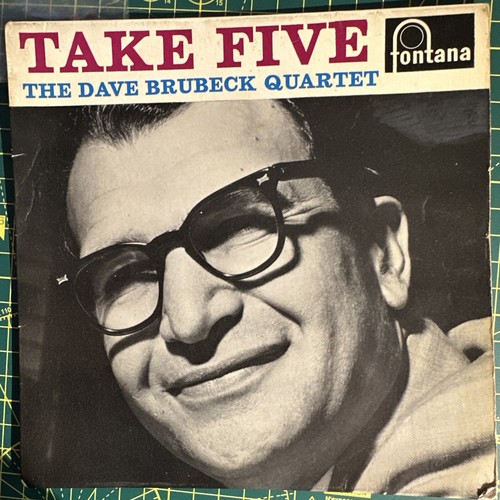
Today in Music (1959): Dave Brubeck released “Take Five”

Take Five

Dave Brubeck Quartet

Writer(s): Paul Desmond


Recorded: July 1, 1959


Released: September 21, 1959


First Charted: July 14, 1961


Peak: 25 BB, 23 CB, 16 GR, 31 HR, 5 AC, 6 UK (Click for codes to charts.)


Sales (in millions): 1.0 US


Airplay/Streaming (in millions): 1.0 radio, 182.75 video, 276.49 streaming

Awards:

Click on award for more details.

About the Song:

Jazz pianist and composer Dave Brubeck formed one of the first racially diverse bands while serving in the US Army. He formed the Dave Brubeck Quartet in 1951 with shifting personnel over the years. The most successful lineup (1958-68) included saxophonist Paul Desmond, bassist Eugene Wright, and drummer Joe Morello. “Their clean-cut cool jazz was a little cerebral and a little bit physical.” TC

When recording their 1959 album Time Out, Brubeck asked the group to experiment by moving away from 4/4 time signatures, much to the chagrin of Columbia, the group’s label. They were also opposed to the group’s intent to record an album entirely of originals, eschewing the usual approach of tackling standards. They thought it wouldn’t sell, but they were wrong – the album reached #2 and sold two million copies, the best-seller of Brubeck’s career.

The album featured “Take Five,” written in 5/4 time. It was written by Desmond, who was known “as one of the most sophisticated and literate – and most enigmatic – of jazzmen.” SS The song grew out of a rehearsal riff “and has come to represent modern jazz at its’ coolest.’” SS It got its name from the meter and the phrase “take five,” meaning “take a break for five minutes.” WK

The song was released in 1959 but went nowhere. Two years later, it was rereleased and became “the biggest-selling jazz single of all time.” WK While “Brubeck is sometimes disdained by jazz purists – mainly because he enjoyed this crossover pop success – the pianist has become one of the genre’s most productive artists.” TB


Resources:


Related Links:


First posted 5/12/2025.