Showing posts with label Show Boat. Show all posts

Sunday, May 22, 2022

Dave's Music Database Hall of Fame: Albums (May 2022)

The Top Musicals

Originally posted 5/22/2022.

January 22, 2019 marked the 10-year anniversary of the DMDB blog. To honor that, Dave’s Music Database announced its own Hall of Fame. This month marks the fourteenth group of album inductees. These are the top musicals of all time, excluding previous inductees South Pacific, My Fair Lady, The Sound of Music, Porgy and Bess, and Camelot.

See the full list of album inductees here.

Jerry Bock (music), Sheldon Harnick (lyrics) Fiddler on the Roof (1964)

Inducted May 2022 as “Top Musicals.”

Fiddler on the Roof tells the story of a Jewish family trying to hold on to their simple values in the shadow of the impending Russian revolution. With more than 3000 performances, it was the most successful musical up to its time and gave us standards like “Sunrise, Sunset” and “If I Were a Rich Man.” It won a Tony for Best Musical and the cast album is in the Grammy Hall of Fame and National Recording Registry. Read more.

Galt MacDermot (music) with Gerome Ragni & James Rado (lyrics) Hair (1967)

Inducted May 2022 as “Top Musicals.”

Hair threw away the conventional approach to musical theater in favor of a musical that catered to the hippie vibe of the late ‘60s. The cast album reached #1 and sold five million copies in the United States. It is in the Grammy Hall of Fame and National Recording Registry. It won a Grammy for Best Musical Theater Album and was named one of the top albums of the 20th century by the Recording Industry Association of America. Read more.

Lin-Manuel Miranda (music & lyrics) Hamilton (2015)

Inducted May 2022 as “Top Musicals.”

Inspired by Ron Chernow’s 2004 biography Alexander Hamilton, Lin-Manuel Miranda wrote a musical that combined the traditional style of show tunes with hip-hop, R&B, pop, and soul in a move that seemed destined for derision, but it became one of the most successful musicals of the 21st century. Hamilton won a Tony for Best Musical, a Grammy for Best Musical Theater Album, and a Pulitzer Prize for Drama. Read more.

Andrew Lloyd Webber (music) & Tim Rice (lyrics) Jesus Christ Superstar (1971)

Inducted May 2022 as “Top Musicals.”

When Andrew Lloyd Webber and Tim Rice couldn’t get funding for a stage production of their rock-music infused, controversial modernization of the Christ story, they released a studio album. Its success (including being named Billboard magazine’s album of the year) led to an eventual run on Broadway and an eight-year run in England, making it the country’s longest-running musical at the time. Read more.

Cole Porter (music & lyrics) Kiss Me, Kate (1949)

Inducted May 2022 as “Top Musicals.”

Kiss Me, Kate was the most successful Broadway musical of Cole Porter’s career, winning the Tony for Best Musical. It came at a time when he was thought to be in decline. Patti Page, Gordon MacRae, and Dinah Shore all had top 20 hits with the show’s song “So in Love.” The cast album spent 10 weeks at #1 in the U.S. and has been added to the Grammy Hall of Fame and National Recording Registry. Read more.

Meredith Willson (music & lyrics) The Music Man (1957)

Inducted May 2022 as “Top Musicals.”

The Music Man was a story of a con man trying to swindle the people in a small Iowa farm town. It won the Tony for Best Musical. The cast album sold a million copies and spent 12 weeks at #1 in the U.S. The album is in the Grammy Hall of Fame. “Till There Was You” and “Seventy Six Trombones” were the show’s best known songs. Read more.

Richard Rodgers (music) & Oscar Hammerstein II (lyrics) Oklahoma! (1943)

Inducted May 2022 as “Top Musicals.”

This was the first show written by the team of Rodgers and Hammerstein. It was a ground-breaking musical, taking the unusual approach of actually having the songs grow out of the characters’ situations. The cast album reached #4 and sold 3 million copies in the U.S. It is in the Grammy Hall of Fame and the National Recording Registry. The 1955 soundtrack topped the charts in the U.S. and U.K. and sold two million copies in the states. Bing Crosby has top-five hits with his recordings of the show’s “People Will Say We’re in Love” and “Oh, What a Beautiful Mornin’.” Read more.

Andrew Lloyd Webber (music) with Charles Hart & Richard Stilgoe (lyrics) Phantom of the Opera (1986)

Inducted May 2022 as “Top Musicals.”

The Phantom of the Opera was based on a 1911 French gothic mystery novel. The story is about a disfigured, musical genius who becomes obsessed with a beautiful soprano singer. The show became the longest-running Broadway musical of all time. It is estimated that the show has played to more than 100 million people in 125 cities in 25 countries. The cast album sold 4 million copies in the U.S. It won both the Tony and Laurence Oliver awards for best musical. Read more.

Jerome Kern (music) & Oscar Hammerstein II (lyrics) Show Boat (1927)

Inducted May 2022 as “Top Musicals.”

Show Boat is generally considered the first true American musical play. It broke tradition from the typical musical revues by telling an actual story accompanied by music. Kern and Hammerstein based the show on Ednar Ferber’s 1926 novel of the same name. The show’s best known songs are “Ol’ Man River” and “Can’t Help Lovin’ Dat Man.” The cast album is in the Grammy Hall of Fame and National Recording Registry. Read more.

Leonard Bernstein (music) & Stephen Sondheim (lyrics) West Side Story (1957)

Inducted May 2022 as “Top Musicals.”

Romeo and Juliet gets an update in West Side Story as a conflict between rival gangs in 1950s’ New York. The cast album hit #5 and sold more than 3 million copies worldwide, but was eclipsed by the monstrous success of the 1961 soundtrack, which spent 54 weeks at #1 in the U.S. where it sold 8 million copies. The cast album is in the Grammy Hall of Fame, won a Grammy for Best Musical album, and was named Billboard’s album of the year. “Somewhere,” “Tonight,” and “Maria” are among the show’s best known songs. Read more.

Monday, June 27, 2016

The Top 100 Broadway Songs

Broadway:

Top 100 Songs

Since the early part of the 20th century, musicals have fueled American music with some of its most beloved standards. In the first half of the 1900’s, many pop hits were recordings of songs which had originated on the Broadway stage. What follows is a list of the top 100 Broadway songs, as determined by an aggregate of 34 Broadway song collections and best-of lists. The show and the year of its stage premiere are listed after each song.

Click here to see other genre-specific song lists.

1. Memory (Cats, 1981)
2. Ol’ Man River (Show Boat, 1927)
3. Some Enchanted Evening (South Pacific, 1949)
4. Tonight (West Side Story, 1957)
5. If I Were a Rich Man (Fiddler on the Roof, 1964)
6. You’ll Never Walk Alone (Carousel, 1945)
7. Send in the Clowns (A Little Night Music, 1973)
8. Oh, What a Beautiful Mornin’ (Oklahoma!, 1943)
9. Seasons of Love (Rent, 1996)
10. What I Did for Love (A Chorus Line, 1975)

11. The Sound of Music (The Sound of Music, 1959)
12. If I Loved You (Carousel, 1945)
13. On the Street Where You Live (My Fair Lady, 1956)
14. All That Jazz (Chicago, 1975)
15. Don’t Cry for Me Argentina (Evita, 1978)
16. The Impossible Dream (Man of La Mancha, 1965)
17. I Don’t Know How to Love Him (Jesus Christ Superstar, 1971)
18. Aquarius (Hair, 1967)
19. I Dreamed a Dream (Les Miserables, 1985)
20. Tomorrow (Annie, 1977)

21. Cabaret (Cabaret, 1966)
22. Defying Gravity (Wicked, 2003)
23. Bewitched, Bothered, & Bewildered (Pal Joey, 1940)
24. The Music of the Night (The Phantom of the Opera, 1986)
25. I Could Have Danced All Night (My Fair Lady, 1956)
26. Climb Ev’ry Mountain (The Sound of Music, 1959)
27. My Favorite Things The Sound of Music, 1959)
28. Till There Was You (The Music Man, 1957)
29. My Funny Valentine (Babes in Arms, 1937)
30. Somewhere (West Side Story, 1957)

31. Oklahoma! (Oklahoma!, 1943)
32. On My Own (Les Miserables, 1985)
33. There’s No Business Like Show Business (Annie Get Your Gun, 1946)
34. I Got Rhythm (Girl Crazy, 1930)
35. Luck Be a Lady (Guys and Dolls, 1950)
36. Put on a Happy Face (Bye Bye Birdie, 1960)
37. Seventy-Six Trombones (The Music Man, 1957)
38. Getting to Know You (The King and I, 1951)
39. Can You Feel the Love Tonight? (The Lion King, 1997)
40. The Time Warp (The Rocky Horror Picture Show, 1973)

41. Hello, Dolly! (Hello, Dolly!, 1964)
42. Do-Re-Mi (The Sound of Music, 1959)
43. Sunrise, Sunset (Fiddler on the Roof, 1964)
44. Day by Day (Godspell, 1971)
45. Shall We Dance? (The King and I, 1951)
46. Can’t Help Lovin’ Dat Man (Show Boat, 1927)
47. If Ever I Would Leave You (Camelot, 1960)
48. The Party’s Over (Bells Are Ringing, 1956)
49. Smoke Gets in Your Eyes (Roberta, 1933)
50. As Long As He Needs Me (Oliver!, 1960)
image from the odysseyonline.com

51. All the Things You Are (Very Warm for May, 1939)
52. Summertime (Porgy and Bess, 1935)
53. Circle of Life (The Lion King, 1997)
54. Everything’s Coming Up Roses (Gypsy, 1959)
55. Written in the Stars (Aida, 1999)
56. One (Singular Sensation) (A Chorus Line, 1975)
57. Someone to Watch Over Me (Oh, Kay!, 1926)
58. You’re the Top (Anything Goes, 1934)
59. Maria (West Side Story, 1957)
60. I Love Paris (Can-Can, 1953)

61. Hello, Young Lovers (The King and I, 1951)
62. New York, New York (On the Town, 1944)
63. Almost Like Being in Love (Brigadoon, 1947)
64. I Get a Kick Out of You (Anything Goes, 1935)
65. The Lady Is a Tramp (Babes in Arms, 1937)
66. People Will Say We’re in Love (Oklahoma!, 1943)
67. Once in Love with Amy (Where’s Charley?, 1948)
68. Maybe This Time (Cabaret, 1966)
69. You Can’t Stop the Beat (Hairspray, 2002)
70. Falling in Love with Love (The Boys from Syracuse, 1938)

71. Superstar (Jesus Christ Superstar, 1971)
72. Comedy Tonight (A Funny Thing Happened on the Way to the Forum, 1962)
73. This Is the Moment (Jekyll and Hyde, 1997)
74. People (Funny Girl, 1964)
75. The Flesh Failures/Let the Sunshine In (Hair, 1964)
76. All I Ask of You (The Phantom of the Opera, 1986)
77. Over the Rainbow (The Wizard of Oz, movie: 1939)
78. Edelweiss (The Sound of Music, 1959)
79. Wouldn’t It Be Loverly (My Fair Lady, 1956)
80. Try to Remember (The Fantastics, 1960)

81. Mack the Knife (The Threepenny Opera, 1928)
82. Younger Than Springtime (South Pacific, 1949)
83. Bill (Show Boat, 1927)
84. Summer Nights (Grease, 1972)
85. Hernando’s Hideaway (The Pajama Game, 1954)
86. June Is Bustin’ Out All Over (Carousel, 1945)
87. On a Clear Day You Can See Forever (On a Clear Day You Can See Forever, 1965)
88. I Enjoy Being a Girl (Flower Drum Song, 1958)
89. This Can’t Be Love (The Boys from Syracuse, 1938)
90. The Phantom of the Opera (The Phantom of the Opera, 1986)

91. So in Love (Kiss Me, Kate, 1948)
92. Camelot (Camelot, 1960)
93. Where or When (Babes in Arms, 1937)
94. Close Every Door (Joseph and the Amazing Technicolor Dream Coat, 1972)
95. For Good (Wicked, 2003)
96. There’s a Small Hotel (On Your Toes, 1936)
97. Wheels of a Dream (Ragtime, 1996)
98. Springtime for Hitler (The Producers, 2001)
99. Beauty and the Beast (Beauty and the Beast, 1998)
100. It’s a Hard-Knock Life (Annie, 1977)


Resources and Related Links:

First posted 6/27/2016.

Thursday, April 29, 1993

On This Day (1893): George J. Gaskin hit #1 with “After the Ball”

After the Ball

George J. Gaskin

Writer(s): Charles K. Harris (see lyrics here)


Published: 1891


First Charted: April 29, 1893


Peak: 110 US (Click for codes to charts.)


Sales (in millions): 5.0 (sheet music)


Airplay/Streaming (in millions): -- radio, 0.13 video, -- streaming

Awards (Gaskin):

Click on award for more details.

Awards (John Yorke Atlee):

Click on award for more details.

About the Song:

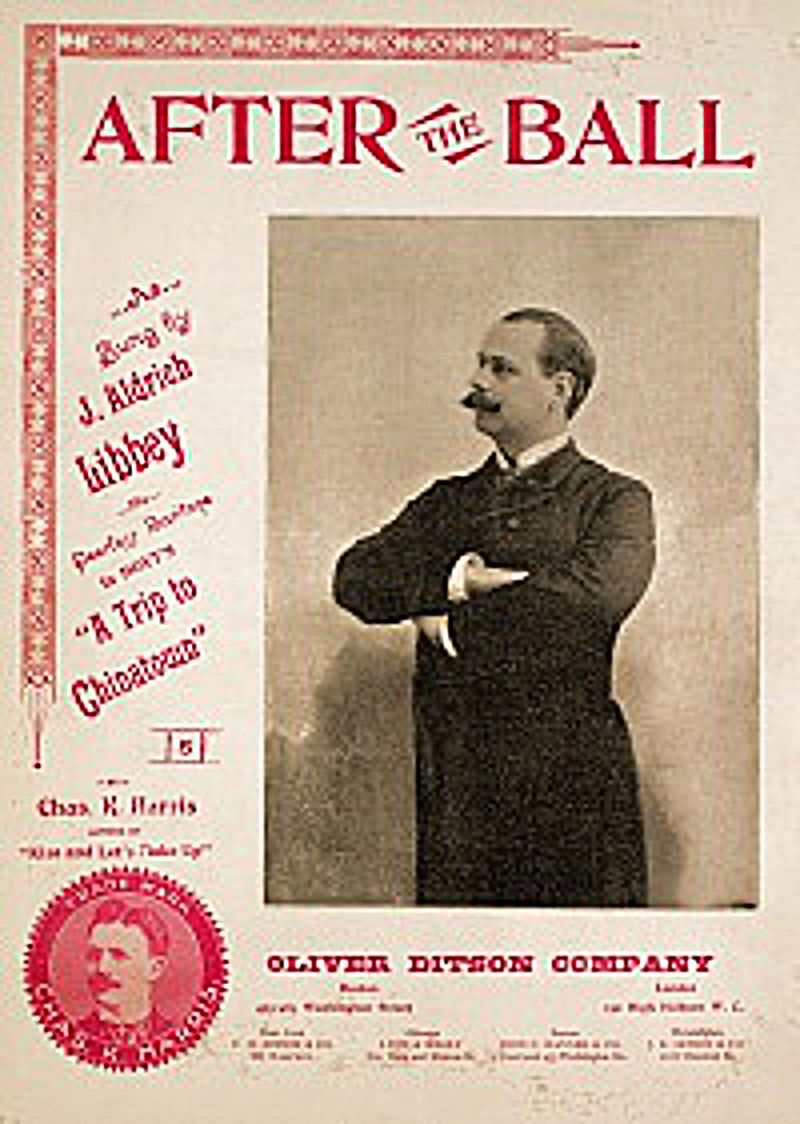
Charles K. Harris wrote this classic waltz in 1891 for an amateur minstrel show in Milwaukee, Wisconsin. The first time it was performed, the singer, Sam Doctor, forgot the words and the song made a poor impression. PG However, Harris believed in the song and paid well-known performer J. Aldrich Libbey to include it in his A Trip to Chinatown show. SS It grew in popularity and John Philip Sousa and his band performed it daily at the World’s Fair in Chicago in 1893. PG That same year, George J. Gaskin and John Yorke Atlee recorded the song. The former was a #1 for 10 weeks while the latter peaked at #2. It was the fourth chart-topper for Gaskin, who was known as “The Silve-Voiced Tenor.” He had a total of 19 songs reach the peak from 1891 to 1901. It was one of only three chart hits for Atlee. PM

In the song, an old man explains to his niece that he never married after seeing his sweetheart kissing another man at a ball. He left, and refusing to hear her explanation, WK only to find out years later that it was her brother. SS Harris got the idea from a dance in Chicago where he saw two lovers get in a fight and leave separately. SF

The song “exemplifies the sentimental ballads published before 1920, whose topics were frequently babies, separation, and death.” WK It has “a memorable, tearjerking chorus in the form of a story constructed for middle-class ladies to learn on their parlour pianos.” LW It “is sometimes credited with beginning the commercial exploitation of popular music.” SF Before 1893, most songs became regional hits and then word spread, but the aggressive marketing behind “After the Ball” set a new standard. SS It was the first song to sell a million copies of sheet music, SF eventually racking up five million and becoming the best seller in Tin Pan Alley’s history. WK Tin Pan Alley was the name given to a group of 19th century and early 20th century music publishers and songwriters in New York City.

The song resurfaced in 1927 when it was used in the groundbreaking musical Show Boat. Norma Terris performed it during its original Broadway run and Irene Dunne performed it for the 1936 film version. It was made into a film again in 1951 and performed by Kathryn Grayson. WK In 1940, it was featured in the biographical musical film Lillian Russell and performed by Alice Faye. WK It has also been performed by Nat “King” Cole, Bing Crosby, Guy Lombardo, Julie London, and Lawrence Welk. WK


Resources:


First posted 4/15/2021; last updated 9/6/2023.

Sunday, December 27, 1987

50 years ago: Show Boat opened on Broadway

Show Boat

Jerome Kern (music), Oscar Hammerstein II (lyrics)

Cast Album


Recorded/Released: 1928


Charted: --


Peak: --


Sales (in millions): --


Genre: show tunes


Soundtrack


Charted: July 21, 1951


Peak: 119 US


Sales (in millions): --


Genre: show tunes


Tracks (Order from Original Show):

  1. Overture
  2. Cotton Blossom
  3. Make Believe
  4. Ol’ Man River
  5. Can’t Help Lovin’ Dat Man
  6. Life Upon the Wicked Stage
  7. Till Good Luck Comes My Way
  8. I Might Fall Back on You
  9. Queenie’s Ballyhoo
  10. Olio Dance
  11. You Are Love
  12. Act I Finale
  13. At the Chicago World’s Fair
  14. Why Do I Love You?
  15. Bill
  16. After the Ball


Tracks (from 1951 Soundtrack):

Song Title (Performers) [time] Click for codes to singles charts.

  1. Show Boat (Main Title) (M-G-M Studio Orchestra & Chorus, Adolph Deutsch) [1:43]
  2. Cap’n Andy’s Calliope (M-G-M Studio Orchestra, Adolph Deutsch) [0:44]
  3. Natchez (M-G-M Studio Orchestra, Adolph Deutsh) [1:03]
  4. Cap’n Andy’s Presentation (M-G-M Studio Orchestra & Chorus, Adolph Deutsch) [2:09]
  5. Cap’n Andy’s Ballyhoo (M-G-M Studio Orchestra, Adolph Deutsch) [0:55]
  6. Encore on Deck (M-G-M Studio Orchestra, Adolph Deutsch) [1:21]
  7. Where’s the Mate for Me? (Gambler’s Song) (Howard Keel) [2:48]
  8. Young Romance (M-G-M Studio Orchestra, Adolph Deutsch) [1:33]
  9. Make Believe (Kathryn Grayson, Howard Keel) [4:00]
  10. Can’t Help Lovin’ Dat Man (Ava Gardner) [3:23]
  11. I Might Fall Back on You (Marge Champion, Gower Champion) [3:17]
  12. Julie Leaves the Boat (M-G-M Studio Orchestra & Chorus, Adolph Deutsch) [1:23]
  13. Ol’ Man River (William Warfield) [3:40]
  14. Ol’ Man River (Reprise) (William Warfield) [2:15]
  15. You Are Love (Kathryn Grayson, Howard Keel) [2:34]
  16. Why Do I Love You? (Kathryn Grayson, Howard Keel) [3:28]
  17. Ravenal Is Gone (M-G-M Studio Orchestra, Adolph Deutsch) [4:25]
  18. Bill (Ava Gardner) [3:22]
  19. Can’t Help Lovin’ Dat Man (Reprise #2) (Kathryn Grayson) [2:29]
  20. Life on the Wicked Stage (Marge Champion, Gower Champion) [5:23]
  21. After the Ball (Kathryn Grayson) [3:09]
  22. Packet Boat (M-G-M Studio Orchestra, Adolph Deutsch) [1:23]
  23. Natchez Dock (M-G-M Studio Orchestra, Adolph Deutsch) [2:00]
  24. Make Believe (Reprise) (Howard Keel) [1:30]
  25. Reunion (M-G-M Studio Orchestra, Adolph Deutsch) [1:46]
  26. Ol’ Man River: Finale Ultimo (William Warfield & the M-G-M Studio Chorus) [2:55]


Singles/Hit Songs:

As was common in the pre-rock era, songs from musicals were often recorded by artists not associated with the musical and released as singles. Here are some of the most notable hit singles resulting from Show Boat:

  • “After the Ball” – George J. Gaskin (#1, 1893), John Yorke Atlee (#1, 1893)
  • ”Ol’ Man River” – Paul Whiteman with Bing Crosby (#1, 1928), Al Jolson (#4, 1928), Paul Robeson with Paul Whiteman (#7, 1928), The Revelers (#10, 1928), Luis Russell (#19, 1934)
  • ”Bill” – Helen Morgan (#4, 1928)
  • ”Can’t Help Lovin’ Dat Man” – Helen Morgan (#7, 1928), Ben Bernie (#19, 1928)
  • ”Make Believe” – Paul Whiteman with Bing Crosby (#7, 1928)
  • ”Why Do I Love You” – Nat Shilkret (#9, 1928)
  • ”You Are Love” – James Melton with Victor Young’s Orchestra (#20, 1932)

Rating:

4.443 out of 5.00 (average of 11 ratings from all versions of Show Boat)


Quotable: “Generally considered to be the first true American ‘musical play’” – Wikipedia


Awards (Cast Album and Soundtrack): (Click on award to learn more).

About the Show:

Show Boat “is generally considered to be the first true American ‘musical play’.” WK It separated itself from the operettas, light musical comedies, and Follies-type musical revues of the 1890s and early 20th century by telling a dramatic plot-and-character driven story accompanied by music. WK

The musical, with music by Jerome Kern and lyrics and book by Oscar Hammerstein II, was based on Ednar Ferber’s 1926 novel of the same name. WK The show works in a few songs not by Kern and Hammerstein, including Bill, written by P.G. Wodehouse in 1918, but reworked by Hammerstein for Show Boat. Goodbye, My Lady Love by Joseph Howard and After the Ball by Charles K. Harris have become mainstays in the American stage productions of the show as well. WK

The show opened on Broadway on December 27, 1927 at the Ziegfeld Theatre in New York, where it ran for a year and a half. The 1928 London cast album was released in England before the United States. Since the U.S. had not started making original cast albums of Broadway shows, there was no album made of the 1927 Broadway cast. WK However, for the 1932 revival of the musical, a cast album was made featuring Helen Morgan and Paul Robeson, who were both in the original American and London casts of Show Boat, E-C alongside “James Melton, Frank Munn, and Countess Olga Albani” WK and an orchestra conducted by Victor Young. WK The recordings of “Ol’ Man River and a Can’t Help Lovin’ Dat Man…are truly authoritative. The…sound is astonishingly good.” E-C

The show was revived again in 1946, 1983, and 1994. WK Similarly, cast album recordings have been made multiple times, including 1946, 1956, 1958, 1962, 1966, 1971, 1988, and 1994. It was also made into a movie in 1936 with members from the original Broadway and London productions. It was made into a movie again in 1951 although it “was prettied up considerably and reshaped almost beyond recognition. On the other hand, Howard Keel’s baritone is one of the most pleasing voices in movies of that era, and teamed with Kathryn Grayson’s fluttering alto, the results are beguiling on songs like Only Make Believe.” E-S It “wasn’t treated too seriously by most purists until the 1990s, when it emerged as a minor classic in its own right.” E-S

Resources and Related Links:


Other Related DMDB Pages:


First posted 8/11/2008; last updated 12/21/2021.