Showing posts with label John Philip Sousa. Show all posts

Saturday, November 29, 2025

1890-1899: Top 100 Songs

Top 100 Songs of the Decade:

1890-1899

These are the songs which kicked off the recorded music era and the debut of charts to track the popularity of songs. Often a song’s popularity in this era had more to do with sheet music than specific recorded performances by individual artists. As such, there are multiple songs repeated here.

Rankings are figured by combining sales figures, chart data, airplay, awards, and appearances on best-of lists.

Check out other “songs of the decade” lists here.

DMDB Top 1%:

1. Katharine Lee Bates (lyrics) & Samuel A. Ward (music) “America the Beautiful” (1895)
2. George J. Gaskin “After the Ball” (1893)
3. James M. Black & Katharine E. Purvis (songwriters) “When the Saints Go Marching In” (1896)
4. Arthur Collins “Hello Ma Baby” (1899)
5. Patty S. Hill & Mildred J. Hill (composers) “Happy Birthday to You” (1893)
6. Scott Joplin “Maple Leaf Rag” (1899)
7. Billy Golden “Turkey in the Straw” (1891)
8. John Philip Sousa “The Stars and Stripes Forever” (1897)
9. Dan Quinn “Daisy Bell (A Bicycle Built for Two)” (1893)
10. Len Spencer “Ta-Ra-Ra Boom-De-Ay” (1892)

11. Dan Quinn “A Hot Time in the Old Town” (1896)
12. “I’ve Been Working on the Railroad” (1894)
13. Dan Quinn “The Sidewalks of New York” (1895)
14. Dan Quinn “The Band Played On” (1895)
15. Edison Male Quartette “My Old Kentucky Home” (1898)
16. George J. Gaskin “On the Banks of the Wabash” (1897)
17. Frank Kidson (first published by) “Scarborough Fair” (1891)
18. traditional “She’ll Be Coming ‘Round the Mountain” (1899)
19. John Yorke Atlee “Listen to the Mocking Bird (aka “The Mocking Bird”)” (1891)
20. Len Spencer “The Old Folks at Home (Swanee River)” (1892)

21. U.S. Marine Band “The Washington Post March” (1890)
22. Dan Quinn “At a Georgia Camp Meeting” (1898)
23. traditional “Red River Valley” (1896)
24. Silas Leachman “Dem Golden Slippers” (1894)
25. Vess Ossman “Yankee Doodle (aka ‘Yankee Doodle Went to Town’)” (1894)
26. Albert Campbell “My Wild Irish Rose” (1899)
27. Len Spencer “Hello Ma Baby” (1899)
28. Len Spencer “Mr. Johnson, Turn Me Loose” (1897)
29. John Yorke Atlee “After the Ball” (1893)
30. George J. Gaskin “Drill, Ye Terriers, Drill” (1891)

31. George Washington Johnson “The Laughing Song” (1891)
32. George J. Gaskin “Break the News to Mother” (1898)
33. U.S. Marine Band “Semper Fidelis” (1890)

DMDB Top 2%:

34. Arthur Collins “I’d Leave My Happy Home for You” (1899)
35. Jules Levy “My Country ‘Tis of Thee” (1893)
36. Len Spencer “A Hot Time in the Old Town” (1897)
37. George J. Gaskin “Oh Promise Me” (1893)
38. George J. Gaskin “My Old New Hampshire Home” (1898)
39. George J. Gaskin “The Fatal Wedding” (1893)
40. Gilmore’s Band “The Star-Spangled Banner” (1892)

41. Sousa’s Band “El Capitan March” (1895)
42. J.W. Myers “The Sidewalks of New York” (1895)
43. Dan Quinn “In the Baggage Coach Ahead” (1896)
44. George J. Gaskin “The Sidewalks of New York” (1895)
45. Tom Turpin (writer) “Harlem Rag” (1897)
46. Steve Porter “On the Banks of the Wabash” (1898)
47. United States Marine Band “The Liberty Bell” (1894)
48. Dan Quinn “The Little Lost Child” (1895)
49. J.W. Myers “Just Tell Them That You Saw Me” (1895)
50. Len Spencer “Smoky Mokes” (1899)

51. James Thornton (music/lyrics) “When You Were Sweet Sixteen” (1898)
52. George J. Gaskin “Sweet Rosie O’Grady” (1897)
53. George J. Gaskin “Down in Poverty Row” (1896)
54. John Yorke Atlee “Home Sweet Home” (1891)
55. U.S. Marine Band “The Thunderer” (1890)
56. Arthur Collins “I Guess I'll Have to Telegraph My Baby” (1899)
57. Dan Quinn “Curse of the Dreamer” (1899)
58. George Washington Johnson “The Whistling Coon” (1891)
59. Bill Dooley “Frankie and Johnny” (1899)
60. Vess Ossman “Yankee Doodle (aka ‘Yankee Doodle Went to Town’)” (new version, 1897)

61. George J. Gaskin “My Wild Irish Rose” (1899)
62. Eubie Blake “Charleston Rag” (1899)
63. George J. Gaskin “A Hot Time in the Old Town” (1897)
64. Sousa’s Band “The Star-Spangled Banner” (1898)
65. Len Spencer “The Bully (aka ‘Dat New Bully’)” (1895)
66. Emile Berliner “Twinkle Twinkle Little Star” (1890)
67. Len Spencer “Carry Me Back to Old Virginny” (1893)
68. Dan Quinn “Daddy Wouldn’t Buy Me a Bow Wow” (1892)
69. Edward M. Favor “Say Au Revoir, But Not Goodbye” (1894)
70. Manhansett Quartette “Sally in Our Alley” (1892)

71. Len Spencer “You’ve Been a Good Old Wagon But You’ve Done Broke Down” (1896)
72. Edward M. Favor “Daisy Bell (A Bicycle Built for Two)” (1894)
73. J.W. Myers “Goodbye Dolly Gray” (1897)
74. Emile Berliner “Auld Lang Syne” (1890)
75. Sousa’s Band “The Washington Post March” (1895)
76. Harry MacDonough & S.H. Dudley “Mid the Green Fields of Virginia” (1899)
77. Issler’s Orchestra “Tiger Rag” (1895)
78. Vess Ossman “At a Georgia Camp Meeting” (1898)
79. George J. Gaskin “Sweet Marie” (1894)
80. J.W. Myers “Two Little Girls in Blue” (1893)

81. Vess Ossman “Whistling Rufus” (1899)
82. Russell Hunting “Michael Casey Taking the Census” (1892)
83. Roger Harding “On the Banks of the Wabash” (1898)
84. Russell Hunting “Michael Casey at the Telephone” (1892)
85. Joe Belmont “Listen to the Mocking Bird (aka “The Mocking Bird”)” (1899)
86. Billy Golden “Bye Bye My Honey” (1898)
87. Len Spencer “My Gal Is a High-Born Lady” (1897)
88. Charles Marsh “Throw Him Down, McCloskey” (1892)
89. George J. Gaskin “The Sunshine of Paradise Valley” (1896)
90. George J. Gaskin “She Was Bred in Old Kentucky” (1898)

91. George J. Gaskin “She May Have Seen Better Days” (1896)
92. William F. Hooley “Gypsy Love Song (Slumber on, My Little Gypsy Sweetheart)” (1899)
93. Dan Quinn “The Bowery” (1893)

DMDB Top 5%:

94. Russell Hunting “Michael Casey As a Physician” (1891)
95. Dan Quinn “And Her Golden Hair Was Hanging Down Her Back” (1894)
96. Manhansett Quartette “The Picture Turned to the Wall” (1892)
97. Manhansett Quartette “The Old Oaken Bucket” (1894)
98. Dan Quinn “My Mother Was a Lady” (1897)
99. Thomas Bott “Love’s Old Sweet Song” (1892)
100. Steve Porter “My Creole Sue” (1899)


Resources/Related Links:


First posted 7/27/2018; last updated 11/29/2025.

Friday, July 4, 2003

100 years ago: “Hiawatha” hit #1

Hiawatha (His Song to Minnehaha)

Harry MacDonough

Writer(s): Neal Moret (music), James O’Dea (lyrics) (see lyrics here)


First Charted: May 1, 1903


Peak: 14 US, 13 GA, 16 SM (Click for codes to singles charts.)


Sales (in millions): --


Airplay/Streaming (in millions): -- radio, -- video, -- streaming

Awards:

Click on award for more details.

About the Song:

Originally subtitled “A Summer Idyll,” “Hiawatha” was written by Charles N. Daniels under the pseudonym of Neil Moret SM and published in 1901. It was an instrumental tribute to Hiawatha, Kansas. SM Moret had lived in Kansas City and dated a girl from Hiawatha. TY2 The melody came to him one day when he was headed to visit her. TY2

John Philip Sousa introduced the song, adding it to his band’s repertoire. TY2 James O’Dea wrote lyrics for it a few years later which changed the song into one about a man who falls for an Indian princess. The subtitle changed to “His Song to Minnehaha,” a reference to a fictional character in Henry Wadsworth Longfellow’s poem “The Song of Hiawatha.” SM

The song started a trend of Indian songs, DJ including Fred Hager’s “Laughing Water,” Kerry Mills’ “Red Wing,” Egbert Van Alstyne’s “Navajo” and “Seminole,” and Percy Wenrich’s “Silver Bell.” TY2 Arthur Collins and Byron Harlan recorded a parody version called “Parody on Hiawatha.” TY

The first chart version of the song was by the Columbia Orchestra in April 1903, reaching #3. Harry MacDonough followed with the most popular version of the song, going all the way to #1. Dan Quinn also had a hit with it that year, hitting #3. Sousa recorded the song as “Hiawatha Two-Step,” and it was also a #3 hit.

At the time, it was common to record songs on cylinders, which had a limited run time. However, “Hiawatha” was recorded on a 78 rpm flat disc to allow for a longer, three minute + run time. SM


Resources:


Related Links:


Last updated 12/15/2022.


Thursday, November 12, 1998

Today in Music (1898): “At a Georgia Camp Meeting” hit #1

At a Georgia Camp Meeting

Dan Quinn

Writer(s): Kerry Mills (lyrics), F.A. Mills (music) (see lyrics here)


Published: 1897


First Charted: November 5, 1898


Peak: 14 PM (Click for codes to charts.)


Sales (in millions): 1.0 million (sheet music)


Airplay/Streaming (in millions): -- radio, 0.004 video, -- streaming

Awards (Dan Quinn):

Click on award for more details.


Awards (Vess Ossman):


Awards (John Philip Sousa):

About the Song:

Marches were played in strict time while cakewalks were played half a beat off. They began as “a backward-leaning, strutting ‘walk’ that rural Southern blacks used…to parody the high manners of white folks.” SS A “cake walk” was often performed as the last song at a dance and the best couple was awarded a cake. AH “Cake walks” became a staple in minstrel shows, emerging as early as 1876. SS

It wasn’t until 1895 that the dance translated to song when Kerry Mills’ “Rastus on Parade” became a hit. He was a New Yorker who wored as a violinist, music teacher, orchestra leader, and publisher in New York, EW most famously writing “Meet Me in St. Louis, Louis” in 1904. Mills reportedly did a cakewalk song as a way to protest against the racial stereotypes of “coon” songs. SS

The follow-up, “At a Georgia Camp Meeting,” published in 1897, was “perhaps the biggest hit song built around ‘cakewalk’ synopcation.” SS The song has been referred to as “the biggest instrumental composition of the era” SS and even referred to as possibly “the first major hit of the ragtime era.” EW The cover of the sheet music describes the song as “a characteristic march which can be used effectively as a two-step, polka, or cake walk.” AH It shows images of Blacks at a dignified party. AH

Dan Quinn first charted with the song on November 5, 1898, reaching #1 for four weeks. On December 10, banjoist Vess Ossman charted with an instrumental version of the song that peaked at #3. John Philip Sousa recorded the song at least six times between 1899 and 1908. SS


Resources:


First posted 6/26/2024.

Wednesday, May 14, 1997

Today in Music (1897): John Philip Sousa “The Stars and Stripes Forever” first performed publicly

The Stars and Stripes Forever

John Philip Sousa

Writer(s): John Philip Sousa (music & lyrics) (see lyrics here)


First Performed: May 14, 1897


First Charted: July 3, 1897


Peak: 18 PM (original), 13 (new 1901 version) (Click for codes to charts.)


Sales (in millions): 10.0 (sheet music)


Airplay/Streaming (in millions): -- radio, 32.8 video, 2.38 streaming

Awards:

Click on award for more details.

About the Song:

John Philip Sousa was born in 1854 in Washington, D.C. He was the son of a trombonist in the U.S. Marine Band and was himself the director of the Marine Band from 1880-1892. He became “the nation’s most famous bandmaster” because of “his epic march compositions.” PM Marches were the favored musical form of dancers at the turn of the century, as the meter was perfect for the then “widly popular two-step dance.” TY2

After Sousa left the Marine Band, he led an ensemble identified simply as Sousa’s Band. They became “the nation’s most popular concert ensemble” TY2 – “the Elvis or Sinatra of his day.” NRR They made more than a thousand recordings TY2 and performing over 10,000 concerts around the world over the years. PM Interestingly, because of his disdain of what he called “canned music,” he rarely participated in recording, turning over conducting duties to others. The compositions, however, were often by him and “bore his distinctive, full-bodied musical style derived from the military and brass band traditions.” SS

“The Stars and Stripes Forever” was not only Sousa’s most successful composition but the most successful march ever written. SS It was, however, inspired by tragedy. On November 8, 1896, he received a telegram that David Blakely, his partner with whom he’d formed Sousa’s Band, was dead. He was in Europe at the time and headed back to America on the ocean liner the SS Teutonic. He fought through his grief by celebrating Blakely’s optimistic spirit and writing a song about how blessed he was to have been born in the United States. By the time the ship docked in New York, he’d composed a fully arranged score in his head of what became “The Stars and Stripes Forever.” NRR

He then wrote down the composition on Christmas Day in 1896. He wrote lyrics for it, but it became more popular as an instrumental. SS The first public performance of the song was in Philadelphia on May 14, 1897, for a Washingoton memorial dedication. SS

The song became one of the most recorded songs of the pre-rock era with more than 100 versions. TY2 The song charted six times prior to the introduction of the Billboard Hot 100. Sousa’s original version and his 1901 remake both hit #1. He returned to #4 with the song in 1917. That version was recorded on December 13, 1912 and officially called “The Stars and Stripes Forever March.” Horace Heidt (#26, 1940), Frankie Laine (#20, 1950), and Ralph Flanagan (#28, 1950) were the others to chart with the song. PM


Resources:


Related Links:


First posted 1/31/2024; last updated 2/1/2024.

Thursday, April 29, 1993

On This Day (1893): George J. Gaskin hit #1 with “After the Ball”

After the Ball

George J. Gaskin

Writer(s): Charles K. Harris (see lyrics here)


Published: 1891


First Charted: April 29, 1893


Peak: 110 US (Click for codes to charts.)


Sales (in millions): 5.0 (sheet music)


Airplay/Streaming (in millions): -- radio, 0.13 video, -- streaming

Awards (Gaskin):

Click on award for more details.

Awards (John Yorke Atlee):

Click on award for more details.

About the Song:

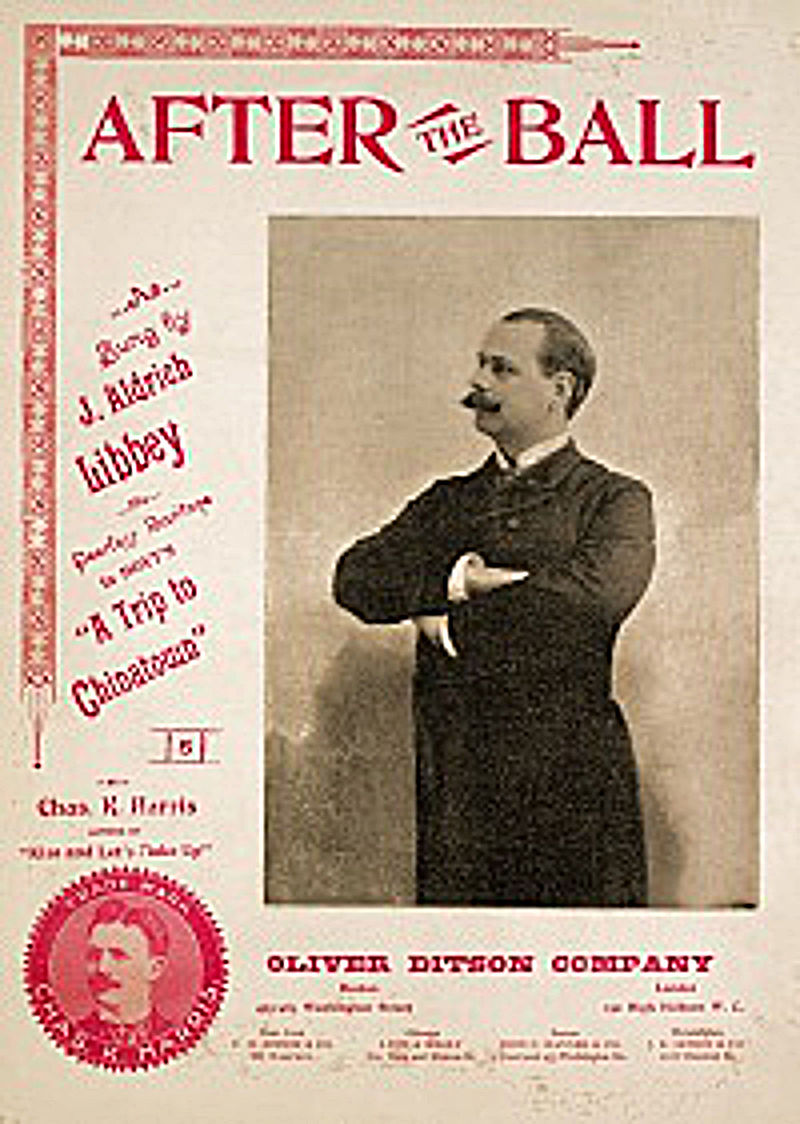
Charles K. Harris wrote this classic waltz in 1891 for an amateur minstrel show in Milwaukee, Wisconsin. The first time it was performed, the singer, Sam Doctor, forgot the words and the song made a poor impression. PG However, Harris believed in the song and paid well-known performer J. Aldrich Libbey to include it in his A Trip to Chinatown show. SS It grew in popularity and John Philip Sousa and his band performed it daily at the World’s Fair in Chicago in 1893. PG That same year, George J. Gaskin and John Yorke Atlee recorded the song. The former was a #1 for 10 weeks while the latter peaked at #2. It was the fourth chart-topper for Gaskin, who was known as “The Silve-Voiced Tenor.” He had a total of 19 songs reach the peak from 1891 to 1901. It was one of only three chart hits for Atlee. PM

In the song, an old man explains to his niece that he never married after seeing his sweetheart kissing another man at a ball. He left, and refusing to hear her explanation, WK only to find out years later that it was her brother. SS Harris got the idea from a dance in Chicago where he saw two lovers get in a fight and leave separately. SF

The song “exemplifies the sentimental ballads published before 1920, whose topics were frequently babies, separation, and death.” WK It has “a memorable, tearjerking chorus in the form of a story constructed for middle-class ladies to learn on their parlour pianos.” LW It “is sometimes credited with beginning the commercial exploitation of popular music.” SF Before 1893, most songs became regional hits and then word spread, but the aggressive marketing behind “After the Ball” set a new standard. SS It was the first song to sell a million copies of sheet music, SF eventually racking up five million and becoming the best seller in Tin Pan Alley’s history. WK Tin Pan Alley was the name given to a group of 19th century and early 20th century music publishers and songwriters in New York City.

The song resurfaced in 1927 when it was used in the groundbreaking musical Show Boat. Norma Terris performed it during its original Broadway run and Irene Dunne performed it for the 1936 film version. It was made into a film again in 1951 and performed by Kathryn Grayson. WK In 1940, it was featured in the biographical musical film Lillian Russell and performed by Alice Faye. WK It has also been performed by Nat “King” Cole, Bing Crosby, Guy Lombardo, Julie London, and Lawrence Welk. WK


Resources:


First posted 4/15/2021; last updated 9/6/2023.