Showing posts with label George J. Gaskin. Show all posts

Thursday, December 1, 2022

USA: #1 Pop Songs, 1890-1899

USA’s #1 Pop Songs:

1890-1899

These are the #1 pop songs in the history of the United States pop charts from 1890 to 1899. These songs topped the pre-Hot 100 pop charts, which ran from 1890-1955. Numbers in parentheses indicate the number of weeks at #1.

Click here to access a full list of #1 songs from 1890 to present. See other chart-based lists here.


1890:

  1. 8/2: U.S. Marine Band “Semper Fidelis” (2 weeks)
  2. 9/13: U.S. Marine Band “The Washington Post March” (6)
  3. 10/25: U.S. Marine Band “The Thunderer” (4)

1891:

  1. 3/7: Len Spencer “Little ‘Liza Loves You” (4)
  2. 4/4: George Washington Johnson “The Laughing Song” (10)
  3. 6/13: Russell Hunting “Michael Casey As a Physician” (4)
  4. 7;11: George Washington Johnson “The Whistling Coon” (5)
  5. 8/22: John Yorke Atlee “Listen to the Mocking Bird (aka “The Mocking Bird”)” (6)
  6. 9/19: Dan Kelly “Pat Kelly As a Police Justice” (4)
  7. 10/17: Billy Golden “Turkey in the Straw” (7)
  8. 12/5: George J. Gaskin “Drill, Ye Terriers, Drill” (5)


1892:

  1. 1/9: George J. Gaskin “Slide Kelly Slide” (3)
  2. 1/30: Len Spencer “Ta-Ra-Ra Boom-De-Ay” (8)
  3. 3/26: Manhansett Quartette “The Picture Turned to the Wall” (6)
  4. 5/7: Manhansett Quartette “Sally in Our Alley” (3)
  5. 5/28: Joe Natus “The Song That Reached My Heart” (3)
  6. 6/18: Charles Marsh “Throw Him Down, McCloskey” (3)
  7. 7/9: Russell Hunting “Michael Casey at the Telephone” (5)
  8. 8/13: Len Spencer “The Old Folks at Home (Swanee River)” (6)
  9. 9/24: Will Denny “The Pretty Red Rose” (2)
  10. 10/8: Russell Hunting “Michael Casey Taking the Census” (6)
  11. 11/19: Len Spencer “Near It” (2)
  12. 12/3: Thomas Bott “Love’s Old Sweet Song” (4)
  13. 12/31: Dan Quinn “Daddy Wouldn’t Buy Me a Bow Wow” (4)

1893:

  1. 1/28: Dan Quinn “The Bowery” (5)
  2. 3/4: George J. Gaskin “Oh Promise Me” (8)
  3. 4/29: George J. Gaskin “After the Ball” (10)
  4. 7/8: Jules Levy “My Country ‘Tis of Thee” (3)
  5. 7/29: Len Spencer “Mamie Come and Kiss Your Honey Boy” (3)
  6. 8/19: J.W. Myers “Two Little Girls in Blue” (4)
  7. 9/16: Dan Quinn “Daisy Bell (A Bicycle Built for Two)” (9)
  8. 11/18: George J. Gaskin “The Fatal Wedding” (8)


1894:

  1. 1/13: Russell Hunting “Casey As Insurance Agent” (3)
  2. 2/3: George J. Gaskin “Sweet Marie” (5)
  3. 3/10: U.S. Marine Band “The Liberty Bell” (5)
  4. 4/14: Edward M. Favor “Say Au Revoir, But Not Goodbye” (7)
  5. 6/2: Vess Ossman “Yankee Doodle” (4)
  6. 6/30: Silas Leachman “Dem Golden Slippers” (4)
  7. 7/28: George J. Gaskin “We Were Sweethearts, Nell and I” (3)
  8. 8/18: Dan Quinn “Lindley, Does You Love Me?” (3)
  9. 10/6: Dan Quinn “My Pearl Is a Bowery Girl” (4)
  10. 11/3: Russell Hunting “Casey at Denny Murphy’s Wake” (3)
  11. 11/24: Dan Quinn “And Her Golden Hair Was Hanging Down Her Back” (6)

1895:

  1. 1/5: Len Spencer “Little Alabama Coon” (5)
  2. 2/9: Dan Quinn “The Sidewalks of New York” (9)
  3. 3/21: Edward M. Favor “My Best Girl’s a New Yorker” (5)
  4. 4/13: J.W. Myers “The Sidewalks of New York” (4)
  5. 4/25: Len Spencer “The Bully (aka ‘Dat New Bully’)” (5)
  6. 5/30: Vess Ossman “Cocoanut Dance” (3)
  7. 6/15: Sousa’s Band “El Capitan March” (7)
  8. 8/1: J.W. Myers “Just Tell Them That You Saw Me” (6)
  9. 8/3: Sousa’s Band “The Washington Post March” (3)
  10. 8/24: Dan Quinn “The Band Played On” (10)
  11. 11/2: Dan Quinn “Little Lost Child” (5)


1896:

  1. 1/4: George J. Gaskin “The Sunshine of Paradise Alley” (6)
  2. 2/15: George J. Gaskin “She May Have Seen Better Days” (5)
  3. 6/20: Len Spencer with Vess Ossman “A Hot Time on the Levee” (3)
  4. 9/12: George J. Gaskin “Down in Poverty Roy” (4)
  5. 10/10: George J. Gaskin “On the Benches in the Park” (4)
  6. 11/7: Dan Quinn “In the Baggage Coach Ahead” (5)
  7. 12/12: Dan Quinn “A Hot Time in the Old Town” (7)

1897:

  1. 1/30: Len Spencer “A Hot Time in the Old Town” (3)
  2. 2/20: Len Spencer “Oh, Mr. Johnson, Turn Me Loose” (4)
  3. 3/20: Len Spencer “My Gal Is a Highborn Lady” (4)
  4. 4/17: Dan Quinn “My Mother Was a Lady” (5)
  5. 5/22: George J. Gaskin “Sweet Rosie O’Grady” (8)
  6. 7/17: Sousa’s Band “The Stars and Stripes Forever” (8)
  7. 9/11: Dan Quinn “There’s a Little Star Shining for You” (4)
  8. 11/6: George J. Gaskin “On the Banks of the Wabash” (10)


1898:

  1. 1/15: Steve Porter “On the Banks of the Wabash” (4)
  2. 2/12: Edison Male Quartette “My Old Kentucky Home” (3)
  3. 4/2: George J. Gaskin “Break the News to Mother” (7)
  4. 5/21: Cal Stewart “Uncle Josh’s Arriva in New York” (5)
  5. 6/25: Len Spencer “I Don’t Like No Cheap Man” (3)
  6. 7/16: George J. Gaskin “She Was Bred in Old Kentucky” (6)
  7. 8/27: Steve Porter “She’s More to Be Pitied Than Censured” (4)
  8. 9/24: Cal Stewart “I’m Old But I’m Awfully Tough (Laughing Song)” (3)
  9. 10/15: Dan Quinn “She Was Happy Till She Met You” (4)
  10. 11/12: Dan Quinn “At a Georgia Camp Meeting” (4)
  11. 12/10: George J. Gaskin “My Old New Hampshire Home” (10)

1899:

  1. 2/18: Arthur Collins “Kiss Me, Honey, Do” (4)
  2. 3/18: Arthur Collins “When you Ain’t Go No More Money, Well, You Needn’t Come Around” (2)
  3. 4/1: Arthur Collins “I Guess I’ll Have to Telegraph My Baby” (4)
  4. 4/29: Arthur Collins “Hello, Ma Baby” (4)
  5. 5/27: Len Spencer “Hello! Ma Baby” (6)
  6. 7/8: George J. Gaskin “My Wild Irish Rose” (3)
  7. 7/29: George J. Gaskin “My Wild Irish Rose” (6)
  8. 9/9: William F. Hooley “Gypsy Love Song” (5)
  9. 10/14: Steve Porter “A Picture No Artist Can Paint” (2)
  10. 10/28: Dan Quinn “Curse of the Dreamer” (7)
  11. 12/16: Arthur Collins “I’d Leave My Happy Home for You” (7)


Resources/Related Links:


First posted 2/24/2021; last updated 12/1/2022.

Friday, January 9, 2004

100 years ago: “Bedelia” hit #1 for first time

Bedelia

Billy Murray

Writer(s): Jean Schwartz (music), William Jerome (lyrics) (see lyrics here)


First Charted: December 2003


Peak: 13 US, 13 GA, 17 SM (Click for codes to singles charts.)


Sales (in millions): 3.0 (sheet music)


Airplay/Streaming (in millions): -- radio, -- video, -- streaming

Bedelia

Haydn Quartet


First Charted: January 9, 1904


Peak: 17 US, 13 GA (Click for codes to singles charts.)


Sales (in millions): 3.0 (sheet music)


Airplay/Streaming (in millions): -- radio, -- video, -- streaming

Awards (Haydn Quartet):

Click on award for more details.


Awards (Billy Murray):

About the Song:

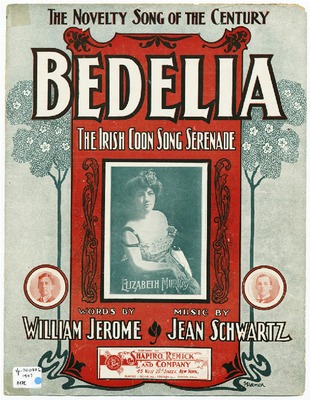
“Building songs around girls’ names has always been popular and this one may have been the most popular of this era.” TY2 The sheet music bills the song as “The Novelty Song of the Century” and “An Irish Coon Song Serenade.” TY2 Coon songs were popular at the time, but steeped in racial stereotypes about African Americans. The song has more Irish influence than African American, so one assumes the publisher was trying to capitalize on the coon craze with the latter billing. TY2

The song was introduced by Blanche Ring playing the character of Liliandra in The Jersey Lily, which opened in September 1903. GA It was her first starring role on Broadway. DJ It is unclear who first recorded the song. SecondHandSongs.com lists a December 1903 release date for a version by Billy Murray. That version went to #1. Considering his parents were Irish immigrants, it was fitting that Murray tackled the song, affecting a thick Irish accent to emphasize the song’s comedic nature. He was also one of the most successful singers of the pre-rock era, recording hundreds of early acoustic recordings as a solo act, in duets, and as part of quartets, during the first two decades of the 20th century. SM

Murray’s was among four versions to chart in January 1904. The first was by Arthur Pryor’s Band (#3). It was quickly followed by a recording by the Haydn Quartet, which spent seven weeks at #1. The Murray version and one by George J. Gaskin (#3) came next. Jan Garber reached #22 with the song in 1948.

SecondHandSongs.com also says Arthur Collins recorded the song in 1903 so it may or may not have preceded Murray’s version. There was also a version by Edward M. Favor in 1904. In his book Popular Songs of the Twentieth Century, Edward Foote Gardner also says there were stage versions of the song done by Elizabeth Murray and Emma Carus around this time. GA Other versions were recorded by Dick Kuhn and His Orchestra (1941), Papa Bue’s Viking Jazzband (1965), Ernie Carson and the Social Polecats (1992), and Claus Forchhammer’s Orkester (2005). SH Instrumental versions were done by the Crawford-Ferguson Night Owls (1965), Butch Thompson et al (1985), the Grand Dominion Jazz Band (1988), Gambit Jazzmen (1995), Vintage Jazz (1996), and the Yerba Buena Stompers (2002). SH

The song also appeared in the movie musical Broadway to Hollywood (1933) and Hello, Frisco, Hello (1943). It was revived again in 1953 in the film The Eddie Cantor Story.


Resources:


Related Links:


First posted 12/13/2022; last updated 12/16/2022.

Friday, November 10, 2000

100 years ago: “When You Were Sweet Sixteen” hit #1

When You Were Sweet Sixteen

George J. Gaskin

Writer(s): James Thornton (see lyrics here)


First Charted: November 10, 1900


Peak: 18 US, 2 GA (Click for codes to singles charts.)


Sales (in millions): 1.0 (sheet music)


Airplay/Streaming (in millions): -- radio, -- video, -- streaming

Awards:

Click on award for more details.

About the Song:

James Thornton was a songwriter and vaudeville performer born in Dublin, Ireland, in 1861. He started out as a singing waiter before finding success doing comedy in music halls. However, he also composed songs, eventually becoming one of the greatest Tin Pan Alley songwriters. WT

He was inspired by his wife, Bonnie, to write “When You Were Sweet Sixteen.” She tried to keep him from spending all his money on alcohol and when he came home drunk on Independence Day, WT she tearfully questioned if he still loved her. He replied that he loved her as much as he did when she was sixteen. She encouraged him to turn it into a song. TY2 He did, and she introduced the song in her act. The ballad became a hit vaudeville song and became a standard for barbershop quartets. WW

George J. Gaskin, nicknamed the “silver-voiced Irish tenor,” WG had the most successful recording of the song. He was born in Belfast, Ireland, in 1863 but came to the United States as a teenager. He started recording with the Edison North American Phonograph Company in 1891, specializing in Tin Pan Alley songs and sentimental Irish ballads. WG He landed twenty #1 hits over the next decade. His final chart-topper was “When We Were Sweet Sixteen.”

Gaskin wasn’t the first to chart with the song, or even the first to hit #1. In March 1900, Jere Mahoney charted with it, taking it to #1 for five weeks. The following year J.W. Myers and Harry MacDonough both reached #3 with their versions. The song saw a revival in 1947 after it appeared in The Jolson Story. Al Jolson took it to #1 in Australia. Perry Como’s million-selling version reached #2 in the United States, followed by top 20 versions by Dick Jurgens and the Mills Brothers. The song resurfaced again in 1981 when the Fureys went to #14 with it in the UK.

The song was also featured in the Shirley Temple film Little Miss Broadway (1938), The Strawberry Blond (1941), and Bing Crosby sang it on the soundtrack for The Great John L. (1945). TY2


Resources:


First posted 12/2/2022; last updated 12/14/2022.

Thursday, July 8, 1999

Today in Music (1899): “My Wild Irish Rose” hit #1

My Wild Irish Rose

George J. Gaskin

Writer(s): Chauncey Olcott (music & lyrics) (see lyrics here)


First Charted: May 6, 1899 (Gaskin), June 17, 1899 (Campbell)


Peak: 13 PM (Gaskin), 16 (Campbell) (Click for codes to charts.)


Sales (in millions): --


Airplay/Streaming (in millions): -- radio, -- video, -- streaming

Awards (George J. Gaskin):

Click on award for more details.


Awards (Albert Campbell):


Awards (Haydn Quartet):

About the Song:

Author Don Tyler asserts that “My Wild Irish Rose,” “Mother Machree,” and “When Irish Eyes Are Smiling” are “the most popular Irish ballads of all time." TY2 The Irish influence on popular music in America was especially significant in the first quarter of the 20th century. TY2

Chauncey Olcott, “one of the most popular performers of his day,” TY2 wrote “My Wild Irish Rose” in 1899 and performed it in the show A Romance of Athlone. He became known as the “Irish Thrush” because of his “impassioned and expressive” performances of “My Wild Irish Rose.” TY2 The song was later used in the musical The Little Cherub and in the musicals Doughboys in Ireland (1943) and My Wild Irish Rose (1947). Olcott recorded it himself in 1913. TY2

“My Wild Irish Rose” became a popular song for “family or community songfests, especially if several mixed voices singers were present so they could harmonize.” TY2 In that era, sales of sheet music boomed as the price of pianos decreased and it became a common purchase for Americans to have in their parlors.

The song charted seven times from 1899 to 1937. Albert Campbell and George J. Gaskin each took it to #1 in 1899. The next year, Harry MacDonough reached #3. The Haydn Quartet got to #2 with the song in 1907. Chauncey Olcott himself recorded the song in 1913 and got to #5. John McCormack’s version hit #7 in 1915 and, finally, Jan Garber took it to #19 in 1937. PM


Resources:

  • TY2 Don Tyler (2007). Hit Songs, 1900-1955. McFarland & Company, Inc.: Jefferson, North Carolina. Page 11.
  • PM Joel Whitburn (1986). Pop Memories 1890-1954. Record Research, Inc: Menomonee Falls, WI. Page 537.


Related Links:


First posted 6/26/2024; last updated 6/27/2024.


Thursday, November 6, 1997

Today in Music (1897): “On the Banks of the Wabash” hit #1

On the Banks of the Wabash

George J. Gaskin

Writer(s): Paul Dresser (music & lyrics) (see lyrics here)


Published: July 1897


First Charted: November 6, 1897 (George J. Gaskin); January 8, 1898 (Steve Porter)


Peak: 110 PM (Gaskin), 14 (Porter) (Click for codes to charts.)


Sales (in millions): 1.0 million (sheet music)


Airplay/Streaming (in millions): -- radio, 0.013 video, 0.024 streaming

Awards (George J. Gaskin):

Click on award for more details.


Awards (Steve Porter):

About the Song:

Paul Dresser grew up near Terre Haute, Indiana. His family had a home and farm adjacent to the Wabash River, which was the state’s primary internal waterway. TI Even after he headed off to New York to eventually become one of the most successful songwriters of the 19th century, he would come home to visit. In the spring of 1897, he wrote “On the Banks of the Wabash” as a reflection of his youthful years about his hometown. He said, “I was born on the banks of the Wabash at Terre Haute…My fondest recollections are of my mother and of my early days along the stream.” TI

He finished it and published it in July. He dedicated the song to Mary E. South, a fourteen-year old from Terre Haute whom he’d never met. IN The song was an immediate success. A department store in Chicago claimed it sold nearly 1500 records of the song in one day. TI The song was compared to Stephen Foster’s “The Folks at Home” (aka “Down on the Swanee River”). SA An Indiana newspaper said, “certainly no song since the latter has awakened so much interest among lovers of a good song, nor has any other American author seemed as capable of filling the void left vacant by Foster. TI

It reportedly wasn the second best-selling song of the 19th century in terms of sheet music sales, TI selling and estimated half million copies in its first year and eventually reaching sales of one million. TI From a chart stand point, George J. Gaskin was the first to chart with it in 1897. After ten weeks at #1, it was dethroened by Steve Porter’s version, which spent four weeks on top. PM Roger Harding also took it to #3 in 1898 and in 1913, Harry MacDonough and the American Quartet got to #5 with their rendition of the song. PM

There are some interesting stories associated with the song. During a Coney Island blackout in 1900, the crowd of roughly 5000 people were kept calm by whistling “On the Banks of the Wabash.” SA The song was rewritten as “On the Banks of Havana” at the onset of the Spanish American War reflect anti-war sentiment. SA It was adopted as the Indiana state official song in 1913.


Resources:


Related Links:


First posted 6/26/2024.