Showing posts with label Chauncey Olcott. Show all posts

Friday, May 1, 2015

100 years ago: “ A Little Bit of Heaven” hit #1

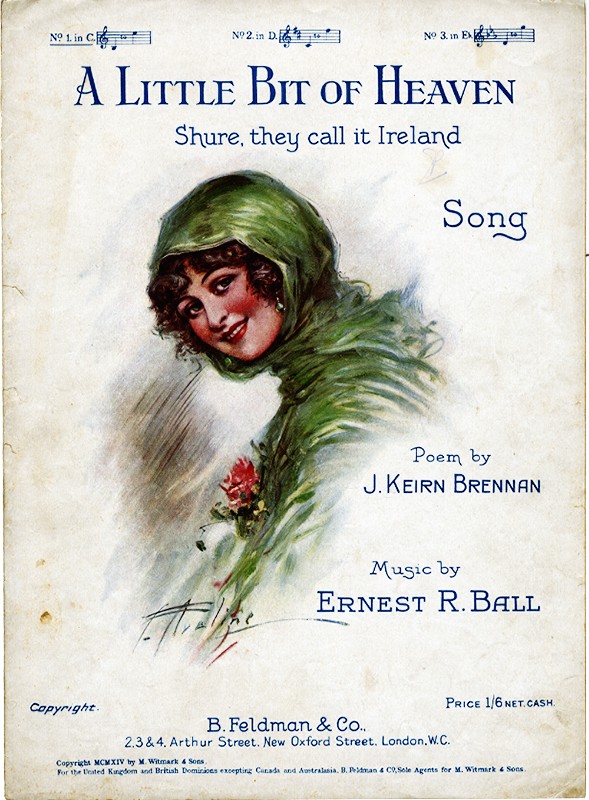
A Little Bit of Heaven (Shure, They Call It Ireland)

George MacFarlane

Writer(s): J. Keirn Brennan, Ernest R. Ball (see lyrics here)


First Charted: May 1, 1915


Peak: 15 US, 112 GA, 112 SM (Click for codes to charts.)


Sales (in millions): 1.0 (sheet music)


Airplay/Streaming (in millions): -- radio, 0.01 video, -- streaming

Awards:

Click on award for more details.

About the Song:

This was one of only four chart entries for George MacFarlane. Songwriter Ernest R. Ball, however, had a rich history, especially collaborating on Irish songs with Chauncey Olcott such as this and “When Irish Eyes Are Smiling” (a #1 hit for Olcott in 1913) even though he wasn’t Irish himself. The Songwriting Hall of Famer also wrote “Will You Love Me in December As You Do in May?” (#2 for Haydn Quartet in 1906), “Mother Machree” (#1 for John McCormack and Will Oakland in 1911), and “Goodbye, Good Luck, God Bless You” (#1 for Henry Burr in 1916).

Like Ball, MacFarlane wasn’t Irish either. He was born in 1878 in Kingston, Ontario, Canada. Despite his lack of Irish connections, he recognized the popularity of Irish songs. SM He had a #16 hit with “My Own Home Town in Ireland” in 1916 and took “A Little Bit of Heaven” to #1 in 1915.

The song was introduced in the Broadway musical The Heart of Paddy Whack by Chauncey Olcott. The show only ran for seventeen performances. SM It asks, “Have you ever heard the story of Ireland got its name?” in the first line and then unfolds the story “as my dear old mother told the tale to me.” TY2 A seldom-sung second verse reminds that Ireland is the “dear old and of fairies” and that nowhere else has “such lakes and dells.” TY2

“MacFarlane sang in a dramatic, operatic baritone voice, singing the praises of the country and how it got its name.” SM His version went to #1, but there were three other chart versions in 1915 – Charles Harrison (#2), John Barnes Wells (#8), and John McCormack (#9). PM

The song was used in a movie musical of the same name in 1940. TY2 It was also featured in the 1944 Ernest Ball biopic Irish Eyes Are Smiling and in the 1947 Olcott biopic My Wild Irish Rose. DJ


Resources:


First posted 3/18/2023.

Friday, July 26, 2013

100 years ago: ”When Irish Eyes Are Smiling” hit #1

When Irish Eyes Are Smiling

Chauncey Olcott

Writer(s): Chauncey Olcott, George Graff Jr., Ernest R. Ball (see lyrics here)


Released: May 1913


First Charted: June 21, 1913


Peak: 17 US, 1 GA, 7 DF (Click for codes to singles charts.)


Sales (in millions): 1.0 (sheet music)


Airplay/Streaming (in millions): -- radio, -- video, -- streaming

Awards:

Click on award for more details.

About the Song:

In 1912, tributes like this one to a romanticized Ireland were common in America as well as England. This one in particular, though, became a favorite of Irish immigrants in the pre-World War I years RCG and has become a perennial St. Patrick’s Day fave. JA Amusingly, this “waltz-like tune” RCG was written by Chauncey Olcott and George Graff Jr. with music by Ernest Ball – none of whom were Irish. SF Of course, many American-born citizens have Irish ancestry, including Olcott, whose mother was born in Ireland. SF

Olcott introduced the song when he sang it in his 1913 Broadway production of The Isle O’Dreams, which was based on a play set in Ireland. SF While the show opened and closed in under a month, SF Olcott’s commercial recording of the song was a hit, topping the charts that summer. Harry MacDonough would also take the song to the top five that year. Four years later, during World War I, John McCormack recorded the song again and took it to #4.

The song was used as the opener for Duffy’s Tavern, a radio show which ran from 1941 to 1951. WK It was revived in Irish Eyes Are Smiling, a 1944 biopic about Ernest Ball, and in 1947 for the Olcott biopic My Wild Irish Rose. JA It became a favorite again years later when Morton Downey sang it more than a thousand times on the air on his radio show. RCG The song has been recorded on more than 200 singles and albums and performed by singers such as Perry Como, Bing Crosby, Connie Francis, Roger Whittaker, and Frank Sinatra.

In 1985, the song garnered attention when U.S. President Ronald Reagan and Canadian Prime Minister Brian Mulroney convened for a summit on St. Patrick’s Day. The two jointly sang “When Irish Eyes Are Smiling,” which caused the Canadian press to extensively criticize Mulroney. WK


Resources:


First posted 7/26/2016; last updated 11/20/2022.

Thursday, July 8, 1999

Today in Music (1899): “My Wild Irish Rose” hit #1

My Wild Irish Rose

George J. Gaskin

Writer(s): Chauncey Olcott (music & lyrics) (see lyrics here)


First Charted: May 6, 1899 (Gaskin), June 17, 1899 (Campbell)


Peak: 13 PM (Gaskin), 16 (Campbell) (Click for codes to charts.)


Sales (in millions): --


Airplay/Streaming (in millions): -- radio, -- video, -- streaming

Awards (George J. Gaskin):

Click on award for more details.


Awards (Albert Campbell):


Awards (Haydn Quartet):

About the Song:

Author Don Tyler asserts that “My Wild Irish Rose,” “Mother Machree,” and “When Irish Eyes Are Smiling” are “the most popular Irish ballads of all time." TY2 The Irish influence on popular music in America was especially significant in the first quarter of the 20th century. TY2

Chauncey Olcott, “one of the most popular performers of his day,” TY2 wrote “My Wild Irish Rose” in 1899 and performed it in the show A Romance of Athlone. He became known as the “Irish Thrush” because of his “impassioned and expressive” performances of “My Wild Irish Rose.” TY2 The song was later used in the musical The Little Cherub and in the musicals Doughboys in Ireland (1943) and My Wild Irish Rose (1947). Olcott recorded it himself in 1913. TY2

“My Wild Irish Rose” became a popular song for “family or community songfests, especially if several mixed voices singers were present so they could harmonize.” TY2 In that era, sales of sheet music boomed as the price of pianos decreased and it became a common purchase for Americans to have in their parlors.

The song charted seven times from 1899 to 1937. Albert Campbell and George J. Gaskin each took it to #1 in 1899. The next year, Harry MacDonough reached #3. The Haydn Quartet got to #2 with the song in 1907. Chauncey Olcott himself recorded the song in 1913 and got to #5. John McCormack’s version hit #7 in 1915 and, finally, Jan Garber took it to #19 in 1937. PM


Resources:

  • TY2 Don Tyler (2007). Hit Songs, 1900-1955. McFarland & Company, Inc.: Jefferson, North Carolina. Page 11.
  • PM Joel Whitburn (1986). Pop Memories 1890-1954. Record Research, Inc: Menomonee Falls, WI. Page 537.


Related Links:


First posted 6/26/2024; last updated 6/27/2024.