Showing posts with label Jan Garber. Show all posts

Friday, January 9, 2004

100 years ago: “Bedelia” hit #1 for first time

Bedelia

Billy Murray

Writer(s): Jean Schwartz (music), William Jerome (lyrics) (see lyrics here)


First Charted: December 2003


Peak: 13 US, 13 GA, 17 SM (Click for codes to singles charts.)


Sales (in millions): 3.0 (sheet music)


Airplay/Streaming (in millions): -- radio, -- video, -- streaming

Bedelia

Haydn Quartet


First Charted: January 9, 1904


Peak: 17 US, 13 GA (Click for codes to singles charts.)


Sales (in millions): 3.0 (sheet music)


Airplay/Streaming (in millions): -- radio, -- video, -- streaming

Awards (Haydn Quartet):

Click on award for more details.


Awards (Billy Murray):

About the Song:

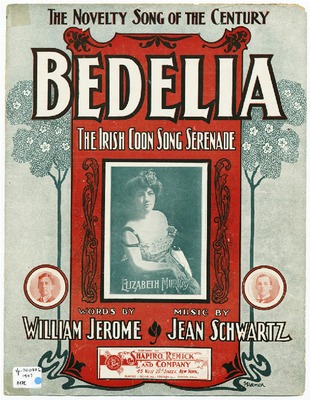
“Building songs around girls’ names has always been popular and this one may have been the most popular of this era.” TY2 The sheet music bills the song as “The Novelty Song of the Century” and “An Irish Coon Song Serenade.” TY2 Coon songs were popular at the time, but steeped in racial stereotypes about African Americans. The song has more Irish influence than African American, so one assumes the publisher was trying to capitalize on the coon craze with the latter billing. TY2

The song was introduced by Blanche Ring playing the character of Liliandra in The Jersey Lily, which opened in September 1903. GA It was her first starring role on Broadway. DJ It is unclear who first recorded the song. SecondHandSongs.com lists a December 1903 release date for a version by Billy Murray. That version went to #1. Considering his parents were Irish immigrants, it was fitting that Murray tackled the song, affecting a thick Irish accent to emphasize the song’s comedic nature. He was also one of the most successful singers of the pre-rock era, recording hundreds of early acoustic recordings as a solo act, in duets, and as part of quartets, during the first two decades of the 20th century. SM

Murray’s was among four versions to chart in January 1904. The first was by Arthur Pryor’s Band (#3). It was quickly followed by a recording by the Haydn Quartet, which spent seven weeks at #1. The Murray version and one by George J. Gaskin (#3) came next. Jan Garber reached #22 with the song in 1948.

SecondHandSongs.com also says Arthur Collins recorded the song in 1903 so it may or may not have preceded Murray’s version. There was also a version by Edward M. Favor in 1904. In his book Popular Songs of the Twentieth Century, Edward Foote Gardner also says there were stage versions of the song done by Elizabeth Murray and Emma Carus around this time. GA Other versions were recorded by Dick Kuhn and His Orchestra (1941), Papa Bue’s Viking Jazzband (1965), Ernie Carson and the Social Polecats (1992), and Claus Forchhammer’s Orkester (2005). SH Instrumental versions were done by the Crawford-Ferguson Night Owls (1965), Butch Thompson et al (1985), the Grand Dominion Jazz Band (1988), Gambit Jazzmen (1995), Vintage Jazz (1996), and the Yerba Buena Stompers (2002). SH

The song also appeared in the movie musical Broadway to Hollywood (1933) and Hello, Frisco, Hello (1943). It was revived again in 1953 in the film The Eddie Cantor Story.


Resources:


Related Links:


First posted 12/13/2022; last updated 12/16/2022.

Thursday, July 8, 1999

Today in Music (1899): “My Wild Irish Rose” hit #1

My Wild Irish Rose

George J. Gaskin

Writer(s): Chauncey Olcott (music & lyrics) (see lyrics here)


First Charted: May 6, 1899 (Gaskin), June 17, 1899 (Campbell)


Peak: 13 PM (Gaskin), 16 (Campbell) (Click for codes to charts.)


Sales (in millions): --


Airplay/Streaming (in millions): -- radio, -- video, -- streaming

Awards (George J. Gaskin):

Click on award for more details.


Awards (Albert Campbell):


Awards (Haydn Quartet):

About the Song:

Author Don Tyler asserts that “My Wild Irish Rose,” “Mother Machree,” and “When Irish Eyes Are Smiling” are “the most popular Irish ballads of all time." TY2 The Irish influence on popular music in America was especially significant in the first quarter of the 20th century. TY2

Chauncey Olcott, “one of the most popular performers of his day,” TY2 wrote “My Wild Irish Rose” in 1899 and performed it in the show A Romance of Athlone. He became known as the “Irish Thrush” because of his “impassioned and expressive” performances of “My Wild Irish Rose.” TY2 The song was later used in the musical The Little Cherub and in the musicals Doughboys in Ireland (1943) and My Wild Irish Rose (1947). Olcott recorded it himself in 1913. TY2

“My Wild Irish Rose” became a popular song for “family or community songfests, especially if several mixed voices singers were present so they could harmonize.” TY2 In that era, sales of sheet music boomed as the price of pianos decreased and it became a common purchase for Americans to have in their parlors.

The song charted seven times from 1899 to 1937. Albert Campbell and George J. Gaskin each took it to #1 in 1899. The next year, Harry MacDonough reached #3. The Haydn Quartet got to #2 with the song in 1907. Chauncey Olcott himself recorded the song in 1913 and got to #5. John McCormack’s version hit #7 in 1915 and, finally, Jan Garber took it to #19 in 1937. PM


Resources:

  • TY2 Don Tyler (2007). Hit Songs, 1900-1955. McFarland & Company, Inc.: Jefferson, North Carolina. Page 11.
  • PM Joel Whitburn (1986). Pop Memories 1890-1954. Record Research, Inc: Menomonee Falls, WI. Page 537.


Related Links:


First posted 6/26/2024; last updated 6/27/2024.


Saturday, May 25, 1996

50 years ago: The Ink Spots hit #1 with “The Gypsy”

The Gypsy

The Ink Spots

Writer(s): Billy Reid (see lyrics here)


First Charted: May 4, 1946


Peak: 113 US, 18 HP, 13 GA, 13 RB (Click for codes to charts.)


Sales (in millions): 1.0 US, -- UK, -- world (includes US + UK)


Airplay/Streaming (in millions): -- radio, 0.38 video, -- streaming

Awards:

Click on award for more details.

About the Song:

Billy Reid was a famous bandleader in London in the 1930s who had the distinction of being the first British songwriter to top the pop charts in the United States. When Welsh singer Dorothy Squires joined his group, he often wrote songs specifically with her in mind – one of which was “The Gypsy.” The song, published in 1945, unfurls a story of someone seeking out the advice of a gypsy fortune teller. The narrator wants to believe his partner is faithful, which the gypsy confirms, although both know it isn’t true. WK

After Reid and his orchestra, fronted by Squires, introduced the song in the UK, WK it became a hit in the United States. Dinah Shore and the Ink Spots both topped the charts with the song, but the Ink Spots’ version was the monster hit, spending 13 weeks at #1 and becoming the biggest hit of 1946. WHC It “seemed tailor-made for the Ink Spots: a smooth melody that could be crooned in Bill Kenny’s high tenor, and a sugary sweet lyric.” TY2

This African-American pop vocal group found success with both white and black audiences. Their early version of doo-wop was fundamental in shaping rock and roll as well as R&B, leading to their induction in the Rock and Roll Hall of Fame. They racked up more than forty hits from the 1930s to the 1950s. Twenty of those songs were top ten hits and six of those went all the way to the top of the American pop charts.

In addition to the versions by Shore and the Ink Spots, “The Gypsy” charted four more times that year – Sammy Kaye (#3), Hildegarde with Guy Lombardo (#7), Hal McIntyre (#8), and Jan Garber (#14). The song has also been recorded by Louis Armstrong, Quincy Jones, Charlie Parker, Oscar Peterson, and Frank Sinatra. WK It appeared in Revolutionary Road, a 2008 movie starring Leonardo DiCaprio and Kate Winslet. WK


Resources:


First posted 5/25/2016; last updated 4/4/2023.