Showing posts with label Hal McIntyre. Show all posts

Friday, May 23, 2008

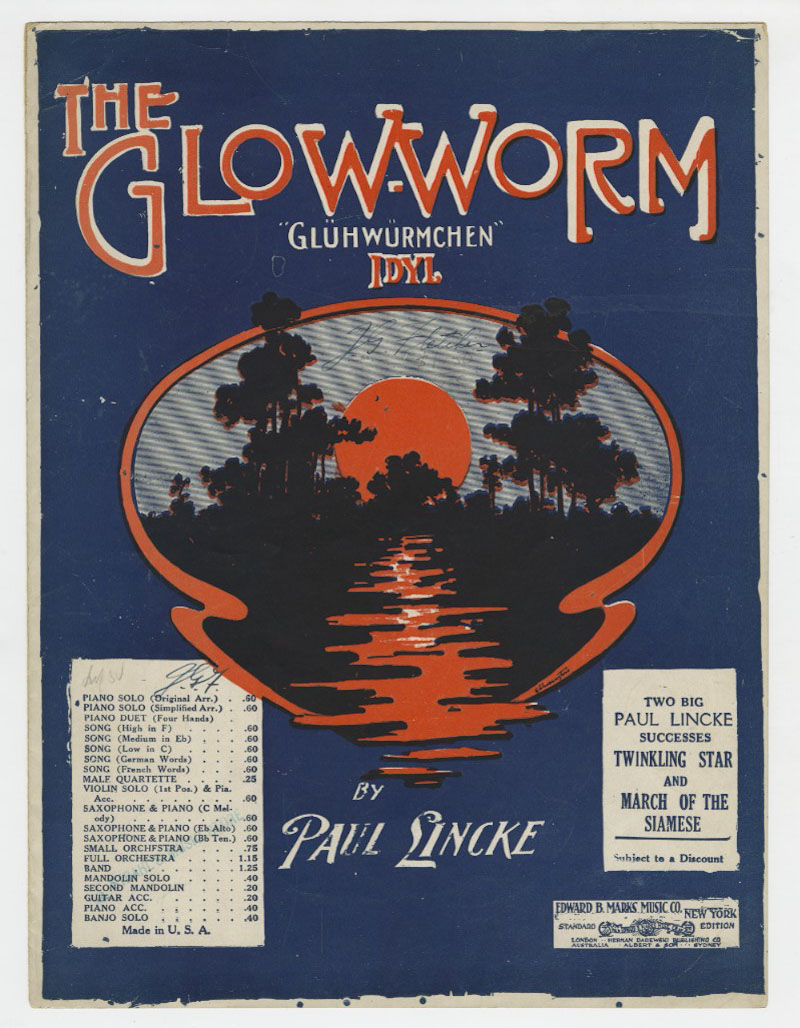
100 years ago: “The Glow-Worm” hit #1 for the first of 3 times

The Glow-Worm

Victor Orchestra

Writer(s): Paul Lincke (music), Lilla Cayley Robinson and Johnny Mercer (lyrics) (see lyrics here)


First Charted: May 16, 1908


Peak: 15 US, 12 GA, 16 SM (Click for codes to singles charts.)


Sales (in millions): 4.0 (sheet music)


Airplay/Streaming (in millions): 1.0 radio, -- video, -- streaming

The Glow-Worm

The Mills Brothers with Hal McIntyre’s Orchestra


First Charted: September 27, 1952


Peak: 13 US, 12 HP, 11 CB (Click for codes to singles charts.)


Sales (in millions): 4.0 (sheet music), 1.0 (US physical sales)


Airplay/Streaming (in millions): 1.0 radio, 1.15 video, -- streaming

Awards (Victor Orchestra):

Click on award for more details.


Awards (Mills Brothers):

About the Song:

Composer Paul Lincke wrote “The Glow Worm” (original title: “Das Glühwürmchen”) in 1902 for the operatta Lysistratra. The original lyrics were written in German by Heinz Bolten-Backers. TY2 and was originally sung as a trio by Cäcilie Carola, Emma Malkowsky & Kathi Herold. SM It was introduced in the United States in 1907 TY2 by May Naudain in the Broadway musical The Girl Behind the Counter. Lilla Cayley Robinson translated the lyrics into English.

In 1908, there were successful chart versions of the song from the Victor Orchestra and Lucy Isabelle Marsh. Each spent five weeks at #1. It was the biggest hit to date for the publisher. DJ In 1925, Nathaniel Shilkret recorded an instrumental version of the song. WK The Victor Orchestra was the in-house band for the Victor Talking Machine Company, usually recording classical or backing opera singers. SM Their version “started as a piece of music played by staccato strings and the recognisable sound of a bell ringing in time. Only after one minute ten seconds, did the recognisable tune of the chorus enter and that lasted for only thirty seconds, after which, a vocal chorus to sing through the chorus once.” SM

“Glow worm” was a term used in Europe for “the wingless female larva of the species Lampyris noctilluca, which glows and resembles a worm.” PS In 1952, the song was given new lyrics by Johnny Mercer, “one of the best lyricists in the history of popular song.” PS Since the glow-worm is not readily found stateside, PS he made it a reference to the insect we know as a firefly. PS He also used phrases like “a cute little pocket mazda” which now would suggest a car brand, but was then a brand of General Electric light bulbs. PS

This earned the song an astonishing third trip to the pinnacle with a version by the Mills Brothers that gave the song a more upbeat tempo and used lyrics both by Mercer and Robinson. TY2 Their recording “harkened back to a decade earlier, when Glenn Miller ruled the universe. It was a blasting, big band sound” PS with orchestration by Hal McIntyre, a founding member of Miller’s orchestra from 1937 to 1942. PS It also featured “Harry Mills’ ultra-smooth lead…[which is] as close to perfection as a recording can get.” PS Mercer himself also charted with the song, reaching #30.


Resources:


Related Links:


First posted 12/8/2022; last updated 12/15/2022.

Saturday, May 25, 1996

50 years ago: The Ink Spots hit #1 with “The Gypsy”

The Gypsy

The Ink Spots

Writer(s): Billy Reid (see lyrics here)


First Charted: May 4, 1946


Peak: 113 US, 18 HP, 13 GA, 13 RB (Click for codes to charts.)


Sales (in millions): 1.0 US, -- UK, -- world (includes US + UK)


Airplay/Streaming (in millions): -- radio, 0.38 video, -- streaming

Awards:

Click on award for more details.

About the Song:

Billy Reid was a famous bandleader in London in the 1930s who had the distinction of being the first British songwriter to top the pop charts in the United States. When Welsh singer Dorothy Squires joined his group, he often wrote songs specifically with her in mind – one of which was “The Gypsy.” The song, published in 1945, unfurls a story of someone seeking out the advice of a gypsy fortune teller. The narrator wants to believe his partner is faithful, which the gypsy confirms, although both know it isn’t true. WK

After Reid and his orchestra, fronted by Squires, introduced the song in the UK, WK it became a hit in the United States. Dinah Shore and the Ink Spots both topped the charts with the song, but the Ink Spots’ version was the monster hit, spending 13 weeks at #1 and becoming the biggest hit of 1946. WHC It “seemed tailor-made for the Ink Spots: a smooth melody that could be crooned in Bill Kenny’s high tenor, and a sugary sweet lyric.” TY2

This African-American pop vocal group found success with both white and black audiences. Their early version of doo-wop was fundamental in shaping rock and roll as well as R&B, leading to their induction in the Rock and Roll Hall of Fame. They racked up more than forty hits from the 1930s to the 1950s. Twenty of those songs were top ten hits and six of those went all the way to the top of the American pop charts.

In addition to the versions by Shore and the Ink Spots, “The Gypsy” charted four more times that year – Sammy Kaye (#3), Hildegarde with Guy Lombardo (#7), Hal McIntyre (#8), and Jan Garber (#14). The song has also been recorded by Louis Armstrong, Quincy Jones, Charlie Parker, Oscar Peterson, and Frank Sinatra. WK It appeared in Revolutionary Road, a 2008 movie starring Leonardo DiCaprio and Kate Winslet. WK


Resources:


First posted 5/25/2016; last updated 4/4/2023.

Friday, February 24, 1995

Today in Music (1945): Hal McIntyre charted with “My Funny Valentine”

My Funny Valentine

Hal McIntyre & His Orchestra with Ruth Gaylor on vocals

Writer(s): Richard Rodgers (music), Lorenz Hart (words) (see lyrics here)


First Charted: February 24, 1945


Peak: 16 PM, 8 DF (Click for codes to charts.)


Sales (in millions): -- US, -- UK, -- world (includes US + UK)


Airplay/Streaming (in millions): -- radio, 113.44 video *, 181.69 streaming *
* multiple versions

Awards (all versions):

Click on award for more details.


Awards (McIntyre):


Awards (Chet Baker):


Awards (Frank Sinatra):


Awards (Tony Bennett):

About the Song:

Richard Rodgers and Lorenz Hart were one of Broadway’s most successful teams writing “some 650 songs for musicals, many of which have become standards.” TC Rodgers “was disciplined, methodical, termperamental, inventive, and almost scholarly.” TC Hart was “forever troubled about his amost dwarf stature, his homosexuality, drinking, and gambling.” TC

They wrote “My Funny Valentine” for the 1937 coming of age musical Babes in Arms. The show opened on Broadway on April 14, 1937 and ran for 289 performances. WK Mitzi Green played the character of Billie Smith and sings “My Funny Valentine” to Ray Heaterton’s character Valentine “Val” LaMar, “the show’s charming but ‘slightly dopey’ protagonist.” RH Billie describes Val in “unflattering and derogatory terms…but ultimately affirms that he makes her smile and that she does not want him to change.” WK

“For a number that’s long been accepted as one of the great American love songs, ‘My Funny Valentine’ is a savagely dark piece of lyric writing.” SS “The description of Valentine was consistent with Lorenz Hart's own insecurities and belief that he was too short and ugly to be loved.” WK Journalist Max Welk said, “He wrote about himself all the time.” TC The lyrics are accompanied by Rodgers’ “languid, rich melody [which] is the very essence of melancholy.” TC

The song’s “gender-neutral lyrics…made it universal, appealing to a wide variety of popular singers.” RH Hal McIntyre was the first to chart with the song in 1945. It has become a popular jazz standard, recorded by more than 600 artists including Chet Baker, Tony Bennett, Elvis Costello, Miles Davis, Ella Fitzgerald, Judy Garland, Rickie Lee Jones, Julie London, Linda Ronstadt, Carly Simon, Frank Sinatra, Sting, and Barbra Streisand. WK Baker’s recording with Gerry Mulligan became his signature song.


Resources:


Related Links:


First posted 5/12/2025.