Showing posts with label Jean Schwartz. Show all posts

Friday, August 17, 2018

100 years ago: “Rock-a-Bye Your Baby with a Dixie Melody” hits #1

Rock-a-Bye Your Baby with a Dixie Melody

Al Jolson with the Charles Prince Orchestra

Writer(s): Sam Lewis, Joe Young, Jean Schwartz (see lyrics here)


First Charted: August 10, 1918


Peak: 18 US, 3 GA (Click for codes to singles charts.)


Sales (in millions): 1.0 US


Airplay/Streaming (in millions): -- radio, -- video, -- streaming

Awards:

Click on award for more details.

About the Song:

Crooner Bing Crosby once said of “Broadway’s most charismatic performer,” “Nobody could sell a song like Jolson.” LW “Rock-a-Bye” was one of his signature songs, debuting alongside 26 other musical numbers in the stage play Sinbad. PS The show, which starred Jolson in his familiar black face, LW opened at the Winter Garden on February 14, 1918 and ran for 164 performances. PS

Jean Schwartz, who was a native Hungarian, wrote the music. His sister had studied under composer Franz Liszt and taught Schwartz to play piano. LW The lyrics were penned by Tin Pan Alley writers Sam Lewis and Joe Young, who also wrote for the vaudeville circuit and penned hits such as “Five Foot Two, Eyes of Blue” and “Sitting on Top of the World.” Lewis had previously worked as a cafĂ© singer while Young demoed songs for publishing houses. LW The “Stephen Foster sound-a-like song” even mentions the famous writer’s “Old Black Joe” and “Swanee River.” RCG

Jolson took the song to #1 in 1918; that same year Arthur Fields’ version went to #9. Jolson integrated the song in his vaudeville act and performed the song in three films – 1939’s Rose of Washington Square, 1946’s The Jolson Story, and 1946’s Jolson Sings Again. The song was also featured in 1929’s The Show of Shows and 1944’s The Merry Monahans. PS

The song resurfaced in 1956 as a top ten, million-selling hit for comedian Jerry Lewis JA and Aretha Franklin hit #37 with he song in 1961. Cher, Sammy Davis Jr., Connie Francis, Judy Garland, and Brenda Lee also recorded versions. RCG


Resources:


Related Links:


First posted 8/17/2016; last updated 11/24/2022.

Friday, January 9, 2004

100 years ago: “Bedelia” hit #1 for first time

Bedelia

Billy Murray

Writer(s): Jean Schwartz (music), William Jerome (lyrics) (see lyrics here)


First Charted: December 2003


Peak: 13 US, 13 GA, 17 SM (Click for codes to singles charts.)


Sales (in millions): 3.0 (sheet music)


Airplay/Streaming (in millions): -- radio, -- video, -- streaming

Bedelia

Haydn Quartet


First Charted: January 9, 1904


Peak: 17 US, 13 GA (Click for codes to singles charts.)


Sales (in millions): 3.0 (sheet music)


Airplay/Streaming (in millions): -- radio, -- video, -- streaming

Awards (Haydn Quartet):

Click on award for more details.


Awards (Billy Murray):

About the Song:

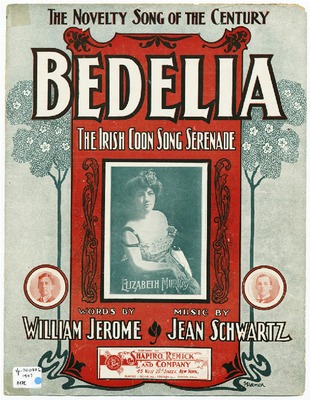
“Building songs around girls’ names has always been popular and this one may have been the most popular of this era.” TY2 The sheet music bills the song as “The Novelty Song of the Century” and “An Irish Coon Song Serenade.” TY2 Coon songs were popular at the time, but steeped in racial stereotypes about African Americans. The song has more Irish influence than African American, so one assumes the publisher was trying to capitalize on the coon craze with the latter billing. TY2

The song was introduced by Blanche Ring playing the character of Liliandra in The Jersey Lily, which opened in September 1903. GA It was her first starring role on Broadway. DJ It is unclear who first recorded the song. SecondHandSongs.com lists a December 1903 release date for a version by Billy Murray. That version went to #1. Considering his parents were Irish immigrants, it was fitting that Murray tackled the song, affecting a thick Irish accent to emphasize the song’s comedic nature. He was also one of the most successful singers of the pre-rock era, recording hundreds of early acoustic recordings as a solo act, in duets, and as part of quartets, during the first two decades of the 20th century. SM

Murray’s was among four versions to chart in January 1904. The first was by Arthur Pryor’s Band (#3). It was quickly followed by a recording by the Haydn Quartet, which spent seven weeks at #1. The Murray version and one by George J. Gaskin (#3) came next. Jan Garber reached #22 with the song in 1948.

SecondHandSongs.com also says Arthur Collins recorded the song in 1903 so it may or may not have preceded Murray’s version. There was also a version by Edward M. Favor in 1904. In his book Popular Songs of the Twentieth Century, Edward Foote Gardner also says there were stage versions of the song done by Elizabeth Murray and Emma Carus around this time. GA Other versions were recorded by Dick Kuhn and His Orchestra (1941), Papa Bue’s Viking Jazzband (1965), Ernie Carson and the Social Polecats (1992), and Claus Forchhammer’s Orkester (2005). SH Instrumental versions were done by the Crawford-Ferguson Night Owls (1965), Butch Thompson et al (1985), the Grand Dominion Jazz Band (1988), Gambit Jazzmen (1995), Vintage Jazz (1996), and the Yerba Buena Stompers (2002). SH

The song also appeared in the movie musical Broadway to Hollywood (1933) and Hello, Frisco, Hello (1943). It was revived again in 1953 in the film The Eddie Cantor Story.


Resources:


Related Links:


First posted 12/13/2022; last updated 12/16/2022.