Showing posts with label Arthur Pryor. Show all posts

Friday, April 10, 2009

100 years ago: “Shine on, Harvest Moon” hit #1

Shine on, Harvest Moon

Harry MacDonough with Miss Walton

Writer(s): Jack Norworth, Nora Bayes (see lyrics here)


First Charted: April 10, 1909


Peak: 19 US, 13 GA, 15 SM (Click for codes to singles charts.)


Sales (in millions): 1.0 (sheet music)


Airplay/Streaming (in millions): -- radio, -- video, -- streaming

Shine on, Harvest Moon

Ada Jones & Billy Murray


First Charted: May 15, 1909


Peak: 15 US, 13 GA (Click for codes to singles charts.)


Sales (in millions): 1.0 (sheet music)


Airplay/Streaming (in millions): -- radio, -- video, -- streaming

Awards (MacDonough):

Click on award for more details.


Awards (Jones/Murray):

About the Song:

Nora Bayes was a Broadway and vaudevillian performer in the early 1900s. In 1908, she married Jack Norworth, a singer, songwriter, and dancer, who also wrote “Take Me Out to the Ball Game.” The pair toured and composed together. The duo’s collaboration, “Shine on, Harvest Moon,” “became her musical trademark” TY2 and one of “the most recognized of the many ‘moon’ ballads.” RCG The song is about “a guy begging the harvest moon to shine brightly so he and his girl can ‘stay outdoors and spoon.’” TY2 It was “decidedly old-fashioned and a product of twentieth century innocence.” RCG She sang the song as a solo act SM in Ziegfeld Follies of 1908. The couple didn’t last, divorcing in 1913 (the second of five marriages for Bayes!), SF but the song survived. Both performed it the rest of their lives. RCG

It became a favorite for player pianos and barbershop quartets RCG and “remains a perennial among amateur singers everywhere.” DJ-172 It had an impressive chart life with seven takes on the song peaking in the top 20 over the next quarter century. The first, and most successful, was a duet between Harry MacDonough and Miss Walton (believed to be Elise Stevenson) in 1909. They took the song to #1 for 9 weeks. Their version used the verse, chorus, and a second verse while another popular duo version by Ada Jones and Billy Murray did just the first verse and chorus. SM That one also went to #1 while other versions that year, one by the duo of Frank Stanley and Henry Burr, another by Bob Roberts, went to #2 and #6 respectively. The following year, Arthur Pryor also went top 5 with the song.

“Harvest Moon” was revived by Ruth Etting in Ziegfeld Follies of 1931. DJ Ethel Waters took the song back to the top ten that same year. Two years later, Kate Smith took the song back to the top 20. Over the years, the song has also been sung by Judy Garland, Vera Lynn, Glenn Miller, and Liza Minnelli. RCG At age 8, Britney Spears sang it for her Mickey Mouse Club audition. WK

It has also appeared in at least a dozen films, most notably an eponymously titled 1944 biopic starring Ann Sheridan and Dennis Morgan as Bayes and Norworth. RCG A 1938 Roy Rogers western was named after the song and Laurel & Hardy performed it in their 1939 film The Flying Deuces. It was also used in A Tree Grows in Brooklyn (1945), Look for the Silver Lining (1949), Nancy Goes to Rio (1950), I’ll See You in My Dreams (1952), The Eddy Duchin Story (1957), TY2 and Pennies from Heaven (1978). WK


Resources:


Related Links:


First posted 4/10/2012; last updated 12/15/2022.

Friday, April 22, 2005

100 years ago: Henry Burr “In the Shade of the Old Apple Tree” hit #1

In the Shade of the Old Apple Tree

Henry Burr (as Irving Gillette)

Writer(s): Egbert Van Alstyne (music), Harry H. Williams (lyrics) (see lyrics here)


First Charted: April 22, 1904


Peak: 17 US, 14 GA, 18 SM (Click for codes to singles charts.)


Sales (in millions): --


Airplay/Streaming (in millions): -- radio, 0.12 video, -- streaming

Awards:

Click on award for more details.

About the Song:

Composer Egbert Van Alstyne and lyricist Harry H. Williams worked as song pluggers for Remick, the famous music-publishing house, when they wrote “In the Shade of the Old Apple Tree,” TY2 their biggest hit. DJ The previous year, the pair wrote “Navajo,” which Billy Murray took to the top of the charts.

They were inspired when they visited Central Park in New York – which, incidentally, has no apple trees. TY2 The song can “be characterized as a highly sentimental tune…about a lost love.” WK The full, four-verse version of the song reveals that the couple are no longer together because she died. However, he sings about hoping to see her again, meaning in the afterlife. SM

The first charted version of the song came in 1905 by Henry Burr. He only sang two of the verses and then ended with two choruses, so his version doesn’t make it clear that she died. SM Burr was born Harry Haley McClaskey in Canada in 1882 and recorded “Apple Tree” under the name of Irving Gillette. That version topped the charts for seven weeks. This was his second trip to the top of the charts. From 1903 to 1922, he reached the pinnacle twenty four times as a solo act and in duets with Albert Campbell. Burr was “the #1 ballad singer of recorded music’s 1890-1930 pioneer era.” PM He sang on on “some twelve thousand recordings, far more than any other vocalist in history.” PM

There were other charted version in 1905 by Albert Campbell (#2), the Haydn Quartet (#2) ,and Arthur Pryor’s Band (#9) all charted with versions of the song. It experienced a revival in 1933 when Duke Ellington recorded the song and took it to #13. Louis Armstrong recorded the song with the Mills Brothers in 1937, Alma Cogan tackled it in 1962, and Bing Crosby recorded it as part of a medley that same year. WK Billy Murray and Ramblin’ Jack Elliott recorded parodies of the song. WK


Resources:


Related Links:


First posted 12/8/2022; last updated 12/15/2022.

Friday, January 9, 2004

100 years ago: “Bedelia” hit #1 for first time

Bedelia

Billy Murray

Writer(s): Jean Schwartz (music), William Jerome (lyrics) (see lyrics here)


First Charted: December 2003


Peak: 13 US, 13 GA, 17 SM (Click for codes to singles charts.)


Sales (in millions): 3.0 (sheet music)


Airplay/Streaming (in millions): -- radio, -- video, -- streaming

Bedelia

Haydn Quartet


First Charted: January 9, 1904


Peak: 17 US, 13 GA (Click for codes to singles charts.)


Sales (in millions): 3.0 (sheet music)


Airplay/Streaming (in millions): -- radio, -- video, -- streaming

Awards (Haydn Quartet):

Click on award for more details.


Awards (Billy Murray):

About the Song:

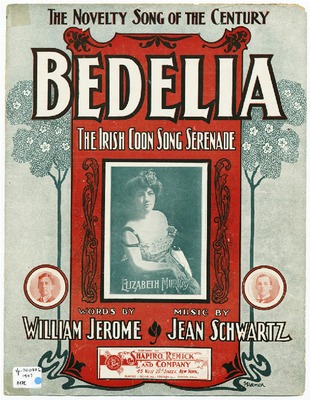
“Building songs around girls’ names has always been popular and this one may have been the most popular of this era.” TY2 The sheet music bills the song as “The Novelty Song of the Century” and “An Irish Coon Song Serenade.” TY2 Coon songs were popular at the time, but steeped in racial stereotypes about African Americans. The song has more Irish influence than African American, so one assumes the publisher was trying to capitalize on the coon craze with the latter billing. TY2

The song was introduced by Blanche Ring playing the character of Liliandra in The Jersey Lily, which opened in September 1903. GA It was her first starring role on Broadway. DJ It is unclear who first recorded the song. SecondHandSongs.com lists a December 1903 release date for a version by Billy Murray. That version went to #1. Considering his parents were Irish immigrants, it was fitting that Murray tackled the song, affecting a thick Irish accent to emphasize the song’s comedic nature. He was also one of the most successful singers of the pre-rock era, recording hundreds of early acoustic recordings as a solo act, in duets, and as part of quartets, during the first two decades of the 20th century. SM

Murray’s was among four versions to chart in January 1904. The first was by Arthur Pryor’s Band (#3). It was quickly followed by a recording by the Haydn Quartet, which spent seven weeks at #1. The Murray version and one by George J. Gaskin (#3) came next. Jan Garber reached #22 with the song in 1948.

SecondHandSongs.com also says Arthur Collins recorded the song in 1903 so it may or may not have preceded Murray’s version. There was also a version by Edward M. Favor in 1904. In his book Popular Songs of the Twentieth Century, Edward Foote Gardner also says there were stage versions of the song done by Elizabeth Murray and Emma Carus around this time. GA Other versions were recorded by Dick Kuhn and His Orchestra (1941), Papa Bue’s Viking Jazzband (1965), Ernie Carson and the Social Polecats (1992), and Claus Forchhammer’s Orkester (2005). SH Instrumental versions were done by the Crawford-Ferguson Night Owls (1965), Butch Thompson et al (1985), the Grand Dominion Jazz Band (1988), Gambit Jazzmen (1995), Vintage Jazz (1996), and the Yerba Buena Stompers (2002). SH

The song also appeared in the movie musical Broadway to Hollywood (1933) and Hello, Frisco, Hello (1943). It was revived again in 1953 in the film The Eddie Cantor Story.


Resources:


Related Links:


First posted 12/13/2022; last updated 12/16/2022.