Showing posts with label Charles K. Harris. Show all posts

Friday, August 10, 2001

100 years ago: “Hello Central, Give Me Heaven” hit #1

Hello Central, Give Me Heaven

Byron G. Harlan

Writer(s): Charles K. Harris (music and lyrics) (see lyrics here)


First Charted: August 3, 1901


Peak: 15 US, 13 GA, 13 SM (Click for codes to singles charts.)


Sales (in millions): 1.0 (sheet music)


Airplay/Streaming (in millions): -- radio, -- video, -- streaming

Awards:

Click on award for more details.

About the Song:

This “classic tearjerker” DJ is songwriter Charles K. Harris “at his weepiest.” DJ It was a contrast to early telephone songs like “Hello Ma Baby.” DJ The song relays the tale of a young girl who wants to use the phone to contact her dead mother. Harris was inspired by a newspaper story about a seven-year-old who tried to make such a call. WK The term “Hello Central” refers to the need at that time to go through an operator to connect to another party. The song was a hit with children’s acts. DJ

Harris was inducted into the Songwriters Hall of Fame in 1970. The “Tin Pan Alley pioneer” SH and “king of the tear jerkers” SH was born in Poughkeepsie, New York in 1867. He started out as a banjo player who wrote for vaudeville acts and silent films. He found his first major success with “After the Ball,” a song which George J. Gaskin took to #1 in 1893.

Byron G. Harlan took the song to #1 in 1901. It was his first trip to the top as a solo act although he’d previously reached the pinnacle with Frank Stanley, Joe Belmont, and the Flordora Girls with “Tell Me, Pretty Maiden.” He hit the top spot 24 times total – half of those were with frequent duet partner Arthur Collins. His solo hits were usually sentimental ballads while his work with Collins focused on “ragtime and minstrel humor.” PM His combined work as a solo artist and with Collins made him one of the top 10 artists of the pre-rock era (1890-1954). PM

Harlan’s version omitted a verse in which the operator connects to heaven and the girl gets a message from her mother. SM In 1913, the song’s title and story was used for an eleven-minute short film written by Dwight M. Wiley. A little girl is told by her pastor that heaven is real so she calls the operator and asks to speak to heaven. She mistakenly “overhears a dire plot – and foils it by her own efforts.” IM


Resources:


Related Links:


First posted 12/2/2022; last updated 12/15/2022.

Thursday, April 29, 1993

On This Day (1893): George J. Gaskin hit #1 with “After the Ball”

After the Ball

George J. Gaskin

Writer(s): Charles K. Harris (see lyrics here)


Published: 1891


First Charted: April 29, 1893


Peak: 110 US (Click for codes to charts.)


Sales (in millions): 5.0 (sheet music)


Airplay/Streaming (in millions): -- radio, 0.13 video, -- streaming

Awards (Gaskin):

Click on award for more details.

Awards (John Yorke Atlee):

Click on award for more details.

About the Song:

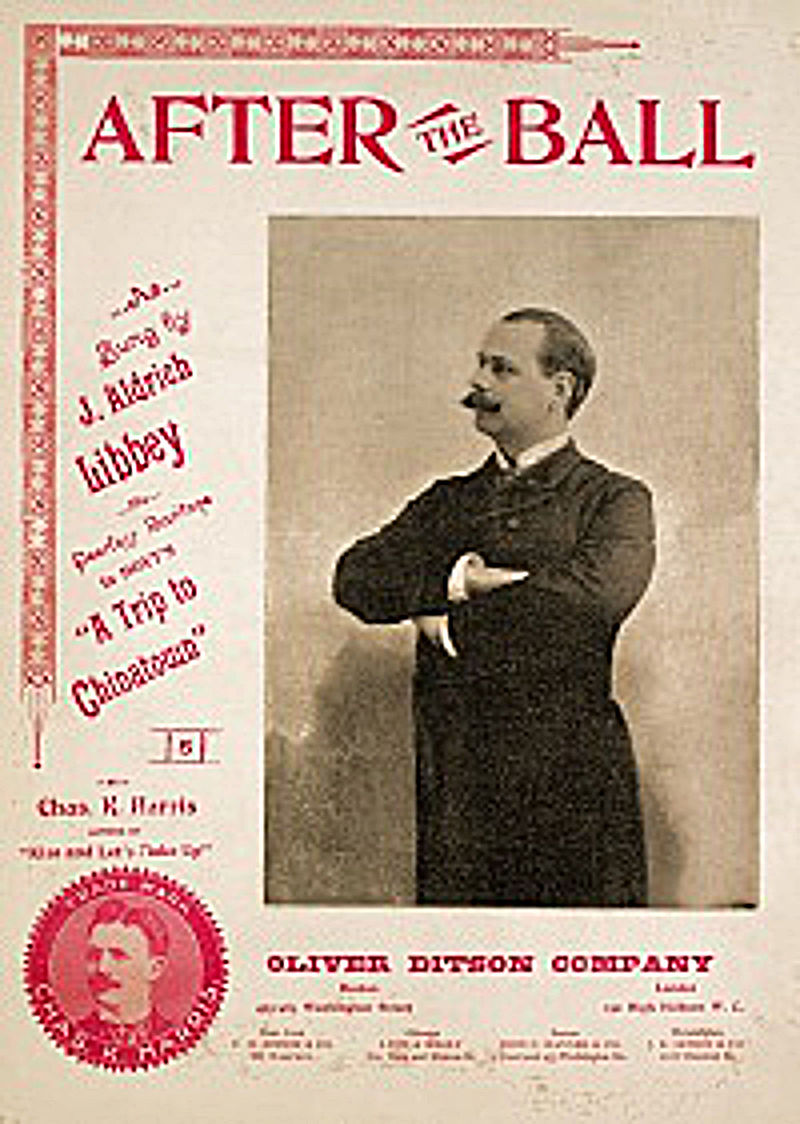
Charles K. Harris wrote this classic waltz in 1891 for an amateur minstrel show in Milwaukee, Wisconsin. The first time it was performed, the singer, Sam Doctor, forgot the words and the song made a poor impression. PG However, Harris believed in the song and paid well-known performer J. Aldrich Libbey to include it in his A Trip to Chinatown show. SS It grew in popularity and John Philip Sousa and his band performed it daily at the World’s Fair in Chicago in 1893. PG That same year, George J. Gaskin and John Yorke Atlee recorded the song. The former was a #1 for 10 weeks while the latter peaked at #2. It was the fourth chart-topper for Gaskin, who was known as “The Silve-Voiced Tenor.” He had a total of 19 songs reach the peak from 1891 to 1901. It was one of only three chart hits for Atlee. PM

In the song, an old man explains to his niece that he never married after seeing his sweetheart kissing another man at a ball. He left, and refusing to hear her explanation, WK only to find out years later that it was her brother. SS Harris got the idea from a dance in Chicago where he saw two lovers get in a fight and leave separately. SF

The song “exemplifies the sentimental ballads published before 1920, whose topics were frequently babies, separation, and death.” WK It has “a memorable, tearjerking chorus in the form of a story constructed for middle-class ladies to learn on their parlour pianos.” LW It “is sometimes credited with beginning the commercial exploitation of popular music.” SF Before 1893, most songs became regional hits and then word spread, but the aggressive marketing behind “After the Ball” set a new standard. SS It was the first song to sell a million copies of sheet music, SF eventually racking up five million and becoming the best seller in Tin Pan Alley’s history. WK Tin Pan Alley was the name given to a group of 19th century and early 20th century music publishers and songwriters in New York City.

The song resurfaced in 1927 when it was used in the groundbreaking musical Show Boat. Norma Terris performed it during its original Broadway run and Irene Dunne performed it for the 1936 film version. It was made into a film again in 1951 and performed by Kathryn Grayson. WK In 1940, it was featured in the biographical musical film Lillian Russell and performed by Alice Faye. WK It has also been performed by Nat “King” Cole, Bing Crosby, Guy Lombardo, Julie London, and Lawrence Welk. WK


Resources:


First posted 4/15/2021; last updated 9/6/2023.