Awards (Gaskin): Click on award for more details.


About the Song:
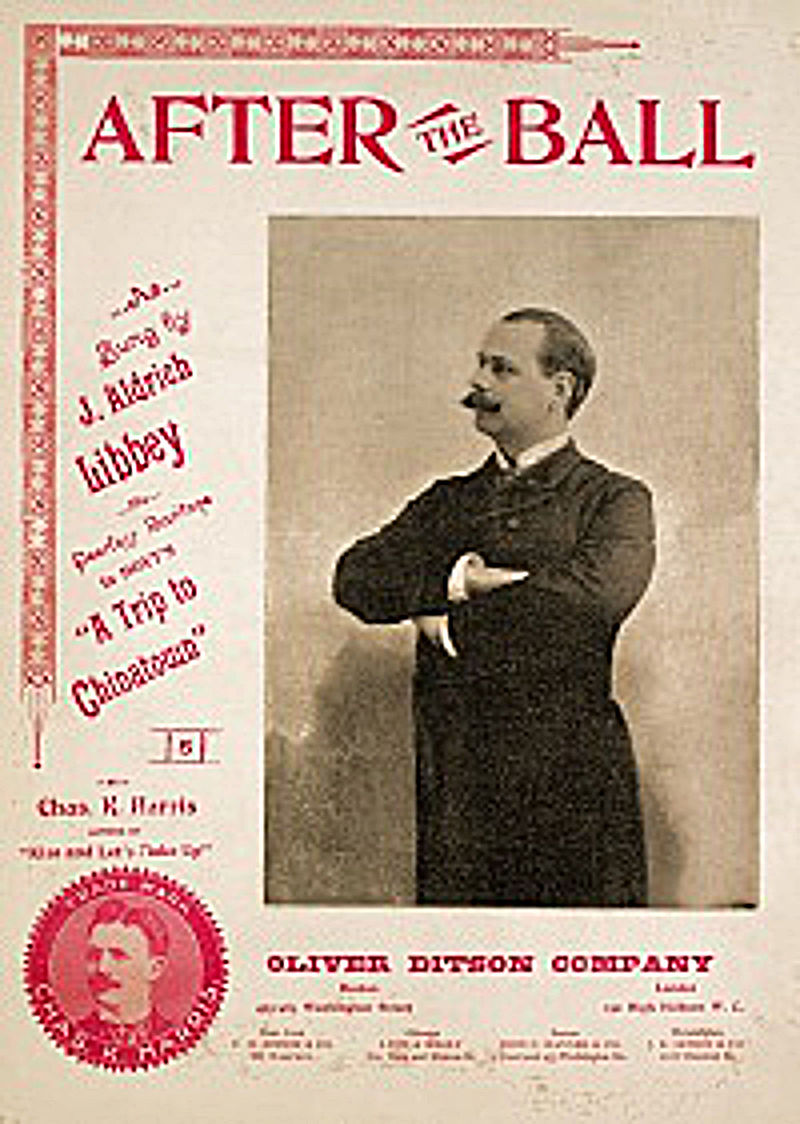
Charles K. Harris wrote this classic waltz in 1891 for an amateur minstrel show in Milwaukee, Wisconsin. The first time it was performed, the singer, Sam Doctor, forgot the words and the song made a poor impression. PG However, Harris believed in the song and paid well-known performer J. Aldrich Libbey to include it in his A Trip to Chinatown show. SS It grew in popularity and John Philip Sousa and his band performed it daily at the World’s Fair in Chicago in 1893. PG That same year, George J. Gaskin and John Yorke Atlee recorded the song. The former was a #1 for 10 weeks while the latter peaked at #2. It was the fourth chart-topper for Gaskin, who was known as “The Silve-Voiced Tenor.” He had a total of 19 songs reach the peak from 1891 to 1901. It was one of only three chart hits for Atlee. PM
In the song, an old man explains to his niece that he never married after seeing his sweetheart kissing another man at a ball. He left, and refusing to hear her explanation, WK only to find out years later that it was her brother. SS Harris got the idea from a dance in Chicago where he saw two lovers get in a fight and leave separately. SF
The song “exemplifies the sentimental ballads published before 1920, whose topics were frequently babies, separation, and death.” WK It has “a memorable, tearjerking chorus in the form of a story constructed for middle-class ladies to learn on their parlour pianos.” LW It “is sometimes credited with beginning the commercial exploitation of popular music.” SF Before 1893, most songs became regional hits and then word spread, but the aggressive marketing behind “After the Ball” set a new standard. SS It was the first song to sell a million copies of sheet music, SF eventually racking up five million and becoming the best seller in Tin Pan Alley’s history. WK Tin Pan Alley was the name given to a group of 19th century and early 20th century music publishers and songwriters in New York City.
The song resurfaced in 1927 when it was used in the groundbreaking musical Show Boat. Norma Terris performed it during its original Broadway run and Irene Dunne performed it for the 1936 film version. It was made into a film again in 1951 and performed by Kathryn Grayson. WK In 1940, it was featured in the biographical musical film Lillian Russell and performed by Alice Faye. WK It has also been performed by Nat “King” Cole, Bing Crosby, Guy Lombardo, Julie London, and Lawrence Welk. WK
Resources:
First posted 4/15/2021; last updated 9/6/2023.
|

 |
Listen to the Mocking Bird (aka “The Mocking Bird”)
Septimus Winner as Alice Hawthorne (words), Richard Milburn (music) |
Writer(s): Septimus Winner as Alice Hawthorne (words), Richard Milburn (music) (see lyrics here)
Published: 1855
First Charted: August 22, 1891 (John Yorke Atlee)
Peak: 16 US (Atlee)
(Click for codes to charts.)
Sales (in millions): 20.0 (sheet music)
Airplay/Streaming (in millions):
-- radio, 0.38 video, -- streaming
|
About the Song:
Septimus Winner, a Philadelphia songwriter, music teacher, publisher, and music store propietor, was inspired to write this tune in 1855 after hearing Richard “Whistling Dick” Milburn. The African American barber busked on the streets of Philadelphia, playing guitar and whistling. He sometimes imitated a mockingbird. Winner added lyrics about a narrator mourning the loss of his beloved Hally. He visits her grave and hears a mockingbird singing, which they often did when she was alive. JM
Soon after he published the song, Winner sold the copyright for five dollars, missing out on a huge windfall. Milburn, meanwhile, reportedly only received 20 copies of the song as payment SF and his name was later removed from the credits. In the early 20th century, a Philadelphia newspaper estimated that the song had sold 20 million copies of sheet music in America and Europe. JM That figure, however, has never been verified and is assumed to be wildly exaggerated. SS
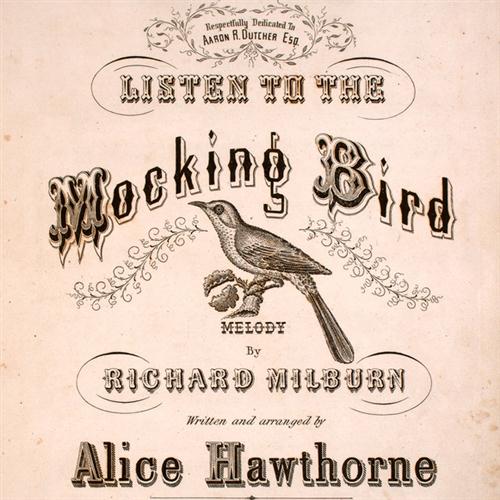
In Yesterdays: Popular Song in America, Charles Hamm asserts that “Mocking Bird” was significant in popularizing the verse-chorus structure that would become nearly universal in popular music. SS Among the song’s fans were King Edward VII of England, who said he whistled the song as a boy, and Abraham Lincoln who called it “a real song…as sincere and sweet as the laughter of a little girl at play.” JM The cover of the sheet music calls the song “a sentimental Ethiopian ballad.” TY2
John Yorke Atlee, who was known as “the Artistic Whistler,” had the first charting version of the song in 1891, taking it to #1. It charted three more times, peaking at #3 each time. Joe Belmont did the trick in 1899, Frank Stanley with Corrine Morgan in 1904, and Alma Gluck in 1915. PM The verse of the song was used as an instrumental introduction to short films by the Three Stooges. WK It has also been used in TV cartoons Heckle and Jeckle, The Flintstones, and SpongeBob SquarePants. WK
Resources:
First posted 4/15/2021; last updated 9/2/2023.
|
|