Showing posts with label Joe Belmont. Show all posts

Friday, May 11, 2001

100 years ago: “Tell Me, Pretty Maiden” hit #1

Tell Me Pretty Maiden

Harry MacDonough & Grace Spencer

Writer(s): Leslie Stuart (music), Owen Hall (words) (see lyrics here)


First Charted: April 27, 1901


Peak: 17 US, 3 GA (Click for codes to singles charts.)


Sales (in millions): --


Airplay/Streaming (in millions): -- radio, -- video, -- streaming

Tell Me Pretty Maiden

Byron G. Harlan with Frank Stanley, Joe Belmont, & the Florodora Girls


First Charted: June 22, 1901


Peak: 13 US, 3 GA (Click for codes to singles charts.)


Sales (in millions): --


Airplay/Streaming (in millions): -- radio, -- video, -- streaming

Awards (MacDonough/Spencer):

Click on award for more details.


Awards (Harlan et al):

About the Song:

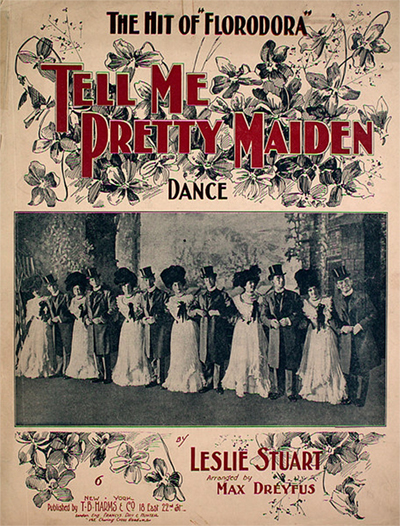
“Tell Me, Pretty Maiden” was introduced in 1899 in London via the musical comedy Florodora. It has been called “the most successful show tune of its time.” PD The original stage version of the song was performed a double sextet by six men and six parasol-twirling women. The women, all five-foot-four and 130 pounds, “received an indordinate amount of adulation and publicity” TY2 and were rumored to have all married millionaires. TY2

“Maiden” was “the first major song hit from a show not performed by principal singers.” CH “With its upbeat and carefree rhythm, that sense of meandering aimlessly, and beautiful and unexpected traditions, it completely transcends the conventions of popular song.” CH

Leslie Stuart, the composer, started out as a church organist before he started writing for musical shows in 1895. Florodora was his first hit. PD It opened in London on November 11, 1899 and ran for 455 performances at London’s Lyric Theatre CH and another 552 for the New York production. PD The story is about “an attempt to cheat a beautiful young heiress out of her rights to a perfume fortune.” CH

Harry MacDonough and Grace Spencer recorded the first version of the song to chart. It reached #1 in May 1901. After seven weeks on top, it was dethroned by another version of the song by Byron G. Harlan, Frank Stanley, Joe Belmont, and the Florodora Girls. Grace Spencer was a soprano singer born in 1872. She was one of the first women to record for Victor PM becoming known as “the First Lady of the Phonograph.” CH “Tell Me, Pretty Maiden” was one of only two chart hits for her. THe other was also a duet with MacDonough.

MacDonough was a tenor singer born in Ontario, Canada, in 1871. He was second only to Henry Burr as one of “the great ballad singers of recordings’ pioneer pre-1920 era.” PM He was the most popular recording artist of the decade, PM making over 350 records by 1908. CH “Tell Me, Pretty Maiden” was his first of fifteen songs to top the Billboard charts. PM


Resources:


Related Links:


First posted 12/2/2022; last updated 12/14/2022.

Thursday, August 22, 1991

On This Day in Music (1891): “Listen to the Mocking Bird” hit #1

Listen to the Mocking Bird (aka “The Mocking Bird”)

Septimus Winner as Alice Hawthorne (words), Richard Milburn (music)

Writer(s): Septimus Winner as Alice Hawthorne (words), Richard Milburn (music) (see lyrics here)


Published: 1855


First Charted: August 22, 1891 (John Yorke Atlee)


Peak: 16 US (Atlee) (Click for codes to charts.)


Sales (in millions): 20.0 (sheet music)


Airplay/Streaming (in millions): -- radio, 0.38 video, -- streaming

Awards: (Winner/Milburn)

Click on award for more details.


Awards (John Yorke Atlee):


Awards (Frank Stanley):

About the Song:

Septimus Winner, a Philadelphia songwriter, music teacher, publisher, and music store propietor, was inspired to write this tune in 1855 after hearing Richard “Whistling Dick” Milburn. The African American barber busked on the streets of Philadelphia, playing guitar and whistling. He sometimes imitated a mockingbird. Winner added lyrics about a narrator mourning the loss of his beloved Hally. He visits her grave and hears a mockingbird singing, which they often did when she was alive. JM

Soon after he published the song, Winner sold the copyright for five dollars, missing out on a huge windfall. Milburn, meanwhile, reportedly only received 20 copies of the song as payment SF and his name was later removed from the credits. In the early 20th century, a Philadelphia newspaper estimated that the song had sold 20 million copies of sheet music in America and Europe. JM That figure, however, has never been verified and is assumed to be wildly exaggerated. SS

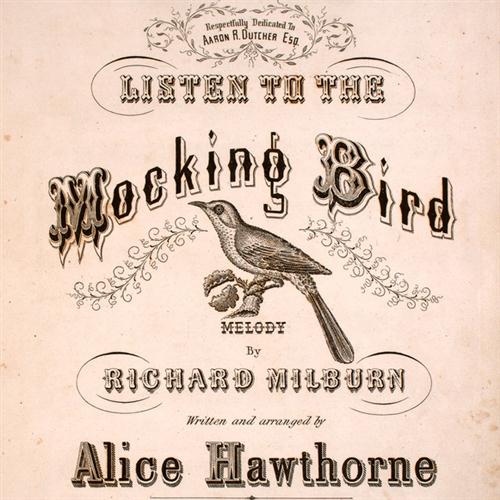
In Yesterdays: Popular Song in America, Charles Hamm asserts that “Mocking Bird” was significant in popularizing the verse-chorus structure that would become nearly universal in popular music. SS Among the song’s fans were King Edward VII of England, who said he whistled the song as a boy, and Abraham Lincoln who called it “a real song…as sincere and sweet as the laughter of a little girl at play.” JM The cover of the sheet music calls the song “a sentimental Ethiopian ballad.” TY2

John Yorke Atlee, who was known as “the Artistic Whistler,” had the first charting version of the song in 1891, taking it to #1. It charted three more times, peaking at #3 each time. Joe Belmont did the trick in 1899, Frank Stanley with Corrine Morgan in 1904, and Alma Gluck in 1915. PM The verse of the song was used as an instrumental introduction to short films by the Three Stooges. WK It has also been used in TV cartoons Heckle and Jeckle, The Flintstones, and SpongeBob SquarePants. WK


Resources:


First posted 4/15/2021; last updated 9/2/2023.