Showing posts with label Woody Herman. Show all posts

Tuesday, June 23, 2026

Big Band Leaders: Top 50+

Big Band Leaders:

Top 50+

Big band was a popular form of music in the first half of the 20th century. It was essentially a jazz orchestra, typically comprised of ten or more musiicans including saxophonists, trumpeters, trombonists, and a rhythm section which might tconsist of guitar, piano, double bass, and drums. By the mid-1930s, swing music, which had a more supple feel than early jazz, became increasingly popular. On the charts, such bands were generally credited to the bandleaders with featured vocalists noted.

This list focuses on those most popular band leaders. It was comprised by aggregating 16 lists focused on the best big band leaders of all time. The list here includes all individuals appearing on 4 or more lists.

See other lists of Acts/Music Makers by Categories.


15 lists:

1. Benny Goodman
2. Count Basie

13 lists:

3. Glenn Miller
4. Duke Ellington

10 lists:

5. Artie Shaw

9 lists:

6. Tommy Dorsey
7. Cab Calloway

8 lists:

8. Louis Armstrong
9. Jimmy Dorsey
10. Harry James
11. Woody Herman

7 lists:

12. Gene Krupa
13. Chick Webb

6 lists:

14. Lionel Hampton
15. 20. Earl Hines

5 lists:

16. Fats Waller
17. Eddy Duchin
18. Kay Kyser
19. Glen Gray
20. Bob Crosby
21. Ozzie Nelson
22. Buddy Rich
23. Fletcher Henderson
24. Jimmie Lunceford
25. Jack Teagarden
26. Charlie Spivak

4 lists:

27. Paul Whiteman
28. Sammy Kaye
29. Isham Jones
30. Freddy Martin

31. Louis Jordan
32. Hal Kemp
33. Ray Noble
34. Russ Morgan
35. Horace Heidt
36. Ted Weems
37. Dizzy Gillespie
38. Stan Kenton
39. Benny Carter
40. Les Brown

41. Frankie Carle
42. Xavier Cugat
43. Bunny Berigan
44. Will Bradley
45. Andy Kirk
46. Red Norvo
47. Claude Thornhill
48. Eddie DeLange
49. Erskine Hawkins
50. Ina Ray Hutton

51. Tony Pastor
52. Jan Savitt


Resources/Related Links:


First posted 6/23/2026.

Friday, October 22, 2021

Dave's Music Database Hall of Fame: Song Inductees (October 2021)

Originally posted 10/22/2021.

In honor of the 10th anniversary of the DMDB blog on January 22, 2019, Dave’s Music Database launched its own Hall of Fame. This is the twelfth set of song inductees. These are the 10 highest-ranked songs that ranked within the top 50 of the DMDB’s list of the “Top Big Band Songs of All Time”. It does not include previously inducted songs such as Glenn Miller’s “In the Mood” and Artie Shaw’s “Stardust” and “Begin the Beguine.”

Fats Waller “Ain’t Misbehavin’” (1929)

Inducted October 2021 as “Top Big Band Songs”

Waller was “a New York City-born pianist and organ accompanist during the ‘20s…[who] broke through as one of the country’s most popular entertainers. PM “Ain’t Misbehavin’” was written for the 1929 all-black revue Hot Chocolates and debuted by Louis Armstrong, who credited the revue with launching his career. TY It was so popular it moved to Broadway RCG where it ran “for a very respectable 219 performances.” SS Read more.

Ted Lewis “On the Sunny Side of the Street” (1930)

Inducted October 2021 as “Top Big Band Songs”

This “cabaret and jazz standard” JA is a “metaphor for optimism.” TY In his book American Popular Song, author Alec Wilder calls it “one of the jazz musicians’ favorites…Singers, as well, love it as much for its extremely fine lyric.” SB In The NPR Curious Listener’s Guide to Popular Standards, Max Morath expresses a similar sentiment, saying the song “works both sides of the street, vocal and instrumental, with equal charm.” MM Read more.

Duke Ellington “Mood Indigo” (1931)

Inducted October 2021 as “Top Big Band Songs”

The clarinet solo was based on a melody called “Dreamy Blues.” Duke Ellington turned the structure upside down, “composing a song of his own on top of it.” DH Typically jazz songs were arranged with the clarinet, trumpet, and trombone from highest to lowest pitch, but Ellington flipped it around the other way. DH He recorded it for an October 1930 broadcast. He said “wads of mail came in raving about the new tune.” WK Read more.

Benny Goodman “Sing Sing Sing (With a Swing)” (1938)

Inducted October 2021 as “Top Big Band Songs”

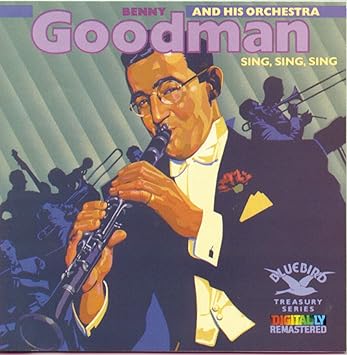
By the start of the Swing era in 1936, Benny Goodman was its king. “Sing, Sing, Sing” was his most renowned performance with solos by Benny as well as drummer Gene Krupa (on his last hit before leaving the band) and trumpeter Harry James. “Sing, Sing, Sing,” which Goodman called a “killer diller,” NPR’99 was the closer at the bandleader’s legendary Carnegie Hall concert on January 16, 1938. It was the first time jazz comprised a full concert instead of being part of a larger show SS and marked the birthplace of the legitimacy of the genre. NPR’99 Read more.

Ella Fitzgerald with Chick Webb’s Orchestra “A-Tisket, A-Tasket” (1938)

Inducted October 2021 as “Top Big Band Songs”

“A-Tisket, A-Tasket” began life as an American children’s rhyming game in 1879. In 1938, Ella Fitzgerald and Al Feldman adapted it into a song with very little change to the lyrics. In a 1973 lecture series at Harvard, Leonard Bernstein said that research showed the song’s melodic motif “is the same all over the world, wherever children tease each other. On every continent, in ever culture, it is one of the few musical universals.” TY Read more.

Tommy Dorsey with Frank Sinatra & the Pied Pipers “I’ll Never Smile Again” (1940)

Inducted October 2021 as “Top Big Band Songs”

Ruth Lowe was a pianist with Ina Ray Hutton’s all-girl orchestra when she composed this song about the death of her husband, just a few months after their marriage. TY She staked out Tommy Dorsey in September 1939 and got Carmen Mastren, the band’s guitarist, to give her demo a listen. SS Dorsey wasn’t initially passed but took a stab at it when Frank Sinatra came on board. SS It became his first #1 song. Read more.

Duke Ellington “Take the ‘A’ Train” (1941)

Inducted October 2021 as “Top Big Band Songs”

Billy Strayhorn was a hopeful pianist and composer in 1938. NPR His rearrangement of the Duke’s song “Sophisticated Lady” sufficiently impressed Ellington to invite Strayhorn to New York. TC Ellington gave directions to his house in New York, starting with “take the ‘A’ train.” WK Along the way, Strayhorn turned the directions into a song. TC It became Ellington’s signature song and one of the all-time best-loved jazz standards. Read more.

Glenn Miller “Chattanooga Choo Choo” (1941)

Inducted October 2021 as “Top Big Band Songs”

The team of Mack Gordon and Harry Warren wrote the song while travelling on the Southern Railway. It didn’t refer to a particular train, but Chattanooga, Tennessee, had been on the route for most trains passing through the American South since 1880. WK The song was used in the film Sun Valley Serenade, sung by members of Glenn Miller’s band. Miller’s recording became his biggest hit after “In the Mood” and the first recording formally certified as a million seller. PM Read more.

Woody Herman “Blues in the Night (My Mama Done Tol’ Me)” (1941)

Inducted October 2021 as “Top Big Band Songs”

Composer Harold Arlen and lyricist Johnny Mercer were approached to write a song for a movie about a jazz quintet riding the rails in search of its big break. Arlen wrote a melody after analyzing blues songs and Mercer penned four pages of lyrics. When they finished, Mercer called Margaret Whiting, who’d sung the pair’s songs “That Old Black Magic” and “Come Rain or Come Shine.” She told Mercer she had guests for dinner, but he and Arlen could come over later. When Mercer found out the guests included Judy Garland, Mickey Rooney, and Mel Tormé, he announced, “My God, we’re coming right over.” After they played the song, Rooney said, “That’s the greatest thing I’ve ever heard.” SB Read more.

Les Brown with Doris Day “Sentimental Journey” (1945)

Inducted October 2021 as “Top Big Band Songs”

When she first saw the sheet music, Doris Day commented, “What a lovely title,” to which Les Brown responded “Wait till you hear it.” SS “The song’s aching nostalgia struck a chord in a nation welcoming its boys back from the front lines,” TM becoming “one of a handful of songs that summed up romantic longing during World War II.” SS Will Friedwald called it “the definitive end-of-war song,” SS “a song that helped define an era.” SS Read more.

Friday, February 14, 1992

Today in Music (1942): Woody Herman hits #1 with “Blues in the Night”

Blues in the Night (My Mama Done Tol’ Me)

Woody Herman

Writer(s): Johnny Mercer, Harold Arlen (see lyrics here)


First Charted: December 6, 1941


Peak: 11 US, 12 HP, 1 GA, 11 SM (Click for codes to charts.)


Sales (in millions): --


Airplay/Streaming (in millions): -- radio, 0.16 video, 0.77 streaming

Awards (Woody Herman):

Click on award for more details.


Awards (Frank Sinatra):


Awards (Ella Fitzgerald):

About the Song:

Composer Harold Arlen and lyricist Johnny Mercer were approached to write a song for a movie about a jazz quintet riding the rails in search of its big break. There was a scene in which the band members ended up in jail and needed to sing a blues song. Arlen wrote a melody after analyzing recordings of blues songs and then Mercer penned four pages of lyrics. Arlen rarely suggested changes to Mercer’s lyrics, but recommended that the line “my mama done tol’ me” be moved to the beginning. It became the song’s subtitle. SB

When they finished the song, Mercer called singer Margaret Whiting, who’d sung the pair’s songs “That Old Black Magic” and “Come Rain or Come Shine.” She told Mercer she had guests for dinner, but he and Arlen could come over later to share the song. When Mercer found out the guests included Judy Garland, Mickey Rooney, and Mel Tormé, he announced, “My God, we’re coming right over.” After they played the song, Garland asked them to play it again and Rooney said, “That’s the greatest thing I’ve ever heard.” SB

The producers of the movie were taken with the song as well – so much so that they changed the name of the movie from Hot Nocturne to Blues in the Night. TY1 Jimmie Lunceford’s band introduced the song in the movie and took it to #4 on the charts. It charted six times in 1941 and 1942. Dinah Shore (#4) had her first million-seller with the song TY1 and Cab Calloway (#8), Artie Shaw (#10), and Benny Goodman (#20) also had success with the song. In 1952, Rosemary Clooney charted with the song again (#17). Frank Sinatra and Ella Fitzgerald also recorded the song. The latter two version are in Steve Sullivan’s Encyclopedia of Great Popular Song Recordings along with Woody Herman’s.

It was Herman who had the most successful recording of the song. He was born Woodrow Charles Herman in 1913 in Milwaukee, Wisconsin. He started as a sideman and singer with Isham Jones’ orchestra from 1934-36, specializing in clarinet and saxophone. SM After Jones retired, Herman fronted his own band and became, in the words of writer Will Friedwald, “the most successful…talent scout in the history of jazz.” SS His initial plan was to record “Blues in the Night” as an instrumental but in a cab ride to the recording session, Mercer taught him the lyrics. SS Mercer and Arlen sat in on the session and reported satisfaction with his performance. SS


Resources:


Related Links:


First posted 2/14/2016; last updated 1/31/2024.