Showing posts with label Ted Lewis. Show all posts

Friday, December 31, 2021

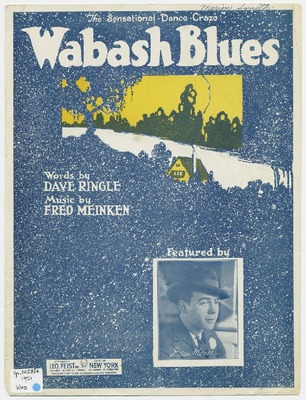
100 years ago: Isham Jones hit #1 with “Wabash Blues”

Wabash Blues

Isham Jones

Writer(s): Fred Meinken (music), Dave Ringle (words) (see lyrics here)


First Charted: December 10, 1921


Peak: 16 US, 11 GA, 12 SM (Click for codes to charts.)


Sales (in millions): 1.0 US


Airplay/Streaming (in millions): -- radio, 0.06 video, -- streaming

Awards:

Click on award for more details.

About the Song:

Born in Ohio in 1894, Isham Jones became a pianist, saxophonist, and composer before he formed his own jazz band. Some considered his “the best dance band of the pre-swing era.” PM That band included trumpeter Louis Panico, who played an integral part of “Wabash Blues” as “the laughing cornet,” a nickname derived from how much his trumpet playing sounded like a person laughing. SM

Wabash was a river which flows through Indiana, Ohio, and Illinois. It had been written about previously, most notably in “On the Banks of the Wabash” in the late 1890s. SM Dave Ringle added “standard blues lyrics” SM about being unhappy and lonesome that were similar to the song “Wang Wang Blues,” a hit from a year earlier. SM

Both songs are examples of “up-tempo, rather cheerful blues,” TY2 a break from the view “of the blues as being slow and depressing.” TY2 “Wabash Blues” “doesn’t follow the classic 12-bar blues form.” TY2 Instead, it was “a good example of a commercial blues, written in Tin Pan Alley for the general market.” TY2

“Wabash Blues” was one of Jones’ earliest hits. He reached the charts 73 times from 1920 to 1938. This was his first of eight #1 songs. PM It became “a jazz band favorite.” DJ The Benson Orchestra, featuring pianist Roy Bargy, also charted with the song (#6, 1922) DJ as did Dolly Kay (#13, 1922), Ted Lewis (#16, 1930), and Russ Morgan (#17, 1939). PM


Resources:


Related Links:


First posted 4/25/2023.

Friday, October 22, 2021

Dave's Music Database Hall of Fame: Song Inductees (October 2021)

Originally posted 10/22/2021.

In honor of the 10th anniversary of the DMDB blog on January 22, 2019, Dave’s Music Database launched its own Hall of Fame. This is the twelfth set of song inductees. These are the 10 highest-ranked songs that ranked within the top 50 of the DMDB’s list of the “Top Big Band Songs of All Time”. It does not include previously inducted songs such as Glenn Miller’s “In the Mood” and Artie Shaw’s “Stardust” and “Begin the Beguine.”

Fats Waller “Ain’t Misbehavin’” (1929)

Inducted October 2021 as “Top Big Band Songs”

Waller was “a New York City-born pianist and organ accompanist during the ‘20s…[who] broke through as one of the country’s most popular entertainers. PM “Ain’t Misbehavin’” was written for the 1929 all-black revue Hot Chocolates and debuted by Louis Armstrong, who credited the revue with launching his career. TY It was so popular it moved to Broadway RCG where it ran “for a very respectable 219 performances.” SS Read more.

Ted Lewis “On the Sunny Side of the Street” (1930)

Inducted October 2021 as “Top Big Band Songs”

This “cabaret and jazz standard” JA is a “metaphor for optimism.” TY In his book American Popular Song, author Alec Wilder calls it “one of the jazz musicians’ favorites…Singers, as well, love it as much for its extremely fine lyric.” SB In The NPR Curious Listener’s Guide to Popular Standards, Max Morath expresses a similar sentiment, saying the song “works both sides of the street, vocal and instrumental, with equal charm.” MM Read more.

Duke Ellington “Mood Indigo” (1931)

Inducted October 2021 as “Top Big Band Songs”

The clarinet solo was based on a melody called “Dreamy Blues.” Duke Ellington turned the structure upside down, “composing a song of his own on top of it.” DH Typically jazz songs were arranged with the clarinet, trumpet, and trombone from highest to lowest pitch, but Ellington flipped it around the other way. DH He recorded it for an October 1930 broadcast. He said “wads of mail came in raving about the new tune.” WK Read more.

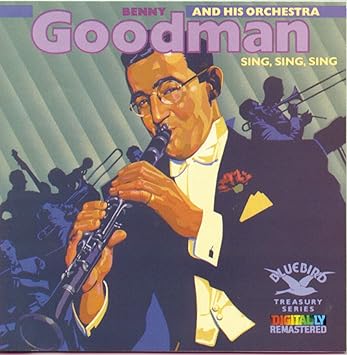
Benny Goodman “Sing Sing Sing (With a Swing)” (1938)

Inducted October 2021 as “Top Big Band Songs”

By the start of the Swing era in 1936, Benny Goodman was its king. “Sing, Sing, Sing” was his most renowned performance with solos by Benny as well as drummer Gene Krupa (on his last hit before leaving the band) and trumpeter Harry James. “Sing, Sing, Sing,” which Goodman called a “killer diller,” NPR’99 was the closer at the bandleader’s legendary Carnegie Hall concert on January 16, 1938. It was the first time jazz comprised a full concert instead of being part of a larger show SS and marked the birthplace of the legitimacy of the genre. NPR’99 Read more.

Ella Fitzgerald with Chick Webb’s Orchestra “A-Tisket, A-Tasket” (1938)

Inducted October 2021 as “Top Big Band Songs”

“A-Tisket, A-Tasket” began life as an American children’s rhyming game in 1879. In 1938, Ella Fitzgerald and Al Feldman adapted it into a song with very little change to the lyrics. In a 1973 lecture series at Harvard, Leonard Bernstein said that research showed the song’s melodic motif “is the same all over the world, wherever children tease each other. On every continent, in ever culture, it is one of the few musical universals.” TY Read more.

Tommy Dorsey with Frank Sinatra & the Pied Pipers “I’ll Never Smile Again” (1940)

Inducted October 2021 as “Top Big Band Songs”

Ruth Lowe was a pianist with Ina Ray Hutton’s all-girl orchestra when she composed this song about the death of her husband, just a few months after their marriage. TY She staked out Tommy Dorsey in September 1939 and got Carmen Mastren, the band’s guitarist, to give her demo a listen. SS Dorsey wasn’t initially passed but took a stab at it when Frank Sinatra came on board. SS It became his first #1 song. Read more.

Duke Ellington “Take the ‘A’ Train” (1941)

Inducted October 2021 as “Top Big Band Songs”

Billy Strayhorn was a hopeful pianist and composer in 1938. NPR His rearrangement of the Duke’s song “Sophisticated Lady” sufficiently impressed Ellington to invite Strayhorn to New York. TC Ellington gave directions to his house in New York, starting with “take the ‘A’ train.” WK Along the way, Strayhorn turned the directions into a song. TC It became Ellington’s signature song and one of the all-time best-loved jazz standards. Read more.

Glenn Miller “Chattanooga Choo Choo” (1941)

Inducted October 2021 as “Top Big Band Songs”

The team of Mack Gordon and Harry Warren wrote the song while travelling on the Southern Railway. It didn’t refer to a particular train, but Chattanooga, Tennessee, had been on the route for most trains passing through the American South since 1880. WK The song was used in the film Sun Valley Serenade, sung by members of Glenn Miller’s band. Miller’s recording became his biggest hit after “In the Mood” and the first recording formally certified as a million seller. PM Read more.

Woody Herman “Blues in the Night (My Mama Done Tol’ Me)” (1941)

Inducted October 2021 as “Top Big Band Songs”

Composer Harold Arlen and lyricist Johnny Mercer were approached to write a song for a movie about a jazz quintet riding the rails in search of its big break. Arlen wrote a melody after analyzing blues songs and Mercer penned four pages of lyrics. When they finished, Mercer called Margaret Whiting, who’d sung the pair’s songs “That Old Black Magic” and “Come Rain or Come Shine.” She told Mercer she had guests for dinner, but he and Arlen could come over later. When Mercer found out the guests included Judy Garland, Mickey Rooney, and Mel Tormé, he announced, “My God, we’re coming right over.” After they played the song, Rooney said, “That’s the greatest thing I’ve ever heard.” SB Read more.

Les Brown with Doris Day “Sentimental Journey” (1945)

Inducted October 2021 as “Top Big Band Songs”

When she first saw the sheet music, Doris Day commented, “What a lovely title,” to which Les Brown responded “Wait till you hear it.” SS “The song’s aching nostalgia struck a chord in a nation welcoming its boys back from the front lines,” TM becoming “one of a handful of songs that summed up romantic longing during World War II.” SS Will Friedwald called it “the definitive end-of-war song,” SS “a song that helped define an era.” SS Read more.

Sunday, August 15, 2021

100 years ago: Ted Lewis “All by Myself” hit #1

All by Myself

Ted Lewis

Writer(s): Irving Berlin (see lyrics here)


First Charted: August 15, 1921


Peak: 14 US, 12 GA, 15 SM (Click for codes to charts.)


Sales (in millions): 1.0 (sheet music)


Airplay/Streaming (in millions): -- radio, -- video, -- streaming

Awards:

Click on award for more details.

About the Song:

This Irving Berlin tune “is a meditation on solitude and the misery of growing old alone.” TY2 It may have been autobiographical as Berlin lost his bride shortly after their honeymoon and never remarried. TY2 It was introduced in vaudeville by Charles King DJ and in The Music Box Revue of 1922, which was part of a series of musical theater revuews by Irving Berlin from 1921 to 1925. It was first recorded by Frank Crumit (#5, 1921), SM a “popular entertainer who appeared in several Broadway musicals of the decade and later hosted a popular radio show.” TY2

Ted Lewis’ jazz band recorded the chart-topping version. SM “The famous bandleader…was famous for his half-spoken, half-singing vocals” TY2 but this recording of “All by Myself” was all instrumental. SM

In all, six versions of the song charted in 1921 – Aileen Stanley (#5), Benny Krueger (#6), Vaughn Deleath (#13), and Ben Selvin (#14). PM Krueger was the former saxophone player with the Original Dixieland Jazz Band. TY2 Deleath was “one of the most famous of the early radio performers” TY2 and “supposedly the first woman to sing on radio.” TY2

Others who recorded the song include Pat Boone, Connee Boswell, Nat “King” Cole, Bing Crosby (for the movie Blue Skies), DJ Bob Crosby, Bobby Darin, Ella Fitzgerald, Connie Francis, Marion Harris, Brenda Lee, Nancy Sinatra, and Kay Starr. WK


Resources:


Related Links:


First posted 1/28/2023.

Monday, June 22, 2020

Dave's Music Database Hall of Fame: Music Maker Inductees (June 2020)

Top 20 Pre-Rock-Era Acts

Originally posted 6/22/2020.

January 22, 2019 marked the 10-year anniversary of the DMDB blog! To honor that, Dave’s Music Database announced its own Hall of Fame. This sixth batch of music maker inductees celebrates the top Pre-Rock-Era Acts, as determined by rankings in Joel Whitburn’s Pop Memories 1890-1954 (see the list here). These are the top 20 from that list, minus previous inductees, which included Henry Burr, Arthur Collins, Bing Crosby, Tommy Dorsey, Byron Harlan, Guy Lombardo, Billy Murray, Frank Sinatra, and Paul Whiteman. See the full list of music maker inductees here.

The Andrews Sisters (active 1938-1951)

Inducted June 2020 as “Top 20 Pre-Rock-Era Act.”

The most popular female vocal group of the pre-rock era. The trio of Patty, Maxene, and LaVerne appeared in many '40s movies and their unmistakable sound helped define the wartime. Had six #1 songs, including “Bei Mir Bist Du Schöen (Means That You’re Grand),” “Ferryboat Serenade,” “Shoo-Shoo Baby,” “Rum and Coca Cola,” “I Can Dream, Can’t I?,” and “I Wanna Be Loved.” However, they are probably best remembered for “Boogie Woogie Bugle Boy.” Read more.

Perry Como (1912-2001)

Inducted June 2020 as “Top 20 Pre-Rock-Era Act.”

Italian-American traditional pop crooner born Pierino Ronald Como in Canonsburg, PA. Left his hometown barber shop to sing with Freddie Carlone’s local band in 1933; about four years later Ted Weems hired him as a featured vocalist. When the Weems band broke up in 1942, he secured a local CBS radio show. Once he started recording the following year there was no stopping him. Como’s relaxed style and romantic vocals made his TV series a popular favorite from the early ‘50s to 1963. His version of “Some Enchanted Evening” is featured in the DMDB book The Top 100 Songs of the Pre-Rock Era, 1890-1953. Read more.

Jimmy Dorsey (1904-1957)

Inducted June 2020 as “Top 20 Pre-Rock-Era Act.”

Bandleader born in Shenandoah, PA. Used his vast skills as alto-saxophonist and clarinetist with a multitude of bands during the late ‘20s and early ‘30s. He and his brother Tommy Dorsey played with others and each other as the Dorsey Brothers before Jimmy struck out on his own in 1935. “Amapola (Pretty Little Poppy),” “Tangerine,” and “Besame Mucho” are in the DMDB’s top 1% of songs. Read more.

Benny Goodman (1909-1986)

Inducted June 2020 as “Top 20 Pre-Rock-Era Act.”

Jazz clarinetist and bandleader born in Chicago, Illinois. Known as "The King of Swing" for ushering in more dance-oriented jazz. Was in a band by age 14. Worked with multiple noted artists before forming his own band in 1934. He launched the careers of many other jazz musicians including guitarist Charlie Christian and drummer Gene Krupa and was one of the first to lead integrated jazz groups. His 1/16/1938 Carnegie Hall concert in New York is, as All Music Guide’s Bruce Eder called it, “the single most important jazz or popular music concert in history.” Read more.

Al Jolson (1886-1950)

Inducted June 2020 as “Top 20 Pre-Rock-Era Act.”

Jazz singer born Asa Yoelson in St. Petersburg, Russia. One of the greatest popular entertainers in American history, becoming a star with minstrel shows, vaudeville, Broadway, and movies, specifically in 1927’s The Jazz Singer, which ushered in the age of sound motion pictures. “You Made Me Love You, I Didn't Want to Do It,” “Rock-a-Bye Your Baby with a Dixie Melody,” “Swanee,” “April Showers,” and “Sonny Boy” are featured in the DMDB book The Top 100 Songs of the Pre-Rock Era, 1890-1953. Read more.

Sammy Kaye (1910-1987)

Inducted June 2020 as “Top 20 Pre-Rock-Era Act.”

Jazz/big band leader born Samuel Zamocay, Jr. in Lakewood, Ohio. Durable leader of popular “sweet” dance band with the slogan “Swing and Sway with Sammy Kaye.” Also clarinet and alto saxman, as well as a composer (“Remember Pearl Harbor”). His song “Daddy” is in the DMDB’s top 1% of songs. Read more.

Ted Lewis (1890-1971)

Inducted June 2020 as “Top 20 Pre-Rock-Era Act.”

Bandleader, clarinetist, and singer born Theodore Friedman in Circleville, Ohio. Sometime songwriter (his theme “When My Baby Smiles at Me”) whose showmanship was honed during early years in vaudeville. His famous slogan was “Is everybody happy?” “On the Sunny Side of the Street” is featured in the DMDB book The Top 100 Songs of the Pre-Rock Era, 1890-1953. Read more.

Harry Macdonough (1871-1931)

Inducted June 2020 as “Top 20 Pre-Rock-Era Act.”

Tenor singer born John Scantlebury MacDonald in Ontario, Canada. Second only to Henry Burr among the great ballad singers of recordings’ pioneer pre-1920 era. Worked with the Edison Male Quartette, Haydn Quartet, Orpheus Quartet, Lyric Quartet, and Victor Light Opera Co. Was a top record company executive after World War I. “Shine on, Harvest Moon” and “Down by the Old Mill Stream” are featured in the DMDB book The Top 100 Songs of the Pre-Rock Era, 1890-1953. Read more.

Glenn Miller (1904-1944)

Inducted June 2020 as “Top 20 Pre-Rock-Era Act.”

Jazz/big band leader born Alton Glenn Miller on 3/1/1904 in Clarinda, IA. Led of the most universally beloved of all big bands. Played trombone and did arrangements for others before starting his own band in 1937. He enlisted in the Army Air Force in September 1942, and formed the war’s most famous service band. Died on 12/15/1944 when his plane was lost over the English Channel. “In the Mood” and “Chattanooga Choo Choo” are featured in the DMDB book The Top 100 Songs of the Pre-Rock Era, 1890-1953. Read more.

Peerless Quartet (active 1907-1928)

Inducted June 2020 as “Top 20 Pre-Rock-Era Act.”

All-time great vocal group which began as the Columbia Male Quartet. Members included Henry Burr, Albert Campbell, Steve Porter, Frank Stanley, Arthur Collins, John Meyer, and Frank Croxton. Their song “Let Me Call You Sweetheart” is featured in the DMDB book The Top 100 Songs of the Pre-Rock Era, 1890-1953. Read more.

Charles Adams Prince (1869-1937)

Inducted June 2020 as “Top 20 Pre-Rock-Era Act.”

Band leader, pianist and celesta player. Musical director of Columbia Records from the turn of the century to the early 1920s. During that period, his band accompanied virtually every singer recording for Columbia. His orchestra charted 82 times between 1905 and 1923, including the #1 hits “Ballin’ the Jack” (DMDB’s 1914 song of the year), “Hello, Hawaii, How Are You?,” and a version of “The Star-Spangled Banner.” Read more.

Ben Selvin (1898-1980)

Inducted June 2020 as “Top 20 Pre-Rock-Era Act.”

Jazz/big band leader and violinist. His 2000+ recordings were more than any other bandleader. He charted more than 100 times, including eight #1 hits. “Dardanella,” “Blue Skies,” and “Happy Days Are Here Again” are featured in the DMDB book The Top 100 Songs of the Pre-Rock Era, 1890-1953. Read more.

Friday, May 1, 2020

100 years ago: “When My Baby Smiles at Me” hit #1

When My Baby Smiles at Me

Ted Lewis

Writer(s): Bill Munro (music), Andrew B. Sterling (words), Ted Lewis (words) (see lyrics here)


First Charted: May 1, 1920


Peak: 17 US, 8 GA, 12 SM (Click for codes to charts.)


Sales (in millions): --


Airplay/Streaming (in millions): -- radio, 0.10 video, -- streaming

Awards:

Click on award for more details.

About the Song:

Ted Lewis was a clarinet player, singer, comedian and bandleader born Theodore Leopold Friedman in Ohio in 1890. His band was one of the first from the northern states to play New Orleans-style jazz SM “although even he would admit, he was more about entertainment than principled jazz playing to the level of the Original Dixieland Jazz Band.” SM

Lewis co-wrote the lyrics for his #1 hit “When My Baby Smiles at Me” and introduced it in 1918 TY2 before incorporating it in the Broadway show The Greenwich Village Follies of 1919. Andrew B. Sterling also had a hand in the lyrics and Bill Munro wrote the music. However, Harry Von Tilzer, whose publishing company published the song, claimed he also had a hand in writing the lyrics. SM

“Baby” became Lewis’ theme song DJ and he even rerecorded it again in 1938 and charted again, reaching #18. The two versions bookended Lewis’ chart career. The original was only his third chart entry and first of six #1 songs. The 1938 version was the last of more than one hundred chart entrys from 1920 to 1938. PM He also recorded the song in 1926 and 1957. TY2

There were also chart versions in 1920 by Billy Murray & Gladys Rice (#8) and Henry Burr (#11). It was also used in the film of the same name in 1948. DJ It was also used in Sing, Baby, Sing (1936); Shirley Temple’s first film, Hold That Ghost (1941); and the Abbott & Costello comedy Behind the Eight Ball (1942). TY2


Resources:


First posted 4/25/2023.