Showing posts with label Jefferson Airplane. Show all posts

Friday, July 3, 2026

Top 40 Psychedelic Rock Acts

Psychedelic Rock:

Top 40 Acts

Psychedelic rock emerged in the mid-‘60s as music inspired, influenced, or representative of the experience of taking hallucinogenic drugs, most notably LSD. The Summer of Love in 1967 and the Woodstock Festival in 1969 were major cultural events which have been tied to the psychedelic rock movement.

This list was created by aggegating 13 lists focused on the best psychedelic rock acts of all time. See other lists of Acts/Music Makers by Genre.


Pink Floyd

1. Pink Floyd
2. Jimi Hendrix
3. The Doors
4. Grateful Dead
5. Cream
6. Jefferson Airplane
7. Tame Impala
8. The 13th Floor Elevators
9. The Beatles
10. The Byrds

11. Love
12. the Yardbirds
13. Iron Butterfly
14. The Rolling Stones
15. Hawkwind
16. Quicksilver Messenger Service
17. Strawberry Alarm Clock
18. The Velvet Underground
19. The Moody Blues
20. Frank Zappa

21. T-Rex
22. Syd Barrett
23. Captain Beefheart
24. Steppenwolf
25. The Zombies
26. The Brian Jonestown Massacre
27. Spirit
28. Moby Grape
29. King Gizzard & the Lizard Wizard
30. The Seeds

31. The Who
32. Janis Joplin /Big Brother & the Holding Company
33. The Animals
34. Traffic
35. The Hollies
36. Procol Harum
37. The Flaming Lips
38. Can
39. Status Quo
40. The Small Faces


Resources/Related Links:


First posted 7/3/2026.

Friday, August 30, 2024

Psychedelic Rock Albums – Top 50

Psychedelic Rock:

The Top 50 Albums

These are the top 50 psychedelic rock albums of all time as determined by Dave’s Music Database. The list was created by consolidating 16 best-of lists into one aggregate. The albums on this list are almost exclusively from the latter half of the 1960s, when the movement started. Some of the biggest bands of the day (The Beatles, The Rolling Stones, The Byrds) dipped their toe into the psychedelic rock pool while other bands (Jefferson Airplane, The Grateful Dead) were birthed as a result of the movement. Check out the DMDB blog entry (Psychedelic Rock Goes Mainstream: June 24, 1967) for a more in-depth explanation of psychedelic rock.

Check out other best-of-genre/category lists here.

1. Love Forever Changes (1967)
2. Pink Floyd The Piper at the Gates of Dawn (1967)
3. Cream Disraeli Gears (1967)
4. The Jimi Hendrix Experience Electric Ladyland (1968)
5. Jefferson Airplane Surrealistic Pillow (1967)
6. The Pretty Things S.F. Sorrow (1968)
7. The Beatles Sgt. Pepper’s Lonely Hearts Club Band (1967)
8. The Doors The Doors (1967)
9. The Jimi Hendrix Experience Are You Experienced? (1967)
10. The Jimi Hendrix Experience Axis: Bold As Love (1967)

11. The United States of America The United States of America (1968)
12. The Zombies Odessey & Oracle (1968)
13. The Doors Strange Days (1967)
14. The Thirteenth Floor Elevators The Psychedelic Sounds of the Thirteenth Floor Elevators (1966)
15. The Grateful Dead Anthem of the Sun (1968)
16. The Rolling Stones Their Satanic Majesties Request (1967)
17. The Small Faces Ogden’s Nut Gone Flake (1968)
18. Country Joe & the Fish Electric Music for the Mind and Body (1967)
19. The Beatles Magical Mystery Tour (1967)
20. Jefferson Airplane After Bathing at Baxter’s (1967)

21. Syd Barrett The Madcap Laughs (1970)
22. The Moody Blues In Search of the Lost Chord (1968)
23. The Beatles Revolver (1966)
24. Spirit Twelve Dreams of Dr. Sardonicus (1970)
25. Big Brother & the Holding Company Cheap Thrills (1968)
26. The Byrds Fifth Dimension (1966)
27. Donovan Sunshine Superman (1966)
28. The Grateful Dead Live/Dead (live, 1969)
29. Velvet Underground & Nico Velvet Underground & Nico (1967)
30. Moby Grape Moby Grape (1967)

31. Traffic Mr. Fantasy/Heaven in Your Mind (1967)
32. Os Mutantes Os Mutantes (1968)
33. Captain Beefheart & His Magic Band Safe As Milk (1968)
34. Iron Butterfly In-a-Gadda-Da-Vida (1968)
35. Pink Floyd A Saucerful of Secrets (1968)
36. Frank Zappa/The Mothers of Invention Freak Out! (1966)
37. Funkadelic Maggot Brain (1971)
38. Pink Floyd Dark Side of the Moon (1973)
39. The Beach Boys Smiley Smile (1967) / Brian Wilson Smile (2004) / The Beach Boys The Smile Sessions (2011)
40. The Soft Machine The Soft Machine (1968)

41. Alexander “Skip” Spence Oar (1969)
42. Captain Beefheart & His Magic Band Trout Mask Replica (1969)
43. The Who Sell Out (1967)
44. Frank Zappa & the Mothers of Invention We’re Only in It for the Money (1968)
45. The Yardbirds Roger the Engineer (aka "Over Under Sideways Down" and "The Yardbirds") (1966)
46. The Thirteenth Floor Elevators Easter Everywhere (1967)
47. The Grateful Dead Aoxomoxoa (1969)
48. The Byrds Younger Than Yesterday (1967)
49. Can Tago Mago (1972)
50. The West Coast Pop Art Experimental Band Part One (1966)


Resources and Related Links:


First posted 7/29/2011; last updated 8/30/2024.

Friday, September 29, 2023

Psychedelic Rock: Top 100 Songs

Psychedelic Rock:

Top 100 Songs

Psychedelic rock emerged in the mid-‘60s as music inspired, influenced, or representative of the experience of taking hallucinogenic drugs, most notably LSD. The Summer of Love in 1967 and the Woodstock Festival in 1969 were major cultural events which have been tied to the psychedelic rock movement. This list was created by aggregating 24 lists focused on psychedelic rock songs.

Click here to see other genre-specific song lists.

1. Jefferson Airplane “White Rabbit” (1967)
2. The Jimi Hendrix Experience “Purple Haze” (1967)
3. The Beatles “Lucy in the Sky with Diamonds” (1967)
4. The Doors “Light My Fire” (1967)
5. Strawberry Alarm Clock “Incense and Peppermints” (1967)
6. The Beatles “Strawberry Fields Forever” (1967)
7. The Byrds “Eight Miles High” (1966)
8. The Beatles “Tomorrow Never Knows” (1966)
9. Pink Floyd “Interstellar Overdrive” (1967)
10. Procol Harum “A Whiter Shade of Pale” (1967)

11. Jefferson Airplane “Somebody to Love” (1967)
12. Iron Butterfly “In-a-Gadda-Da-Vida” (1968)
13. Grateful Dead “Dark Star” (1968)
14. The Amboy Dukes “Journey to the Center of the Mind” (1968)
15. The Electric Prunes “I Had Too Much to Dream Last Night” (1966)
16. The Beatles “I Am the Walrus” (1967)
17. Cream “Sunshine of Your Love” (1967)
18. Scott McKenzie “San Francisco (Be Sure to Wear Some Flowers in Your Hair)” (1967)
19. The Jimi Hendrix Experience “Are You Experienced?” (1967)
20. Steppenwolf “Magic Carpet Ride” (1968)

21. The Small Faces “Itchycoo Park” (1967)
22. The Chambers Brothers “Time Has Come Today” (1967)
23. The Doors “The End” (1967)
24. The Beatles “A Day in the Life” (1967)
25. Status Quo “Pictures of Matchstick Men” (1967)
26. The Animals “Sky Pilot” (1968)
27. Pink Floyd “Astronomy Domine” (1967)
28. Cream “White Room” (1968)
29. The Beatles “All You Need Is Love” (1967)
30. The Velvet Underground & Nico “Venus in Furs” (1967)

31. The United States of America “The American Metaphysical Circus” (1968)
32. Pink Floyd “See Emily Play” (1967)
33. The Rolling Stones “2000 Light Years from Home” (1967)
34. Tommy James & the Shondells “Crimson and Clover” (1968)
35. The Who “I Can See for Miles” (1967)
36. The Count Five “Psychotic Reaction” (1966)
37. The Doors “Strange Days” (1967)
38. Tomorrow “My White Bicycle” (1967)
39. The Beach Boys “Good Vibrations” (1966)
40. The Turtles “Happy Together” (1967)

41. Kenny Rogers & the First Edition “Just Dropped in to See What Condition My Condition Was In” (1967)
42. Big Brother & the Holding Company “Piece of My Heart” (1968)
43. Pink Floyd “Set the Controls for the Heart of the Sun” (1968)
44. Donovan “Hurdy Gurdy Man” (1968)
45. The Rolling Stones “She’s a Rainbow” (1967)
46. The Balloon Farm “A Question of Temperature” (1968)
47. The Byrds “Mr. Tambourine Man” (1965)
48. The Kinks “Waterloo Sunset” (1967)
49. The Yardbirds “The Shapes of Things” (1966)
50. The Animals “San Franciscan Nights” (1967)

51. Buffalo Springfield “For What It’s Worth” (1966)
52. The Grass Roots “Let’s Live for Today” (1967)
53. The Bubble Puppy “Hot Smoke & Sassafras” (1969)
54. The Young Rascals “Groovin’” (1967)
55. The Beatles “Within You Without You” (1967)
56. Pink Floyd “Echoes” (1971)
57. The Box Tops “The Letter” (1967)
58. Vanilla Fudge “You Keep Me Hangin’ On” (1967)
59. Donovan “Sunshine Superman” (1966)
60. Country Joe & the Fish “Grace” (1967)

61. Traffic “Dear Mr. Fantasy” (1967)
62. The Doors “People Are Strange” (1967)
63. Love “The Red Telephone” (1967)
64. Kaleidoscope “Beacon from Mars” (1968)
65. The 13th Floor Elevators “You’re Gonna Miss Me” (1966)
66. The Lemon Pipers “Green Tambourine” (1967)
67. The Jimi Hendrix Experience “Third Stone from the Sun” (1967)
68. Traffic “Paper Sun” (1967)
69. Bobbie Gentry “Ode to Billie Joe” (1967)
70. The Rolling Stones “Ruby Tuesday” (1967)

71. The Monkees “Pleasant Valley Sunday” (1967)
72. Pink Floyd “Comfortably Numb” (1979)
73. The Moody Blues “Nights in White Satin” (1967)
74. Pink Floyd “Arnold Layne” (1967)
75. H.P. Lovecraft “At the Mountains of Madness” (1968)
76. The Blues Magoos “We Ain’t Got Nothin’ Yet” (1966)
77. The Crazy World of Arthur Brown “Fire” (1968)
78. The Jimi Hendrix Experience “All Along the Watchtower” (1968)
79. Donovan “Mellow Yellow” (1966)
80. The Yardbirds “Happenings Ten Years Time Ago” (1966)

81. Blue Cheer “Summertime Blues” (1968)
82. Cream “Strange Brew” (1967)
83. The Youngbloods “Get Together” (1967)
84. The 13th Floor Elevators “Roller Coaster” (1966)
85. Country Joe & the Fish “Bass Strings” (1967)
86. The United States of America “Cloud Song” (1968)
87. Donovan “Season of the Witch” (1966)
88. The Beatles “Norwegian Wood (This Bird Has Flown)” (1965)
89. Black Sabbath “Planet Caravan” (1970)
90. Country Joe & the Fish “Section 43” (1967)

91. West Coast Pop Art Experimental Band “Shifting Sands” (1967)
92. The Byrds “Mind Gardens” (1967)
93. The Rolling Stones “We Love You” (1967)
94. Steve Miller Band “In My First Mind” (1968)
95. Tim Buckley “Hallucinations” (1967)
96. The Doors “Break on Through” (1967)
97. Funkadelic “Maggot Brain” (1971)
98. It’s a Beautiful Day “White Bird” (1969)
99. The Doors “When the Music’s Over” (1967)
100. Cream “I Feel Free” (1966)


Resources/Related Links:


First posted 4/17/2020; last updated 9/29/2023.

Friday, December 6, 2019

Today in Music (1969): Death at the Altamont Festival

December 6, 1969

Death at the Altamont Festival

To cap off their 1969 tour, The Rolling Stones organized a free rock festival which they would headline. Also appearing were Santana; Jefferson Airplane; the Flying Burrito Brothers; and Crosby, Stills, Nash & Young. Roughly 300,000 people attended the concert at the Altamont Speedway in northern California in the San Francisco area. Anticipated by some as a “Woodstock West”, it instead has become symbolic as the end of the 1960s and the peace-oriented hippie era because of the ensuing violence at the event. The festival was filmed for the 1970 documentary Gimme Shelter (which ranks as one of the top 50 music movies of all time according to the DMDB).

Members of a local Hell’s Angel motorcycle club were tapped, at least according to some, to serve as stage security for $500 worth of beer. The Rolling Stones’ manager Sam Cutler has denied this, saying that the only agreement was that the Hell’s Angels would ensure that no one tampered with the generators. They were not asked to police the event.

Throughout the day, the crowds and the Angels became increasing intoxicated and violent. By the time the Stones took the stage as the final act, there had been numerous fights between the Angels and the crowd. Jefferson Airplane’s Marty Balin was even knocked unconscious by an Angel during the band’s set and the Stones’ Mick Jagger had punched by a fan within moments of arriving at the site. The Grateful Dead, who had been scheduled to perform, refused to play after hearing about Balin.

With audiences trying to rush the stage, more scuffles broke out. One concert-goer, Meredith Hunter, tried getting on stage and was stabbed by Hell’s Angel Alan Passaro who saw Hunter with a gun. Hunter died and Passaro was arrested and tried for murder. It was concluded, thanks to the incident being captured on film, that Passaro had acted in self-defense.


Resources and Related Links:


First posted 12/6/2011; updated 12/4/2023.

Thursday, November 9, 2017

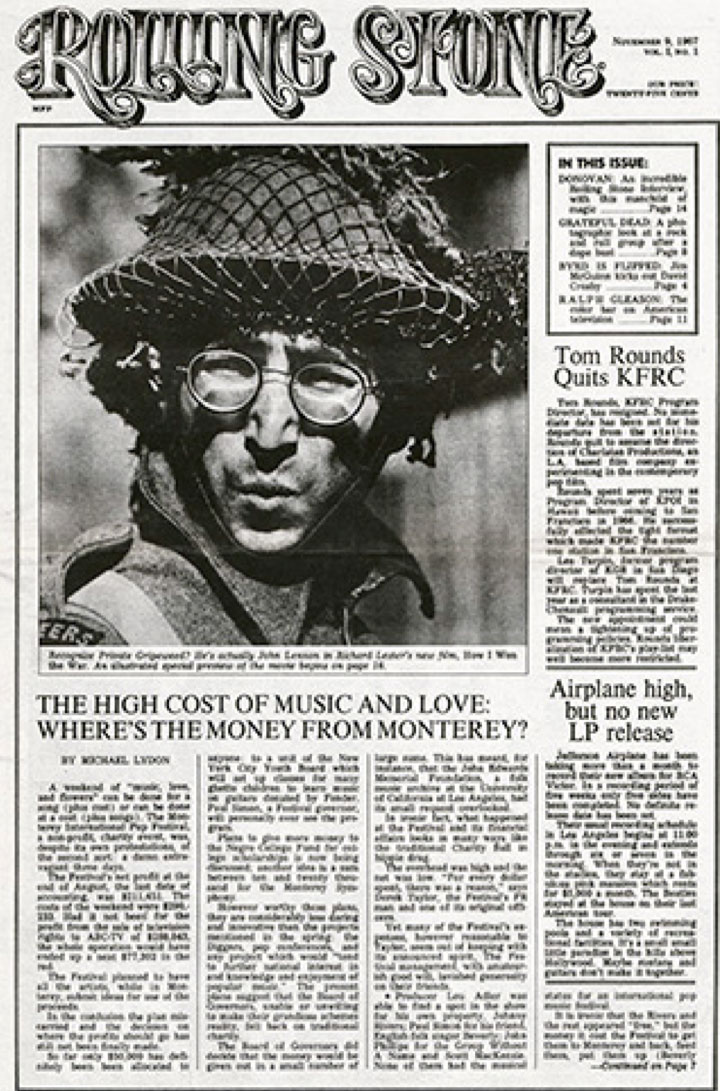
Today in Music (1967): Rolling Stone magazine hit the newsstands

November 9, 1967:

Rolling Stone magazine hit newsstands

The iconic magazine has become “a rock and roll institution” GB and “the most authoritative publication on rock and roll music.” ABC It was launched in San Francisco in 1967 by still-editor and publisher Jann Wenner along with music critic Ralph J. Gleason. Wenner was a transplanted New Yorker who’d moved west to go to Berkeley. As a student, he became a political activist and aspiring journalist. Gleason was a jazz critic with the San Francisco Chronicle who helped Wenner land a job after he dropped out of college in 1966.

In the first issue, Wenner described it as “sort of a magazine and sort of a newspaper” AG which was “not just about the music, but about the things and attitudes that music embraces.” GB The name for the magazine was inspired by the phrase “a rolling stone gathers no moss.” Of course, the famed British rock group of the same name also figured into the mix, as did the Muddy Waters’ song from which they took their name. In addition, Bob Dylan’s “first rock and roll record” was called “Like a Rolling Stone”. AG

The first issue featured a cover image of John Lennon from his movie How I Won the War. Some of the pieces in that issue included an investigation on what happened to profits from the Monterey Pop Festival, the split between the Byrds and David Crosby, Jefferson Airplane’s future plans, and a report that The Who’s “I Can See for Miles” was released that week.

The magazine has ironically received criticism for 1) a bias toward the 1960s and 1970, and 2) an attempt in more recent years to pander to younger audiences. Some bands, such as Led Zeppelin, were largely written off in their active years but celebrated years later. Also, some albums were rated as average or even poor initially (Nirvana’s Nevermind, The Beatles’ Let It Be), but in subsequent issues were celebrated as classics. In addition, the magazine’s liberal politics have occasionally come under fire.

The format has undergone several changes over the years. It started as a black-and-white print tabloid newspaper style publication. From 1973-1980, it was printed on newsprint paper size and then became a 10” x 12” magazine. In 2008, it switched to the smaller, standard-format size. As of April 19, 2010, it began featuring the entire collection archived online. It now operates under a subscription model meaning readers have to be paid members to access some content. The bi-weekly publication has done more than a thousand issues and has a circulation of 1.4 million.


Resources and Related Links:


First posted 11/9/2011; updated 11/5/2023.

Saturday, June 24, 2017

50 years ago: Jefferson Airplane charted with “White Rabbit”

White Rabbit

Jefferson Airplane

Writer(s): Grace Slick (see lyrics here)


First Charted: June 24, 1967


Peak: 8 US, 6 CB, 3 GR, 7 HR, 1 CL, 94 UK, 12 CN, 1 DF (Click for codes to charts.)


Sales (in millions): 2.0 US


Airplay/Streaming (in millions): 1.0 radio, 83.9 video, 199.27 streaming

Awards:

Click on award for more details.

About the Song:

This was “one of the defining songs of the 1967 ‘Summer of Love’” SF and “one of the crucial sounds of the late ‘60s freak scene” DT of the psychedelic rock movement. When St. Louis radio station KSHE switched from an easy listening format to rock in 1967, “White Rabbit” was the first song they played to make it clear they “were aligning themselves with the counterculture.” SF

Grace Slick wrote the “disquietingly catchy” TB song while in her first band, the Great Society. She explained that the music came to her when she “took acid and listened to Miles Davis’ Sketches of Spain album for 24 hours straight until it burned into my brain.” SS The “insistent, militaristic rhythms and the way the song gradually builds to its menacing peak” TB were loosely based on the classical piece “Bolero” by Maurice Ravel. SJ

The lyrics were famously inspired by Lewis Carroll’s Alice’s Adventures in Wonderland. She said, “Our parents read us stories like Peter Pan, Alice in Wonderland and The Wizard of Oz…They all have a place where children get drugs, and are able to fly or see an Emerald City or experience extraordinary animals and people….And our parents are suddenly saying, ‘Why are you taking drugs?’ Well, hello!’” RS500 She said, “I don’t think most people realize the song was aimed at parents who drank and told their kids not to do drugs.” SF It was “a metaphor for the hypocrisy of the straight world.” TC

The FCC came down on the song as drug-related and it was banished from the airwaves, but not until the Nixon administration. Slick has said the song isn’t just about drug use, but “about opening up, looking around, checking out what’s happening…Feeding your head is not necessarily pumping chemicals into it.” SJ It’s about “finding a new awareness whether that be spiritual, political, or sexual.” TC

Jefferson Airplane adapted the song for their second album, Surrealistic Pillow, when Grace Slick came on board. “Jorma Kaukonen brought his acidic, sharp guitar tones to the tune and Spencer Dryden’s staccato drumming made it very unsettling. Most of all, though, there was Slick’s caustic, banshee voice that just tore down the melody. To hear Slick scream ‘feed your head’ is to have a psychedelic experience.” TC


Resources:


Related Links:


First posted 4/17/2020; last updated 3/31/2023.

Friday, June 24, 2011

Psychedelic Rock Goes Mainstream: June 24, 1967


Psychedelic rock is a style of music which strives to replicate the experience of mind-altering psychedelic drugs. It grew out of folk- and blues-rock in the mid ‘60s and integrated non-Western sources such as Indian music. New recording techniques and effects also marked the genre. It was a stepping stone to progressive rock, glam rock, hard rock, and heavy metal. PR

June 24, 1967 does not mark the birth of psychedelic rock. It does, however, make for a fitting place to plant the freak flag on mainstream music turf. Several significant recordings made their chart debuts, trumpeting the genre’s full-fledged arrival on British and American shores.

In the U.K., Pink Floyd charted with their second single, “See Emily Play”. That same day Syd Barrett & Co. made their television debut performing it on Top of the Pops. The recording process for the song implemented studio trickery such as backward tapes, echo, and reverb. SP It hit #6 in the UK and makes the Rock and Roll Hall of Fame’s list of the Top 500 Songs That Shaped Rock and Roll.


By summer’s end, Pink Floyd released their debut album, Piper at the Gates of Dawn, which All Music Guide’s Steve Huey called “one of the best psychedelic albums of all time.” SH


Click photo for more about the album.


On American shores The Beatles debuted on the Billboard charts with Sgt. Pepper’s Lonely Hearts Club Band, another landmark psychedelic album. Many within the music industry, including Dave’s Music Database, call it the best album of all time.


Click photo for more about the album.


That same day, Jefferson Airplane debuted on the Billboard Hot 100 with “White Rabbit.” With references to Lewis Carroll’s Alice in Wonderland as a means of relaying the experience of psychedelic drugs, the song could lay claim as the official psychedelic rock anthem. The group was on the bill of the Monterey Pop Festival which unofficially launched the Summer of Love. That moniker has become the go-to term for a transformative time when hippie lifestyles, complete with their own peace mantra and psychedelic soundtrack, converged upon San Francisco.


Procol Harum’s “A Whiter Shade of Pale” is another “stone cold classic of psychedelia” HS which captured “a moment in the summer of 1967 when, if you were fortunate enough not to have to work for a living and bought into the whole flower power freedom movement, anything seemed possible.” HS The song makes the aforementioned Rock Hall 500 list and is featured in The Top 100 Songs of the Rock Era, 1954-1999. It topped the list of Britain’s most heard songs in 2009. TS


Certainly the development and proliferation of the psychedelic rock movement cannot be narrowed to one day. However, the convergence several game changers on June 24, 1967, is enough to give one a head trip.

Resources:
  • HS Headfullofsnow.com “Procol Harum Week: A Whiter Shade of Pale” (10/4/09)
  • SH Steve Huey, All Music Guide
  • TS Ted Spangler, American SongwriterBritain’s 75 Most Heard Song List Topped By…Procol Harum?” (4/15/09)
  • PR Wikipedia entry on psychedelic rock
  • SP Wikipedia entry on “See Emily Play
  • Wednesday, August 19, 2009

    Woodstock: 40th Anniversary

    Originally posted August 29, 2009. Last updated March 2, 2019.

    Woodstock

    various artists

    Recorded: August 15-18, 1969 (all of below as well)


    Released: June 6, 1970


    Peak: #14 US


    Sales (in millions): 2.0 US


    Genre: classic rock (all of below as well)


    Released:April 10, 1971


    Peak: #7 US


    Sales (in millions): 0.5 US


    Released: June 21, 1994


    Peak: --


    Sales (in millions): 0.1 US


    Released: August 27, 1994


    Peak: #186 US


    Sales (in millions): --


    Released: August 30, 1994


    Peak: --


    Sales (in millions): 0.025 US


    Released: August 18, 2009


    Peak: --


    Sales (in millions): --

    Tracks:

    * The list below reflects, in order of performance, what has been commercially released on any of collections referenced on this page. For track listings of each of those collections individually, check the links under “Review Source(s).”

    Day 1:

    • Set 1: RICHIE HAVENS: Choppity Choppity [John Morris stage announcement] W40, I Can’t Make It Anymore WD, Handsome Johnny W25, W40, Freedom (Motherless Child) W1, WB, W25, W40
    • Set 2: SWEETWATER: Look Out W40, Two Worlds W40
    • Set 3: BERT SOMMER: Jennifer W40, And When It’s Over W40, Smile W40
    • There Goes Marilyn! [John Morris] W40
    • Set 4: TIM HARDIN: Hang on to a Dream W40, If I Were a Carpenter W25, WD, Simple Song of Freedom W40
    • Flat Blue Acid [John Morris] W40
    • Set 5: RAVI SHANKAR: Raga Puriya-Dhanashri/ Gat in Sawarital W40
    • Set 6: MELANIE: Momma Momma W40, Beautiful People W2, W25, W40, Birthday of the Sun W2, W40
    • Set 7: ARLO GUTHRIE: Coming into Los Angeles W1, W25, W40, Wheel of Fortune W40, Walkin’ Down the Line W25, Every Hand in the Land W40
    • All You Funny People [John Morris] W40
    • Set 8: JOAN BAEZ: Joe Hill W1, WB, W25, W40, Sweet Sir Galahad W2, W25, W40, Hickory Wind W40, Drug Store Truck Drivin' Man [with Jeffrey Shurtleff] W1, W25, W40
    • Bring Scully His Asthma Pills [John Morris stage announcement] W40
    • Insulin/ Quill Intro [John Morris stage announcement] W40

    Day 2:

    • Set 1: QUILL: They Live the Life W40, That's How I Eat W40
    • I Understand Your Wife Is Having a Baby [Chip Monck] W40
    • Set 2: COUNTRY JOE McDONALD: Donovan's Reef W40, The "Fish" Cheer/I-Feel-Like-I'm-Fixin'-To-Die Rag W1, WB, W25, W40
    • Set 3: SANTANA: Persuasion W40, Soul Sacrifice W1, WB, W25, W40
    • Set 4: JOHN SEBASTIAN: How Have You Been W40, Rainbows All Over Your Blues W1, W25, W40, I Had a Dream W1, WB, W25, W40
    • Set 5: KEEF HARTLEY BAND: --
    • Set 6: THE INCREDIBLE STRING BAND: The Letter W40, When You Find Out Who You Are W40
    • She Is Lost [Chip Monck] W40
    • We're in Pretty Good Shape [Chip Monck stage announcement] W40
    • Set 7: CANNED HEAT: Going Up the Country W1, WB, W25, W40, Leaving This Town W25, Woodstock Boogie W2, W40
    • The Brown Acid Is Not Specifically Too Good [Chip Monck stage announcement] W1, W40
    • Set 8: MOUNTAIN: Blood of the Sun W2, W25, W40, Theme for an Imaginary Western W2, W25, W40, For Yasgur's Farm W40, Southbound Train WD
    • For Those of You Who Have Partaken of the Green Acid... [Chip Monck] W40
    • Green Acid Advice [Country Joe McDonald] W40
    • Set 9: GRATEFUL DEAD: Dark Star W40
    • Set 10: CREEDENCE CLEARWATER REVIVAL: Green River W25, W40, Ninety-Nine and a Half Won’t Do W25, Commotion W25, Bad Moon Rising W40, I Put a Spell on You W25, W40
    • Set 11: JANIS JOPLIN: Try (Just a Little Bit Harder) W25, WD, Work Me, Lord W25, W40, Ball and Chain W25, WD, W40
    • Set 12: SLY & THE FAMILY STONE: Medley: Dance to the Music/Music Lover/I Want to Take You Higher W1, W25, W40, Love City WD
    • The Politics of the Situation [Abbie Hoffman] W40
    • Set 13: THE WHO: Amazing Journey W40, Pinball Wizard W40, Abbie Hoffman vs. Pete Townshend W40, We're Not Gonna Take It W1, WB, W25, W40
    • Set 14: JEFFERSON AIRPLANE: The Other Side of This Life W40, Volunteers W1, WB, W25, W40, Saturday Afternoon/Won’t You Try W2, W25, W40, We Got a Whole Lot of Orange [Grace Slick stage announcement] W40, Eskimo Blue Day W2, Uncle Sam’s Blues W25, Somebody to Love W25, WD, W40, White Rabbit W25, WD

    • Breakfast in Bed for 400,000 [Wavy Gravy] W1, W40
    • It Just Keeps Goin’ [John Morris] W40
    • Max Yasgur Speaks [Max Yasgur] W40

    Day 3:

    • Set 1: JOE COCKER/ THE GREASE BAND: Feelin' Alright W40, Let's Go Get Stoned W25, WD, W40, I Shall Be Released WD, With a Little Help from My Friends W1, WB, W25, W40
    • The Rainstorm W40
    • Let the Sunshine In [AUDIENCE] W2
    • Set 2: COUNTRY JOE McDONALD & THE FISH: Rock & Soul Music W1, W25, W40, Thing Called Love W40, Not So Sweet Martha Lorraine W40, Summer Dresses W40, Silver and Gold W40, Rock & Soul Music (Reprise) W40
    • Set 3: TEN YEARS AFTER: I’m Goin’ Home W1, WB, W25
    • Set 4: THE BAND: Long Black Veil W25, The Weight W25, WD, Loving You Is Sweeter Than Ever W25
    • Set 5: JOHNNY WINTER: Leland Mississippi Blues W40, Mean Town Blues W25, WD, W40
    • Set 6: BLOOD, SWEAT & TEARS: You've Made Me So Very Happy W40
    • Set 7: CROSBY, STILLS & NASH/YOUNG: Suite: Judy Blue Eyes W1, W25, W40, Blackbird WD, Guinnevere W2, W25, W40, Marrakesh Express W2, W25, W40, 4 + 20 W2, W25, W40, Sea of Madness W1, W25, W40, Wooden Ships W1, WB, W40, Find the Cost of Freedom W25

    Day 4:

    • Set 1: PAUL BUTTERFIELD BLUES BAND: No Amount of Loving W40, Love March W1, W25, W40, Everything’s Gonna Be Alright W2, W40
    • Set 2: SHA NA NA: Get a Job W40, At the Hop W1, W25, W40, Get a Job (Reprise) W40
    • Set 3: JIMI HENDRIX: Get My Heart Back Together W2, Jam Back at the House (aka “Beginnings”) W2, Izabella W2, Voodoo Chile (Slight Return)/ Stepping Stone W25, WD, The Star Spangled Banner/ Purple Haze/ Woodstock Improvisation W1, WB, W25, W40
    • Woodstock Farewell [Chip Monck] W40

    Review:

    This page highlights only the most significant various artists collections out of a myriad of official and bootleg albums that have covered much of the music featured at the August 15-18, 1969 events at Yasgur’s field. The 1970 Woodstock Soundtrack is the highest ranked of the batch in the Dave’s Music Database. The best way to get this version is the 2009 Rhino remaster, “but even it has problems: the source tapes were problematic at best. It restores the original LP order, features new liners by Gene Sculatti, and has more photos in the booklet.” J1

    There’s also the 1971 sequel, Woodstock 2, which was combined with the original Woodstock soundtrack on the Mobile Fidelity triple-CD version. BE

    In 1994, a 25th anniversary, four-disc box set was released and then in 2009 another box set, Woodstock: 40 Years On – Back to Yasgur’s Farm, celebrated the 40th anniversary by expanding to six discs. This is the best place to go for the most complete view of Woodstock.

    Check out Wikia Entertainment for the full schedule and setlists of each performer. WoodstockProject.com is a great resource for tracking down all the commercially and bootlegged Woodstock material.

    Here’s the highlights of each set.


    Woodstock Soundtrack:
    “It’s almost impossible to regard the soundtrack albums for the Michael Wadleigh documentary Woodstock, simply as music, apart from the event that inspired them or what that event has come to represent. Music from the Original Soundtrack and More: Woodstock was originally released by Atlantic’s Cotillion imprint as a three-LP set in a gatefold sleeve” J1. It “was really rock’s first ‘coffee table’ album. Bought by millions but not really listened to that often, it’s amid a flood of wrong notes and the inherent flaws in recording live in front of hundreds of thousands of people in a temporary, makeshift venue. It was more satisfying for journalists and scholars than for ordinary listeners, what with its artists represented by one or two tracks and no more than 15 minutes of music by any single performer. But it did sell in the millions (and yielded a follow-up, Woodstock 2), fueled by the mystique surrounding the event and the release of the accompanying movie, and at times it did have a certain amount of energy to help drive it.” BE

    “There were some telling moments: the second-ever public appearance by Crosby, Stills & Nash, not in great voice but surprisingly adequate given that they were trying to harmonize in front of 250,000 people, and the introduction of Neil Young as the fourth member of the group; Joan Baez, at her most politically defiant and at the height of her reach with younger audiences, doing what is probably the definitive version of Gram Parsons’ Drugstore Truck Driving Man; Canned Heat near the end of the road for its classic lineup; Joe Cocker on his way up the superstar ladder; Jefferson Airplane near the end of its classic era; and Jimi Hendrix in one of his biographically (if not musically) transcendant public appearances.” BE

    “Musically, the second disc sounds the least dated with its over the top performances by a shockingly great Santana with Soul Sacrifice, Ten Years After’s guitar workout on I’m Goin’ Home, Jimi Hendrix’s Star Spangled Banner medley (still a stunner after all these decades); the Jefferson Airplane’s rocking and raucous version of Volunteers, and the orgiastic Sly & the Family Stone medley that includes Dance to the Music, Music Lover, and an insanely great I Want to Take You Higher. There is some filler as well thanks to a drippy John Sebastian track called Rainbows All Over Your Blues, and an indulgent Love March by an out-of-their-prime Butterfield Blues Band.” J1

    “Disc one is more complex. There are some fine moments here, especially the CS&N and CSN&Y tunes, including Suite: Judy Blue Eyes (perhaps not perfect in voice but a very inspired performance), and Wooden Ships, with a decent if not thrilling Sea of Madness, in between. There is a desultory We’re Not Gonna Take It from the Who that is out of context, given they performed the entirety of Tommy. While Canned Heat’s Goin’ Up the Country has aged well, Country Joe & the Fish’s The ‘Fish’ Cheer/ I-Feel-Like-I’m-Fixin’-to-Die Rag has not, nor has Joan Baez’s performance of ‘Drug Store Truck Drivin’ Man.’ Her version of Joe Hill is generic.” J1 “Richie Havens’ Freedom (which is really a rewrite of ‘Motherless Child’)” BE “is still thrilling, especially since it is preceded by Sebastian opening the entire set up with another duller-than-dull I Had a Dream.” J1

    “Freedom” and “Arlo Guthrie’s Comin’ into Los Angeles give listeners about the same level of intimacy on their acoustic guitars. And listening to CSNY’s Suite: Judy Blue Eyes, while it might not be the group’s best harmonizing or tightest performance, Stephen Stills does one hell of a great job and offers a sample of what he’d deliver on his stunning first solo album a little down the road.” BE

    The most out of place thing here is Sha Na Na’s At the Hop, which sounds surreal but ragged and right, and Joe Cocker’s With a Little Help from My Friends, that closes disc one; it’s electrifying if rather out of tune.” J1

    “The original, domestic triple-LP vinyl version had notoriously noisy pressings, and the original master suffered from all of the sound leakages and other defects inherent in recording live in the open air in front of several hundred thousand people.” BE The album, and its sequel, also “took the music out of the historical sequence of the festival and re-ordered (and edited) it for a sense of flow. Whether or not it accomplished its objective has been the subject of much debate…What is relevant is that these performances signified via their spotty recording quality – and sometimes dodgy performances – that there was an amazing array of legendary talent on hand at Woodstock; though not all of it is captured here.” J1

    “So as it stands, Woodstock is a wildly mixed bag, and not particularly pleasant to listen to, but it does indeed have a significant place in the rock pantheon and should be regarded more as an artifact than as an album in its own right.” J1


    Woodstock Two:
    The original 1970 soundtrack “sold so well that Cotillion issued a sequel double album of more music from the festival that never appeared in the film.” J1 “This set featured many of the same artists who’d appeared on the first volume, with two additions: Mountain and Melanie. If anything, this set, more concise and more focused, is a better bet than its predecessor. Disc one is a stunner on more than one level. First, there are three tracks by Jimi Hendrix and his expanded lineup after breaking up the Experience (adding guitarist Larry Lee), and a trio of percussionists along with Mitch Mitchell and bassist Billy Cox. There’s the killer Jam Back at the House, which rolls in riffs and an instrumental array of tunes from his catalog including ‘Rainy Day Dream Away’; there’s a killer take on Izabella that’s raggedy but full of killer improvisation – check the interaction between Cox and Mitchell – and Get My Heart Back Together, also known as ‘Hear My Train A’ Comin’.’ These 20 minutes of music make it worth the purchase of this collection if you don’t already possess the Jimi Hendrix Live at Woodstock disc.” J2

    “Jefferson Airplane is also here with an extra 12 minutes of music. Judging by this contribution and the inclusion of ‘Volunteers,’ on volume 1, this ranks as one of their greatest live sets ever issued. They begin Saturday Afternoon/ Won’t You Try with a medley of tunes from After Bathing at Baxter’s, issued early on in their career. The vocal performances by Marty Balin, Grace Slick, and Paul Kantner are simply stellar, but Jorma Kaukonen’s guitar as a guiding light also really shines here, and it screams on their other selection, Eskimo Blue Day, from the Volunteers album, even if its basic structure aped Bob Dylan’s ‘All Along the Watchtower.’ Disc one ends with the Butterfield Blues Band redeeming themselves with Little Walter’s Everything’s Gonna Be Alright, after the indulgent debacle of ‘Love March’ on volume one.” J2

    “Disc Two features a trio of fine cuts by Crosby, Stills, Nash & Young including Marrakesh Express, and a pair from Mountain: the stellar rocker Blood of the Sun, and the more pastoral Theme from an Imaginary Western. Canned Heat’s 13-minute Woodstock Boogie is a bit monotonous, but it’s a blast all the same. The tracks by Melanie and Joan Baez included here add nothing to this set and should have been left off in favor of some other artists who weren’t included on either volume, but that's personal preference. The Rhino edition of Woodstock Two contains new liner notes by Gene Sculatti, new photos, and completely remastered sound that’s a grand improvement on any CD edition released thus far.” J2


    The Best of Woodstock:
    This is a completely unnecessary CD since it simply distills the Woodstock Soundtrack from a two-disc collection down to one. Consequently, this “is far from a thorough overview of the festival – some of the artists aren’t represented by their most enduring material, and, after all, you can't cover three days’ worth of music in just one disc. Despite those limitations, the sampler does contain some of the festival's best moments, like Country Joe & the Fish’s ‘I-Feel-Like-I'm-Fixin'-to-Die Rag’ and Jimi Hendrix’s ‘Star Spangled Banner’ and Purple Haze. In the absence of the actual Woodstock album, this can be an affordable substitute.” H


    25th Anniversary Box:
    “In 1995, the Woodstock: Three Days of Peace & Music [25th Anniversary] four-CD box appeared, combining virtually all the key parts” BE of “the original three-record Woodstock set from 1970, its two-LP 1971 sequel, Woodstock II, and a generous store of previously unreleased tracks from Creedence Clearwater Revival, Janis Joplin, the Band, Jimi Hendrix, and others.” S “Like the famed August 1969 rock festival it chronicles [the set] is something of a sprawling, disorderly, engaging mess.” S “There’s plenty of chaff to go with the wheat (one is tempted to conclude John (‘Far out!’) Sebastian’s blissed-out rant hasn’t aged well, but it’s just as likely most of the crowd at Yasgur’s Farm would have gagged him if given half a chance, and Jefferson Airplane and Crosby, Stills & Nash clearly had better days). But Sly & the Family Stone, Joe Cocker, Santana, and Richie Havens shine, the stage patter has become part of the lexicon, and the whole package now stands as a remarkable account of a pivotal musical and cultural event.” S


    Woodstock Diary:
    With Best of Woodstock and the 25th anniversary box set already having been released in 1994, “this album, may, at first glance, seem like an afterthought. Actually, it’s a pretty neat compilation. Shorn of the long, indulgent jams, crowd chants, and warnings against bad acid that were an integral part of the earlier, better-known records, Woodstock Diary is a polished little gem – an alternate take on the mother of all rock festivals. Woodstock minus the melodrama, if you will. It isn’t a faultless set list by any means: Jimi Hendrix’s performance – revelatory and inspired as it was – has been covered enough elsewhere, so you can’t help wishing that they’d given his 12 minutes to, say, the Grateful Dead or Blood Sweat and Tears, both of whom haven’t been featured on any of the Woodstock compilations to date. That said, there are lovely moments aplenty: Crosby, Stills and Nash doing the Beatles’ Blackbird; Johnny Winter dropping hot riffs all over Mean Town Blues (the only song he performed at Woodstock); and Joe Cocker’s cover of I Shall Be Released, on which he manages to be affecting without burning the tune down to the ground like he did far more famously on ‘With a Little Help from My Friends.’ Along with the Band’s The Weight, Richie Havens’ tender version of Gordon Lightfoot’s I Can’t Make It Anymore, and Tim Hardin’s If I Were a Carpenter, they make this album predominantly a celebration of the quieter moments at Woodstock. Nine of the 14 tracks here are featured on the 1994 box set, so, for those who own that album, this may not be vital.” M, although it is important to note that those five tracks do not appear on any of the other Woodstock collections referenced on this page. Also, “as a companion piece to the Woodstock and Woodstock 2 albums, it is excellent value.” M


    40th Anniversary Box:
    In 2009, Woodstock was boxed again, this time as a six-CD set, making it “the most comprehensive collection ever available of artists that performed at the original festival.” AZ “It can be argued that this is merely a cash-in, but a number of things should be considered when critically looking at a set of this size, covering one of the most important events in rock music history. Perhaps the most significant aspect of this set is that it contains tracks by almost every single artist who appeared on the Woodstock stage in their proper sequence. The exceptions are the Band and Ten Years After as well as the introductory speech by Swami Satchidananda.” J40

    The collection features “38 previously unreleased recordings, including the Grateful Dead, The Who, Tim Hardin, Jefferson Airplane, Country Joe & The Fish, and others.” AZ “In addition to the music, the set offers considerable amount of ancillary material sprinkled throughout the discs,” AZ including “stage announcements by Chip Monck, John Morris, and Wavy Gravy” J40, “lysergic babble, the sounds of rain, a cameo appearance by Abbie Hoffman, and the graciousness of Max Yasgur’s address to the crowd, heard for the first time in its entirety.” AZ

    “In presenting a historical document of this proportion there are some interesting judgment calls to make. Producers Andy Zax, Mason Williams, and Cheryl Pawleski” J40 “pored over every inch of multitrack tape in search of the strongest parts of each of the 33 sets.” AZ “The sound, which was done by Eddie Kramer, is as good as it can possibly get…The book is a monster, loaded with photos and featuring Bud Scoppa’s wonderfully researched and presented liner essay, whose chapters account for each day, act by act.” J40

    “Ultimately, however, it all comes down to the music. While we only get Dark Star by the Dead, we get (a bit) more music from the Who. The three tracks by CCR are all monsters, and hearing the five tracks by…[CSN/Y] all in correct sequence between BS&T and the Butterfield Blues Band makes total sense. One of the more welcome surprises is the expanded set by Sha Na Na. Fans of individual acts here will be delighted or complain about the treatment individual artists receive. Even though there is a bit more music, the Who still get short-sheeted (but we do get to hear the infamous row between Pete Townshend and Abbie Hoffman), as do the Dead. We didn’t need more of Arlo Guthrie than we already had, and why we still needed three tracks by Melanie or more by the completely unmusical Country Joe & the Fish is a mystery. We could have used more of the Incredible String Band or Richie Havens! But these are individual complaints. The set as it stands is the ultimate document – thus far – and will likely be for some time to come.” J40


    Review Source(s):


    Awards (for Woodstock soundtrack):


    Saturday, August 29, 1998

    Jefferson Airplane/Starship: A Retrospective (1966-1991)

    Jefferson Airplane/Starship

    A Retrospective: 1966-1991

    Overview:

    Jefferson Airplane formed in 1965 in San Francisco, California. They became one of the flagship psychedelic rock bands, most notably with their 1967 album Surrealistic Pillow. They lasted until 1973, at which point they evolved into Jefferson Starship. Five of the members reunited in 1989 for a one-off album.

    In 1974, four of the members of Jefferson Airplane formed Jefferson Starship. That group remained active until 1984, at which time several of the members then formed Starship. That group disbanded in 1991. Only Grace Slick was a member of all three groups.

    Kaukoenen and Casady also formed the spin-off group Hot Tuna. Casady, Balin, and Kanter formed the KBC Band in 1985.


    The Players

    These are the members who have been part of Jefferson Airplane, Jefferson Starship, Starship, Hot Tuna, and the KBC Band from 1966 to 1991.
    • Slick Aguilar (guitar – KBC Band: 1985-87; Jefferson Starship: 91)
    • Signe Anderson (vocals – Jefferson Airplane: 1965-66)
    • Kenny Aronoff (drums – Jefferson Airplane: 1989)
    • Don Baldwin (drums – Jefferson Starship: 1982-84; Starship: 1985-89)
    • Marty Balin (vocals/guitar – Jefferson Airplane: 1965-71, 1989; Jefferson Starship: 1975-79; KBC Band: 1985-87) *
    • John Barbata (drums – Jefferson Airplane: 1972-73; Jefferson Starship: 1974-84)
    • Jack Casady (bass – Jefferson Airplane: 1965-73, 1989; Hot Tuna: 1969-77, 1983, 1986-; KBC Band: 1985-87) *
    • Craig Chaquico (guitar – Jefferson Starship: 1974-84; Starship: 1985-89)
    • Papa John Creach (violin – Jefferson Airplane: 70?-73; Jefferson Starship: 1974-84)
    • Keith Crossan (saxophone/guitar/vocals – KBC Band: 1985-87)
    • Joey Covington (drums – Jefferson Airplane: 1970-72)
    • Spencer Dryden (drums – Jefferson Airplane: 1966-70) *
    • Aynsley Dunbar (drums – Jefferson Starship: 1979-82)
    • David Freiberg (bass/vocals – Quicksilver Messenger Service: 65?-71, Jefferson Airplane: 1972-73; Jefferson Starship: 1974-84)
    • Tom Gorman (keyboards/vocals – KBC Band: 1985-87)
    • Paul Kanter (guitar/vocals – Jefferson Airplane: 1965-72, 1989; Jefferson Starship: 1974-84; KBC Band: 1985-87) *
    • Jorma Kaukonen (guitar – Jefferson Airplane: 1965-73, 1989; Hot Tuna: 1969-77, 1983, 1986-) *
    • Prairie Prince (drums – The Tubes; Jefferson Starship: 1991)
    • Pete Sears (bass – Jefferson Starship: 1974-84; Starship: 1985-89)
    • Grace Slick (vocals: Jefferson Airplane: 1966-72, 1989; Jefferson Starship: 1974-78, 1981-84; Starship: 1985-88) *
    • Alexander “Skip” Spence (drums – Jefferson Airplane: 1965-66)
    • Mickey Thomas (vocals: Jefferson Starship: 1979-84; Starship: 1985-89)
    • Darrell Verdusco (drums – KBC Band: 1985-87)

    * inducted into the Rock and Roll Hall of Fame in 1996 as members of Jefferson Airplane


    Links

    Awards (Jefferson Airplane):

    Awards (Jefferson Airplane/Jefferson Starship):

    Compilations

    This page highlights all of the songs featured on these compilations.

    Songs featured on any of the above anthologies are noted below chronologically under the studio albums under which they originally appeared. If the song charted, the date of the song’s release or first chart appearance and its chart peaks are noted in parentheses. Click for codes to charts.

    Spotify Playlist

    Check out my Spotify playlist Jefferson Airplane/Jefferson Starship/Starship 1966-1991 to hear these songs in one massive playlist.

    1966-1969

    Jefferson Airplane released five albums from 1966 to 1969. Here are the tracks from those albums that are featured on the noted compilations.

    Jefferson Airplane Takes Off (1966)

    • Blues from an Airplane (41 CL) W
    • It’s No Secret (47 CL, 32 DF) W,H

    Surrealistic Pillow (1967)

    • Somebody to Love (4/1/67, 5 BB, 5 CB, 8 GR, 6 HR, 1 CL, 1 CN, 4 DF) W,H
    • White Rabbit (6/23/67, 8 BB, 6 CB, 3 GR, 7 HR, 1 CL, 94 UK, 1 CN, 1 DF) W,H
    • Plastic Fantastic Lover (5/31/69, 25 CL) W,H
    • Embryonic Journey W,H
    • Comin’ Back to Me H
    • Today W

    After Bathing at Baxter’s (1967)

    • Ballad of You & Me & Pooneil (9/2/67, 42 BB, 24 CB, 24 HR, 30 CL) W,H
    • Watch Her Ride (12/9/67, 61 BB, 37 CB, 45 HR, 34 CL) W
    • Martha W

    Crown of Creation (1968)

    • Greasy Heart (4/6/68, 98 BB, 77 CB, 70 HR, 25 CL) W,H
    • Crown of Creation (11/2/68, 64 BB, 60 CB, 84 HR, 25 CL) W,H
    • Lather W,H
    • Chushingura W

    Volunteers (1969)

    • Volunteers (11/8/69, 65 BB, 58 HR, 11 CL) W,H
    • Good Shepherd W,H
    • Wooden Ships (37 CL, 27 DF) W,H
    • We Can Be Together W

    The Worst of Jefferson Airplane

    Jefferson Airplane


    Recorded: 1966-1969


    Released: November 1970

    Peak: 12 US, -- UK, -- CN, 28 AU


    Sales (in millions): 1.0 US


    Genre: psychedelic rock/classic rock


    Rating:

    3.996 out of 5.00 (average of 8 ratings)

    Tracks:

    (1) It’s No Secret (2) Blues from an Airplane (3) Somebody to Love (4) Today (5) White Rabbit (6) Embryonic Journey (7) Martha (8) The Balld of You & Me & Pooneil (9) Watch Her Ride * (10) Greasy Heart * (11) Crown of Creation (12) Chushingura (13) Lather (14) Plastic Fantastic Lover (live) (15) Good Shepherd (16) We Can Be Together (17) Volunteers


    About the Album:

    Songs marked with an asterisk (*) were added to the 2006 CD reissue.

    This collection captures Jefferson Airplane after their first five studio albums. They would release just two more studio albums before becoming Jefferson Starship.

    1970-1978

    Jefferson Airplane only released two more albums before they became Jefferson Starship in 1974. Then they released four albums as Jefferson Starship from 1974 to 1978. Here are the tracks from those albums that are featured on the noted compilations.

    Early Flight (archives, 1974)

    • Have You Seen the Saucers? (5/70, B-side of “Mexico”) H

    Bark (1971)

    • Pretty As You Feel (11/13/71, 60 BB, 35 CB, 42 HR, 20 CL) H
    • Third Week in Chelsea H

    Long John Silver (1972)

    • Long John Silver H

    Dragon Fly (1974)

    • Ride the Tiger (11/6/74, 84 BB, 94 CB, 16 CL, 27 DF) G,P,H
    • Caroline G,P,H
    • Hyperdrive G

    Red Octopus (1975)

    • Miracles (8/23/75, 3 BB, 4 CB, 2 HR, 4 RR, 17 AC, 2 CL, 11 DF) G,P,H
    • Play on Love (12/6/75, 49 BB, 47 CB, 20 CL, 27 DF) G,P
    • Fast Buck Freddie G

    Spitfire (1976)

    • With Your Love (7/24/76, 12 BB, 13 CB, 11 HR, 9 RR, 6 AC, 9 CL, 26 DF) G,P,H
    • St. Charles (12/4/76, 64 BB) G

    Earth (1978)

    • Count on Me (3/11/78, 8 BB, 9 CB, 10 HR, 6 RR, 15 AC, 6 CL) G,P,H
    • Runaway (5/27/78, 12 BB, 13 CB, 14 HR, 8 RR, 37 AC, 8 CL) G,P,H
    • Love Too Good G,P

    Gold

    Jefferson Starship


    Recorded: 1974-1978


    Released: January 22, 1979

    Peak: 20 US, -- UK, 53 CN, -- AU


    Sales (in millions): 0.5 US


    Genre: classic rock


    Rating:

    3.500 out of 5.00 (average of 4 ratings)

    Tracks:

    (1) Ride the Tiger (2) Caroline (3) Play on Love (4) Miracles (5) Fast Buck Freddie (6) Light the Sky on Fire (7) With Your Love (8) St. Charles (9) Count on Me (10) Love Too Good (11) Runaway (12) Hyperdrive


    About the Album:

    This compilation covers the first four studio albums from Jefferson Starship and includes “Light the Sky on Fire,” a non-album cut that the band performed on the Star Wars holiday special in 1978.


    Tracks Not on Previously Noted Albums:

    • Light the Sky on Fire (12/2/78, 66 BB, 65 CB, 70 HR, 40 CL) G

    1979-1984

    Jefferson Starship released four more studio albums from 1979 to 1984 before becoming Starship. Here are the tracks from those albums that are featured on the noted compilations.

    Freedom at Point Zero (1979)

    • Jane (11/3/79, 14 BB, 6 CB, 14 HR, 4 RR, 4 CL, 21 UK, 11 DF) P,TY,H

    Modern Times (1981)

    • Find Your Way Back (4/4/81, 29 BB, 29 CB, 36 HR, 25 RR, 10 CL, 3 AR, 24 DF) P,TY,H
    • Stranger (5/2/81, 48 BB, 55 CB, 56 HR, 28 CL, 17 AR, 37 DF) P,TY,H

    Winds of Change (1982)

    • Be My Lady (10/9/82, 28 BB, 26 CB, 19 RR, 33 AR, 32 DF) P,H
    • Winds of Change (11/6/82, 38 BB, 37 CB, 27 RR 18 AR, 34 DF) P

    Nuclear Furniture (1984)

    • No Way Out (5/12/84, 23 BB, 25 CB, 19 RR, 1 AR, 15 DF) P,TY,H
    • Layin’ It on the Line (6/16/84, 66 BB, 6 AR, 18 DF) P,TY,H

    Playlist

    Jefferson Starship


    Recorded: 1974-1984


    Released: 2008

    Peak: --


    Sales (in millions): --


    Genre: classic rock


    Rating:

    3.138 out of 5.00 (average of 4 ratings)

    Tracks:

    (1) Ride the Tiger (2) Caroline (3) Miracles (4) Play on Love (5) With Your Love (6) Love Too Good (7) Count on Me (8) Runaway (9) Jane (10) Find Your Way Back (11) Stranger (12) Winds of Change (13) Be My Lady (14) No Way Out (15) Layin’ It on the Line


    About the Album:

    This covers the ten years Jefferson Starship existed as a group in between Jefferson Airplane and Starship. The collection contains nine top-40 hits, including the top-10 hits “Miracles” and “Count on Me.”

    1985-1991

    After ten years as Jefferson Starship, the group renamed themselves again, this time simply as Starship. They only recorded three studio albums over six years, but it proved to be their most commercially rewarding time with three #1 hits (“We Built This City,” “Sara,” and “Nothing’s Gonna Stop Us Now”) on the Billboard Hot 100. Here are the tracks from those albums that are featured on the noted compilations.

    Knee Deep in the Hoopla (1985)

    • We Built This City (9/7/85, 1 BB, 1 BA, 1 CB, 1 GR, 1 RR, 37 AC, 1 AR, 12 UK, 1 CN, 1 AU, 7 DF) TY,H
    • Sara (12/14/85, 1 BB, 1 BA, 1 CB, 1 GR, 2 RR, 1 AC, 12 AR, 1 CN, 22 DF) TY,H
    • Tomorrow Doesn’t Matter Tonight (4/5/86, 26 BB, 24 CB, 22 RR, 25 AR, 34 DF) H

    No Protection (1987)

    • Nothing’s Gonna Stop Us Now (1/30/87, 1 BB, 1 BA, 1 CB, 1 GR, 1 RR, 1 AC, 16 AR, 1 UK, 1 CN, 3 AU, 9 DF) TY,H
    • It’s Not Over ‘Til It’s Over (6/27/87, 9 BB, 12 CB, 12 RR, 9 AR) TY,H

    Love Among the Cannibals (1989)

    • It’s Not Enough (8/5/89, 12 BB, 11 CB, 12 RR, 30 AC, 10 AR, 37 DF) TY,H

    Ten Years and Change

    Jefferson Starship/Starship


    Recorded: 1979-1991


    Released: May 14, 1991

    Peak: --


    Sales (in millions): 0.5 US


    Genre: classic rock


    Rating:

    3.175 out of 5.00 (average of 4 ratings)

    Tracks:

    (1) Jane (2) Find Your Way Back (3) Stranger (4) No Way Out (5) Layin’ It on the Line (6) Don’t Lose Any Sleep (7) We Built This City (8) Sara (9) Nothing’s Gonna Stop Us Now (10) It’s Not Over ‘Til It’s Over (11) It’s Not Enough (12) Good Heart


    About the Album:

    This collection covers four studio albums from Jefferson Starship from 1979 to 1984 and three studio albums from Starship released between 1985 and 1989. There are two new cuts on the collection.


    Tracks Not on Previously Noted Albums:

    • Good Heart (4/19/91, 81 BB) TY
    • Don’t Lose Any Sleep TY

    Hits

    Jefferson Airplane/Jefferson Starship/Starship


    Recorded: 1966-1991


    Released: August 29, 1998

    Peak: --


    Sales (in millions): --


    Genre: classic rock


    Rating:

    3.000 out of 5.00 (average of 5 ratings)

    Tracks, Disc 1:

    (1) It’s No Secret (2) Somebody to Love (3) White Rabbit (4) Embryonic Journey (5) Plastic Fantastic Lover (6) Comin’ Back to Me (7) The Ballad of You and Me and Pooneil (8) Greasy Heart (9) Lather (10) Crown of Creation (11) Wooden Ships (12) Volunteers (13) Good Shepherd (14) Have You Seen the Saucers (15) Pretty As You Feel (16) Third Week in Chelsea (17) Long John Silver (18) Caroline (19) Ride the Tiger

    Tracks, Disc 2:

    (1) Miracles (2) With Your Love (3) Count on Me (4) Runaway (5) Jane (6) Find Your Way Back (7) Stranger (8) Be My Lady (9) No Way Out (10) Layin’ It on the Line (11) We Built This City (12) Sara (13) Tomorrow Doesn't Matter Tonight (14) Nothing’s Gonna Stop Us Now (15) It’s Not Over (Til It’s Over) (16) It's Not Enough


    About the Album:

    This two-disc retrospective covers the incarnations of Jefferson Airplane, Jefferson Starship, and Starship over 25 years. While it may be jarring for some to hear “White Rabbit” and “We Built This City” on the same collection, this wisely chronologically-ordered set makes for a fascinating look at how much these groups changed over the years.

    Resources and Related Links:


    First posted 7/16/2025; last updated 7/17/2025.