Showing posts with label Jule Styne. Show all posts

Thursday, May 21, 2009

50 years ago: Gypsy opened on Broadway

Gypsy

Jule Styne (music), Stephen Sondheim (lyrics)

The Musical

Opened on Broadway: May 21, 1959


Number of Performances: 702


Opened at London’s West End: May 29, 1973


Number of Performances: 300


Movie Release: November 1, 1962

Cast Album


Charted: July 20, 1959


Peak: 13 US


Sales (in millions): --


Genre: show tunes


Soundtrack


Charted: December 15, 1962


Peak: 10 US


Sales (in millions): --


Genre: show tunes


Songs on Cast Album:

Song Title (Performers)

  1. Overture
  2. Let Me Entertain You (JACQUELINE MAYRO/ KAREN MOORE/ ETHEL MERMAN)
  3. Some People (ETHEL MERMAN/ STEPHEN SONDHEIM)
  4. Small World (ETHEL MERMAN/ JACK KLUGMAN)
  5. Baby June and Her Newsboys
  6. Mr. Goldstone, I Love You (ETHEL MERMAN)
  7. Little Lamb (SANDRA CHURCH)
  8. You’ll Never Get Away from Me (ETHEL MERMAN/ JACK KLUGMAN)
  9. Dainty June and Her Farmboys
  10. If Momma Was Married (SANDRA CHURCH/ LANE BRADBURY)
  11. All I Need Is the Girl (PAUL WALLACE/ SANDRA CHURCH)
  12. Everything’s Coming Up Roses (ETHEL MERMAN)
  13. Together (Wherever We Go) (ETHEL MERMAN/ JACK KLUGMAN/ SANDRA CHURCH)
  14. You Gotta Get a Gimmick (FAITH DANE/ CHOTZI FOLEY/ MARIA KARNILOVA)
  15. Let Me Entertain You (SANDRA CHURCH)
  16. Rose’s Turn (ETHEL MERMAN)


Songs on Soundtrack:
  1. Overture
  2. Small World
  3. Some People
  4. Baby June And Her Newsboys (Let Me Entertain You)
  5. Mr. Goldstone, I Love You
  6. Little Lamb
  7. You'll Never Get Away From Me
  8. Dainty June And Her Farm Boys
  9. If Mama Was Married
  10. All I Need Is The Girl
  11. Everything's Coming Up Roses
  12. Together Wherever We Go
  13. You Gotta Have A Gimmick
  14. Let Me Entertain You
  15. Rose's Turn
  16. Finale

Rating:

4.502 out of 5.00 (average of 9 ratings for cast album and soundtrack combined)


Quotable: “One of the crowning achievements of the mid-20th century’s conventional musical theatre art form” – Wikipedia


Awards (Cast Album and Soundtrack): (Click on award to learn more).

About the Show:

Critic Ben Brantley said Gypsy may be the greatest of all American musicals.” WK-C Frank Rich said it was “Broadway’s own brassy, unlikely answer to King Lear.” WK-C This 1959 tribute to burlesque was loosely based on the 1957 memoirs of famed striptease artist Gypsy Rose Lee. The story “casts an affectionate eye on the hardships of show business life” WK-C by following Gypsy’s mother, Rose, and her efforts to raise her daughters as performers.

Producer David Merrick had read a selection of the memoirs in Harper’s Magazine and sought the rights, knowing Ethel Merman was looking for a starring vehicle. Arthur Laurents was tapped to write the book and Stephen Sondheim, with whom Laurents had worked on West Side Story, was brought in to write the lyrics after Irving Berlin and Cole Porter declined. Merman wanted Jule Styne to write the music, but Sondheim initially refused since he wanted to write the music and lyrics – that is, until he was persuaded to take the job by Oscar Hammerstein. WK-C

The talents of Styne, who represented broad show business entertainment, and Sondheim, who symbolized more “modern, dark, psychological drama,” MWR made for a perfect balance. It “was considered the definitive Merman performance and the crowning achievement of her long career.” MWR Theater critic Clive Barnes described Rose as “one of the few truly complex characters in the American musical.” WK-C

The musical, which ran for 702 performances, introduced “the Merman standard Everything’s Coming Up Roses, and the song that is invariably used to introduce anything having to do with the strip tease, Let Me Entertain You.” MWR

In 1962, it was made into a film directed by Mervyn LeRoy. In his book The Musical Film, Douglas McVay said, “Fine as West Side Story is…it is equaled and, arguably, surpassed – in a rather different idiom – by another filmed Broadway hit: Mervyn LeRoy’s Gypsy.” WK-S

Resources and Related Links:


Other Related DMDB Pages:


First posted 3/22/2011; last updated 12/23/2021.

Friday, December 22, 1995

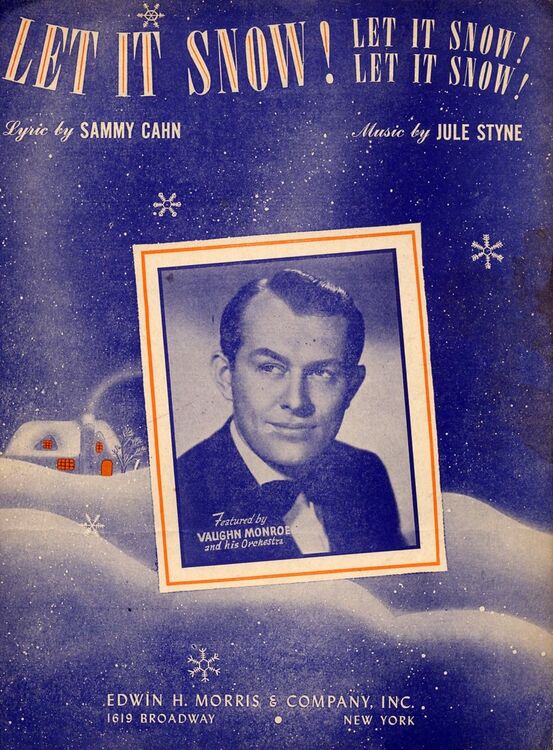
Today in Music (1945): Vaughn Monroe “Let It Snow! Let It Snow! Let It Snow!” charted

Let It Snow! Let It Snow! Let It Snow!

Vaughn Monroe

Writer(s): Jule Styne (music), Sammy Cahn (words) (see lyrics here)


First Charted: December 22, 1945


Peak: 15 BB, 15 BS, 15 DJ, 15 JB, 2 GA, 16 SM, 12 HP, 2 DF (Click for codes to charts.)


Sales (in millions): --


Airplay/Streaming (in millions): -- radio, 1.34 video, 2.06 streaming

Awards:

Click on award for more details.

About the Song:

Lyricist Sammy Cahn and composer Jule Styne wrote “Let It Snow! Let It Snow! Let It Snow!” in July 1945 during a heat wave in Hollywood, California. WK Cahn would go on to write four Academy Award winning songs. “Three Coins in the Fountain” (1954), “All the Way” (1957), and “High Hopes” (1959) were all popularized by Frank Sinatra. Styne also worked on “Three Coins” and he and Cahn also teamed up for Academy Award nominees “I”ve Heard That Song Before” (1942), “I’ll Walk Alone” (1944), “Anywhere” (1945), “I Fall in Love Too Easily” (1945), “It’s Magic” (1948), and “It’s a Great Feeling” (1949).

It has become a seasonal favorite “despite not mentioning Christmas in the lyrics, nor the holiday season.” SM Instead, it is “about being warm and cozy at home in wintertime,” SM cuddling up with someone, and popping corn. Billboard magazine ranked it the second biggest Christmas hit from 1935 to 1954. TY2 The song experienced a revival when it was included in the 1990 Bruce Willis’ movie Die Hard II.

Vaughn Monroe was the first to record it that fall. It became a hit that Christmas, reaching #1 for 5 weeks. He was a “big-voiced baritone, trumpeter, and bandleader” PM who charted 67 times from 1940 to 1954. “Let It Snow! Let It Snow! Let It Snow!” was his sixth of nine #1 songs. PM

Three other versions of the song charted in 1946 – Woody Herman (#7), Connee Boswell (#9), and Bob Crosby (#14). PM Frank Sinatra’s 1950 version of the song charted in Australia (#17), Canada (#28), and the UK (#33). Dean Martin recorded the song in 1959 although it would be 2018 before it reached the Billboard Hot 100, going all the way to #8. Others who have charted with the song include George Strait (#72 CW, 1999), Michael BublĂ© (#1 AC, #44 UK, 2003), Jessica Simpson (#20 AC, 2004), Carly Simon (#6 AC, 2005), Mannheim Steamroller (#26 AC, 2007), Toby Keith (#53 CW, 2007), Rod Stewart & Dave Koz (#1 AC, 2012), Dave Koz with Kenny G (#14 AC, 2014), Seal (#11 AC, 2017), and Pentatonix (#17 AC, 2017).


Resources:


Related Links:


First posted 12/20/2023.

Saturday, March 6, 1993

50 years ago: Harry James hit #1 with “I’ve Heard That Song Before” for first of 13 weeks

I’ve Heard That Song Before

Harry James and Helen Forrest

Writer(s): Jule Styne, Sammy Cahn (see lyrics here)


First Charted: January 16, 1943


Peak: 113 US, 14 HP, 18 GA, 11 RB (Click for codes to charts.)


Sales (in millions): 1.25 US


Airplay/Streaming (in millions): -- radio, 0.85 video, 7.09 streaming

Awards:

Click on award for more details.

About the Song:

Composer Jule Styne and lyricist Sammy Cahn launched a successful musical writing partnership with this song TY1 about how musical numbers aid listeners in strolling down memory lane and thinking about lost loves. It was featured in the 1942 film, Youth on Parade and landed an Academy Award nomination. The pair went on to write together for numerous films and Broadway musicals, winning an Oscar for the title song of 1954’s Three Coins in the Fountain. Both are Songwriters Hall of Fame inductees.

Bob Crosby introduced the song in Youth on Parade, but it was the version by the Harry James’ Orchestra with Helen Forrest on vocals which became the hit. They recorded the song on July 31, 1942, one day before the Musician Union’s ban. WK Their rendition charted in January of 1943 and became the biggest song of the year CPM and one of the biggest #1 hits in history. In the pre-rock era, only Bing Crosby’s “White Christmas” and Francis Craig’s “Near You” spent more weeks atop the charts.

James was a trumpeter who’d played with Ben Pollack and then Benny Goodman before starting his own band in 1938. For several years, he charted only with instrumentals. However, in 1941-42, his hits tended to feature vocalists, including Forrest on the #1 song “I Don’t Want to Walk without You.” PM When the Musician Union’s ban disrupted the release of new recordings, Columbia dipped into their vaults and released older recordings by James. The most significant was a 1939 recording of “All or Nothing at All” which featured a then largely-unknown Frank Sinatra. PM James and Forrest recorded “I’ve Heard That Song Before” a day before the strike and Columbia released it five months later. SS

Forrest became one of big band’s most popular female singers SS working with Artie Shaw (“They Say,” “Thanks for Everything,” both #1’s) from 1938-39 and then had her own stint with Goodman (“Taking a Chance on Love,” #1) from 1939 to 1941. Her stint with James from 1941-43 was “her happiest band experience” SS thanks to James’ approach at building arrangements around her voice and his horn. SS She also had success recording with Dick Haymes (“Long Ago and Far Away,” #2).

Other artists to record the song included Pat Boone, the King Cole Trio, Steve Lawrence, Vera Lynn, Al Martino, Frank Sinatra, Mel Tormé, and Margaret Whiting. WK The song has also been featured in the 1986 Woody Allen movie, Hannah and Her Sisters.


Resources:


First posted 1/6/2013; last updated 4/5/2023.