Showing posts with label Sammy Cahn. Show all posts

Friday, December 22, 1995

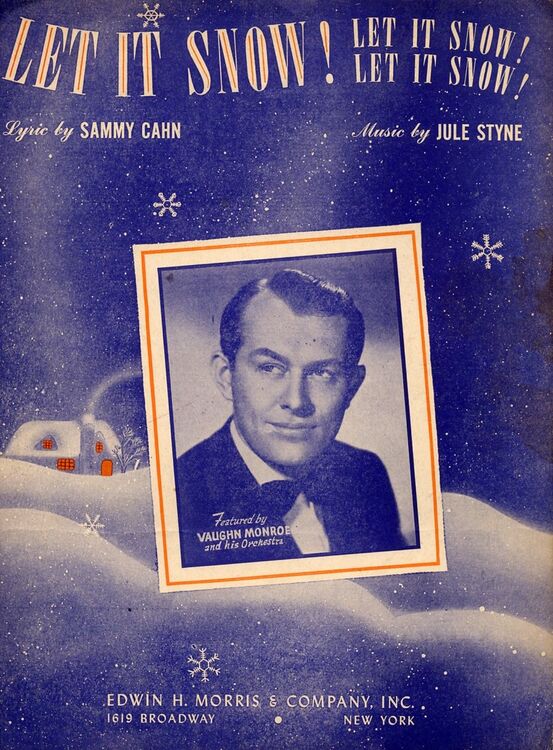
Today in Music (1945): Vaughn Monroe “Let It Snow! Let It Snow! Let It Snow!” charted

Let It Snow! Let It Snow! Let It Snow!

Vaughn Monroe

Writer(s): Jule Styne (music), Sammy Cahn (words) (see lyrics here)


First Charted: December 22, 1945


Peak: 15 BB, 15 BS, 15 DJ, 15 JB, 2 GA, 16 SM, 12 HP, 2 DF (Click for codes to charts.)


Sales (in millions): --


Airplay/Streaming (in millions): -- radio, 1.34 video, 2.06 streaming

Awards:

Click on award for more details.

About the Song:

Lyricist Sammy Cahn and composer Jule Styne wrote “Let It Snow! Let It Snow! Let It Snow!” in July 1945 during a heat wave in Hollywood, California. WK Cahn would go on to write four Academy Award winning songs. “Three Coins in the Fountain” (1954), “All the Way” (1957), and “High Hopes” (1959) were all popularized by Frank Sinatra. Styne also worked on “Three Coins” and he and Cahn also teamed up for Academy Award nominees “I”ve Heard That Song Before” (1942), “I’ll Walk Alone” (1944), “Anywhere” (1945), “I Fall in Love Too Easily” (1945), “It’s Magic” (1948), and “It’s a Great Feeling” (1949).

It has become a seasonal favorite “despite not mentioning Christmas in the lyrics, nor the holiday season.” SM Instead, it is “about being warm and cozy at home in wintertime,” SM cuddling up with someone, and popping corn. Billboard magazine ranked it the second biggest Christmas hit from 1935 to 1954. TY2 The song experienced a revival when it was included in the 1990 Bruce Willis’ movie Die Hard II.

Vaughn Monroe was the first to record it that fall. It became a hit that Christmas, reaching #1 for 5 weeks. He was a “big-voiced baritone, trumpeter, and bandleader” PM who charted 67 times from 1940 to 1954. “Let It Snow! Let It Snow! Let It Snow!” was his sixth of nine #1 songs. PM

Three other versions of the song charted in 1946 – Woody Herman (#7), Connee Boswell (#9), and Bob Crosby (#14). PM Frank Sinatra’s 1950 version of the song charted in Australia (#17), Canada (#28), and the UK (#33). Dean Martin recorded the song in 1959 although it would be 2018 before it reached the Billboard Hot 100, going all the way to #8. Others who have charted with the song include George Strait (#72 CW, 1999), Michael Bublé (#1 AC, #44 UK, 2003), Jessica Simpson (#20 AC, 2004), Carly Simon (#6 AC, 2005), Mannheim Steamroller (#26 AC, 2007), Toby Keith (#53 CW, 2007), Rod Stewart & Dave Koz (#1 AC, 2012), Dave Koz with Kenny G (#14 AC, 2014), Seal (#11 AC, 2017), and Pentatonix (#17 AC, 2017).


Resources:


Related Links:


First posted 12/20/2023.


Saturday, March 6, 1993

50 years ago: Harry James hit #1 with “I’ve Heard That Song Before” for first of 13 weeks

I’ve Heard That Song Before

Harry James and Helen Forrest

Writer(s): Jule Styne, Sammy Cahn (see lyrics here)


First Charted: January 16, 1943


Peak: 113 US, 14 HP, 18 GA, 11 RB (Click for codes to charts.)


Sales (in millions): 1.25 US


Airplay/Streaming (in millions): -- radio, 0.85 video, 7.09 streaming

Awards:

Click on award for more details.

About the Song:

Composer Jule Styne and lyricist Sammy Cahn launched a successful musical writing partnership with this song TY1 about how musical numbers aid listeners in strolling down memory lane and thinking about lost loves. It was featured in the 1942 film, Youth on Parade and landed an Academy Award nomination. The pair went on to write together for numerous films and Broadway musicals, winning an Oscar for the title song of 1954’s Three Coins in the Fountain. Both are Songwriters Hall of Fame inductees.

Bob Crosby introduced the song in Youth on Parade, but it was the version by the Harry James’ Orchestra with Helen Forrest on vocals which became the hit. They recorded the song on July 31, 1942, one day before the Musician Union’s ban. WK Their rendition charted in January of 1943 and became the biggest song of the year CPM and one of the biggest #1 hits in history. In the pre-rock era, only Bing Crosby’s “White Christmas” and Francis Craig’s “Near You” spent more weeks atop the charts.

James was a trumpeter who’d played with Ben Pollack and then Benny Goodman before starting his own band in 1938. For several years, he charted only with instrumentals. However, in 1941-42, his hits tended to feature vocalists, including Forrest on the #1 song “I Don’t Want to Walk without You.” PM When the Musician Union’s ban disrupted the release of new recordings, Columbia dipped into their vaults and released older recordings by James. The most significant was a 1939 recording of “All or Nothing at All” which featured a then largely-unknown Frank Sinatra. PM James and Forrest recorded “I’ve Heard That Song Before” a day before the strike and Columbia released it five months later. SS

Forrest became one of big band’s most popular female singers SS working with Artie Shaw (“They Say,” “Thanks for Everything,” both #1’s) from 1938-39 and then had her own stint with Goodman (“Taking a Chance on Love,” #1) from 1939 to 1941. Her stint with James from 1941-43 was “her happiest band experience” SS thanks to James’ approach at building arrangements around her voice and his horn. SS She also had success recording with Dick Haymes (“Long Ago and Far Away,” #2).

Other artists to record the song included Pat Boone, the King Cole Trio, Steve Lawrence, Vera Lynn, Al Martino, Frank Sinatra, Mel Tormé, and Margaret Whiting. WK The song has also been featured in the 1986 Woody Allen movie, Hannah and Her Sisters.


Resources:


First posted 1/6/2013; last updated 4/5/2023.

Friday, January 22, 1988

Today in Music (1938): The Andrews Sisters “Bei Mir Bist Du Schöen” hit #1

Bei Mir Bist Du Schöen (Means That You're Grand)

The Andrews Sisters

Writer(s): Sholom Secunda (music), Jacob Jacobs (Yiddish lyrics), Sammy Cahn and Saul Chaplin (English lyrics) (see lyrics here)


First Charted: January 1, 1938


Peak: 15 PM, 12 HP, 14 GA, 16 SM (Click for codes to charts.)


Sales (in millions): 1.0 US, -- UK, 14.0 world (includes US + UK)


Airplay/Streaming (in millions): -- radio, -- video, 11.11 streaming

Awards:

Click on award for more details.

About the Song:

During the 1930s, the Andrews Sisters – Patty, Maxene, and LaVerne – started out in vaudeville shows and then, with their parents chaperoning, started singing anywhere they could get hired. NRR Their father was frustrated that they weren’t going anywhere and gave them a year to make it or they would return home to Minneapolis. Dave Kapp, head of Decca Records, heard them on a New York radio station and hired them. NRR Their first record didn’t go anywhere, but their second was their first of 90 chart hits from 1938 to 1951 and their first of six #1 songs. PM

The A-side of the second single was originally “Nice Work if You Can Get It,” a Gershwin song which had been featured in the Fred Astaire film A Damsel in Distress. The B-side was “an obscure Yiddish love song called ‘Bei Mir Bist Du Schoen,’ often translated as ‘To Me, You Are Beautiful.’” NRR It first appeared in I Would if I Could, a 1932 Yiddish musical comedy, NRR under the title “Bay Mir Bistu Sheyn” and was sung by Aaron Lebedeff. SS

Sammy Cahn and Saul Chaplin wrote English lyrics for the song after, according to Cahn, he heard it performed by African-American singers Johnny & George in 1935 at Harlem’s famed Apollo Theater. SS However, Vic Schoen, the arranger for the Andrews Sisters, claimed he discovered the song in a lobby shop of a Yiddish theater. NRR Meanwhile Lou Levy, who shared an apartment with Cahn, said he bought the song. NRR

When the song was released, it was “Bei Mir Bist Du Schoen” that attracted record buyers flooding record stores with requests for “Buy a Beer, Monsieur Shane,” “Mr. Barney McShane,” “My Dear Mr. Shane” and “My Mere Bits of Shame.” NRR The song became so popular that Life magazine published a story about the song’s history. NRR By the end of January, it had sold 250,000 copies NRR and would eventually become the first gold record awarded to a female group. TY2 By year’s end, the American Society of Composers, Authors and Publishers (ASCAP) named it the most popular song of 1938. NRR


Resources:


Related Links:


First posted 1/21/2024.