


 |
Originally posted 7/22/2021. In honor of the 10th anniversary of the DMDB blog on January 22, 2019, Dave’s Music Database launched its own Hall of Fame. This is the eleventh set of song inductees. These are the 10 highest-ranked songs that make the DMDB’s list of the “Top 100 Vaudeville Songs of All Time”. It does not include previously inducted songs “You’re a Grand Old Flag” by Billy Murray, “Alexander’s Ragtime Band” by Arthur Collins and Bryon G. Harlan, “April Showers” and “Swanee” by Al Jolson, “Take Me Out to the Ball Game” by Billy Murray & the Haydn Quartet. |
Arthur Collins “Bill Bailey, Won’t You Come Home” (1902)Inducted July 2021 as “Top Vaudeville Songs” |
| This “early ragtime classic” RCG and “favorite of Dixie jazz bands” JA-22 became a “sing-along standard” RCG thanks to the ease with which it could be adapted to jazz or played on honky-tonk piano or banjo. RCG John Queen, a minstrel and songwriter introduced this instant hit. Arthur Collins, Dan Quinn, and Silas Leachman each took the song to the top 5 in 1902, but Collins’ version was the biggest. PM He was no stranger to the top, having landed there seven times before. This, however, was his biggest hit yet. Read more. |  |
Billy Murray “Meet Me in St. Louis, Louis” (1904)Inducted July 2021 as “Top Vaudeville Songs” |
| In 1904, the world shone a light on St. Louis. In celebration of the centential of the Louisiana Purchase, the U.S. “Gateway to the West” became the stage for two major parties – the World’s Fair and the third modern Olympic Games. Composer Kerry Mills and lyricist Andrew Sterling capitalized on the city’s popularity by penning what what would become the exposition’s theme song. RA Read more. |  |
Haydn Quartet “Sweet Adeline (You’re the Flower of My Heart)” (1904)Inducted July 2021 as “Top Vaudeville Songs” |
| As “the signature barbershop song,” DS “Sweet Adeline” may represent the sound of the first decade of the 20th century, WHC maybe even the first two decades, DS more than any other song. WHC The style of four-part male harmony with little or no musical accompaniment was popularized by groups like the Haydn Quartet who scored their sixth #1 with “Sweet Adeline,” the biggest hit of 1904. WHC Read more. |  |
Billy Murray “Yankee Doodle Boy” (1905)Inducted July 2021 as “Top Vaudeville Songs” |
| George M. Cohan “virtually invented musical comedy” LW predating future musical theatre greats like Jerome Kern, George Gershwin, and Richard Rodgers. His first two efforts at Broadway musicals flopped, but his third attempt, 1904’s Little Johnny Jones, was a hit PS producing “Give My Regards to Broadway” and “Yankee Doodle Boy.” PS Billy Murray’s recording of the latter gave the Victor record company its biggest seller up to that point. SS Read more. | 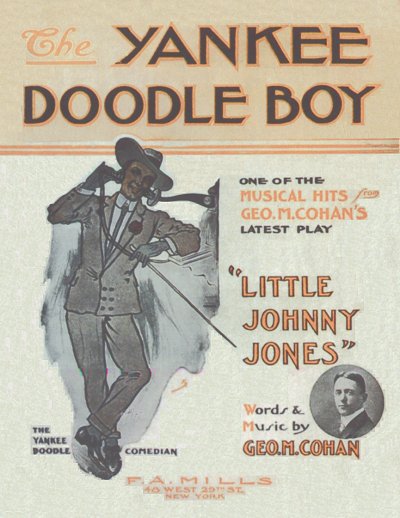 |
Billy Murray “Give My Regards to Broadway” (1905)Inducted July 2021 as “Top Vaudeville Songs” |
| George M. Cohan wrote, composed, produced, acted, and danced in the Broadway musical, Little Johnny Jones, inspired by real-life jockey Tod Sloan. The show featured “Give My Regards to Broadway” which “could only have been sung by an opinionated, cocky young man with a very high opinion of his own worth.” LW Cohan was a natural. Read more. |  |
Bryon G. Harlan “School Days (When We Were a Couple of Kids)” (1907)Inducted July 2021 as “Top Vaudeville Songs” |
| In the early 1900s, sentimental ballads were popular and songs like “Shine on, Harvest Moon,” “In the Shade of the Old Apple Tree,” and “School Days” “exemplified this musical style.” WHC These songs dominated sheet music sales, as they “could be sung in the parlor at home around the family piano.” WHC It “remains a singalong favorite.” JA Read more. |  |
Harry Macdonough with Miss Walton “Shine on Harvest Moon” (1909)Inducted July 2021 as “Top Vaudeville Songs” |
| Nora Bayes and husband Jack Norworth wrote what may be “the most recognized of the many ‘moon’ ballads.” RCG It was “decidedly old-fashioned and a product of twentieth century innocence.” RCG The duo introduced the song in Florenz Ziegfeld’s Follies of 1908. The couple didn’t last, divorcing in 1913 (the second of five marriages for Bayes!), SF but the song survived. Both performed it the rest of their lives and it became Bayes’ signature song. RCG Read more. |  |
Billy Murray with the Haydn Quartet “By the Light of the Silvery Moon” (1910)Inducted July 2021 as “Top Vaudeville Songs” |
| Edward Madden crafted the words for “By the Light of the Silvery Moon” around Gus Edwards “somewhat dreamy music that lends itself to soft shoe.” RCG Its “moon-June-croon rhymes” are “cliché by today’s standards,” RCG but were representative of the Tin Pan Alley era which dominated music in the early 1900s. Read more. |  |
Sophie Tucker “Some of These Days” (1911)Inducted July 2021 as “Top Vaudeville Songs” |
| This has been called “the most important turning point in Tin Pan Alley history” because it was completely different than other popular music of the day. RCG Canadian songwriter Shelton Brooks originally composed this blues number as a waltz, but integrated jazz into the song’s loose structure. As such, jazz musicians had a wide-open pallet on which to improvise. RCG Read more. |  |
American Quartet “Moonlight Bay” (1912)Inducted July 2021 as “Top Vaudeville Songs” |
| “Arguably the best moonlight song ever written,” PS “Moonlight Bay” “conjures up an entire lost era of a slower-paced America that…had plenty of time for gentle spooning in an unspoiled natural setting.” SS It is “a very durable song from Tin Pan Alley about an idyllic setting for romance.” RCG Read more. |  |


