DavesMusicDatabase.com is devoted to ranking, rating, and reviewing music of all genres and eras. The DMDB blog serves up album and song reviews, best-of lists, music history snapshots, and music-related essays.
According to Wikipedia, “crooners are singers who sing in a soft, intimate style made possible by the introduction of microphones and amplification.” This technological breakthrough made it possible to pick up quieter sounds and a greater frequency range. Prior to such breakthroughs, singers had to be able to project through a very loud vocal style. Crooners often performed in front of big bands. The style grew to its height in popularity in the 1940s through the late ‘60s. It has, however, continued through modern day artists such as Michael Bublé and Harry Connick, Jr. who sing vocal jazz in a style which has come to be labeled as “traditional pop.”
This list was created by aggregating 10 lists focused on the best crooners of all time. See other lists of Acts/Music Makers by Categories.
Airplay/Streaming (in millions):
-- radio, 41.2 video, 390.64 streaming
Awards:
Click on award for more details.
About the Song:
Two-time Grammy winner Mel Tormé had a career spanning more than 50 years. His smooth, crooning style earned him the nickname “The Velvet Fog.” When he wrote “The Christmas Song,” however, he was at the beginning of his career. He was 19 and his friend Robert Wells was 22 when they wrote what BMI says is the most-performed Christmas song of all time. SB According to Tormé, they penned the song in the heart of summer, trying to “stay cool by thinking cool.” SB
Tormé and Nat “King” Cole were both managed by Carlos Gastel. Tormé and Wells presented the song to Cole, who was used to recording with the King Cole Trio, which he’d established in 1937. Cole served as pianist alongside guitarist Oscar Moore and bassist Wesley Prince. Gastel and the executives at Capitol Records insisted Cole should record with strings and a studio orchestra – and suggested Cole stand and sing instead of taking up his usual position behind the keyboard. SS
Despite the objections of Capitol Records, Cole made two recordings – the first with the Trio in June 1946 and the second, in August, WK with a small section of strings. It was the latter which became the seasonal classic, peaking at #3, but returning every season. In 1953, Cole recorded the song again with the same arrangement, but this time with a full orchestra arranged and conducted by Nelson Riddle. JA He recorded it again in 1961 with an orchestra conducted by Ralph Carmichael. SB
“The Christmas Song” ranks as the fifth most-recorded song of the rock era. SS Other artists who recorded the song include Christina Aguilera, Julie Andrews, Tony Bennett, Justin Bieber, Michael Bolton, Garth Brooks, James Brown, Chicago, Natalie Cole, Bing Crosby, Doris Day, John Denver, Celine Dion, Bob Dylan, Gloria Estefan, Aretha Franklin, Judy Garland, Whitney Houston, Etta James, Peggy Lee, Demi Lovato, Barry Manilow, Paul McCartney, The Miracles, New Kids on the Block, Kenny Rogers, Linda Ronstadt, Frank Sinatra, Rod Stewart, Barbra Streisand, The Supremes, James Taylor, The Temptations, Luther Vandross, and Stevie Wonder. WK Cole’s version was one of the first eight inductees into the Grammy Hall of Fame.
Richard Rodgers and Lorenz Hart made their names as giants of musical theater having written The Garrick Gaieties (1925), A Connecticut Yankee (1927), and Present Arms (1928). Ironically, though, their biggest-selling song TY didn’t become a hit because of an appearance in a musical or movie. The pair wrote a song intended for a 1933 Jean Harlow film which has been said to be called “The Prayer” TY and “Make Me a Star.” BR1 It underwent several revisions, becoming “The Bad in Every Man” and “Act One,” but continued to be passed over for movies.
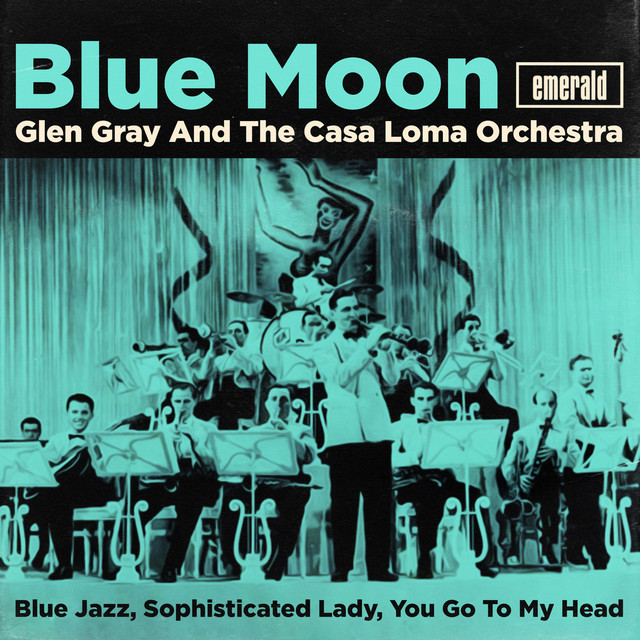
Jack Robbins, the head of MGM’s musical publishing division, heard the song and said he’d promote it if the lyrics were rewritten to be more commercial. KL The resulting “Blue Moon” became a #1 hit for Glen Gray in 1935. That same year, Benny Goodman had a #2 hit with it and Al Bowlly and Ray Noble took it to #5. In 1949, the song charted again thanks to its appearance in the 1948 film Words and Music. Mel Torme took it to #20 and Billy Eckstine got to #21.
After that, it was featured in movies frequently, including With a Song in My Heart (1952), This Could Be the Night (1957), New York, New York (1977), and An American Werewolf in London (1981). Elvis Presley recorded the song while at Sun Records and had a minor hit with it. However, the song got its biggest boost from a quintet from Pittsburgh who were named after a popular hairstyle. BR1
The Marcels went into the studio to record four songs. One was “Blue Moon,” a song which only one of the members knew, but he’d taught to the rest of the group in an hour. In their final eight minutes of recording time, they recorded two takes of the song. The vocal arrangement was borrowed from The Collegians’ 1957 doo-wop classic “Zoom Zoom Zoom,” TB a move which Richard Rodgers called “an abomination.” KL After New York DJ Murray the K played the Marcels’ recording 26 times one one show at WINS radio, BR1 became a hit, launching a doo-wop revival. TB It hit #1 in the U.S. on the pop and R&B charts and also topped the charts in the UK.
BR1 Fred Bronson (2003). The Billboard Book of Number One Hits (5th edition). New York, NY: Billboard Books. Page 87.
JA David A. Jasen. (2002). A Century of American Popular Music: 2000 Best-Loved and Remembered Songs (1899-1999). Routledge: Taylor & Francis, Inc. Page 24.
KL Jon Kutner/Spencer Leigh (2005). 1000 UK Number One Hits: The Stories Behind Every Number One Single Since 1952. London, Great Britain: Omnibus Press. Page 74.
TB Thunder Bay Press (2006). Singles: Six Decades of Hot Hits & Classic Cuts. Outline Press Ltd.: San Diego, CA. Page 50.
TY Don Tyler (1985). Hit Parade 1920-1955. New York, NY: Quill. Pages 72-3.
PM Joel Whitburn (1986). Pop Memories 1890-1954. Menomonee Falls, WI; Record Research, Inc. Page 478.
Airplay/Streaming (in millions):
-- radio, 16.13 video, 34.38 streaming
Awards (Glen Gray version):
Click on award for more details.
Awards (The Marcels version):
Click on award for more details.
About the Song:
Richard Rodgers and Lorenz Hart made their names as giants of musical theater having written The Garrick Gaieties (1925), A Connecticut Yankee (1927), and Present Arms (1928). Ironically, though, their biggest-selling song TY didn’t become a hit because of an appearance in a musical or movie. The pair wrote a song intended for a 1933 Jean Harlow film which has been said to be called “The Prayer” TY and “Make Me a Star.” FB It underwent several revisions, becoming “The Bad in Every Man” and “Act One,” but continued to be passed over for movies.
Jack Robbins, the head of MGM’s musical publishing division, heard the song and said he’d promote it if the lyrics were rewritten to be more commercial. KL The resulting “Blue Moon” became a #1 hit for Glen Gray in 1935. That same year, Benny Goodman had a #2 hit with it and Al Bowlly and Ray Noble took it to #5. In 1949, the song charted again thanks to its appearance in the 1948 film Words and Music. Mel Torme took it to #20 and Billy Eckstine got to #21.
After that, it was featured in movies frequently, including With a Song in My Heart (1952), This Could Be the Night (1957), New York, New York (1977), and An American Werewolf in London (1981). Bob Dylan said, “Anyone can play and sing it.” BD He also called it “a universal song that can appeal to anybody at any time.” BD Elvis Presley recorded the song while at Sun Records and had a minor hit with it. However, the song got its biggest boost from a quintet from Pittsburgh who were named after a popular hairstyle. FB
In 1961, The Marcels revived the song as a doo-wop hit, showing that “Blue Moon” had an appeal that crossed genres and eras. Dylan said, “The song has traveled through time and crossed every cultural abyss. It has been country crooned and soulfully invoked. It is a cornerstone of doo-wop and a springboard for jazz improvisation.” BD
The Marcels went in the studio to record four songs. In their final eight minutes of recording time, they recorded two takes of “Blue Moon.” The vocal arrangement was borrowed from The Collegians’ 1957 doo-wop classic “Zoom Zoom Zoom,” TB a move which Richard Rodgers called “an abomination.” KL After New York DJ Murray the K played the Marcels’ recording 26 times one one show at WINS radio, FB became a hit, launching a doo-wop revival. TB It hit #1 on the U.S. pop and R&B charts and also landed on top of the UK charts.