Showing posts with label best doo wop songs. Show all posts

Saturday, July 30, 2005

50 years ago: The Platters chart with “Only You”

Only You (And You Alone)

The Platters

Writer(s): Ande Rand, Buck Ram (see lyrics here)


First Charted: July 30, 1955


Peak: 5 US, 3 CB, 4 HR, 17 RB, 5 UK, 19 AU, 2 DF (Click for codes to charts.)


Sales (in millions): 1.0 US, -- UK, 1.0 world (includes US + UK)


Airplay/Streaming (in millions): 6.0 radio, 90.18 video, 122.62 streaming

Awards:

Click on award for more details.

About the Song:

Buck Ram signed the Platters and managed them, but was primarily a songwriter. His first big success was with “I’ll Be Home for Christmas,” which was a hit for Bing Crosby. AH He wrote “Only You” originally with the Ink Spots in mind, but they never recorded it. He stuck the sheet music in a box where his assistant, Jean Bennett, later discovered it. Ram said the song was rubbish, but she put it on top of his piano where the Platters’ lead singer Tony Williams found it and insisted they record it. AH

They recorded this song in 1954 for Federal Records, but it wasn’t released. When the doo-wop group moved to Mercury Records in 1955, they re-recorded it and scored a hit when it was released in May. It went to #1 on the Billboard R&B chart and hit #5 on the pop chart. Their “deliciously smooth, rich vocal textures on ‘Only You’ owed something to swing-era outfits like the Mills Brothers and the Ink Spots but it made them the first black combo of the rhythm & blues years to earn mainstream success” TB with a song that “was neither a jump tune or some kind of novelty.” DM

Herb Reed, the bass singer, said the group “tried it so many times, and it was terrible. One time we were rehearsing in the car…and the car jerked. Tony went ‘O-oHHHH-nly you.’ We laughed at first, but when he sang that song—that was the sign we had hit on something.” WK Ram, however, had a different take. He said Williams’ voice broke in rehearsal but they kept the effect on the recording. WK

The Hilltoppers also recorded the song in 1955, reaching #8 on the U.S. charts and #3 in the UK. In 1959, Franck Pourcel took an instrumental version of the song to #9 on the Billboard Hot 100. Ringo Starr recorded it in 1974 and took it to #6. Harry Connick Jr., Brenda Lee, Little Richard, Reba McEntire, Roy Orbison, Carl Perkins, and the Statler Brothers also recorded versions. WK


Resources:


First posted 3/13/2021; last updated 3/24/2023.

Saturday, January 5, 1985

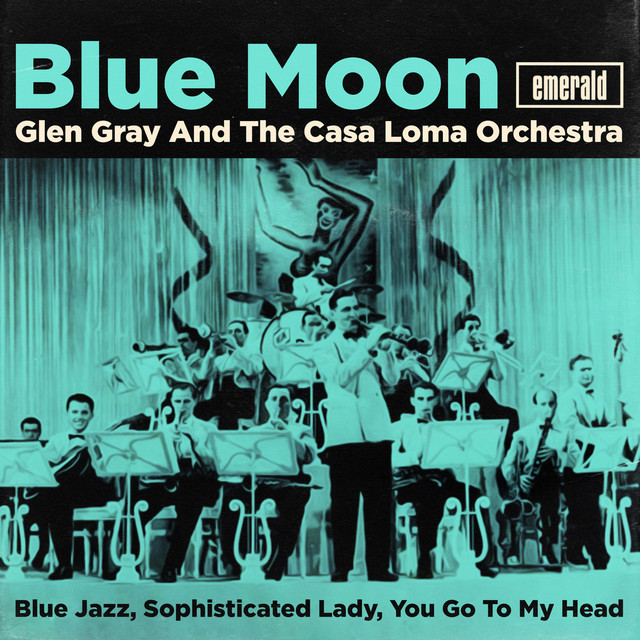
Today in Music (1935): “Blue Moon” charted for the first of 9 times on the U.S. pop charts

Blue Moon

Glen Gray

Writer(s): Richard Rodgers, Lorenz Hart (see lyrics here)


First Charted: January 5, 1935


Peak: 13 US, 2 DF (Click for codes to singles charts.)


Sales (in millions): --


Airplay/Streaming (in millions): -- radio, 0.11 video, 0.13 streaming

Blue Moon

The Marcels


First Charted: February 27, 1961


Peak: 13 US, 13 CB, 13 HR, 12 RB, 1 UK, 12 CN, 4 AU, 1 DF (Click for codes to singles charts.)


Sales (in millions): --


Airplay/Streaming (in millions): -- radio, 16.13 video, 34.38 streaming

Awards (Glen Gray version):

Click on award for more details.


Awards (The Marcels version):

Click on award for more details.

About the Song:

Richard Rodgers and Lorenz Hart made their names as giants of musical theater having written The Garrick Gaieties (1925), A Connecticut Yankee (1927), and Present Arms (1928). Ironically, though, their biggest-selling song TY didn’t become a hit because of an appearance in a musical or movie. The pair wrote a song intended for a 1933 Jean Harlow film which has been said to be called “The Prayer” TY and “Make Me a Star.” FB It underwent several revisions, becoming “The Bad in Every Man” and “Act One,” but continued to be passed over for movies.

Jack Robbins, the head of MGM’s musical publishing division, heard the song and said he’d promote it if the lyrics were rewritten to be more commercial. KL The resulting “Blue Moon” became a #1 hit for Glen Gray in 1935. That same year, Benny Goodman had a #2 hit with it and Al Bowlly and Ray Noble took it to #5. In 1949, the song charted again thanks to its appearance in the 1948 film Words and Music. Mel Torme took it to #20 and Billy Eckstine got to #21.

After that, it was featured in movies frequently, including With a Song in My Heart (1952), This Could Be the Night (1957), New York, New York (1977), and An American Werewolf in London (1981). Bob Dylan said, “Anyone can play and sing it.” BD He also called it “a universal song that can appeal to anybody at any time.” BD Elvis Presley recorded the song while at Sun Records and had a minor hit with it. However, the song got its biggest boost from a quintet from Pittsburgh who were named after a popular hairstyle. FB

In 1961, The Marcels revived the song as a doo-wop hit, showing that “Blue Moon” had an appeal that crossed genres and eras. Dylan said, “The song has traveled through time and crossed every cultural abyss. It has been country crooned and soulfully invoked. It is a cornerstone of doo-wop and a springboard for jazz improvisation.” BD

The Marcels went in the studio to record four songs. In their final eight minutes of recording time, they recorded two takes of “Blue Moon.” The vocal arrangement was borrowed from The Collegians’ 1957 doo-wop classic “Zoom Zoom Zoom,” TB a move which Richard Rodgers called “an abomination.” KL After New York DJ Murray the K played the Marcels’ recording 26 times one one show at WINS radio, FB became a hit, launching a doo-wop revival. TB It hit #1 on the U.S. pop and R&B charts and also landed on top of the UK charts.


Resources:

  • DMDB Encyclopedia entry for Richard Rodgers
  • DMDB Encyclopedia entry for Lorenz Hart
  • DMDB Encyclopedia entry for Glen Gray
  • DMDB Encyclopedia entry for The Marcels
  • FB Fred Bronson (2007). The Billboard Book of Number One Hits (4th edition). Billboard Books: New York, NY. Page 87.
  • BD Bob Dylan (2022). The Philosophy of Modern Song. New York, NY: Simon & Schuster. Pages 225-9.
  • KL Jon Kutner and Spencer Leigh. (2005). 1000 UK Number One Hits. Omnibus Press: London, UK. Page 74.
  • TB Thunder Bay Press. (2006). Singles: Six Decades of Hot Hits & Classic Cuts. Outline Press Ltd.: San Diego, CA. Page 50.
  • TY Don Tyler (1985). Hit Parade 1920-1955. New York, NY: Quill. Pages 72-3.


First posted 1/5/2013; last updated 11/5/2022.