Showing posts with label Dick Clark. Show all posts

Sunday, November 20, 2022

American Music Awards (1974-2022)

American Music Awards:

Pop/Rock Songs of the Year, 1974-2022

The American Music Awards (AMAs) were established in 1973 when ABC lost its contract to air the Grammys. They were created by Dick Clark. The AMAs are determined by public vote. The winners for favorite pop/rock song are listed here. That category existed from 1974-1995, was retired for more than a decade, and then returned in 2016. In the interim, there was also a Single of the Year award from 2013-2015.

Check out other “songs of the year” lists here.


Resources/Related Links:


First posted 10/9/2018; last updated 11/20/2022.

Thursday, April 19, 2012

Goodbye, Dick Clark

image from evilbeetgossip.com

“America’s oldest teenager” will not be blowing out any more candles on birthday cakes. We’ll never ring in another new year with him. The man who helmed the original American Bandstand and gave us the famous catch phrase, “It’s got a good beat and you can dance to it” was stricken down at age 82. On Tuesday night, Dick Clark underwent an outpatient procedure at St. John’s Hospital in Santa Monica, California. He suffered a heart attack afterwards and could not be resuscitated. He is survived by three children and third wife, Kari Wigton, whom he married in 1977.

Clark’s career began in 1945 in the mail room at a radio station in Utica, New York when he was still in high school. In 1952, he went to Philadelphia to work for radio station WFIL and its affiliated television station. In 1956, he became the host of Bandstand, a Philadelphia dance show targeted to teens, and took it national the next year. It was a mainstay on ABC for thirty years becoming one of the most influential television shows in history as kids rushed home after school to see it every weekday afternoon. In its infancy, rock ‘n’ roll was perceived as a passing fancy; Clark legitimized it. The show marked the network television debuts of artists like Jerry Lee Lewis, The Doors, The Jackson Five, the Talking Heads, and Prince.

The Jackson 5 “I Want You Back”

While his clean-cut image and the sanitized American Bandstand had its critics, Clark was a defender of artistic freedom and condemned censorship. At a time when it was safer and more commercially viable to turn to white performers for cover versions of popular R&B hits by black artists, Clark played the original songs.

In 1972, Clark launched a tradition with his New Year’s Eve telecast. He also created the American Music Awards and hosted shows such as The $25,000 Pyramid and TV’s Bloopers and Practical Jokes. At one time during the 1980s, he had shows on all three networks. He suffered a stroke in 2004, but continued to be an iconic presence for events such as New Year’s Rockin’ Eve despite his impaired speech.


Resources and Related Links:

Dick Clark interviews Madonna

Friday, January 13, 2012

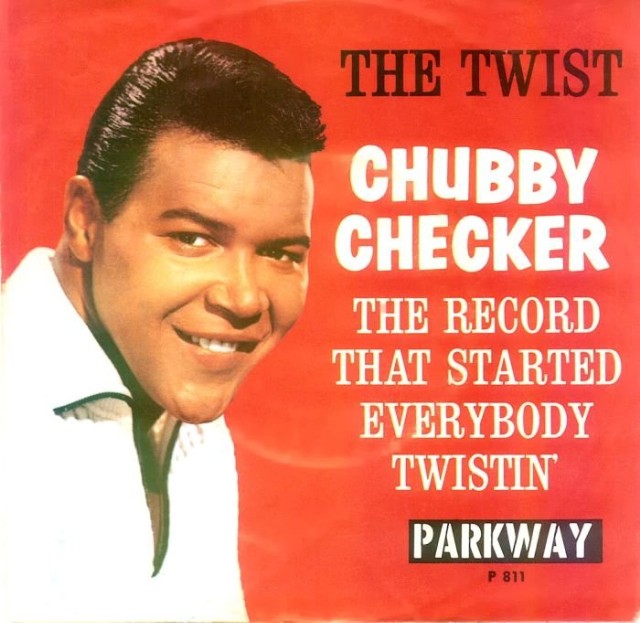
Today in Music (1962): Chubby Checker’s “The Twist” hit #1…again

The Twist

Chubby Checker

Writer(s): Hank Ballard (see lyrics here)


Released: June 1960


First Charted: July 18, 1960


Peak: 13 US, 18 CB, 3 GR, 15 HR, 2 RB, 5 UK, 16 CN, 20 AU, 1 DF (Click for codes to charts.)


Sales (in millions): 1.0 US, -- UK, 1.0 world (includes US + UK)


Airplay/Streaming (in millions): 2.0 radio, 54.1 video, 70.75 streaming

Awards:

Click on award for more details.

About the Song:

“The Twist” became the only song in U.S. history to top the pop charts in two separate runs. Author Andrew Hickey called it “the most successful record in chart history.” AH It was first recordedd by Hank Ballard and the Midnighters, RS500 who were “a washed-up R&B group” AH by 1958. The song’s inspiration has been cited as a new dance Ballard saw Florida teens doing, SF but Ballard claims that his band invented it from his group’s on-stage dance routines. SJ

Another account suggests the dance and song originated with Jo Jo Wallace and Bill Woodruff, members of the black gospel group the Sensational Nightingales. SS They were touring on the same bill as the Midnighters and offered the song to Ballard because they couldn’t sing a secular song about a euphemism for sex. AH He reworked the lyrics to a melody they’d used for “Is Your Love for Real?” AH and took sole composer credit. SS That song was inspired by “Whatcha Gonna Do?” by Clyde McPhatter and the Drifters. AH

The Midnighters’ version came out in early 1959 as the B-side to “Teardrops on Your Letter” but “The Twist” started getting attention from DJs at dances. TB White teenagers then started doing the twist on the TV dance-party program The Buddy Deane Show. This caught the attention of Dick Clark at American Bandstand, “the biggest of the dance-party TV shows.” TB When it became that show’s hottest dance, FB Clark wanted it on his show, but either couldn’t get the Midnighters because they were on tour or he wanted a “less threatening” artist (code for less “black”), someone younger, and/or someone with whom he had some financial interest. AH

Clark met Ernest Evans when he went to Cameo Records to record an audio Christmas card for friends. Evans, who took the stage name Chubby Checker when Clark’s wife, Barbara, said he looked like a young Fats Domino, recorded the song doing impressions of Domino, Elvis Presley, and the Chipmunks. Clark wanted someone to perform “The Twist” exactly like Hank Ballard & the Midnighters so he turned to Checker. AH Clark introduced it on his show as the “hottest dance sensation in the last four years, a thing called the twist.” TB

As for the results, Ballard said, “they cloned it.” SF In fact, when he first heard it on the radio, he thought it was his version. TBP However, he was not bitter considering the huge songwriter royalties he received once Checker’s version became a hit SF – twice. The song owed its first wave of success to the teens. However, it became a hit all over again, thanks to the Peppermint Lounge in Manhattan. AH

Joey Dee & the Starliters played covers of dance hits at the club, as happened in many bars. However, the Peppermint Lounge hired a publicist to get celebrities to their club, which would get mentioned in society columns. Since the club was close to Broadway, It started attracting major stars including Judy Garland, Marilyn Monroe, and Greta Garbo. That garnered more attention for the dancing done in the club, which helped the Starliters reach #1 with “Peppermint Twist” and revived interest in “The Twist.” AH The song was re-released went back to the top. The two chart runs gave it a record 39 weeks on the Hot 100 for a #1 song, a feat that lasted until 1988 when UB40’s second chart run with “Red Red Wine” gave that song 40 weeks on the charts. BB

Part of the success of the dance was because anyone could do it. As Checker said, “It’s like putting out a cigarette with both feet.” SJ It succeeded on American Bandstand because it “was energetic and improvisatory...adaptable enough that it didn’t have to be sexualized…[and] didn’t require a partner, so shows like Bandstand were never in danger of violating any morality codes.” TB Black activist Eldridge Cleaver called it “a guided missile, launched from the ghetto into the very heart of suburbia.” SS


Resources:


First posted 1/13/2012; last updated 4/2/2023.

Saturday, July 9, 2011

Dick Clark Takes Over American Bandstand: July 9, 1956


On October 13, 1952, WFIL-TV began a local show called Bandstand. Originally hosted by Bob Horn, it kept Philadelphia teenagers up-to-date on the latest dance steps. Horn was fired following a drunk driving arrest. On July 9, 1956, Dick Clark took over as host. By the spring of 1957, he pitched it to ABC and the show went national as American Bandstand on August 5, 1957. Clark held the job for the next thirty years, becoming a major media mogul and earning the nickname “America’s Oldest Teenager”.

Clark got his start in broadcasting right out of high school. After graduation in 1947, he worked at Rome, New York’s WRUN-AM, a station owned by his uncle and managed by his father. Clark quickly moved into a role as the vacationing weatherman and an announcer for station breaks. By 1952, he was a disc jockey at Philadelphia radio station WFIL. He also became a regular substitute host for Bandstand on the station’s affiliate television network.


The show went through a variety of time slots and air times. After a few years airing as a weekday afternoon program, it was reconfigured in 1963 as a once-a-week Saturday show. A year later, it relocated from Philadelphia to Los Angeles. ABC was home to the show until 1987. A two-year stint in first-run syndication followed before the show went to the USA cable network. It only lasted there six months and then closed its doors in 1989.

Featured artists were expected to lip-sync their current hits while the commercially released version of the song played. Clark regularly asked teen audience members their opinions of the songs, giving rise to the well known phrase “It’s got a good beat and you can dance to it.”

Clark is rated as one of the top 1000 music makers of all time by Dave’s Music Database.


Les Elgart’s version of “Bandstand Boogie”, used as the theme in the show’s early national days


Resources and Related Links:


Sunday, January 6, 2008

50 years ago: “At the Hop” hit #1 for first of 7 weeks

At the Hop

Danny & the Juniors

Writer(s): Artie Singer/John Medora/David White (see lyrics here)


First Charted: November 18, 1957


Peak: 17 US, 15 CB, 16 HR, 15 RB, 3 UK, 13 CN, 3 DF (Click for codes to charts.)


Sales (in millions): 2.5 US, -- UK, 2.5 world (includes US + UK)


Airplay/Streaming (in millions): 1.0 radio, 9.79 video, -- streaming

Awards:

Click on award for more details.

About the Song:

Just as Elvis Presley had appropriated black music to become the King of Rock and Roll, this white vocal quartet tapped into the doo-wop format largely owned by black groups. They formed in high school in Philadelphia in 1955 as the Juvenairs and sang on street corners and local dances and parties. Their break came in 1957 when they decided to sing at the street corner right under the window of record producer John Madara. He introduced them to a DJ who, in turn, introduced them to Artie Singer, who owned Singular Records. Singer signed them. SJ

The group recorded “Do the Bop,” a song written by Madara and band member Dave White. SJ Singer was acquainted with Dick Clark, who hosted American Bandstand from Philadelphia and played the song for him. Clark was impressed, but since the bop dance craze was on the way out, he suggested changing the title to “At the Hop.” SJ

It wasn’t the only break the group got from Clark. When another act scheduled to appear didn’t show up, Danny & the Juniors filled in. The song was picked up by ABC Paramount Records for national distribution and would go on to top the pop and R&B charts. This was their only top-ten pop hit, but it became the biggest single of 1958. CPM

The song is “one of the all time great slabs of rock ‘n’ rolling exuberance;” DT it “makes you want to dance.” PW It is “reminiscent of the blues, while capitalizing on the upbeat feeling of 50s music.” KW It is a “catchy tune” PW with an “attractive beat” PW “and dumb words. The joybful, liberating power of a few well-chosen dumb words should never be underestimated.” PW


Resources:


First posted 4/15/2020; last updated 4/2/2023.