Showing posts with label XFM. Show all posts

Saturday, June 11, 2016

50 years ago: The Rolling Stones’ “Paint It Black” hit #1

Paint It Black

The Rolling Stones

Writer(s): Mick Jagger, Keith Richards (see lyrics here)


Released: May 7, 1966


First Charted: May 14, 1966


Peak: 12 US, 11 CB, 11 HR, 1 CL, 11 UK, 11 CN, 13 AU, 1 DF (Click for codes to singles charts.)


Sales (in millions): --


Airplay/Streaming (in millions): -- radio, 188.0 video, 641.81 streaming

Awards:

Click on award for more details.

About the Song:

This was the sixth #1 hit for the Rolling Stones in the UK and their third in the United States. The song was featured on the U.S. version of Aftermath and the UK version of the Big Hits (High Tides and Green Grass) compilation. The song “broke free of the blues and R&B influences” AMG of previous hits, showcasing singer Mick Jagger and guitarist Keith Richards as “versatile, growing writers who could compete head-to-head with the best rock composers of the era, such as their chief rivals, the Beatles, of course.” AMG

The song holds the distinction as the first number-one hit to feature a sitar WK and “perhaps the most effective use of the Indian instrument in a rock song.” AMG Brian Jones started exploring eastern instruments out of frustration from being overshadowed by Jagger and Richards. WK Jones used the sitar to arrange the basic arrangements for “Paint It Black” after a discussion with George Harrison, who had recently used the sitar on the Beatles’ “Norwegian Wood.” WK It may have been Jones’ “greatest musical achievement,” AMG but he got no songwriting credit for it. Richards explained that Jones never presented a finished song to the group, hence his omission from the credits. SF

The intent of the song lyrically was to use color-based metaphors to describe the grief one suffers after the loss of a spouse or partner, WK reportedly inspired by the death of a former girlfriend of Jagger’s. AMG There are also claims Jagger drew on the 1922 novel Ulysses by James Joyce and its themes of desperation and depression. WK Jagger explained that the song’s exploration of a character “so entrenched in his depression and rage that he has lost all hope” WK fit with the theme of Aftermath, where each song offered insight into “the darkness of his psyche.” WK When Jagger sings that he wants to “see the sun blotted out from the sky, [it is] surely one of the most despairing images in popular music.” AMG

Amusingly, the song was originally released as “Paint It, Black.” The comma, however, was an error on the part of Decca Records and not meant to be part of the title. The incorrect title implied that a person named “Black” was being encouraged to do the painting. AMG Some fans interpreted it as a statement on racial relations. WK


Resources:


Related Links:


First posted 10/19/2020; last updated 11/3/2022.

Friday, December 18, 2015

50 years ago: The Beatles “Day Tripper” hit #1 in UK

Day Tripper

The Beatles

Writer(s): John Lennon, Paul McCartney (see lyrics here)


Released: December 3, 1965


First Charted: December 11, 1965


Peak: 5 US, 10 CB, 12 HR, 2 CL, 15 UK, 17 AU (Click for codes to singles charts.)


Sales (in millions): -- US, -- UK, -- world (includes US + UK)


Airplay/Streaming (in millions): -- radio, 15.2 video, -- streaming

Awards:

Click on award for more details.

About the Song:

In the UK, “We Can Work It Out” and “Day Tripper” were released as a double-A-sided, stand-alone single in the UK, where it hit #1. In the United States, the songs were treated separately. John Lennon wanted his song, “Day Tripper,” to be the A-side, but “We Can Work It Out” was pegged as “the safer, friendlier song” SG with more commercial appeal. The former was a chart-topper in the U.S., but “Day Tripper” fared just fine, reaching #5. Both songs were then released on the U.S.-only album Yesterday…and Today in June 1966.

As was often the case, Paul McCartney wrote “We Can Work It Out” with more focus on the melody while “the Lennon-written ripper ‘Day Tripper’” SG is an example of what John called “straight, shouting rock ‘n’ roll.” FB The song “rocks harder, playing around with the ferocity that the Beatles’ new competitors the Rolling Stones were bringing” SG although there’s still “there’s a neatness, a pertness about this band on this record.” FT

In addition to the “big, heavy riff” SG the song also represented one of the band’s “creative attempts to smuggle drugs and sex into their songs…’She’s a big teaser, she’s a day tripper,’ subtle stuff there lads! The song’s a frustrated goodbye, but who’d really blame a girl for having fun with boys whose eagerness to please is so apparent?” FT

While John wrote the song, it was sung jointly by him and Paul. The “arrangement is a homage to Stax Records.” KL Interestingly, Otis Redding covered that song as well as the Rolling Stones’ “(I Can’t Get No) Satisfaction,” telling friends (falsely) that he wrote both songs. KL


Resources:

  • DMDB encyclopedia entry for The Beatles
  • DMDB page for “We Can Work It Out
  • FB Fred Bronson (2007). The Billboard Book of Number One Hits (4th edition). Billboard Books: New York, NY. Page 191.
  • FT FreakyTrigger.co.uk (5/17/2005). “Popular (UK #1 Singles)” by Tom Ewing
  • KL Jon Kutner and Spencer Leigh. (2005). 1000 UK Number One Hits. Omnibus Press: London, UK. Pages 116-7.
  • SG Stereogum (8/24/2018). “The Number Ones” by Tom Breihan


Related Links:


First posted 6/23/2022.

Thursday, October 14, 2010

XFM: Top 100 Songs

XFM:

Top 100 Songs

XFM is an alternative-oriented radio station out of London. Their top 1000 songs of all time list was presented online on 10/14/2010 and turned into a book. The list was based on an annual listeners’ poll, most requested songs, and suggestions from radio DJs and celebrity guests. However, since the list was unranked, the DMDB has taken the liberty of ranking the list for them.

To try to capture the distinct British flavor of the list (which means mostly, but not all, British-based acts), the DMDB averaged all British-based lists together, weeded out any songs not appearing on the XFM list, and then ranked the songs from most points on down. Here’s the resulting top 100 list:

Click here to see other lists from publications and/or organizations.

1. John Lennon “Imagine” (1971)
2. The Beatles “Hey Jude” (1968)
3. Nirvana “Smells Like Teen Spirit” (1991)
4. Oasis “Wonderwall” (1995)
5. The Verve “Bitter Sweet Symphony” (1997)
6. R.E.M. “Losing My Religion” (1991)
7. Oasis “Don’t Look Back in Anger” (1996)
8. The Kinks “Waterloo Sunset” (1967)
9. Pulp “Common People” (1995)
10. U2 “One” (1992)

11. Oasis “Live Forever” (1994)
12. The Rolling Stones “(I Can’t Get No) Satisfaction” (1965)
13. The Beatles “Strawberry Fields Forever” (1967)
14. The Beatles “Let It Be” (1970)
15. R.E.M. “Everybody Hurts” (1992)
16. Joy Division “Love Will Tear Us Apart” (1980)
17. The Undertones “Teenage Kicks” (1978)
18. Radiohead “Creep” (1993)
19. David Bowie “Heroes” (1977)
20. The Jimi Hendrix Experience “All Along the Watchtower” (1968)

21. U2 “With Or Without You” (1987)
22. New Order “Blue Monday” (1983)
23. The Who “My Generation” (1966)
24. David Bowie “Space Oddity” (1969)
25. The Stone Roses “Fools Gold” (1989)
26. The Smiths “How Soon Is Now?” (1985)
27. Massive Attack “Unfinished Sympathy” (1991)
28. The Sex Pistols “Anarchy in the U.K. ” (1976)
29. David Bowie “Life on Mars? ” (1973)
30. The Verve “The Drugs Don’t Work” (1997)

31. The Jam “Going Underground” (1980)
32. The Smiths “This Charming Man” (1983)
33. Guns N’ Roses “Sweet Child O’ Mine” (1988)
34. The La’s “There She Goes” (1989)
35. The Clash “London Calling” (1979)
36. Blur “Song 2” (1997)
37. The Jimi Hendrix Experience “Voodoo Chile (Slight Return)” (1968)
38. The Stone Roses “I Am the Resurrection” (1989)
39. Oasis “Champagne Supernova” (1996)
40. Red Hot Chili Peppers “Under the Bridge” (1992)

41. The Rolling Stones “Jumpin’ Jack Flash” (1968)
42. Coldplay “Yellow” (2000)
43. The Rolling Stones “Paint It Black” (1966)
44. The Jam “A Town Called Malice” (1982)
45. The Kinks “Lola” (1970)
46. Pink Floyd “Wish You Were Here” (1975)
47. The Kinks “You Really Got Me” (1964)
48. Radiohead “Paranoid Android” (1997)
49. The Sex Pistols “God Save the Queen” (1977)
50. Radiohead “Fake Plastic Trees” (1995)

51. Manic Street Preachers “Motorcycle Emptiness” (1992)
52. Underworld “Born Slippy” (1995)
53. The Doors “Light My Fire” (1967)
54. U2 “Where the Streets Have No Name” (1987)
55. Lou Reed “Walk on the Wild Side” (1972)
56. The Specials “Ghost Town” (1981)
57. The Rolling Stones “Sympathy for the Devil” (1968)
58. The Jam “That’s Entertainment” (1981)
59. The Rolling Stones “Honky Tonk Women” (1969)
60. Manic Street Preachers “A Design for Life” (1996)

61. Paul Weller “Wild Wood” (1993)
62. Green Day “Good Riddance (Time of Your Life)” (1997)
63. Pink Floyd “Comfortably Numb” (1979)
64. Oasis “Supersonic” (1994)
65. The Killers “Mr. Brightside” (2004)
66. The Buzzcocks “Ever Fallen in Love” (1978)
67. The Who “Won’t Get Fooled Again” (1971)
68. James “Sit Down” (1991)
69. The Strokes “Last Nite” (2001)
70. The Smiths “There Is a Light That Never Goes Out” (1986)

71. Radiohead “Street Spirit (Fade Out)” (1996)
72. Radiohead “Karma Police” (1997)
73. The Who “Substitute” (1996)
74. The Prodigy “Firestarter” (1996)
75. Manic Street Preachers “If You Tolerate This Your Children Will Be Next” (1998)
76. The Rolling Stones “Brown Sugar” (1971)
77. The Rolling Stones “Gimme Shelter” (1969)
78. Depeche Mode “Enjoy the Silence” (1990)
79. U2 “I Still Haven’t Found What I’m Looking For” (1987)
80. Oasis “Some Might Say” (1995)

81. The Jimi Hendrix Experience “Hey Joe” (1966)
82. Primal Scream “Loaded” (1990)
83. Blur “Parklife” (1994)
84. The Clash “White Man in Hammersmith Palais” (1978)
85. Oasis “Whatever” (1994)
86. Green Day “Basket Case” (1994)
87. The Killers “All These Things That I’ve Done” (2004)
88. The Rolling Stones “Get Off of My Cloud” (1965)
89. Oasis “Cigarettes and Alchol” (1994)
90. David Bowie “Starman” (1972)

91. The Beatles “Day Tripper” (1965)
92. Blur “Girls and Boys” (1994)
93. Snow Patrol “Run” (2004)
94. The Beatles “Eleanor Rigby” (1966)
95. Coldplay “The Scientist” (2002)
96. Led Zeppelin “Whole Lotta Love” (1969)
97. The Jam “Down in the Tube Station at Midnight” (1978)
98. New Order “True Faith” (1987)
99. Run-D.M.C. with Aerosmith’s Steven Tyler & Joe Perry “Walk This Way” (1986)
100. John Lennon “Instant Karma (We All Shine On)” (1970)


Resources/Related Links:

First posted 10/17/2010; last updated 3/31/2021.

Saturday, June 26, 2004

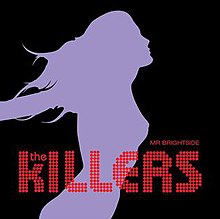
The Killers charted with “Mr. Brightside”

Mr. Brightside

The Killers

Writer(s): Brandon Flowers, Dave Keuning, Mark Stoermer, Ronnie Vannucci Jr. (see lyrics here)


Released: September 29, 2003


First Charted: June 26, 2004


Peak: 10 US, 10 RR, 11 A40, 3 AR, 10 UK, 5 CN, 29 AU, 6 DF (Click for codes to charts.)


Sales (in millions): 3.0 US, 4.8 UK, 10.54 world (includes US + UK)


Airplay/Streaming (in millions): 0.5 radio, 467.0 video, 1797.97 streaming

Awards:

Click on award for more details.

About the Song:

The Killers “crawled out of Vegas armed with glitzy beats and faux Bowie accents.” RS’09 “Merging Duran Duran makeup, New Order hi-hats, and Bruce Springsteen-ian grandiosity, they gave rock fans a non-geriatric arena-ready alternative to the world’s Nickelbacks this decade.” PF

The group might have just been another of the pack of the new millennium’s wave of new dance-rock, but “‘Mr. Brightside’ made them famous.” RS’09 “Preening and posturing and fusing high drama, power pop, and rock gravitas into one perfectly transcendent song.” LR “In a stroke of genius they never quite equaled, these Las Vegas rockers married the infectious grooves of the then-trendy dance-rock scene to a surging melody straight out of the U2/ Coldplay handbook.” MX They brought along “a story line that sums up the first two seasons of Gossip Girl.” RS’09

The Killers’ lead singer Brandon Flowers had a girlfriend who cheated on him and the band’s guitarist, Dave Keuning, extracted revenge with this song about her. Flowers told Q magazine about discovering her unfaithfulness. “I was asleep and I knew something was wrong. I have these instincts. I went to the Crown and Anchor [a Vegas pub] and my girlfriend was there with another guy.” PF

However, Flowers’ anguish proved to have a “bright side.” The song didn’t just give The Killers their biggest hit, but one thoroughly embraced by fans. UK radio station XFM wrapped the decade with a listener poll to determine the top 1000 songs of all time and “Mr. Brightside” topped the list. While such a lofty position showed the weaknesses of turning an “all time” poll over to voters, it still showed just how much fans cherished the song.


Resources:


Related Links:


Last updated 7/24/2023.

Monday, May 26, 1997

Radiohead “Paranoid Android” released

Paranoid Android

Radiohead

Writer(s):Radiohead (see lyrics here)


Released: May 26, 1997


Peak: 3 UK (Click for codes to singles charts.)


Sales (in millions): --


Airplay/Streaming (in millions): -- radio, 22.8 video, -- streaming

Awards:

Click on award for more details.

About the Song:

“If you had to play somebody one Radiohead song to convince them of the band's brilliance, it should probably be ‘Paranoid Android.’” RS’11 This is “their first truly original artistic statement” RB and “very possibly the best rock song of the millennium, the last few decades and maybe even ever.” PS’16 “They distilled everything that makes them great, the energy, the beauty, the experimentation, the abrasiveness, the gentleness, the fearlessness, the fears, the transcendence of those fears, the songwriting, the musicianship, the uniqueness, the utter, unadulterated brilliance, the whole ball of wax, into one crazy, untamable beast of a song.” AS “Nothing about ‘Paranoid Android’… makes sense: The chords don’t go together. The sections feel jumbled. There’s no clear narrative. The melodies are too strange. The choir sounds cut off. The song’s too long! But these are also reasons why it's one of Radiohead's best songs.” RB

This is “a towering pop mutation” RB “clocking in at a tortured, schizophrenic 6-and-a-half minutes.” BZ It is “as tricky and complex as anything found in ‘70s prog,” DF “a ‘Bohemian Rhapsody’ for the nineties.” AD It also “draws comparisons to The Beatles’ ‘A Day in the Life’” RV and its three stitched-together parts from other songs was inspired by the Beatles’ “Happiness Is a Warm Gun.” RS’11 “tethered…by a pleading urgency in which Yorke lashes out at his unnamed opposition in between distorted guitar screeches and dead-eyed harmonies.” BB Guitarist Ed O’Brien described the song as “Queen meets the Pixes.” RG The initial version was “a 14-minute sprawler that included organ” CS which producer Nigel Godrich said delved into “Deep Purple territory” RG while Yorke jokingly described the song as a “Pink Floyd cover.” FT

“The comparisons to ‘Bohemian Rhapsody’ were inevitable, but whereas Queen’s song suite bursts with melodic joy, the moody “Paranoid Android” is full of anxiety and lacks any obvious hooks.” BB “There’s absolutely no interest in coddling listeners or adhering to trends” SA and when Radiohead released it as the album’s first single, they refused to cut it down for radio. RS’11 It is “a lumbering Frankenstein’s monster of sludgy prog-rock and stuttery electronica” SA which “incorporates several different styles into a single bombastic symphony of dread.” RV

The epic is packed with “alternating time signatures, wild dynamic shifts, drama and adrenaline to spare.” VH1 “This dizzying suite begins as a creepy lullaby” EX and then “combusts with speaker-blown alt-rock,” EX “morphing and rocketing around like a firework with a broken fuse.” CS“Just when you think you’ve had enough, it slows back down” SP to “the Gregorian-chant pace working subtle magic on our defenses that have already been battered by the first two parts,” AS “before finally being sucked down into hell with a squalling guitar freakout.” EX “Greenwood gives you every reason to practice your air guitar, where everything sounds as if it’s burning down.” CS

It is long enough that one of its “three sections…even has its own sub-section. There’s a terrific, jazzy 7/8 part with electric piano and deep-grooving bass; there’s a hefty dose of blistering rock (with two guitar solos); and there’s a truly awesome vocal harmony sequence reminiscent of a load of monks chanting a particularly intense extract from David Bowie’s ‘The Man Who Sold the World.’” QM

“Yorke delivers some of his best singing here, pleading for redemption from on high only to be rebuffed by another version of himself snapping him back to reality.” AS Listening to the song is about spending time “with either a manic-depressive or a brief thunderstorm.” SP Yorke wrote it after encountering a woman at a bar who turned violent when someone spilled a drink on her. BZ He said it was about “the fall of the Roman Empire, but good luck finding anything in the lyrics that seem related to that topic in any way.” RS’11 The title refers to Marvin the Paranoid Android from Douglas Adams’ The Hitchhiker’s Guide to the Galaxy, CS but that also seems to have nothing to do with the song. “As unhinged as the lyrics…may seem, there is a consistent thread of dread running through them, the feeling that all of these seemingly unreal acts of tyranny and fascism are committed on a smaller scale every single day.” AS

The video “interestingly seems to reflect the sound as heard.” DG-54 “The adventures of the cartoon protagonists seem to match the music.” DG-54


Resources:


Related Links:


First posted 6/9/2022.