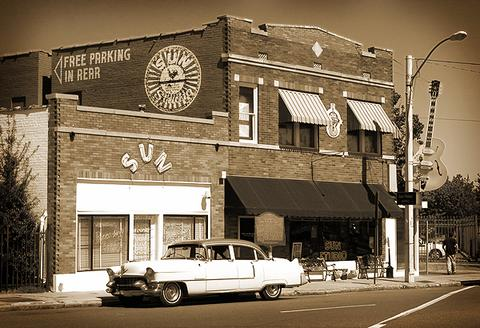
Showing posts with label Sun Records. Show all posts

Wednesday, August 23, 2023

Sun Records: Top 50 Songs

Sun Records

Top 50 Songs

Sun Records has been called the birthplace of rock and roll. In January 1950, Sam Phillips opened Memphis Recording Service, which evolved into Sun Records in 1952. Located in Memphis, Tennessee, the studio focused on southern-rooted music like blues and country. It was the merger of these two genres which has largely been defined as the beginning of rock and roll. To that end, the studio birthed songs such as “Rocket 88” by Jackie Brenston & His Delta Cats and “That’s All Right” by Elvis Presley, which have both staked claims as the first rock and roll song.

Of course, the studio is best known as the launching pad for Elvis Presley, but it also served that purpose for B.B. King, Howlin’ Wolf, Little Junior Parker, Johnny Cash, Carl Perkins, Roy Orbison, Jerry Lee Lewis, and Charlie Rich.

Click here to see other genre-specific song lists.


Top 50 Songs


Dave’s Music Database lists are determined by song’s appearances on best-of lists, appearances on compilations and live albums by the featured act, and songs’ chart success, sales, radio airplay, streaming, and awards.

DMDB Top 1%:

1. Jerry Lee Lewis “Whole Lotta Shakin’ Goin’ On” (1957)
2. Jerry Lee Lewis “Great Balls of Fire” (1957)
3. Johnny Cash “I Walk the Line” (1956)
4. Carl Perkins “Blue Suede Shoes” (1956)
5. Elvis Presley “That’s All Right, Mama” (1954)
6. Jackie Brenston & His Delta Cats “Rocket 88” (1951)
7. Johnny Cash “Folsom Prison Blues” (1955)

DMDB Top 2%:

8. Elvis Presley “Mystery Train” (1955)

DMDB Top 5%:

9. Bill Justis “Raunchy” (1957)
10. Jerry Lee Lewis “Breathless” (1958)

DMDB Top 10%:

11. Jerry Lee Lewis “Crazy Arms” (1956)
12. Roy Orbison “Ooby Dooby” (1956)
13. Jerry Lee Lewis “High School Confidential” (1958)
14. Elvis Presley “Blue Moon” (1954)
15. Johnny Cash “Ballad of a Teenage Queen” (1957)
16. Elvis Presley “Blue Moon of Kentucky” (1954)
17. Howlin’ Wolf “How Many More Years” (1951)

DMDB Top 20%:

18. Elvis Presley “Baby Let’s Play House” (1955)
19. Johnny Cash “Guess Things Happen That Way” (1958)
20. Johnny Cash “Get Rhythm” (1956)

21. Carl Perkins “Honey Don’t” (1956)
22. Jerry Lee Lewis “What’d I Say” (1961)
23. Carl Mann “Mona Lisa” (1959)
24. Carl Perkins “Matchbox” (1957)
25. Elvis Presley “Good Rockin’ Tonight” (1954)
26. Rufus Thomas “Bear Cat” (1953)
27. Billy Riley & His Little Green Men “Flyin’ Saucers Rock & Roll” (1957)
28. Elvis Presley “I’m Left, You’re Right, She’s Gone” (1955)
29. Charlie Rich “Lonely Weekends” (1960)
30. Johnny Cash “Cry! Cry! Cry!” (1955)

31. Carl Perkins “Dixie Fried” (1956)

Beyond the DMDB Top 20%:

32. Johnny Cash “The Ways of a Woman in Love” (1958)
33. Little Junior Parker’s Blue Flames “Mystery Train” (1953)
34. Johnny Cash “There You Go” (1956)
35. Billy Riley & His Little Green Men “Red Hot” (1957)
36. Elvis Presley “I Don’t Care if the Sun Don’t Shine” (1954)
37. Little Junior Parker’s Blue Flames “Feelin’ Good” (1953)
38. Howlin’ Wolf “Moanin’ at Midnight” (1951)
39. Elvis Presley “I Forgot to Remember to Forget” (1955)
40. Johnny Cash “Give My Love to Rose” (1957)

41. Jerry Lee Lewis “You Win Again” (1957)
42. Carl Perkins “Boppin’ the Blues” (1956)
43. Elvis Presley “You’re a Heartbreaker” (1954)
44. Johnny Cash & the Tennessee Two “Big River” (1957)
45. Elvis Presley “Milkcow Blues Boogie” (1954)
46. Johnny Cash “Hey Porter” (1955)
47. Charlie Rich “Who Will the Next Fool Be” (1961)
48. Warren Smith “Red Cadillac and a Black Moustache” (1957)
49. Johnny Cash “Home of the Blues” (1957)
50. Little Junior Parker’s Blue Flames “Love My Baby” (1953)


Resources and Related Links:


First posted 8/21/2023; last updated 8/23/2023.

Friday, January 3, 2020

Today in Music (1950): Sun Records opened

January 3, 1950

Sun Records opened.

Sam Phillips opened the Memphis Recording Service in Memphis, Tennessee, on January 3, 1950. The building served as the headquarters for the failed Phillips Records and his later Sun Records label. He used the studio to record amateurs such as B.B. King, Howlin’ Wolf, and Junior Parker and then sold their performances to larger record labels. During its 16-year run, Sun produced 226 singles and more rock and roll records than any of its contemporary record labels. WK One of the most significant songs to come out of Sun was “Rocket 88” by Jackie Brenston & His Delta Cats. The song was released by Chess in 1951 and has been called the first rock and roll record by some historians.

Phillips was interested primarily in the blues, an art form which he thought both white and black people understood. As he said, it was how people “relieved the burden of what existed day in and day out.” WK In addition to the blues artists mentioned above, Bobby “Blue” Bland, Little Milton, and Rufus Thomas recorded there.

Part of the company’s appeal, however, was its broad range of genres. Sun has become most associated with launching the careers of more rockabilly-oriented artists like Johnny Cash, Jerry Lee Lewis, Carl Perkins, and Roy Orbison. Of course, the label benefited most from its discovery of Elvis Presley. When Sun was experiencing financial trouble in 1955, Phillips famously sold Elvis’ contract to RCA Records. The sale helped boost some of the other artists, most notably the distribution for Carl Perkins’ “Blue Suede Shoes”, the first national hit for Sun Records.

In 1959, Phillips Recording opened to replace the old facility. Phillips sold the label in 1969. Gary Hardy reopened the original building in 1987 as Sun Studio and attracted artists such as U2, Def Leppard, Ringo Starr, and Bonnie Raitt. In 2003, the building was recognized as a National Historic Landmark.


Resources:


First posted 1/3/2012; updated 12/30/2023.

Saturday, July 6, 2013

Elvis makes legendary recordings at Sun Studios: July 5-6, 1954

l to r: Elvis Presley, Bill Black, Scotty Moore, Sam Phillips
image from thoughtontracks.com

Elvis Presley’s Sun recordings from July of 1954 are considered by some to be the beginning of rock and roll. Many historians would argue that rock and roll’s origins predate Elvis and can’t be tied to one event or recording, but Elvis’ brief tenure with Sun is indistibutably monumental in the development of rock and roll.

The July 5-6 session was not the future King of Rock and Roll’s first time to record with Sun. Nearly a year earlier, he paid $3.98 to the Memphis Record Service, now commonly known as Sun Studio, to record “My Happiness” and “That’s When Your Heartaches Begin.” In January 1954, he returned to record “I’ll Never Stand in Your Way” and “It Wouldn’t Be the Same Without You.”

That May, Sun Studio head Sam Phillips found a demo of “Without You” and, in a search for a white performer who could sing blues and boogie-woogie, he brought Elvis back in the studio. Local Western swing musicians Scotty Moore (electric guitar) and Bill Black (slap bass) rehearsed songs on July 4 and met at Sun the next couple days to record a few songs.

Scotty Moore talks about the sessions

The first song they recorded was “I Love You Because.” After a few more country-oriented songs, Elvis started playing around with Arthur Crudup’s blues song “That’s All Right, Mama.” Also among the songs they recorded were a faster version of bluegrass musician Bill Monroe’s “Blue Moon of Kentucky” and “Harbor Lights.”

“Mama” and “Kentucky” were released as a single before the end of the month and garnered some success in the South. The trio would record at Sun through 1955 before Phillips sold Presley’s contract to RCA for a then-record $35,0000 to $40,000, depending on the source. It was in 1956 that Elvis would claim the throne as the King, but he’d established himself as royalty via those 1953-55 Sun recordings.


Elvis Presley Awards:


Resources and Related Links:

Friday, November 23, 2007

50 years ago: “Great Balls of Fire” charted

Great Balls of Fire

Jerry Lee Lewis

Writer(s): Otis Blackwell, Jack Hammer (see lyrics here)


First Charted: November 23, 1957


Peak: 2 US, 2 CB, 2 HR, 12 CW, 3 RB, 12 UK, 1 DF (Click for codes to charts.)


Sales (in millions): 1.0 US, -- UK, 5.0 world (includes US + UK)


Airplay/Streaming (in millions): 1.0 radio, 0.51 video, 98.8 streaming

Awards:

Click on award for more details.

About the Song:

Some of rock ‘n’ roll’s earliest architects walked a fine line between their religious Southern upbringings and the shockingly sexual and aggressive style that defined early rock music. With a musical prowess birthed as much from the black honky-tonks as the Assembly of God Church, AC Lewis concocted an uncomfortable blend of music inspired by God and the devil. He got booted from Bible college AC for “playing hymns boogie-woogie style.” TB His “onstage terrorization of the piano” FR earned him the nickname “The Killer.”

Nowhere was Lewis’ musical dichotomy more on display than with “Great Balls of Fire,” a song that “transcends everything doctrinaire and theoretical.” DM This is “nerve shaking, frame rattling, brain charring – rock ‘n’ roll at its most primal.” DT Jerry Lee’s signature song was “full of Southern Baptist hellfire turned into a near-blasphemous ode to pure lust.” RS500 Lewis realized the shock in 1957 of such sexual innuendo coming from a Southern music man SF and initially refused to sing the song. RS500 He argued with Sun Records’ founder Sam Phillips that “recording the song would send him straight to hell.” SS Phillips eventually won out, thanks to the ever-flowing liquor during the session. RS500

The song came to Lewis via songwriter Otis Blackwell. He was a poor kid from Brooklyn, New York, the first black man to really tap into the Nashville sound, dominating the country and rock charts in the mid to late-‘50s. AC He wrote “Don’t Be Cruel” and “All Shook Up” for Elvis Presley. After seeing Lewis perform on TV, he sent a demo of “Great Balls of Fire” to Sun Records. Both Phillips and Lewis knew it was a hit AH worthy of following Lewis’ breathrough hit “Whole Lotta Shakin’ Goin’ On.” Regarding Blackwell’s writing partner, Jack Hammer, several accounts say his sole contribution is coming up with the title and selling it to Blackwell. LW

The song was a “refinement of the ‘Whole Lotta Shakin’’ formula but it has a few differences that give the song far more impact.” AH “Great Balls of Fire” “has a much more dynamic opening, one that sets the tone for the whole record with its stop-start exclamations” AH that are reminiscent of Carl Perkins’ “Blue Suede Shoes.”

It wouldn’t be much longer before Lewis’ career would come crashing down in flames. In May 1958, he was in the UK for a tour and the press asked who the girl was with him. It emerged that it was his thirteen-year-old cousin Myra – and his bride. The tour was cancelled and Lewis returned home in disgrace. He would revive his career years later on the country charts, but would never again reclaim the pop and rock glory he had in the 1950s.


Resources:


Related Links:


Last updated 8/23/2023.

Friday, July 21, 2006

50 years ago: Johnny Cash hit #1 on the country chart with "I Walk the Line"

I Walk the Line

Johnny Cash

Writer(s): Johnny Cash (see lyrics here)


Released: May 1, 1956


First Charted: June 9, 1956


Peak: 17 US, 23 CB, 21 HR, 16 CW, 2 DF (Click for codes to charts.)


Sales (in millions): 2.0 US


Airplay/Streaming (in millions): 1.0 radio, 12.2 video, 284.47 streaming

Awards:

Click on award for more details.

About the Song:

Johnny Cash, “to many, epitomizes country music more than any other artist.” AH Indeed, he would eventually rank as one of the top 5 country artists of all-time according to Billboard magazine. However, in his beginning years at Sun Records he was “making music that was stylistically indistinguishable from any of the other rockabilly artists there.” AH As such, “his image was always a little more appealing to rock audiences” AH than most country singers. In fact, it was Elvis Presley’s “That’s All Right, Mama,” recorded at Sun, which encouraged Cash to approach Sam Phillips at Sun Records. AH

In 1956, Cash’s career was barely underway. He had charted with “Cry! Cry! Cry!” (#14), “So Doggone Lonesome” (#4), and “Folsom Prison Blues” (#4). His fourth chart entry, “I Walk the Line,” hit #1 on the Billboard country chart and #17 on the Billboard Hot 100. Over the next thirty years, he sent well over 100 songs to the country charts, fourteen which topped the chart.

The song’s unusual chord progression dated back to 1950. During Cash’s days in the Air Force in Germany, he wrote songs with the help of a tape machine. Five years later, he was fiddling around with it backstage while on tour with label mate Carl Perkins. Perkins said Cash should build a song around it. Cash didn’t come up with the idea for the song until he and Perkins talked later about guys running around on their wives while out on the road. Cash, who had a new baby and was newly married, said, “Not me buddy. I walk the line.” Perkins said, “there’s your song title.” TC Interestingly, Cash had suggested the title to Perkins for his biggest hit, “Blue Suede Shoes.” Cash relayed the story to Perkins of a buddy in the Air Force who would get all dressed up to go out and warn people, “don’t step on my blue suede shoes, man.” TC

“I Walk the Line” is “the essence of musical simplicity, yet somehow carries an aura of deep mystery, power, and total devotion but also understated menace if that devoted is ever betrayed.” SS Cash recorded the song with Perkins and his own regular Tennessee Two duo of guitarist Luther Perkins and bassist Marshall Grant. TC To get a more percussive sound from his guitar, Cash wound a piece of wax paper through the guitar strings. RS500 The melody was the result of a mix-up on a reel-to-reel tape recorder in which the tahpe got turned around and the guitar chords were played backwards. As he said, “The drone and those weird chord changes stayed with me and surfaced in the melody of ‘I Walk the Line.’” SS Bob Dylan said, “It was different than anything else you had ever heard…a voice from the middle of the earth.” RS500

Cash wanted to perform it “as a slow, plaintive, lovelorn ballad” AH but Phillips “thought it had some potential if it was sped up to the kind of tempo that ‘Hey Porter,’ “Cry Cry Cry,’ and ‘Folsom Prison Blues’ had all been performed in – a rock and roll tempo, for Cash’s rock and roll audience.” AH They ended up recording two versions but, to Cash’s dismay, Phillips released the faster one. When it became a “massive hit…Cash decided that maybe the sound wasn’t so bad after all.” AH


Resources:


Related Links:


First posted 7/15/2011; last updated 8/23/2023.