Showing posts with label Ritchie Valens. Show all posts

Saturday, February 3, 2024

Today in Music (1959): The Day the Music Died

February 3, 1959

The Day the Music Died

At the onset of 1959, Buddy Holly, J.P. “The Big Bopper” Richardson, and Ritchie Valens were three of the biggest rockers around. Holly had scored hits like “That’ll Be the Day” and “Peggy Sue.” Richardson’s biggest hit was the top 10 “Chantilly Lace” and Valens, only 17, was just getting started with his #2 hit “Donna” and the iconic “La Bamba.”

Along with Dion & the Belmonts, the trio of rockers embarked on a Winter Dance Party Tour set to hit 24 Midwestern cities over three weeks. On February 2, they performed at the Surf Ballroom in Clear Lake, Iowa. Holly was frustrated with the unheated tour bus and needed extra time to do laundry so he chartered a plane for himself and his bandmates Waylon Jennings and Tommy Alsup. However, Jennings gave up his seat to Richardson who had the flu, and Alsup lost a coin toss with Valens. Jennings, later of country music fame, joked with Holly, “I hope your ol’ plane crashes.” Jennings has said the words haunted him the rest of his life. WK

The Beechcraft Bonanza plane, piloted by Roger Peterson, departed around 1am and crashed less than 6 miles outside of the airport. Everyone died instantly. The crash was attributed to poor weather conditions and pilot error. Peterson was still testing on-flight instrumentation and had not been certified to fly in weather that required sole reliance on the instruments.

Don McLean famously eulogized the event in his hit 1972 #1 hit “American Pie” as “the day the music died.” It has been called “the first and greatest tragedy rock and roll has ever suffered.” WK


Spotify Podcast:

Check out the Dave’s Music Database podcast episode February 3, 1959: The Day the Music Died which highlights four of the songs mentioned in this post.


Resources:


First posted 2/3/2012; updated 2/3/2024.

Monday, November 24, 2008

50 years ago: “La Bamba” hit the charts

La Bamba

Ritchie Valens

Writer(s): William Clauson, Ritchie Valens (see lyrics here)


First Charted: November 24, 1958


Peak: 22 US, 49 CB, 23 GR, 49 HR, 49 UK, 14 CN, 87 AU, 1 DF (Click for codes to charts.)


Sales (in millions): 1.0 US


Airplay/Streaming (in millions): 2.0 radio, 43.76 video, 106.89 streaming

La Bamba

Los Lobos


First Charted: June 27, 1987


Peak: 13 US, 12 CB, 12 GR, 12 RR, 4 AC, 11 AR, 1 CO, 12 UK, 17 CN, 17 AU, 6 DF (Click for codes to charts.)


Sales (in millions): 2.0 US, -- UK, 3.03 world (includes US + UK)


Airplay/Streaming (in millions): 2.0 radio, 117.29 video, 155.58 streaming

Awards (Valens):

Click on award for more details.

Awards (Los Lobos):

Click on award for more details.

About the Song:

“La Bamba” is a traditional folk tune which, according to Cesar Rosas of Los Lobos, the song “probably goes back 200 years.” FB It has been attributed to slaves who chanted the names of their African villages, one of which was Mamamba. That chant became the wedding song “La Bamba” when it travelled to Mexico. KL The lyrics varied greatly since performers usually improvised, but the music stayed largely the same. WK The title is presumably based on the Spanish verb “bambolear,” which means “to sway, shake, or wobble.” WK

It may have been recorded as early in 1908, but the earliest confirmed recording was in 1939 by Alvaro Hernández Ortiz, known as El Jarocho. It gained popularity in 1945 when Miguel Alemán Valdés, a Mexican presidential candidate, used it in his campaign. The Huesca brothers recorded it that year and two years later it emerged in the musical film Fiesta, performed by Los Bocheros. Subsequent versions were recorded by Swedish-American folk singer William Clauson in the early ‘50s, Cynthia Gooding in 1953, and Juanita Linda in 1956. WK

In 1958, the song was recorded by Ritchie Valens, born Richard Steven Valenzuela. His sister, Connie, said he heard the song performed at family gatherings and learned to sing it in Spanish even though he never spoke the language. FB He “adapted the time signature and added electric bass and guitar to the sound” TC to create “the first Spanish rock & roll song.” TC Sadly, he was only 17 when he was killed in a plane crash on February 3, 1959, which also took the lives of Buddy Holly and the Big Bopper. After his death, his song “Donna” reached #2. The flip side, “La Bamba,” peaked at #22 the day before he died.

The song became iconic, with subsequent versions recorded by Harry Belafonte, Glen Campbell, Neil Diamond, and Trini Lopez. However the most successful version was recorded by “Los Lobos, an innovative California-based band who play a wide range of music from Tex-Mex to their own original songs.” DJ Their #1 version, which was recorded for the 1987 biopic La Bamba about Valens’ life, was the first #1 song on the Billboard Hot 100 by a Hispanic act. TC


Resources:


First posted 3/29/2021; last updated 7/11/2023.

Monday, August 4, 2008

50 years ago: The Big Bopper “Chantilly Lace” charted

Chantilly Lace

The Big Bopper

Writer(s): J.P. Richardson (see lyrics here)


First Charted: August 4, 1958


Peak: 6 US, 4 CB, 4 HR, 3 RB, 12 UK, 2 CN, 2 DF (Click for codes to singles charts.)


Sales (in millions): -- US, -- UK, -- world (includes US + UK)


Airplay/Streaming (in millions): 2.0 radio, 11.0 video, 24.37 streaming

Awards:

Click on award for more details.

About the Song:

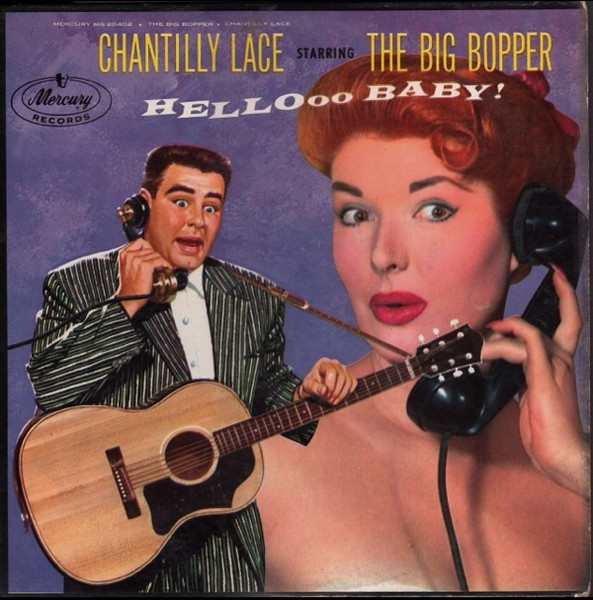
The Big Bopper was born Jiles Perry Richardson, Jr. in 1930 in Texas. The singer/songwriter and guitarist tragically died in an airplane crash in 1959 along with other rock and roll pioneers Buddy Holly and Ritchie Valens. In his short life, he worked as a radio disc jockey (where he picked up the nickname “The Big Bopper”) and served a stint in the Army before launching his career as a songwriter and eventually singer.

He only charted three times as a singer on the Billboard Hot 100 – all in 1958 – with “Chantilly Lace” (#6), “Big Bopper’s Wedding” (#38), and “Little Red Riding Hood” (#72). He is credited with creating the first music video, something he did for all three of his chart hits. He also wrote “White Lightning,” which was George Jones’ first #1 country hit, and “Running Bear,” a #1 pop hit for Johnny Preston. Still, the Big Bopper is most associated with “Chantilly Lace.”

The song, which used the same chord progression as Chuck Berry’s “Sweet Little Sixteen,” WK was originally called “That’s What I Like.” SF It was originally released as the B-side for “The Purple People Eater Meets the Witch Doctor,” a parody of Sheb Wooley’s “The Purple People Eater” and David Seville’s “Witch Doctor.” WK DJs preferred the flip side and “Chantilly Lace” became the third most played song of 1958. WB

Richardson’s background as a DJ played into the song’s success. The intro of the song had him announcing, in typical DJ patter, “this is the Big Bopper speakin’.” The technique helped people closely identify the song with him and made it easier for listeners to ask for the song at record stores. SF


Resources:


First posted 10/30/2022.

Saturday, January 15, 1972

Don McLean’s “American Pie” hit #1

American Pie

Don McLean

Writer(s): Don McLean (see lyrics here)


First Charted: November 19, 1971


Peak: 14 US, 14 CB, 15 GR, 15 HR, 13 AC, 2 UK, 15 CN, 15 AU, 1 DF (Click for codes to singles charts.)


Sales (in millions): 1.0 US, 0.6 UK, 1.6 world (includes US + UK)


Airplay/Streaming (in millions): 3.0 radio, 170.8 video, 362.11 streaming

Awards:

Click on award for more details.

About the Song:

February 3, 1959, is often called “the day the music died” because of a plane crash that killed early rockers Buddy Holly, Ritchie Valens, and the Big Bopper. Although singer/songwriter Don McLean doesn’t mention any of them by name, he immortalized the legendary trio with his epic song “American Pie.”

McLean has stated that Holly “was the first and last person I ever really idolized as a kid.” FB Holly was, in fact, McLean’s inspiration for taking up the guitar in the first place. TB McLean learned of the tragedy while folding newspapers for his paper route. WK McLean lamented that by 1964 Holly had been largely forgotten, but as McLean said, “I didn’t forget him.” TB In fact, he acknowledged that in writing the song’s first verse, he “exorcised his long-running grief over Holly’s death.” WK

The song expresses a general theme about the death of idealism in the 1960s, BBC but its lyrics maintained enough ambiguity to inspire radio stations to devote entire shows to analyzing “American Pie.” HL It has been amusingly suggested that one could “obtain a doctorate by writing on its hidden meaning.” HL McLean has done little to help in the interpretations, saying merely that it was an “attempt at an epic song about America and I used the imagery of music and politics to do that.” KN

“American Pie” was an epic in more than just theme; its nearly eight-and-a-half minute running time meant that the song was split into two parts to fit on the 45 RPM single format of the day. Initially, some stations played only the first side, but as the song grew in popularity, stations succumbed to playing it in its entirety. WK


Resources:

  • DMDB Encyclopedia entry for Don McLean
  • BBC BBC Radio 2 (2004). “Sold on Song Top 100”
  • FB Fred Bronson (2003). The Billboard Book of Number One Hits (5th edition). Billboard Books: New York, NY. Page 305.
  • HL Michael Heatley and Spencer Leigh. (1998). Behind the Song: The Stories of 100 Great Pop & Rock Classics. London, England: Blandford Books. Page 62.
  • KN Steve Knight (2007). The Top 25 Rock Songs of All-Time are…
  • TB Thunder Bay Press (2006). Singles: Six Decades of Hot Hits & Classic Cuts. Outline Press Ltd.: San Diego, CA. Page 132.
  • WK Wikipedia


First posted 1/5/2012; last updated 11/26/2022.