Showing posts with label J.P. Richardson. Show all posts

Saturday, February 3, 2024

Today in Music (1959): The Day the Music Died

February 3, 1959

The Day the Music Died

At the onset of 1959, Buddy Holly, J.P. “The Big Bopper” Richardson, and Ritchie Valens were three of the biggest rockers around. Holly had scored hits like “That’ll Be the Day” and “Peggy Sue.” Richardson’s biggest hit was the top 10 “Chantilly Lace” and Valens, only 17, was just getting started with his #2 hit “Donna” and the iconic “La Bamba.”

Along with Dion & the Belmonts, the trio of rockers embarked on a Winter Dance Party Tour set to hit 24 Midwestern cities over three weeks. On February 2, they performed at the Surf Ballroom in Clear Lake, Iowa. Holly was frustrated with the unheated tour bus and needed extra time to do laundry so he chartered a plane for himself and his bandmates Waylon Jennings and Tommy Alsup. However, Jennings gave up his seat to Richardson who had the flu, and Alsup lost a coin toss with Valens. Jennings, later of country music fame, joked with Holly, “I hope your ol’ plane crashes.” Jennings has said the words haunted him the rest of his life. WK

The Beechcraft Bonanza plane, piloted by Roger Peterson, departed around 1am and crashed less than 6 miles outside of the airport. Everyone died instantly. The crash was attributed to poor weather conditions and pilot error. Peterson was still testing on-flight instrumentation and had not been certified to fly in weather that required sole reliance on the instruments.

Don McLean famously eulogized the event in his hit 1972 #1 hit “American Pie” as “the day the music died.” It has been called “the first and greatest tragedy rock and roll has ever suffered.” WK


Spotify Podcast:

Check out the Dave’s Music Database podcast episode February 3, 1959: The Day the Music Died which highlights four of the songs mentioned in this post.


Resources:


First posted 2/3/2012; updated 2/3/2024.

Monday, August 4, 2008

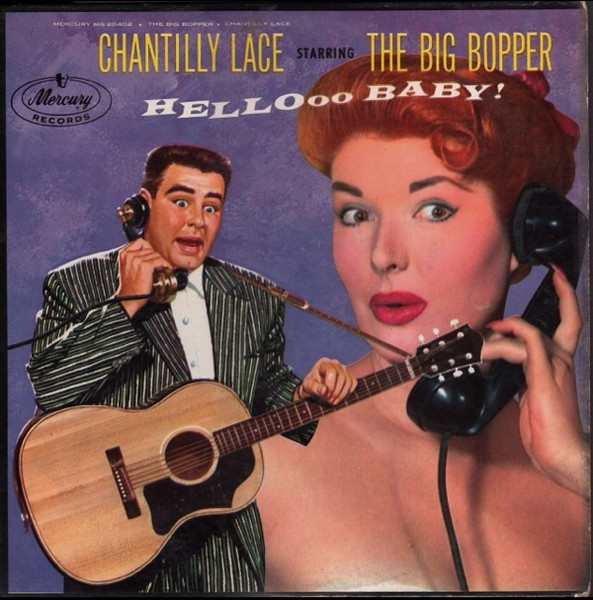
50 years ago: The Big Bopper “Chantilly Lace” charted

Chantilly Lace

The Big Bopper

Writer(s): J.P. Richardson (see lyrics here)


First Charted: August 4, 1958


Peak: 6 US, 4 CB, 4 HR, 3 RB, 12 UK, 2 CN, 2 DF (Click for codes to singles charts.)


Sales (in millions): -- US, -- UK, -- world (includes US + UK)


Airplay/Streaming (in millions): 2.0 radio, 11.0 video, 24.37 streaming

Awards:

Click on award for more details.

About the Song:

The Big Bopper was born Jiles Perry Richardson, Jr. in 1930 in Texas. The singer/songwriter and guitarist tragically died in an airplane crash in 1959 along with other rock and roll pioneers Buddy Holly and Ritchie Valens. In his short life, he worked as a radio disc jockey (where he picked up the nickname “The Big Bopper”) and served a stint in the Army before launching his career as a songwriter and eventually singer.

He only charted three times as a singer on the Billboard Hot 100 – all in 1958 – with “Chantilly Lace” (#6), “Big Bopper’s Wedding” (#38), and “Little Red Riding Hood” (#72). He is credited with creating the first music video, something he did for all three of his chart hits. He also wrote “White Lightning,” which was George Jones’ first #1 country hit, and “Running Bear,” a #1 pop hit for Johnny Preston. Still, the Big Bopper is most associated with “Chantilly Lace.”

The song, which used the same chord progression as Chuck Berry’s “Sweet Little Sixteen,” WK was originally called “That’s What I Like.” SF It was originally released as the B-side for “The Purple People Eater Meets the Witch Doctor,” a parody of Sheb Wooley’s “The Purple People Eater” and David Seville’s “Witch Doctor.” WK DJs preferred the flip side and “Chantilly Lace” became the third most played song of 1958. WB

Richardson’s background as a DJ played into the song’s success. The intro of the song had him announcing, in typical DJ patter, “this is the Big Bopper speakin’.” The technique helped people closely identify the song with him and made it easier for listeners to ask for the song at record stores. SF


Resources:


First posted 10/30/2022.