Showing posts with label Van and Schenck. Show all posts

Friday, May 26, 2017

100 years ago: “For Me and My Gal” charted for the first time

For Me and My Gal

Van & Schenck

Writer(s): George Meyer (music), Edgar Leslie and E. Ray Goetz (words) (see lyrics here)


First Charted: May 26, 1917


Peak: 13 US, 112 GA, 112 SM (Click for codes to charts.)


Sales (in millions): 3.0 (sheet music)


Airplay/Streaming (in millions): -- radio, -- video, -- streaming

For Me and My Gal

Judy Garland & Gene Kelly


First Charted: January 24, 1942


Peak: 3 US, 6 GA, 8 HP, 12 DF (Click for codes to charts.)


Sales (in millions): 3.0 (sheet music)


Airplay/Streaming (in millions): -- radio, -- video, -- streaming

Awards (Van & Schenck):

Click on award for more details.


Awards (Garland/Kelly):

Click on award for more details.

About the Song:

George W. Meyer was a composer born in Boston in 1884. He had hits spanning many years, including “”My Song of the Nile,” “Lonesome,” “My Mother’s Rosary” and the great novelty song “Where Did Robinson Crusoe Go with Friday on Saturday Night?” PS However, his biggest hit was probably “For Me and My Gal.” He wrote the music and came up with the title and then tapped Edgar Leslie and E. Ray Goetz to write the lyrics. TY2 When Meyer died, his wife had the song title inscribed on his tombstone. RCG

The song “was a forerunner of the jazz age.” RCG Its lyrics about “bells ringing and birds singing as two turtle doves go off to their wedding” RCG showed that in 1917, even as Americans were consumed by World War I, they still relished love songs.

The popular vaudeville team of Van & Schenck recorded the song and took it #1. Others to sing it on vaudeville included Belle Baker, Fanny Brice, Eddie Cantor, George Jessel, Al Jolson, Sophie Tucker. 1917 saw three more chart version in addition to Van & Schenck’s – Prince’s Orchestra (#5), Henry Burr & Albert Campbell (#7), and Billy Murray (#9). PM The sheet music moved three million copies.

The song “was still on pianos all over America” RCG In 1942 when Gene Kelly and Judy Garland sang the song in the movie of the same name. The movie celebrated vaudeville and other hits from the World War I era. Their recording was a #3 hit featuring Garland’s then-husband David Rose and His Orchestra. DJ Guy Lombardo also charted with a version of the song in 1943, reaching #17.


Resources:


Related Links:


First posted 5/26/2012; last updated 3/31/2023.


Monday, January 1, 1973

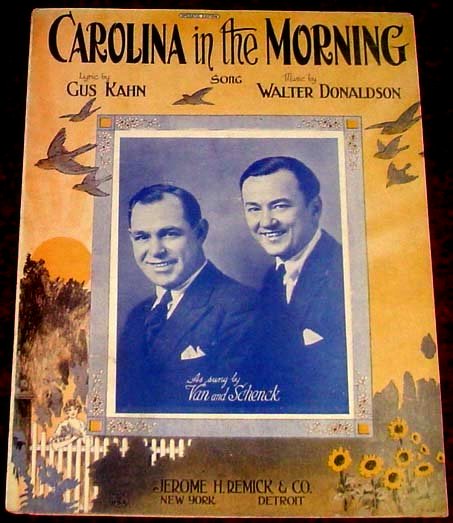
50 years ago: Van & Schenck “Carolina in the Morning” hit #1

Carolina in the Morning

Van & Schenck

Writer(s): Gus Kahn, Walter Donaldson (see lyrics here)


First Charted: January 1, 1923


Peak: 13 US, 12 GA, 14 SM (Click for codes to charts.)


Sales (in millions): 1.0 (sheet music)


Airplay/Streaming (in millions): -- radio, -- video, -- streaming

Awards:

Click on award for more details.

About the Song:

The song was introduced by vaudeville performer William Frawley and then quickly added to the musical revue The Passing Show of 1922, RCG where it was sung by the brothers Willie and Eugene Howard. DJ The show opened on September 20, 1922 at the Winter Garden Theater and closed on December 2, 1922 after 85 performances. SB

Marion Harris was the first to record the song (#4), SM but it was the comedy-musical team of Gus Van and Joe Schenck who took “Carolina” to #1, although this wasn’t a comedic recording. Paul Whiteman (#5) and the American Quartet (#8) also charted with the song that year. Danny Winchell revived the song in 1952, reaching #30. PM Al Jolson revived it in the movie The Jolson Story (1946) RCG with a version which outsold the original. WK It emerged again in the 1951 Gus Kahn biopic I’ll See You in My Dreams. DJ Danny Winchell charted with it in 1952, making it to #30. Bing Crosby, Jimmy Durante, Benny Goodman, Judy Garland, Bill Haley & His Comets, Danny Kaye, Dean Martin, and Dinah Shore have all recorded it. SB Frawley himself sang the song on two different television shows on which he was a star – I Love Lucy and My Three Sons WK and Dick Van Dyke and Mary Tyler Moore performed it on The Dick Van Dyke Show. WK The song has also been used frequently for Warner Brothers’ Merrie Melodies and Looney Tunes cartoons. WK

Both North and South Carolina lay claim to this tune which deals with longing to “return home where ‘The dew is pearly kinda early in the morning’.” RCG “The southern drawl is alluded to by rhyming ‘Carolina’ with ‘finer.’” RCG

Amusingly, the song was written by a New Yorker (Walter Donaldson, born in Brooklyn in 1893) and a German (Gus Kahn, born in Coblenz in 1886). Donaldson wrote more than 600 songs; his best known came in the years between World War I and II. PS Kahn’s family came to the United States in 1891 and settled in Chicago. He had his first song published in 1907 and then wrote lyrics for vaudeville performers in Chicago and New York before moving to California in 1933 to write for movies. Some of his best-known songs are “Pretty Baby” (1916), “Makin’ Whoopee” (1928), and “Liza” (1928). PS


Resources:


First posted 1/13/2016; last updated 1/29/2023.

Friday, September 10, 1971

50 years ago: Van & Schenck hit #1 “Ain’t We Got Fun?”

Ain’t We Got Fun?

Van & Schenck

Writer(s): Gus Kahn, Raymond B. Egan, Richard Whiting (see lyrics here)


Released: July 1921


First Charted: August 13, 1921


Peak: 12 US, 11 GA, 13 SM (Click for codes to charts.)


Sales (in millions): 1.0 (sheet music)


Airplay/Streaming (in millions): -- radio, -- video, -- streaming

Awards:

Click on award for more details.

About the Song:

As Don Tyler says in his book Hit Parade 1920-1955, this foxtrot from the Roaring Twenties “would have made a good theme song for those hellbent on seeking the fun typical of the era.” TY1 However, it is also “a satirical social comment on the reality that people were not really having fun.” SM Men returning home after World War I “were promised a new world but it hadn’t happened.” SM While the decade was seen as a time of economic growth, there was a short depression in 1920-21.

Thus the song “mixes zesty music with a nonsense lyric” RCG about “young people enjoying the times even as a bill collector knocks on the door.” RCG It says that “despite tough times, most people are resilient and cope with the bad times.” PS Sometimes they can even do it with a sense of humor, showcased by lines like “the rich get richer and the poor get children.”

Arthur West first performed the song in the revue Satires of 1920 DJ and George Watts introduced it in vaudeville. TY1 Then Ruth Roye and the duo of Gus Van and Joe Schenck helped popularize it. TY1 The latter were a comedy-musical team who not only found success in vaudeville, but Broadway and radio. PM They also had the most successful chart run with the song with their #1 version in 1921. PM

Two other versions charted in 1921-22: the Benson Orchestra of Chicago took it to #9 and Billy Jones hit #12. PM However, the song has been recorded by many big names over the years. Some of the artists who have recorded this song include Chet Atkins, Rosemary Clooney, Bing Crosby, Doris Day, Cliff “Ukulele Ike” Edwards, Bob Hope, Al Jolson, Jack Kerouac, Peggy Lee, Gordon MacRae, Mitch Miler, Debbie Reynolds, Dick Van Dyke, and Margaret Whiting. LP

The song even figures into literature, including Dorothy Parker’s 1929 award-winning short story “Big Blonde” and F. Scott Fitzgerald’s classic novel, The Great Gatsby. SF It also showed up in the 1974 film adaptation of the latter, TY1 as well as in 1953’s By the Light of the Silvery Moon TY1 and 1951’s I’ll See You in My Dreams. The latter was a biopic about Gus Kahn, one of the song’s lyricists. DJ Eddie Cantor sang it for the 1953 soundtrack for The Eddie Cantor Story. DJ Woody Allen also used the song in the 1983 film Zelig. WK Carnival Cruise Lines also used the song in the 1990s in their commercials. DJ


Resources:


First posted 8/3/2012; last updated 1/28/2023.