Showing posts with label Edgar Leslie. Show all posts

Sunday, December 1, 2019

100 years ago: “Oh What a Pal Was Mary” hit #1

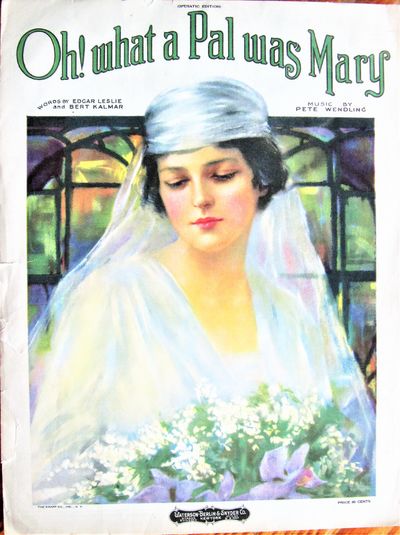
Oh, What a Pal Was Mary

Henry Burr

Writer(s): Pete Wendling (music), Edgar Leslie (words), Bert Kalmar (words) (see lyrics here)


First Charted: October 25, 1919


Peak: 16 US, 14 GA, 16 SM (Click for codes to charts.)


Sales (in millions): 1.0 (sheet music)


Airplay/Streaming (in millions): -- radio, 0.01 video, -- streaming

Awards:

Click on award for more details.

About the Song:

Henry Burr was “the biggest star of the 1910s.” SM “The soft-voiced tenor became a major star soon after his first recordings in 1903, and remained so for the next quarter-century.” PM2 He is “said to have sung on some twelve thousand recordings – far more than any other vocalist in history.” PM2

“Oh What a Pal Was Mary” was his 13th of fourteen chart-toppers as a solo artist and his eighty-third chart entry overall. He’d also landed eight #1’s with partner Albert Campbell from 1912 to 1919. He and Campbell were also members of the Peerless Quartet, which reached the top seven times. This gave Burr 28 #1 songs as a soloist, duet partner, and group member. Burr took “Mary” to #1 in 1919, but it charted again in 1920 (Edward Allen, #10).

It “was a sad song that would end the decade on a sad note.” SM It is “a beautiful waltz that conveys heartfelt feelings of deep love.” TY2 Edgar Leslie, one of the song’s lyricists, was a founding member of ASCAP (American Society of Composers, Authors and Publishers) in 1914 and was inducted into the Songwriters Hall of Fame in 1972. “Among My Souvenirs,””Hello, Hawaii, How Are You?,” and “For Me and My Gal” are some of his best known songs.

Music writer Don Tyler notes that it wasn’t until 1920 that women got the right to vote and “there were many more women’s equality issues to be resolved.” TY2 As such, he ponders, were women “taking a different role by ’19? Could they really have gained enough equality that a woman could be a man’s pal?” TY2 Of course, the song cues the listener in that Mary was, in fact, the narrator’s sweetheart as well as his friend. We aren’t told exactly what happened, but she is gone now, possibly deceased.


Resources:


Related Links:


First posted 4/24/2023.

Friday, May 26, 2017

100 years ago: “For Me and My Gal” charted for the first time

For Me and My Gal

Van & Schenck

Writer(s): George Meyer (music), Edgar Leslie and E. Ray Goetz (words) (see lyrics here)


First Charted: May 26, 1917


Peak: 13 US, 112 GA, 112 SM (Click for codes to charts.)


Sales (in millions): 3.0 (sheet music)


Airplay/Streaming (in millions): -- radio, -- video, -- streaming

For Me and My Gal

Judy Garland & Gene Kelly


First Charted: January 24, 1942


Peak: 3 US, 6 GA, 8 HP, 12 DF (Click for codes to charts.)


Sales (in millions): 3.0 (sheet music)


Airplay/Streaming (in millions): -- radio, -- video, -- streaming

Awards (Van & Schenck):

Click on award for more details.


Awards (Garland/Kelly):

Click on award for more details.

About the Song:

George W. Meyer was a composer born in Boston in 1884. He had hits spanning many years, including “”My Song of the Nile,” “Lonesome,” “My Mother’s Rosary” and the great novelty song “Where Did Robinson Crusoe Go with Friday on Saturday Night?” PS However, his biggest hit was probably “For Me and My Gal.” He wrote the music and came up with the title and then tapped Edgar Leslie and E. Ray Goetz to write the lyrics. TY2 When Meyer died, his wife had the song title inscribed on his tombstone. RCG

The song “was a forerunner of the jazz age.” RCG Its lyrics about “bells ringing and birds singing as two turtle doves go off to their wedding” RCG showed that in 1917, even as Americans were consumed by World War I, they still relished love songs.

The popular vaudeville team of Van & Schenck recorded the song and took it #1. Others to sing it on vaudeville included Belle Baker, Fanny Brice, Eddie Cantor, George Jessel, Al Jolson, Sophie Tucker. 1917 saw three more chart version in addition to Van & Schenck’s – Prince’s Orchestra (#5), Henry Burr & Albert Campbell (#7), and Billy Murray (#9). PM The sheet music moved three million copies.

The song “was still on pianos all over America” RCG In 1942 when Gene Kelly and Judy Garland sang the song in the movie of the same name. The movie celebrated vaudeville and other hits from the World War I era. Their recording was a #3 hit featuring Garland’s then-husband David Rose and His Orchestra. DJ Guy Lombardo also charted with a version of the song in 1943, reaching #17.


Resources:


Related Links:


First posted 5/26/2012; last updated 3/31/2023.