Showing posts with label Rock and Roll Hall of Fame songs that shaped rock. Show all posts

Saturday, September 10, 2016

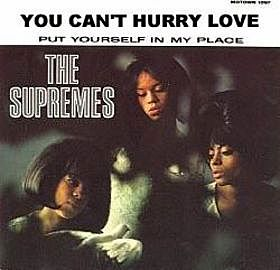
50 years ago: The Supremes “You Can’t Hurry Love” hit #1

You Can’t Hurry Love

The Supremes

Writer(s): Brian Holland, Lamont Dozier, Eddie Holland (see lyrics here)


Released: July 25, 1966


First Charted: August 5, 1966


Peak: 12 US, 11 CB, 11 GR, 12 HR, 12 RB, 3 UK, 3 CN, 6 AU, 1 DF (Click for codes to charts.)


Sales (in millions): 1.0 US, 0.6 UK


Airplay/Streaming (in millions): 5.0 radio, 10.0 video, 366.54 streaming

Awards:

Click on award for more details.

About the Song:

“You Can’t Hurry Love” was the seventh chart-topper from the Supremes. Like its predecessors, it was written by the Motown songwriting and production trio of Holland-Dozier-Holland. Billboard magazine described it as “the group’s most exciting side to date.” WK “Every one of the Supremes’ hits had a big beat working for it, a four-four engine driven by handclaps and bass-drum hits. But none of the hits leading up to ‘You Can’t Hurry Love’ had a beat quite that big.” SG “That beat is the focal point, even more than the vocals. Diana Ross and her fellow Supremes flit around that bassline like hummingbirds.” SG

Lamont Dozier, one of the songwriters, said “It was basically a gospel feel we were after.” FB To that end, they were inspired by the ‘50s gospel song “You Can’t Hurry God, He’s Right on Time” by Dorothy Love Coates & the Original Gospel Harmonettes. SG It includes the lines “You can’t hurry God/ You just have to wait/ Trust and give him time/ No matter how long it takes.”

In the Supremes’ hands, Diana Ross sings “as someone who wants to be in a relationship and who finds herself getting more and more impatient.” SG It “works less as a lonely woman’s lament and more as a piece of romantic advice.” SG Cash Box summed it up as a “pulsating pop-R&B rhythmic ode which contends that romance is a slow-developing game of give-and-take.” WK

Phil Collins’ 1982 cover of the song reached #10 in the United States and topped the charts in the UK, doing even better than the #3 peak of the original. Dozier considers it one of the best covers of a song by the Supremes. FB Dozier would later co-write “Two Hearts,” a #1 song in the United States for Collins from the 1988 movie Buster.


Resources:


Related Links:


First posted 2/6/2023.

Sunday, October 21, 2007

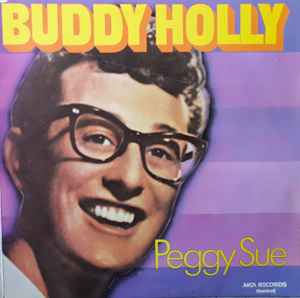
50 years ago: Buddy Holly “Peggy Sue” charted

Peggy Sue

Buddy Holly & the Crickets

Writer(s): Jerry Allison, Buddy Holly, Norman Petty (see lyrics here)


First Charted: October 21, 1957


Peak: 3 US, 4 HP, 2 CB, 3 HR, 2 RB, 6 UK, 4 DF (Click for codes to charts.)


Sales (in millions): 1.0 US


Airplay/Streaming (in millions): 2.0 radio, 15.5 video, 40.5 streaming

Awards:

Click on award for more details.

About the Song:

“What do you think McCartney and Lennon, Dylan, Jagger and Richards, Fogerty, Townshend, and the rest spent their teen years daydreaming about? They wanted to be rock and rollers: stand like Elvis, shout like Little Richard and Jerry Lee, rock like Chuck, testify like Muddy, and speak in music like Buddy Holly…Listen to ‘Peggy Sue’ and you’ll understand why.” PW For the “purpose of getting across…what he’s feeling, [Holly] invents a dozen new ways of using the human voice as a communicative vehicle.” PW

“Peggy Sue” was originally going to be named “Cindy Lou” after Buddy Holly’s baby niece. However, Jerry Allison, the Crickets’ drummer, suggested the name change to get back into the good graces with his girlfriend “Peggy Sue,” with whom he’d recently broken up. TB It worked. The two eloped on July 22, 1958. TB

The song was recorded at producer Norman Petty’s studio in Clovin, New Mexico on July 1, 1957 (actually before Holly charted with his #1 hit “That’ll Be the Day”). SS Amazingly, the song only features Holly and Allison. They started out trying to record it with a calypso feel, but it didn’t work. Then Holly suggested Allison do some drum rolls PW “which he did on a snare drum with the snares turned off.” TB This gave the song “a dynamic rock ‘n’ roll aspect.” TB Critic Dave Marsh called it “the biggest drum beats in rock and roll history.” DM

“It’s all that Holly can do to summon the strength to sing over them, and the guitar has to race to keep up.” DM He ends up “playing his rhythm guitar part entirely with speedy downstrokes.” TB Jimmy Guterman called it “the greatest rhythm guitar solo in all rock ‘n’ roll.” SS “The lyrics are childlike in their simplicity and repetition, but Holly belts them out with such conviction and sensuality that no one can doubt his intense ardor for this woman.” SS The song has “an almost throwaway quality [that] lifts the song and makes it irresistible.” TC


Resources:


Related Links:


First posted 3/26/2023; last updated 3/30/2023.

Thursday, December 15, 2005

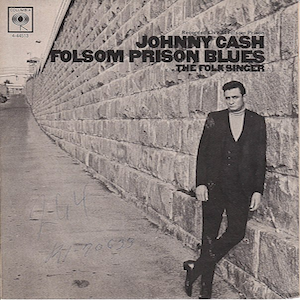
50 years ago: Johnny Cash “Folsom Prison Blues” released

Folsom Prison Blues

Johnny Cash

Writer(s): Johnny Cash (see lyrics here)


Released: December 15, 1955 (studio), April 30, 1968 (live)


First Charted: February 11, 1956 (studio), May 25, 1968 (live)


Peak: 4 CW, 5 DF (studio), 32 US, 36 CB, 23 GR, 32 HR, 39 AC, 14 CW, 17 CN, 4 DF (live) (Click for codes to charts.)


Sales (in millions): -- US, 0.25 UK


Airplay/Streaming (in millions): 1.0 radio, 52.0 video, 178.65 streaming

Awards:

Click on award for more details.

About the Song:

Johnny Cash was born in Arkansas in 1932 and grew up dirt poor. At 12, he started writing songs. After graudating from high school, he briefly worked in an auto factory in Michigan before enlisting in the Air Force. While in Germany on assignment, he learned to play guitar and wrote his first important songs – one of which was “Folsom Prison Blues.” SS

After his release from the Air Force in 1954, Cash took a course on radio announcing while working as an appliance salesman. His brother Roy introduced him to Luther Perkins and Marshall Grant, two mechanics at the garage who played guitar. The three started performing together, eventually auditioning for Sam Phillips at Sun Records and landing a recording contract. SS His first session produced “Hey Porter” and “Cry! Cry! Cry!” The latter became his first top-20 country hit.

With Perkins on flat-top guitar and Grant on upright bass, Cash recorded “Folsom Prison Blues,” SS “a country song with a rockabilly accent,” TC “touches of gospel and an uncanny sense of spiritualty” TC presented with “an unsually poetic eye.” TC It was paired with “So Doggone Lonesome”for a single which reached #4 on the country charts. Phillips reportedly didn’t like “Folsom” and wanted to send it to Tennessee Ernie Ford, but Cash wanted to keep it for himself. SS

It became a concert favorite and was naturally the opening song when he performed a concert at Folsom Prison in 1968. The “live energy and enthusiasm was captured so well…it was as if the song was ‘happy’ to be home.” AC It was released as a single and went to #1 on the country charts.

Cash never served actual prison time, “but the utter conviction he brought to this tale sends chills up the spine.” SS He said there are those who are “firmly convinced…that I led a life of violent crime.” SS His tale of “a cold-blooded, unrepentant convicted killer” SS was partly inspired by a 1951 documentary called Inside the Walls of Folsom Prison. He realized everyone “was locked in some type of prison. It might be loneliness, poverty, booze…but there was something holding just about everyone back.” SS The song’s most vivid line (“I shot a man in Reno, just to watch him die”) came from his goal to, as he said, “think up the worst reason a person could have for killing another person.” SS


Resources:


Related Links:


First posted 8/23/2023.