Showing posts with label Folsom Prison Blues. Show all posts

Sunday, February 24, 2019

50 years ago: Johnny Cash recorded live at San Quentin

First posted 2/26/2008; updated 12/4/2020.

Live at San Quentin

Johnny Cash


Recorded live: February 24, 1969


Released: June 16, 1969


Charted: July 5, 1969


Peak: 14 US, 120 CW, 2 UK, 13 CN, 12 AU


Sales (in millions): 3.0 US, 0.1 UK, 3.34 world (includes US and UK)


Genre: country


Tracks:

Song Title (date of original studio release of single – unless noted as live, chart peaks) Click for codes to singles charts.

  1. Big River (1/20/58, 4 CW) *
  2. I Still Miss Someone *
  3. Wreck of the Old ‘97
  4. I Walk the Line (6/9/56, 1 CW, 17 US)
  5. Darlin’ Companion
  6. I Don’t Know Where I’m Bound *
  7. Starkville City Jail
  8. San Quentin
  9. San Quentin
  10. Wanted Man
  11. A Boy Named Sue (live: 7/26/69, 1 CW, 2 US, 4 UK, 1 AC, sales: ½ million, airplay: 1 million)
  12. Peace in the Valley
  13. Folsom Prison Blues (live: 6/1/68, 1 CW, 32 US, 39 AC) *
  14. Ring of Fire (6/1/63, 1 CW, 63 US, airplay: 1 million) *
  15. He Turned Water into Wine *
  16. Daddy Sang Bass (12/7/68, 1 CW, 42 US, airplay: 1 million) *
  17. The Old Account Was Settled Long Ago *
  18. Closing Medley *

* Tracks added to the Legacy Edition


Total Running Time: 34:04

Rating:

4.518 out of 5.00 (average of 23 ratings)


Awards: (Click on award to learn more).

About the Album:

“To put the performance on At San Quentin in a bit of perspective: Johnny Cash's key partner in the Tennessee Two, guitarist Luther Perkins, died in August 1968, just seven months before this set was recorded in February 1969. In addition to that, Cash was nearing the peak of his popularity – his 1968 live album, At Folsom Prison, was a smash success – but he was nearly at his wildest in his personal life, which surely spilled over into his performance.” STE

“All of this sets the stage for At San Quentin, a nominal sequel to At Folsom Prison that surpasses its predecessor and captures Cash at his rawest and wildest. Part of this is due to how he feeds off of his captive audience, playing to the prisoners and seeming like one of them, but it’s also due to the shifting dynamic within the band. Without Perkins, Cash isn’t tied to the percolating two-step that defined his music to that point. Sure, it’s still there, but it has a different feel coming from a different guitarist, and Cash sounds unhinged as he careens through his jailhouse ballads, old hits, and rockabilly-styled ravers, and even covers the Lovin’ Spoonful (Darlin’ Companion).” STE

“No other Johnny Cash record sounds as wild as this. He sounds like an outlaw and renegade here, which is what gives it power – listen to A Boy Named Sue, a Shel Silverstein composition that could have been too cute by half, but is rescued by the wild-eyed, committed performance by Cash, where it sounds like he really was set on murdering that son of a bitch who named him Sue.” STE

“He sounds that way throughout the record, and while most of the best moments did make it to the original 1969 album, the 2000 Columbia/Legacy release eclipses it by presenting nine previously unreleased bonus tracks, doubling the album’s length, and presenting such insanely wild numbers as Big River as well as sweeter selections like Daddy Sang Bass. Now, that’s the only way to get the record, and that’s how it should be, because this extra material makes a legendary album all the greater – in fact, it helps make a case that this is the best Johnny Cash album ever cut.” STE


Notes: The 2000 Legacy re-release as San Quentin: The Complete 1969 Concert included the bonus cuts noted with an asterisk (*) in the track listing.

Resources and Related Links:

Thursday, December 15, 2005

50 years ago: Johnny Cash “Folsom Prison Blues” released

Folsom Prison Blues

Johnny Cash

Writer(s): Johnny Cash (see lyrics here)


Released: December 15, 1955 (studio), April 30, 1968 (live)


First Charted: February 11, 1956 (studio), May 25, 1968 (live)


Peak: 4 CW, 5 DF (studio), 32 US, 36 CB, 23 GR, 32 HR, 39 AC, 14 CW, 17 CN, 4 DF (live) (Click for codes to charts.)


Sales (in millions): -- US, 0.25 UK


Airplay/Streaming (in millions): 1.0 radio, 52.0 video, 178.65 streaming

Awards:

Click on award for more details.

About the Song:

Johnny Cash was born in Arkansas in 1932 and grew up dirt poor. At 12, he started writing songs. After graudating from high school, he briefly worked in an auto factory in Michigan before enlisting in the Air Force. While in Germany on assignment, he learned to play guitar and wrote his first important songs – one of which was “Folsom Prison Blues.” SS

After his release from the Air Force in 1954, Cash took a course on radio announcing while working as an appliance salesman. His brother Roy introduced him to Luther Perkins and Marshall Grant, two mechanics at the garage who played guitar. The three started performing together, eventually auditioning for Sam Phillips at Sun Records and landing a recording contract. SS His first session produced “Hey Porter” and “Cry! Cry! Cry!” The latter became his first top-20 country hit.

With Perkins on flat-top guitar and Grant on upright bass, Cash recorded “Folsom Prison Blues,” SS “a country song with a rockabilly accent,” TC “touches of gospel and an uncanny sense of spiritualty” TC presented with “an unsually poetic eye.” TC It was paired with “So Doggone Lonesome”for a single which reached #4 on the country charts. Phillips reportedly didn’t like “Folsom” and wanted to send it to Tennessee Ernie Ford, but Cash wanted to keep it for himself. SS

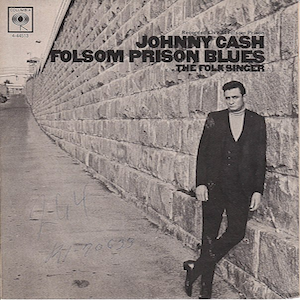
It became a concert favorite and was naturally the opening song when he performed a concert at Folsom Prison in 1968. The “live energy and enthusiasm was captured so well…it was as if the song was ‘happy’ to be home.” AC It was released as a single and went to #1 on the country charts.

Cash never served actual prison time, “but the utter conviction he brought to this tale sends chills up the spine.” SS He said there are those who are “firmly convinced…that I led a life of violent crime.” SS His tale of “a cold-blooded, unrepentant convicted killer” SS was partly inspired by a 1951 documentary called Inside the Walls of Folsom Prison. He realized everyone “was locked in some type of prison. It might be loneliness, poverty, booze…but there was something holding just about everyone back.” SS The song’s most vivid line (“I shot a man in Reno, just to watch him die”) came from his goal to, as he said, “think up the worst reason a person could have for killing another person.” SS


Resources:


Related Links:


First posted 8/23/2023.