Showing posts with label Norman Whitfield. Show all posts

Friday, December 14, 2018

50 years ago: Marvin Gaye hit #1 with “I Heard It Through the Grapevine”

I Heard It Through the Grapevine

Marvin Gaye

Writer(s): Barrett Strong, Norman Whitfield (see lyrics here)


Released: October 30 1968


First Charted: November 16, 1968


Peak: 17 US, 15 CB, 14 GR, 11 HR, 17 RB, 13 UK, 8 CN, 40 AU, 1 DF (Click for codes to charts.)


Sales (in millions): 4.0 US, -- UK, 6.0 world (includes US + UK)


Airplay/Streaming (in millions): 6.0 radio, 64.5 video, 299.89 streaming

Awards:

Click on award for more details.

About the Song:

Marvin didn’t want to record it, RS500 Motown didn’t want to release it, RSP and Berry Gordy, the company head honcho, thought it was horrible. FB Naturally it became Gaye’s first pop #1 and biggest hit, as well as Motown’s longest running #1 to date. FB

Norman Whitfield, a producer for Motown, had a habit of pushing the same song on multiple acts. While it frustrated some of his charges, it also worked, at least on occasion. Never was that more the case than with Gaye’s cover of “Grapevine.” RS500 First the Miracles put their spin on it, then the Isley Brothers, whose version is still locked somewhere in the Motown vaults. FB In 1967, both Gaye and Gladys Knight & The Pips tackled it. WK Before year’s end, the Pips had a #1 R&B and #2 pop hit with it.

Gaye’s version was more aligned with the song’s lyrical theme. TB It was spookier than the Pips’ “journeyman rendition,” MA slowed down “to a voodoo chant pace” TC and “accenting a more churchy, Ray Charles feel.” TC When they were recording the song, Whitfield encouraged the reluctanct Gaye to sing in a high, raspy voice. As was generally the case, Whitfield got his way. WK

Whitfield championed Gaye’s “Grapevine,” but it was shelved for more than a year, finally emerging when filler was needed for Gaye’s In the Groove album. A DJ on a radio station in Chicago began playing the song and when it was obvious it was a hit, Gordy finally gave in and allowed the single to be released. WK


Resources:


Related Links:


First posted 11/16/2011; last updated 2/3/2023.

Saturday, December 2, 1972

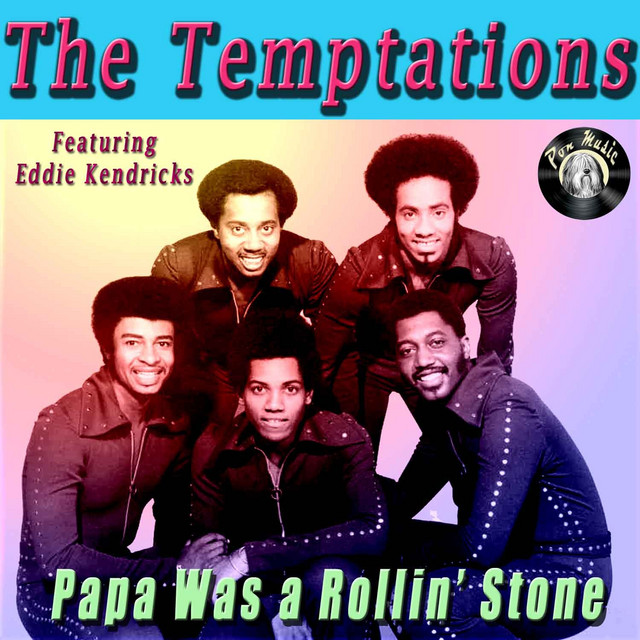
The Temptations “Papa Was a Rollin’ Stone” hit #1

Papa Was a Rollin’ Stone

The Temptations

Writer(s): Barrett Strong, Norman Whitfield (see lyrics here)


Released: September 28, 1972


First Charted: October 13, 1972


Peak: 11 US, 11 CB, 3 GR, 3 HR, 5 RB, 14 UK, 12 CN, 69 AU, 6 DF (Click for codes to charts.)


Sales (in millions): 2.0 US, 0.2 UK


Airplay/Streaming (in millions): -- radio, 66.7 video, 130.49 streaming

Awards:

Click on award for more details.

About the Song:

“By 1972, the classic Motown sound — that gorgeous, efficient pop-soul assembly line — was just about dead. Instead, the music had turned lush and psychedelic and orchestral.” SG However, within Motown artists like Marvin Gaye and Stevie Wonder had fought for more artistic control and it had a positive impact on other artists on the roster. The Temptations, who had major Motown hits with songs like “My Girl” and “”Ain’t Too Proud to Beg” were transforming as well. By the late ‘60s and early ‘70s, their sound evolved into that of psychedelic soul, due in large part to the songwriting of Barrett Strong and Norman Whitfield.

Perhaps the peak of Strong and Whitfield’s output was “Papa Was a Rollin’ Stone,” “an all-time monster of a hit, a masterful orchestral howl that would anticipate so many of the changes to come.” SG It was first given to Motown act The Undisputed Truth, Whitfield’s pet project which he’d assembled in 1970. SG That “fuzzed-out, horn-drenched” SG version stalled at #63 on the Billboard Hot 100 and #24 on the R&B chart. When the Temptations covered it, it swelled into “a dazed, world-swallowing 12-minute symphony.” SG Even the edited single version ran seven minutes.

Amidst the undeniably funky groove, however, lurked the dark story of siblings (as voiced by four of the Temptations trading verses throughout the song) WK discussing the now-deceased father who he never met – and apparently wasn’t worth meeting. Dad was a drunk bum who slept around and even had another whole family.

Despite the success of the song – which included three Grammys – the Temptations were frustrated with what “was more of a Norman Whitfield record than a Temptations record.” SG They weren’t happy about their songs becoming increasingly focused on instrumentation instead of vocals and complained to Motown chief Berry Gordy. Member Dennis Edwards said he hated the song when he first heard it. FB Whitfield soon left to start his own label and the Temptations returned to the kinds of songs they wanted to sing, which led to them drifting into “artistic and commercial irrelevance.” SG


Resources:

  • FB Fred Bronson (2003). The Billboard Book of Number One Hits (5th edition). Billboard Books: New York, NY. Page 323.
  • SF Songfacts
  • SG Stereogum (3/14/2019). “The Number Ones” by Tom Breihan
  • WK Wikipedia


Related Links:


First posted 2/4/2023.