Showing posts with label Culture Club. Show all posts

Saturday, December 15, 1984

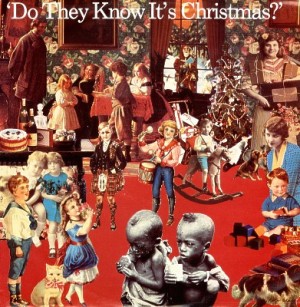
Band Aid’s “Do They Know It’s Christmas” hit #1 in the UK

Do They Know It’s Christmas

Band Aid

Writer(s): Bob Geldof, Midge Ure (see lyrics here)


Released: December 3, 1984


Peak: 13 US, 7 CB, 39 GR, 35 A40, 32 AR, 15 UK, 12 CN, 14 AU, 2 DF (Click for codes to charts.)


Sales (in millions): 1.0 US, 3.94 UK, 11.7 world (includes US + UK)


Airplay/Streaming (in millions): -- radio, 39.3 video, 403.22 streaming

Awards:

Click on award for more details.

About the Song:

Bob Geldof made his name initially as the frontman of the Boomtown Rats, an Irish punk-pop outfit which got its start in the late ‘70s and found success with a pair of #1 songs on the UK charts with “Rat Trap” and “I Don’t Like Mondays.” However, in his obituary someday, the leading line will reference him as the man who organized Band Aid and Live Aid.

Geldof was so moved one night by images from the BBC of “Ethiopians as they trudged for miles in search of food” HL that he felt obligated to do something. He started out collecting money at Boomtown Rats shows HL but wanted to do something on a grander scale. He connected with Midge Ure, the frontman from Ultravox, to pen a song about those suffering in the African famine. He wrote the lyrics in the back seat of a taxi and Midge produced the backing track in his studio. TB

To garner even more attention to the cause, however, the pair then tackled their collective rolodexes to round up a Who’s Who of British pop superstars to sing a Christmas charity single as the collective Band Aid. Among the stars enlisted were Bono, Phil Collins, Sting, George Michael, Duran Duran, Culture Club, Status Quo, Paul Weller, Spandau Ballet, Heaven 17, and Kool & the Gang.

36 artists HL gathered at Sarm West Studios in London on November 25, 1984. Geldof implored attendees “to leave your egos outside the studio” HL and, in a wonderful display of unity, “everyone got on with everyone else.” HL They started the recording process by singing the “Feed the world, let them know it’s Christmas time” refrain first as a group. Then individual singers sang the song the entire way through so that Ure, who also produced the song, could splice the best parts together for the final version. WK The whole song was recorded within a 24-hour period. WK

Geldof wanted to make sure all the proceeds went straight to the Ethiopians so he in addition to getting the musicians to work for free, he arranged for free studio time, manufacturing, and distribution. The song sold 750,000 in its first week of release in England, making it their fastest-selling single in history at the time. MG It went on to sell more than 3.5 million, making it the best-selling song in Britain until Elton John’s 1997 re-recording of “Candle in the Wind”. WK Combined with the 1985 Live Aid concert, Geldof’s efforts raised £110 million. MG


Resources:


First posted 12/15/2011; last updated 4/12/2023.

Saturday, September 24, 1983

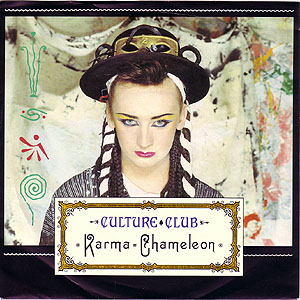
Culture Club “Karma Chameleon” hit #1 in the UK

Karma Chameleon

Culture Club

Writer(s): George O'Dowd, Jon Moss, Roy Hay, Mikey Craig, Phil Pickett (see lyrics here)


First Charted: September 17, 1983


Peak: 13 US, 13 CB, 13 RR, 3 AC, 67 RB, 1 CO, 16 UK, 13 CN, 15 AU, 9 DF (Click for codes to singles charts.)


Sales (in millions): 1.0 US, 1.62 UK, 5.0 world (includes US + UK)


Airplay/Streaming (in millions): 1.0 radio, 644.41 video, 366.73 streaming

Awards:

Click on award for more details.

About the Song:

Culture Club broke through in 1982 with “Do You Really Want to Hurt Me?,” “a sweetly sensitive lite-reggae bounce that became a global smash.” SG While they “came from London’s punk and new wave scenes,” SG they “didn’t sound like other new wave groups.” SG They sounded more like Lionel Richie than Human League. SG “They made tender crushed-velvet white soul” SG “occasionally sprinkled with soft reggae or post-disco dance-pop accents. Boy George sang as much like Smokey Robinson as he could…shooting for that same soft precision and that same sense of strength through vulnerability.” SG

Teens throughout the UK “were emulating George’s outrageous and oft-changing style which usually involved long white gowns and mult-colored plaits.” KL However, “Culture Club weren’t simply a novelty; they were a pop juggernaut.” SG “Their ability to dominate in a time of rampant homophobia is pretty amazing, and it speaks to Boy George’s singular charisma.” SG He was “a purring androgyne flirt who used the brand-new vehicle of MTV to present a persona that was defiant in its femininity.” SG

He was born George Alan O’Dowd “into a working-class Irish Catholic family in Kent…George’s father was abusive, and he also had to deal with growing up gay in a profoundly unfriendly environment. But he found escape in the New Romantic world of the early ’80s, dancing at clubs like London’s Blitz.” SG It was there when “former Sex Pistols svengali Malcolm McLaren saw George and invited him to sing with Bow Wow Wow, the band McLaren was managing at the time.” SG George didn’t stay long, opting instead to start his own band. He enlisted the band’s bassist, Mikey Craig, and they also recruited guitarist and former hairdresser Roy Hay along with drummer Jon Moss, who’d worked with the Stranglers, the Damned, and Adam & the Ants.

“Karma Chameleon” was the lead single from the group’s sophomore album, Colour by Numbers. It was the group’s fifth consecutive top-10 in the United States. It became the biggest selling single of 1983 in the UK FB and the first single by a group to sell a million copies in Canada. KL George said the song is about “the fear of standing up for one thing. It’s about trying to suck up to everybody…If you aren’t true, if you don’t act like you feel, then you get karma.” FB “Like a lot of Culture Club songs, [it] is a disguised lament about the tempestuous relationship between Boy George and his bandmate Jon Moss” SG at a time when George was still in the closet and keeping the relationship a secret.


Resources:

  • DMDB encyclopedia entry for Culture Club
  • FB Fred Bronson (2007). The Billboard Book of Number One Hits (4th edition). Billboard Books: New York, NY. Page 583.
  • KL Jon Kutner/Spencer Leigh (2005). 1000 UK Number One Hits: The Stories Behind Every Number One Single Since 1952. London, Great Britain: Omnibus Press. Pages 293-4.
  • SG Stereogum (8/7/2020). “The Number Ones” by Tom Breihan
  • WK Wikipedia


Related Links:


First posted 11/13/2022.

Saturday, October 23, 1982

Culture Club “Do You Really Want to Hurt Me” hit #1 in UK

Do You Really Want to Hurt Me

Culture Club

Writer(s): Roy Hay, Boy George, Mikey Craig, Jon Moss (see lyrics here)


Released: September 6, 1982


First Charted: September 18, 1982


Peak: 2 US, 11 CB, 12 RR, 8 AC, 39 RB, 21 AR, 1 CO, 13 UK, 12 CN, 16 AU, 4 DF (Click for codes to singles charts.)


Sales (in millions): -- US, 0.88 UK, 6.5 world (includes US + UK)


Airplay/Streaming (in millions): -- radio, 117.91 video, 112.03 streaming

Awards:

Click on award for more details.

About the Song:

The new wave/pop band Culture Club formed in London, England, in 1981. Lead singer Boy George’s flamboyant, androgynous style first caught the attention of Sex Pistols’ manager Malcolm McLaren, who wanted him to replace the lead singer of Bow Wow Wow. Boy George, however, broke away from the group to form Culture Club. KL

The group released two singles, “White Boy” and “I’m Afraid of Me” but neither made any impact. However, they hit gold with “Do You Really Want to Hurt Me.” Boy George, who was dating the band’s drummer Jon Moss at the time, said the song “was about all the guys I dated at that time in my life.” WK That included the band’s drummer, Jon Moss, who he dated for about six years but they kept their relationship hidden from the public. SF

Boy George originally opposed releasing it as a single, saying “it was too personal and wasn’t a dance record.” KL However, the song caught on after the group appeared on the UK music show Top of the Pops. Shakin’ Stevens pulled out and Culture Club was asked the night before to fill in. WK Boy George’s look (a “white nightie with dreads wrapped in colourful ribbons and a face caked in make up”) SF and sexual ambiguity made newspaper headlines. The song soared up the UK charts (and hit #1 in 23 countries overall). SF All Music Guide’s Jose F. Promis described it as “a simple masterpiece, resonating with an ache that harked back to the classic torch songs of yesteryear.” WK

The song also caught on in the United States, where it reached #2, held out of the top spot by Michael Jackson’s “Billie Jean.” The group’s debut album, Kissing to Be Clever, reached #5 in the UK and #14 in the United States, where it achieved platinum status. The album produced three more top-10 hits in the U.S.


Resources:

  • DMDB encyclopedia entry for Culture Club
  • KL Jon Kutner and Spencer Leigh (2005). 1000 UK Number One Hits: The Stories Behind Every Number One Single Since 1952. London, Great Britain: Omnibus Press. Pages 284-5.
  • SF Songfacts
  • WK Wikipedia


First posted 10/1/2022.