Showing posts with label Paul Weller. Show all posts

Monday, June 29, 2026

Britpop Acts: Top 25

Britpop:

Top 25 Acts

Britpop was a genre which emerged in the early ‘90s in the United Kingdom. It grew out of the British indie music scene and was characterized by its guitar-driven pop sound.

This list was created by aggregating 17 best-of lists focused on Britpop. The top 10 is comprised of those acts appearing on 9 or more lists. After the top 10, any act appearing on 2 or more lists is ranked based on its overall status in Dave’s Music Database.

See other lists of Acts/Music Makers by Genre.


Oasis

1. Oasis
2. Blur
3. Suede
4. Pulp
5. Supergrass

6. Elastica
7. The Verve
8. Manic Street Preachers
9. The Charlatans
10. Kula Shaker

11. Radiohead
12. The Smiths
13. Coldplay
14. The Stone Roses
15. Muse

16. Noel Gallagher/High Flying Birds
17. Paul Weller
18. Snow Patrol
19. Stereophonics
20. Keane

21. James
22. Happy Mondays
23. Ash
24. Travis
25. Ocean Colour Scene


Resources/Related Links:


First posted 6/29/2026.

Saturday, April 20, 2002

NME – Greatest Artists of All Time

image from kingloaf.com

New Musical Express, or NME, is a British music magazine. In April 2002, they featured a list of those artists which they said had the biggest impact over the magazine’s first 50 years.

  1. The Smiths
  2. The Beatles
  3. The Stone Roses
  4. David Bowie
  5. The Sex Pistols
  6. Oasis
  7. Radiohead
  8. Paul Weller
  9. U2
  10. Public Enemy

  11. Bez and Shaun Ryder (of Happy Mondays)
  12. The Clash
  13. Nirvana
  14. Elvis Presley
  15. Joy Division
  16. Blur
  17. The Strokes
  18. The Rolling Stones
  19. The Verve
  20. Bob Marley

  21. The Fall
  22. Prodigy
  23. Lou Reed/Velvet Underground
  24. R.E.M.
  25. Frankie Goes to Hollywood
  26. Dexy’s Midnight Runners
  27. Beastie Boys
  28. T-Rex
  29. The Jesus and Mary Chain
  30. The Specials

  31. Manic Street Preachers
  32. Roxy Music
  33. The Pixies
  34. Iggy Pop
  35. Shane MacGowan (of The Pogues)
  36. Primal Scream
  37. Frank Sinatra
  38. Bob Dylan
  39. Blondie
  40. Eminem

  41. Boy George
  42. Madonna
  43. Marvin Gaye
  44. Pulp
  45. Michael Jackson
  46. The Charlatans
  47. Echo & the Bunnymen
  48. The KLF
  49. Neil Young
  50. PJ Harvey

Resources:

Saturday, December 15, 1984

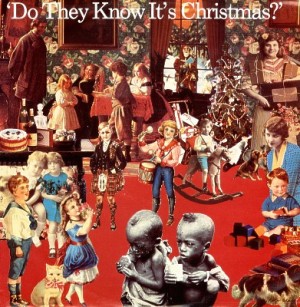
Band Aid’s “Do They Know It’s Christmas” hit #1 in the UK

Do They Know It’s Christmas

Band Aid

Writer(s): Bob Geldof, Midge Ure (see lyrics here)


Released: December 3, 1984


Peak: 13 US, 7 CB, 39 GR, 35 A40, 32 AR, 15 UK, 12 CN, 14 AU, 2 DF (Click for codes to charts.)


Sales (in millions): 1.0 US, 3.94 UK, 11.7 world (includes US + UK)


Airplay/Streaming (in millions): -- radio, 39.3 video, 403.22 streaming

Awards:

Click on award for more details.

About the Song:

Bob Geldof made his name initially as the frontman of the Boomtown Rats, an Irish punk-pop outfit which got its start in the late ‘70s and found success with a pair of #1 songs on the UK charts with “Rat Trap” and “I Don’t Like Mondays.” However, in his obituary someday, the leading line will reference him as the man who organized Band Aid and Live Aid.

Geldof was so moved one night by images from the BBC of “Ethiopians as they trudged for miles in search of food” HL that he felt obligated to do something. He started out collecting money at Boomtown Rats shows HL but wanted to do something on a grander scale. He connected with Midge Ure, the frontman from Ultravox, to pen a song about those suffering in the African famine. He wrote the lyrics in the back seat of a taxi and Midge produced the backing track in his studio. TB

To garner even more attention to the cause, however, the pair then tackled their collective rolodexes to round up a Who’s Who of British pop superstars to sing a Christmas charity single as the collective Band Aid. Among the stars enlisted were Bono, Phil Collins, Sting, George Michael, Duran Duran, Culture Club, Status Quo, Paul Weller, Spandau Ballet, Heaven 17, and Kool & the Gang.

36 artists HL gathered at Sarm West Studios in London on November 25, 1984. Geldof implored attendees “to leave your egos outside the studio” HL and, in a wonderful display of unity, “everyone got on with everyone else.” HL They started the recording process by singing the “Feed the world, let them know it’s Christmas time” refrain first as a group. Then individual singers sang the song the entire way through so that Ure, who also produced the song, could splice the best parts together for the final version. WK The whole song was recorded within a 24-hour period. WK

Geldof wanted to make sure all the proceeds went straight to the Ethiopians so he in addition to getting the musicians to work for free, he arranged for free studio time, manufacturing, and distribution. The song sold 750,000 in its first week of release in England, making it their fastest-selling single in history at the time. MG It went on to sell more than 3.5 million, making it the best-selling song in Britain until Elton John’s 1997 re-recording of “Candle in the Wind”. WK Combined with the 1985 Live Aid concert, Geldof’s efforts raised £110 million. MG


Resources:


First posted 12/15/2011; last updated 4/12/2023.

Saturday, March 22, 1980

The Jam’s “Going Underground” debuted at #1 in the UK

Going Underground

The Jam

Writer(s): Paul Weller (see lyrics here)


Released: March 10, 1980


First Charted: March 22, 1980


Peak: 17 CL, 2 CO, 13 UK, 50 AU, 7 DF (Click for codes to singles charts.)


Sales (in millions): 0.25 UK


Airplay/Streaming (in millions): -- radio, 13.9 video, 37.85 streaming

Awards:

Click on award for more details.

About the Song:

The Jam were an English punk rock/new wave band which formed in 1972 and released six studio albums before their breakup in 1982. Their first chart single was 1977’s “In the City” from their debut album of the same name. Their success steadily grew until their tenth chart entry, “Going Underground,” debuted atop the UK charts. It was the first song to do so in six years. KL Despite The Jam’s success in their homeland, they never reached the Billboard Hot 100 in the United States.

The Jam were actually touring the United States when they found at “Going Underground” hit #1. Drummer Rick Buckler said, “It was a shock when we got to #1, otherwise we wouldn’t have been in the states…We had a good drink that night. However, everyone wanted to be back in Britain. We made out we had all come down with a virus. We canceled the rest of the tour of the States. We flew back to Britain on Concorde to record ‘Going Underground’ on Top of the Pops for the following week.” SF

The song wasn’t intended as a single. It was supposed to be the B-side of “Dreams of Children,” but “Going Underground” became the hit. “Striking the right balance aggressive punk posturing, Beatlesque guitar and catching singalong pop to create perfect harmony, the single would become The Jam’s defining release.” XFM

“Going Underground” might appear to be about London’s tube rail system, but it wasn’t. KL Singer Paul Weller wrote it in protest of the British Conservative government’s policy to spend taxpayers’ money on building their nuclear arsenal instead of funding other government programs. SF The song references the Russian invasion of Afghanistan in December 1979. KL


Resources:

  • DMDB encyclopedia entry for The Jam
  • KL Jon Kutner and Spencer Leigh (2005). 1000 UK Number One Hits: The Stories Behind Every Number One Single Since 1952. London, Great Britain: Omnibus Press. Page 259.
  • SF Songfacts
  • WK Wikipedia
  • XFM Mike Walsh (editor) (2010). The XFM Top 1000 Songs of All Time. Elliott & Thompson Limited: London, England. Page 205.


First posted 10/13/2021; last updated 11/12/2022.