Showing posts with label Live Aid. Show all posts

Thursday, January 12, 2012

The History of the Dave's Music Database Blog


Check out these books by Dave Whitaker available through DavesMusicDatabase.com or Amazon.

Also check the Dave’s Music Database Facebook page for daily music-related posts.


The third anniversary of the DMDB blog is right around the corner (January 22). It has come a long way in three years! That first post, entitled “How to Get into the Rock and Roll Hall of Fame”, mocked that institution’s biases with five observations about what will (or won’t) lead to canonization in Cleveland.

A couple weeks later, I put up the post “2009 Grammy Nominees for Album of the Year”. I analyzed the five hopefuls for the big prize and correctly predicted Robert Plant and Alison Krauss would take home the gold for Raising Sand.

I didn’t post again until July. By year’s end, I’d put up a whopping 13 posts. I upped the ante in 2010 with 14 posts. Things didn’t really get moving until mid-way through 2011 when I changed the focus of the blog from essays on music-related topics to more objective snapshots of musical history tied to that particular day.

The second DMDB publication gathered all the essays posted here on the blog. Click on the book cover to go to the DMDB website where you can order the book.


The move paid off in spades. Prior to the thematic switch, my biggest month was September 2009 with 422 hits. I more than doubled that number in June 2011 with the new approach. The numbers have gone up every month since. December 2011 saw more than 7300 hits and January 2012 looks to be on pace to double that number! Over the blog’s three-year life time, it has been seen by more than 31,000 pairs of eyeballs. The top post of all time is “Live Aid: July 13, 1985” with 1500+ hits, more than double the runner-up, “The Top 50 Pink Floyd Songs”.

Graph shows number of hits each month from May 2009 to December 2011.


I haven’t done lots of research to figure out how to garner such numbers and am not entirely certain why my numbers keep growing by leaps and bounds each month. I have followed a few basic tips which I think have made the difference. When I switched from essay to daily history format, that meant two things – I put up daily content and posts were shorter, generally 300-500 words. I also added images and video. However, I think most of my hits have simply come from google searches which land on the key words I’ve connected to each blog.

I don’t know exactly how it has happened, but I’m grateful to everyone who’s either read faithfully since the beginning or merely stumbled across an entry here and there. It has been a great journey and one I plan to continue indefinitely.


Saturday, July 13, 1985

U2 gave a career-making performance of “Bad” at Live Aid

Bad

U2

Writer(s): U2 (music), Bono (lyrics) (see lyrics here)


Released: October 1, 1984 (as album cut on The Unforgettable Fire)


First Charted: August 24, 1985


Peak: 19 AR, 3 CO, 1 DF (Click for codes to charts.)


Sales (in millions): --


Airplay/Streaming (in millions): -- radio, 47.5 video, -- streaming

Awards:

Click on award for more details.

About the Song:

“Bad” can arguably be called U2’s breakthrough moment – specifically their performance of the song at Live Aid on July 13, 1985. Their 12-minute performance of the song at the star-packed concert shown a global spotlight on the band then known mostly for “Pride (In the Name of Love),” their only U.S. top-40 hit. Not only did Bono come down off the stage to help a fan who was being crushed by the crowd, W1 but he showcased his star power, energy, and enthusiasm in capturing an audience of 72,000 people at Wembley Stadium in London with an anthemic performance of a song about heroin.

Bono has given varying accounts over the years regarding the exact inspiration for the song, saying, among other things that “I wrote the song for a friend of mine; He has said the song is about a friend who died of a heroin overdose, but on another occasion said, “I also wrote it for myself because you can be addicted to anything. And, you know, that song’s not just about: it’s about a lot of things.” W1 At a performance in Pittsburgh in 2011, he said it was about “a very special man, who is here in your city.” W1

He’s also talked about it without reference to any specific person, saying of a lot of teens who fell victim to the heroin epidemic in Dublin in the late ‘70s and early ‘80s that “they gave up everything they held sacred to this drug…I tried to describe that with the song…what it was like to feel that rush, that elation, and then to go on to the nod, the awful sleep that comes with that drug, and then scream: ‘I’m wide awake, I’m wide awake, I’m not sleeping!’ I can see what’s going on.” SF

The studio version of the song was criticized as “unfinished” and “unfocused,” but it made more sense on sense. Rolling Stone called the live version a “show stopper.” W1 The song was originally released on 1984’s The Unforgettable Fire, but an eight-minute live recording of the song was released on the 1985 EP Wide Awake in America. This latter version, recorded at the National Exhibition Centre in Birmingham, England on November 12, 1984, W2 was the one which garnered radio airplay.


Resources:


Related Links:


First posted 7/15/2021; last updated 3/18/2023.

Live Aid: July 13, 1985

Originally posted July 13, 2011.


On July 13, 1985, an estimated 1.9 billion people in 150 nations watched the broadcast of Live Aid. It “was the most ambitious international satellite television venture that had ever been attempted at the time“. WK Musicians Bob Geldof and Midge Ure organized the star-studded concerts, held simultaneously in London’s Wembley Stadium and Philadelphia’s John F. Kennedy Stadium. The two venues attracted 72,000 and 100,000 fans respectively.

Geldof, best known for the U.K. #1 song “I Don’t Like Mondays” with his group the Boomtown Rats, was dismayed by the plight of starving Ethiopians after seeing a BBC documentary. Determined to make a difference, he had assembled some of Britain’s biggest musical stars the previous winter for the charity recording “Do They Know It’s Christmas?”, written by Geldof and Ure. The song became, at the time, the best-selling record ever in the UK. HE

Highlights included reunions of Led Zeppelin, Black Sabbath with Ozzy Osbourne, and Crosby, Stills, Nash & Young. U2’s performance, “established them as a pre-eminent live group for the first time”. WK Queen’s 20-minute set has been called “the greatest live performance in the history of rock music”. WK


Also of note were Paul McCartney’s performance of “Let It Be”, followed by an all-star gathering to close out the London concert with “Christmas”. Stateside, the concert closed with the U.S. response to that song, USA for Africa’s “We Are the World”.

A planned duet between Mick Jagger and David Bowie – one on each coast – had to be scrapped because it was too complicated. Instead, they recorded a duet version of Martha & the Vandellas’ “Dancing in the Street” and the video was shown at both venues. Phil Collins made news by performing at both venues. He hopped a Concorde after his Wembley appearance and jetted overseas to Philadelphia.


Resources and Related Links:

Saturday, December 15, 1984

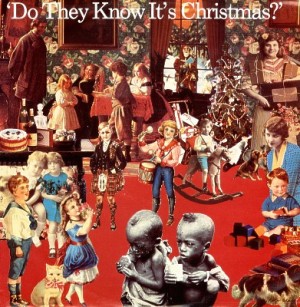
Band Aid’s “Do They Know It’s Christmas” hit #1 in the UK

Do They Know It’s Christmas

Band Aid

Writer(s): Bob Geldof, Midge Ure (see lyrics here)


Released: December 3, 1984


Peak: 13 US, 7 CB, 39 GR, 35 A40, 32 AR, 15 UK, 12 CN, 14 AU, 2 DF (Click for codes to charts.)


Sales (in millions): 1.0 US, 3.94 UK, 11.7 world (includes US + UK)


Airplay/Streaming (in millions): -- radio, 39.3 video, 403.22 streaming

Awards:

Click on award for more details.

About the Song:

Bob Geldof made his name initially as the frontman of the Boomtown Rats, an Irish punk-pop outfit which got its start in the late ‘70s and found success with a pair of #1 songs on the UK charts with “Rat Trap” and “I Don’t Like Mondays.” However, in his obituary someday, the leading line will reference him as the man who organized Band Aid and Live Aid.

Geldof was so moved one night by images from the BBC of “Ethiopians as they trudged for miles in search of food” HL that he felt obligated to do something. He started out collecting money at Boomtown Rats shows HL but wanted to do something on a grander scale. He connected with Midge Ure, the frontman from Ultravox, to pen a song about those suffering in the African famine. He wrote the lyrics in the back seat of a taxi and Midge produced the backing track in his studio. TB

To garner even more attention to the cause, however, the pair then tackled their collective rolodexes to round up a Who’s Who of British pop superstars to sing a Christmas charity single as the collective Band Aid. Among the stars enlisted were Bono, Phil Collins, Sting, George Michael, Duran Duran, Culture Club, Status Quo, Paul Weller, Spandau Ballet, Heaven 17, and Kool & the Gang.

36 artists HL gathered at Sarm West Studios in London on November 25, 1984. Geldof implored attendees “to leave your egos outside the studio” HL and, in a wonderful display of unity, “everyone got on with everyone else.” HL They started the recording process by singing the “Feed the world, let them know it’s Christmas time” refrain first as a group. Then individual singers sang the song the entire way through so that Ure, who also produced the song, could splice the best parts together for the final version. WK The whole song was recorded within a 24-hour period. WK

Geldof wanted to make sure all the proceeds went straight to the Ethiopians so he in addition to getting the musicians to work for free, he arranged for free studio time, manufacturing, and distribution. The song sold 750,000 in its first week of release in England, making it their fastest-selling single in history at the time. MG It went on to sell more than 3.5 million, making it the best-selling song in Britain until Elton John’s 1997 re-recording of “Candle in the Wind”. WK Combined with the 1985 Live Aid concert, Geldof’s efforts raised £110 million. MG


Resources:


First posted 12/15/2011; last updated 4/12/2023.