Showing posts with label Brits Award Song of the Year. Show all posts

Monday, December 1, 1997

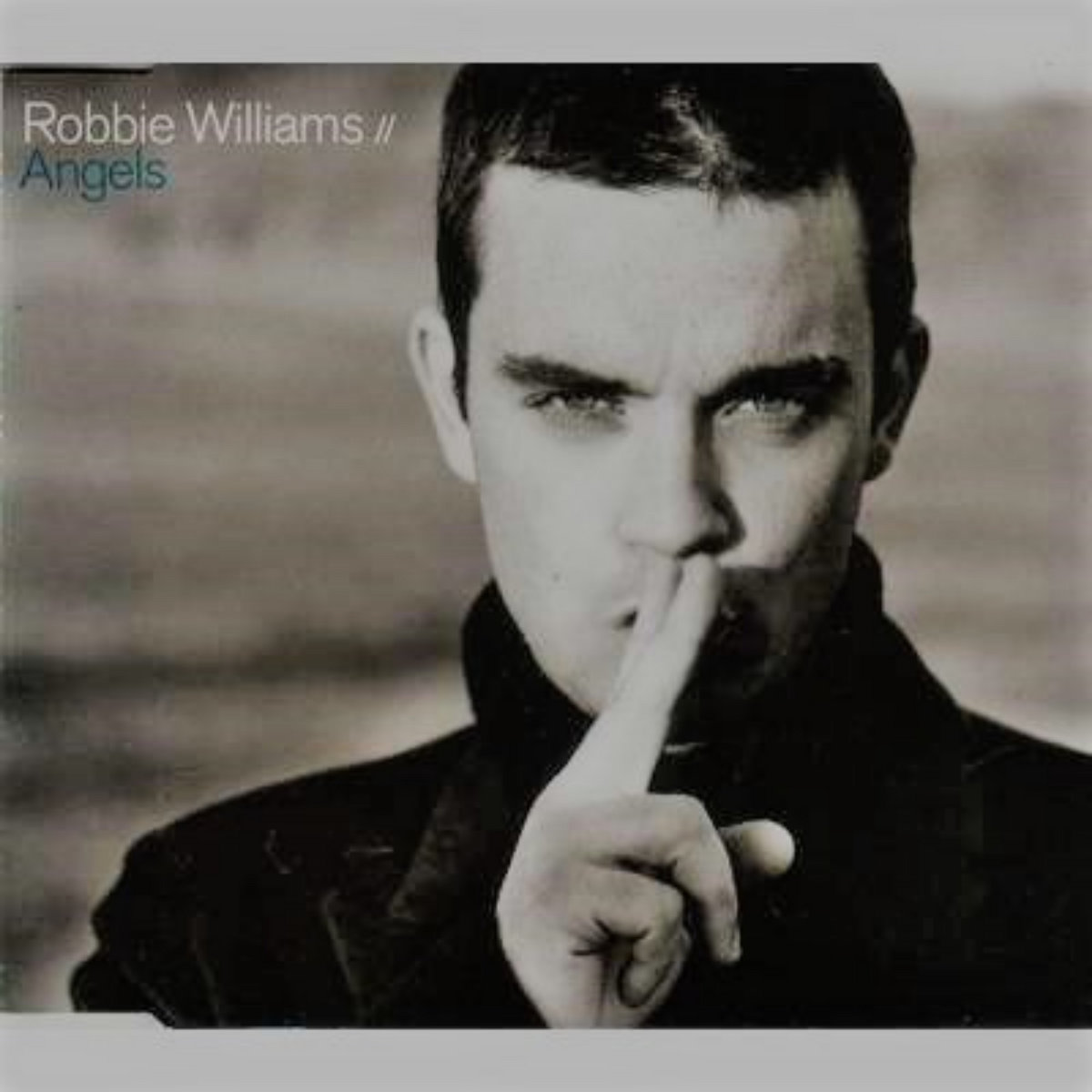
Robbie Williams charted with “Angels”

Angels

Robbie Williams

Writer(s): Robbie Williams, Guy Chambers, Ray Heffernan (see lyrics here)


Released: December 1, 1997


First Charted: December 13, 1997


Peak: 53 US, 25 RR, 10 AC, 21 A40, 4 UK, 18 CN, 40 AU (Click for codes to singles charts.)


Sales (in millions): -- US, 1.8 UK, 2.13 world (includes US + UK)


Airplay/Streaming (in millions): -- radio, 260.61 video, 309.32 streaming

Awards:

Click on award for more details.

About the Song:

Robbie Williams first gained fame in the British boy band Take That in the early ‘90s before striking out on his own in 1996. As a solo artist, he has topped the UK singles chart seven times. However, “Angels,” which peaked at #4, is his best-selling single. In a VH1 poll in the UK, this was voted the best song which should have topped the charts. SF At the 2005 Brit Awards, it was voted the best song of the previous 25 years. WK

Irish Independent called it an “epic ballad” WK and ShortList’s Dave Fawbert called it a “genuinely brilliant song.” WK Billboard magazine’s Larry Flick praised the song as a “sweet ballad that never gets sappy.” He said “the lyric is thoughtful and ear-grabbing, and his smoky, crisp vocal is a sheer delight. All that and a chorus to kill for.” WK

The song is about loved ones who’ve died and come back as guardian angels to offer protection and affection. In 2005, Britons voted it the song they most wanted played at their funerals. WK Detractors referred to Williams as “a glorified cabaret singer” and attacked this song as his attempt at a mainstream song in a Britpop style. SF

Williams claimed he wrote the song with collaborator Guy Chambers about his aunt and uncle. He said they were inspired to write the chorus by watching a water fountain while sitting outside a cafĂ©. However, Irish singer/songwriter Ray Heffernan says he wrote the son in 1996 after his partner had a miscarriage. By chance, he met Williams in a Dublin pub and showed him the song and the two of them recorded a demo of the song. Williams then said and Chambers significantly rewrote the song. Williams’ management paid Heffernan £7,500 (about $10,000 in U.S. dollars) for the rights to the song.


Resources:


Related Links:


First posted 10/15/2021.

Saturday, August 29, 1987

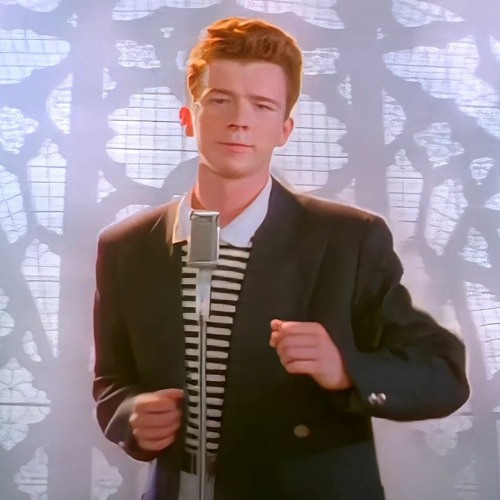
Rick Astley “Never Gonna Give You Up” hit #1 in UK

Never Gonna Give You Up

Rick Astley

Writer(s): Matt Stock, Mike Aitken, Peter Waterman (see lyrics here)


Released: July 27, 1987


First Charted: August 8, 1987


Peak: 12 US, 2 GR, 11 RR, 13 AC, 15 UK, 13, 17 AU, 8 DF (Click for codes to singles charts.)


Sales (in millions): 5.0 US, 1.12 UK, 7.09 world (includes US + UK)


Airplay/Streaming (in millions): 3.0 radio, 1301.85 video, 606.03 streaming

Awards:

Click on award for more details.

About the Song:

Some songs are hits of the moment, to be quickly forgotten in passing years. Others – for sometimes bizarre reasons – enter the public consciousness and never go away. In 2007, an Internet phenomenon known as rick-rolling emerged. People received links and opened them, but instead of getting what they expected they were subjected to a video clip of Rick Astley singing his 20-year-old hit “Never Gonna Give You Up.” Stereogum’s Tom Breihan said, they “could’ve presumably used any song in the vast history of recorded music, but they went with ‘Never Gonna Give You Up’…[because it] is a bad song, and it’s a catchy bad song. It could get stuck in someone’s head, and it could ruin that person’s day.” SG Ruin a person’s day? Lighten up.

Astley himself had a much better sense of humor and perspective about it. He said, “I think it’s just one of those odd things where something gets picked up and people run with it. But that’s what brilliant about the internet…If this had happened around some kind of rock song, with a lyric that really meant something – a Bruce Springsteen, “God Bless America,” or an anti-something kind of song, I could kind of understand that. But for something as – and I don’t mean to belittle it, because I still think it’s a great pop song – but it’s a pop song. Do you know what I mean? It doesn’t have any kind of weight behind it, as such. But maybe that’s the irony of it.” SG

“The pasty and deep-voiced young man…came from a rural English village called Newton-Le-Willows.” SG He started as a drummer with bands like Give Way and FBI, but “pulled a Phil Collins and became the singer” SG because, as he said, he was writing most of the songs. FB He got his big break when producer Peter Waterman heard him sing. The famed Stock-Aitken-Waterman team “basically colonized the UK charts” SG in the late ‘80s with hits from Kylie Minogue, Bananarama, and Dead or Alive. All told, they had more than a hundred top 40 UK hits. LW

The ”shy vocalist with the boy-next-door looks” FB started working at Waterman’s PWL studio – making tea while also learning the technical aspects of recording and making demos. FB When they released Astley’s first single in the summer of 1987, it “practically made Astley an overnight star.” SG “The blippy bassline and handclap-driven drum track” SG is “pretty much swiped wholesale” SG from “Trapped,” a 1985 house single by Colonel Abrams which hit #3 in the UK. However, “Give You Up” “has none of the gospel-descended euphoric desperation that drives so much house” SG being marked instead by “the chintziest, shallowest Motown pastiche you’re ever going to hear. The strings are transparently fake. The horn stabs might be even faker. Over that beat, Rick Astley bellows thoroughly generic love-song lyrics from straight off of the Stock-Aitken-Waterman assembly line.” SG “Astley’s voice has all the chesty showiness of his British white-soul ancestor Tom Jones, but he has absolutely none of Jones’ swagger.” SG

The song became the biggest hit of 1987 in the UK and went on to top the charts in America in 1988.


Resources:


First posted 10/18/2022; last updated 11/24/2022.

Saturday, September 24, 1983

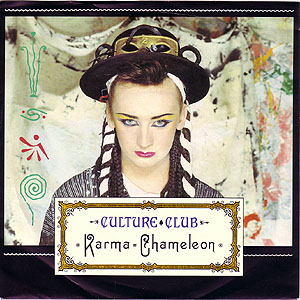
Culture Club “Karma Chameleon” hit #1 in the UK

Karma Chameleon

Culture Club

Writer(s): George O'Dowd, Jon Moss, Roy Hay, Mikey Craig, Phil Pickett (see lyrics here)


First Charted: September 17, 1983


Peak: 13 US, 13 CB, 13 RR, 3 AC, 67 RB, 1 CO, 16 UK, 13 CN, 15 AU, 9 DF (Click for codes to singles charts.)


Sales (in millions): 1.0 US, 1.62 UK, 5.0 world (includes US + UK)


Airplay/Streaming (in millions): 1.0 radio, 644.41 video, 366.73 streaming

Awards:

Click on award for more details.

About the Song:

Culture Club broke through in 1982 with “Do You Really Want to Hurt Me?,” “a sweetly sensitive lite-reggae bounce that became a global smash.” SG While they “came from London’s punk and new wave scenes,” SG they “didn’t sound like other new wave groups.” SG They sounded more like Lionel Richie than Human League. SG “They made tender crushed-velvet white soul” SG “occasionally sprinkled with soft reggae or post-disco dance-pop accents. Boy George sang as much like Smokey Robinson as he could…shooting for that same soft precision and that same sense of strength through vulnerability.” SG

Teens throughout the UK “were emulating George’s outrageous and oft-changing style which usually involved long white gowns and mult-colored plaits.” KL However, “Culture Club weren’t simply a novelty; they were a pop juggernaut.” SG “Their ability to dominate in a time of rampant homophobia is pretty amazing, and it speaks to Boy George’s singular charisma.” SG He was “a purring androgyne flirt who used the brand-new vehicle of MTV to present a persona that was defiant in its femininity.” SG

He was born George Alan O’Dowd “into a working-class Irish Catholic family in Kent…George’s father was abusive, and he also had to deal with growing up gay in a profoundly unfriendly environment. But he found escape in the New Romantic world of the early ’80s, dancing at clubs like London’s Blitz.” SG It was there when “former Sex Pistols svengali Malcolm McLaren saw George and invited him to sing with Bow Wow Wow, the band McLaren was managing at the time.” SG George didn’t stay long, opting instead to start his own band. He enlisted the band’s bassist, Mikey Craig, and they also recruited guitarist and former hairdresser Roy Hay along with drummer Jon Moss, who’d worked with the Stranglers, the Damned, and Adam & the Ants.

“Karma Chameleon” was the lead single from the group’s sophomore album, Colour by Numbers. It was the group’s fifth consecutive top-10 in the United States. It became the biggest selling single of 1983 in the UK FB and the first single by a group to sell a million copies in Canada. KL George said the song is about “the fear of standing up for one thing. It’s about trying to suck up to everybody…If you aren’t true, if you don’t act like you feel, then you get karma.” FB “Like a lot of Culture Club songs, [it] is a disguised lament about the tempestuous relationship between Boy George and his bandmate Jon Moss” SG at a time when George was still in the closet and keeping the relationship a secret.


Resources:

  • DMDB encyclopedia entry for Culture Club
  • FB Fred Bronson (2007). The Billboard Book of Number One Hits (4th edition). Billboard Books: New York, NY. Page 583.
  • KL Jon Kutner/Spencer Leigh (2005). 1000 UK Number One Hits: The Stories Behind Every Number One Single Since 1952. London, Great Britain: Omnibus Press. Pages 293-4.
  • SG Stereogum (8/7/2020). “The Number Ones” by Tom Breihan
  • WK Wikipedia


Related Links:


First posted 11/13/2022.

Saturday, August 7, 1982

Dexy's Midnight Runners hit #1 in UK with “Come in Eileen”

Come on Eileen

Dexy’s Midnight Runners

Writer(s): Kevin Rowland, Jim Paterson, Billy Adams (see lyrics here)


Released: June 25, 1982


First Charted: July 3, 1982


Peak: 11 US, 11 CB, 3 GR, 3 RR, 31 AC, 6 AR, 1 CO, 14 UK, 2 CN, 15 AU, 8 DF (Click for codes to charts.)


Sales (in millions): -- US, 1.61 UK, 1.96 world (includes US + UK)


Airplay/Streaming (in millions): -- radio, 45.8 video, 793.21 streaming

Awards:

Click on award for more details.

About the Song:

Dexy’s Midnight Runners’ “Come on Eileen” hit #1 in the UK and U.S. – eight months apart. The “gloriously gimmicky pop single” AMG topped the UK charts in August 1982 and became the biggest-selling single of the year. SF It topped the Billboard Hot 100 in April 1983, sandwiched between Michael Jackson’s two monstrous chart-toppers from Thriller – “Billie Jean” and “Beat It.” It was the group’s only hit stateside, but they had another chart-topper in the UK with “Geno” in 1980 and also landed a couple of other top-10 hits.

The band went through a variety of looks and sounds. When they formed in 1978, their music had a “Stax Records/Van Morrison-influenced soul flavor” FB accompanied by a street gang look inspired by Rober DeNiro’s character in Mean Streets. FB However, they split up and lead singer Kevin Rowland reformed the group with a more puritanical bent before mixing things up again with a “silly street urchin look” AMG married with the sound of “born-again Celtic soulsters.” FB

It’s that later iteration which is employed on “Come on Eileen” and the parent album Too-Rye-Ay. FB The song is “armed with a cheerful and gay melodic hook courtesy of the band’s new fiddle section and the sort of chorus you can starting singing almost before you’ve heard it the first time.” AMG It also employs banjo, accordion, and saxophone, setting it apart from other hits of the synthesizer-driven era. SF Depending on perspective, “Come on Eileen” can be seen as “an elegantly catchy bit of pop folklore or teeth-grindingly tinny gypy lament.” TB

The former altar boy and one-time candidate for the priesthood was taught by his Irish-Catholic relatives that sex was dirty and used the song to make a point about Catholic repression. WK Rowland has said (but also denied) that the song is about a “a girl who I grew up with basically…and there was a time, about 14 or 15,…sex came into it and our relationship had always been so clean. It seemed at that time to get dirty and that’s what it’s about.” FB In his All Music Guide review, Stewart Mason amusingly describes the song as “about that special time in a young boy’s life when he realizes he wants to shag his best mate.” AMG


Resources:


First posted 1/20/2021; last updated 5/2/2024.