Saturday, December 27, 1980

John Lennon “Just Like Starting Over” hit #1

Just Like Starting Over

John Lennon

Writer(s): John Lennon (see lyrics here)


Released: October 20, 1980


First Charted: October 24, 1980


Peak: 15 US, 15 CB, 14 GR, 15 HR, 12 RR, 17 AC, 1 CL, 1< sup>1 UK, 17 CN, 14 AU, 5 DF (Click for codes to charts.)


Sales (in millions): 1.0 US, 0.5 UK


Airplay/Streaming (in millions): 1.0 radio, 20.2 video, 27.96 streaming

Awards:

Click on award for more details.

About the Song:

After John Lennon’s 1975 retirement from music to become a house-husband and stay-at-home dad, he triumphantly returned in 1980 with Double Fantasy. The album emerged out of a vacation to Bermuda during which he started writing again. All the songs were completed within three weeks. TB Sadly, the release of the album and lead single “Just Like Starting Over” at year’s end were tragically overshadowed when Mark David Chapman shot and killed John Lennon on December 8, 1980 in front of Lennon’s New York City apartment.

“Starting Over” had already reached the top 10 the week of Lennon’s murder; it would go on to top the Billboard Hot 100 for five weeks. Similarly, Double Fantasy would posthumously top the album chart for eight weeks and take home the Grammy for Album of the Year.

The “pleasantly breezy love song” SG was, as its title implies, “supposed to mark a new beginning in Lennon’s public life, not an end to it.” SG However, it took on deeper meaning in the wake of Lennon’s death. Now it was about “a happy middle-aged guy looking forward to a life that he would never get to live.” SG

“He does a hiccupy and gimmicky rockabilly-revival thing” SG with his voice while the music is built on “a rock ‘n’ roll rhythm that takes the listener back to the days when John himself was just starting out.” DT Lennon said, “It was a 1950s sound because I’d never really recorded a song that sounded like that period, although that was my period, the music I identified with.” HL Indeed, “shades of Sun rockabilly, Roy Orbison, and the Beach Boys can be heard in the arrangement.” HL He also cited Elvis Presley, Gen Vincent, and Jerry Lee Lewis as influences. SG


Resources:


Related Links:


First posted 4/9/2023.

Monday, December 15, 1980

Eagles “Seven Bridges Road” released

Seven Bridges Road (live)

Eagles

Writer(s): Steve Young (see lyrics here)


Released: December 15, 1980


First Charted: December 20, 1980


Peak: 21 US, 27 CB, 31 HR, 18 RR, 17 AC, 55 CW, 7 CL, 1 DF (Click for codes to singles charts.)


Sales (in millions): -- US, -- UK, -- world (includes US + UK)


Airplay/Streaming (in millions): -- radio, 7.7 video, -- streaming

Awards:

Click on award for more details.

About the Song:

American musician Steve Young wrote and recorded “Seven Bridges Road” in 1969 for his Rock Salt & Nails album. It refers to Woodley Road, a rural two-lane road in Montgomery, Alabama. The road features three pairs of wooden bridges and a seventh about a mile south. Young described the area as almost like an old Disney scene or something, with these high bank dirt roads and trees hanging down, old cemeteries, and so on.” WK His friend, Jimmy Evans, said, “I thought it was the most beautiful place around Montgomery that I’d ever seen.” WK

Evans also shared that Young wrote the song one night when there was a full moon and they were driving around in Evans’ Oldsmobile. They got out and sat there a while and Young started writing down the words. WK

Young said, “I still don’t understand why it was so successful…I [just] wrote a song about a girl and a road in south Alabama” WK where he and his friends used to go “carousing around.” WK

British singer Iain Matthews recorded “Road” as a multi-part harmony song for his August 1973 album Valley Hi. Producer Michael Nesmith says the Eagles lifted their “arrangement absolutely note for note for vocal harmony” WK when they recorded it for their 1980 Eagles Live concert album. The Eagles’ Don Felder says the group would warm up before concerts by singing the song in the locker room. Then they started opening concerts with it and, as he says, the five members singing a capella into one microphone blew audiences away. WK


Resources:


Related Links:


First posted 6/10/2022; last updated 10/28/2022.

Saturday, December 13, 1980

AC/DC chart with “Back in Black” single

Back in Black

AC/DC

This post has been moved here.

Wednesday, December 10, 1980

Journey’s Dream after Dream released

First posted 10/12/2008; updated 9/11/2020.

Dream After Dream

Journey


Released: December 10, 1980


Recorded: date


Charted: date


Peak: -- US, -- UK, -- CN, -- AU


Sales (in millions): -- US, -- UK, 0.5 world (includes US and UK)


Genre: classic rock


Tracks:

Song Title (date of single release, chart peaks) Click for codes to singles charts.

  1. Destiny
  2. Snow Theme
  3. Sand Castles
  4. A Few Coins
  5. Moon Theme
  6. When the Love Has Gone
  7. Festival Dance
  8. The Rape
  9. Little Girl


Total Running Time: 35:22


The Players:

  • Steve Perry (vocals)
  • Neal Schon (guitar, backing vocals)
  • Gregg Rolie (keyboards, backing vocals)
  • Ross Valory (bass, backing vocals)
  • Steve Smith (drums)

Rating:

3.976 out of 5.00 (average of 7 ratings)

About the Album:

Dream after Dream was a soundtrack album for the Japanese fantasy film Yume, Yume No Ato. Because the music was by Journey, who’d become a well-known rock band thanks to their three previous Steve Perry-led affairs, the soundtrack received much more attention than the movie. Still, the music was a departure from Journey’s more current sound. Instead, it was a throwback to the more progressive rock beginnings of their first three albums before Perry joined.

Most of the soundtrack consists of instrumentals, meaning Steve Perry makes minimal contributions to the album. Two songs have sparse vocals – Destiny and Sand Castles. JM The only “true vocal track” JM is on “the lovelorn ballad Little Girl, easily making it the highlight of the album.” AMG It resurfaced later as the B-side to 1982’s “Open Arms” and was featured on Journey’s box set, Time 3.

These components made this “one of the most overlooked albums in Journey’s catalog.” AMG While it certainly didn’t fit the tastes of the arena-rock fanbase the group had developed over the last three albums, it “is a fine example of Journey’s underrated musicianship, and recommended to devoted fans.” AMG The album is also noteworthy for featuring Gregg Rolie’s final work with the band.

Resources and Related Links:

Monday, December 8, 1980

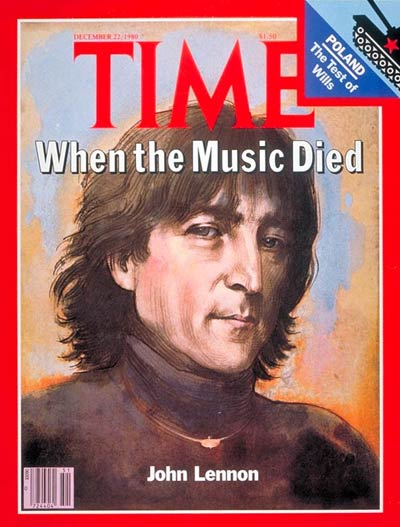
John Lennon was murdered.

December 8, 1980

John Lennon murdered.

On the evening of December 8, 1980, John Lennon was returning to the Dakota Apartments where he lived in New York City. Mark David Chapman, a Beatles’ fan, fired five bullets from a .38 special revolver at Lennon. The legendary musician was rushed to the Roosevelt Hospital but pronounced dead on arrival at 11:15 pm. He was 40 years old. Famed broadcaster Howard Cosell announced the news on Monday Night Football.

Chapman was a 25-year-old security guard from Honolulu, Hawaii, with no prior criminal convictions. He had planned the killing over several months. He was reportedly enraged by Lennon’s rich lifestyle and comment in 1966 that the Beatles were “more popular than Jesus.” Chapman was inspired by Holden Caulfield, the protagonist in J.D. Salinger’s novel The Catcher in the Rye, who rages against hypocrisy and phonies. After shooting Lennon, Chapman remained at the scene reading The Catcher in the Rye.

Chapman arrived at the Dakota early in the morning of December 8. He talked to the doorman and Beatles’ fans throughout the day. At around 5pm, Lennon was leaving for a recording session at the Record Plant and Chapman approached him and had him sign a copy of Double Fantasy, the latest album from Lennon and wife Yoko Ono. Chapman shot Lennon when he returned home about 10:50pm. Chapman pleaded guilty to the murder and was sentenced to 20 years-to-life. He has been denied parole twelve times since becoming eligible in 2000.


Resources and Related Links:


First posted 12/6/2023.

Saturday, December 6, 1980

Alan Parsons Project “Games People Play” charted

Games People Play

The Alan Parsons Project

This post has been moved here.

50 years ago: Red Nichols charted with “I Got Rhythm”

I Got Rhythm

Red Nichols

Writer(s): George Gershwin/ Ira Gershwin (see lyrics here)


First Charted: December 6, 1930


Peak: 5 US, 16 GA, 6 DF (Click for codes to charts.)


Sales (in millions): --


Airplay/Streaming (in millions): -- radio, 0.04 video, -- streaming

Awards:

Click on award for more details.

About the Song:

“I Got Rhythm” was originally written for 1928’s Treasure Girl, but didn’t get used. SB George Gershwin took the initial slower melody and upped the tempo. TY1 The song surfaced again in the 1930 show Girl Crazy, featuring a 21-year-old Ethel Merman TM in her Broadway debut. MM “With a clarion contralto that could shatter glass and shoo away the blues,” TM she made the song into a “perky spirit rouser in the first year of the Great Depression.” TM

Merman also reportedly stole the limelight from Ginger Rogers, who was featured in her first leading role singing two of the show’s other classics, “Embraceable You” and “But Not for Me.” SB Merman would serve as the “sassy muse” in Cole Porter’s Anything Goes, Irving Berlin’s Annie Get Your Gun, and Jule Styne and Stephen Sondheim’s Gypsy. TM

Red Nichols, who led the show’s all-star orchestra including Jimmy Dorsey, Benny Goodman, Gene Krupa, and Glenn Miller, SB also charted with the song, taking it to #5. Ethel Waters and Louis Armstrong each took the song to #17. The Happenings revived it in 1967 with their #3 DJ million-selling version. SB Others to tackle it include Bobby Darin, Ella Fitzgerald, Judy Garland, Erroll Garner, Lena Horne, Django Reinhadt, Sarah Vaughn, Fats Waller, Roger Williams, and Teddy Wilson. MM

The song is “probably the most widely heard Gershwin song and the one most commonly recorded by instrumentalists.” SB It is “a standout for jazz performers” DJ who “must know intuitively its changes and its plain AABA architecture, a matrix for improvisation as essential as the twelve-bar blues.” MM Jazz artists Sidney Bechet, Dizzy Gillespie, Thelonious Monk, and Charlie Parker all used variations of the song’s rhythm changes for improvisation. SB Will Friedwald, author of Stardust Melodies, says, “It would be impossible to name a melody or set of chord sequences that has withstood more interpretations and variations.” SB


Resources:


Related Links:


Last updated 4/10/2023.

Friday, December 5, 1980

Today in Music (1830): Berlioz premieres his Symphony Fantastique

Symphonie Fantastique

Hector Berlioz (composer)


Composed: 1830


First Performed: December 5, 1830


Peak: --


Sales (in millions): --


Genre: classical > symphony


Parts/Movements:

  • Visions and passions
  • Un bal: Valse, Allegro non troppo
  • Scene au champ, Adagio
  • Marche au supplice, Allegro non troppo
  • Songe d’une nuit du Sabbat


Average Duration: 51:40

Rating:

4.869 out of 5.00 (average of 5 ratings)


Awards:

(Click on award to learn more).

About the Work:

The Symphonie Fantastique is “an important piece of the early Romantic period.” WK Leonard Bernstein described it “as the first musical expedition into psychedelia because of its hallucinatory and dream-like nature.” WK History actually suggests Berlioz composed at least part of it under the influence of opium. WK

The symphony was inspired by Berlioz’s infatuation with Harriet Smithson, a pretty British ingénue who came to Paris to play Shakespeare. AM His efforts to win her affection “led him to the work’s guiding theme – a man pursuing his romantic ideal to the gates of Hell.” TM He did eventually marry her, but “discovered that the onstage illusion was better than the reality.” TM

In Berlioz’s work, he “details the journey of a lovesick artist who, having glimpsed the feminine ideal, is involved in an all-consuming chase.” TM In an attempt at suicide, the young musician “smokes copious amounts of opium” TM and ends up hallucinating about his “Beloved” appearing “as a recurring melody with several personalities.” AM

The symphony “expanded the idea set forth in Beethoven’s ‘Pastorale’ Symphony No 6, that an orchestra could echo and emulate natural phenomena.” TM “Where Beethoven whipped up a storm, Berlioz created a mob scene that concludes with the protagonist’s death: his decapitated head bounces into a waiting basket pizzicato. In the finale, Berlioz went far beyond Beethoven’s merrymaking peasants; he created a witches’ sabbath, without precedent in music before 1830. Along with liberating orchestral color, he overthrew the tyranny of bar-lines, downbeat accents, and academic dogma.” AM

Dreams, Passions begins with the hero’s despair…The Beloved’s signature melody is the main theme of a sonata structure with exposition repeat.” AMA Ball (Allegro non troppo, A major) is the waltz without a trio, although a contrasting section in F major has unison flute and oboe playing the Beloved’s theme.” AMScene in the Fields is an Adagio that begins and concludes with an antiphonal shepherds’ duet on oboe and English horn.” AM

“The G minor March to the Scaffold recreates a scene from the Revolution…The protagonist dreams he’s been condemned to die for killing his Beloved, who appears briefly as a clarinet, and he is guillotined as the crowd shouts approval.” AMDream of the Witches’ Sabbath features a four-part structure after an eerie introduction in E flat. The Beloved’s melody is the main theme of Part I, now, however, distorted and vulgarized by clarinets.” AM

It was first performed at December 5, 1830 at the Paris Conservatoire WK with Berlioz conducting. “He revised it in 1832 and added two cornets to the instrumentation in 1845.” AM

Reviews:


Related DMDB Links:


Last updated 2/25/2026.