Showing posts with label top cover songs. Show all posts

Saturday, August 27, 2005

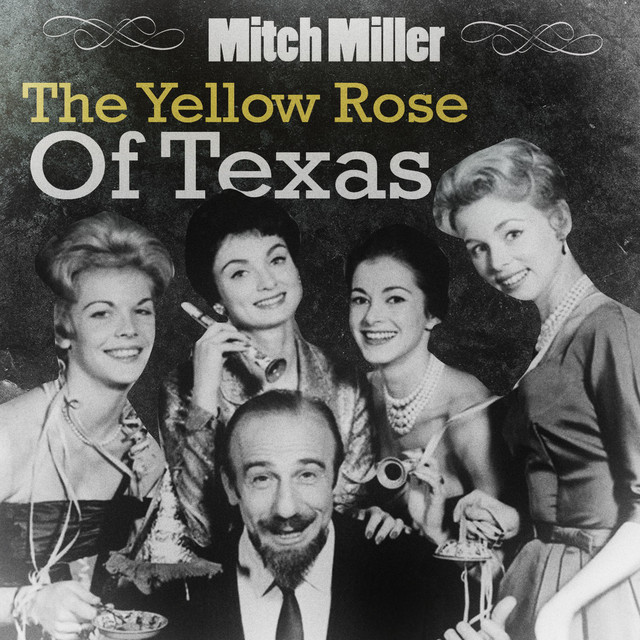
Today in Music (1955): Mitch Miller “The Yellow Rose of Texas” hit #1

The Yellow Rose of Texas

Mitch Miller

Writer(s): Don George, traditional (see lyrics here)


Released: July 11, 1955


First Charted: July 25, 1955


Peak: 16 US, 16 BA, 16 DJ, 16 JB, 19 HP, 17 CB, 17 HR, 2 UK, 16 AU (Click for codes to charts.)


Sales (in millions): 1.0 US


Airplay/Streaming (in millions): -- radio, 53.40 video, 8.36 streaming (multiple versions)

Awards (overall):

Click on award for more details.


Awards (Mitch Miller):

About the Song:

“The Yellow Rose of Texas” was a century old when Mitch Miller took his rendition to the top of the charts. The song was first published in Philadlephia in 1853 in the songbook Christy’s Plantation Melodies No. 2, a collection of songs performed by the Christy’s Minstrels, a blackface minstrel show founded by Edwin Pearce Christy. The song was originally uncredited and had not sheet music. WK In 1858, someone known only as “J.K.” revised the lyrics and added piano accompaniment. In 2010, research uncovered that “J.K.” was John Kelly, a member of Christy’s Minstrels. It may be that he was the original writer as well. WK

The song is written from the perspective of an African-American singer referring to himself as a “darkey.” He wants to go home to a “yellow girl,” a term for a light-skinned or biracial woman with African-American and European-American heritage. WK The 1858 version of the song changed the words “yellow girl” to “yellow rose.” WK It later became “a popular Confederate marching song during the Civil War.” DJ

Gene Autry and Jimmie Long recorded the song in 1933 as a cowboy song with some changes to the lyrics, namely removing racial references. Roy Rogers performed it in the 1944 film of the same name. WK In 1955, composer and arranger Don George gave it “an exciting march beat.” TY2 His version appeared on a collection of Civil War songs, which is how it came to the attention of Miller. He was an orchestra conductor and record company executive at Columbia who was born in 1911 in Rochester, New York. He’d provided the back-up orchestra for some hits by Guy Mitchelland Frankie Laine. “Yellow Rose,” however, was done under his own name. He gave the song a new arrangement with an “exciting snare drum part.” T2 The song might never have seen release if it weren’t for Miller’s status with the record company. He ordered 100,000 copies of the single, promising to buy back all copies at cost if they didn’t sell. WK

It sold more than a million copies and topped multiple U.S. pop charts and ranked in the top five on Billboard, Cash Box, and Variety year-end lists. TY2 That same year, Johnny Desmond (#3), Ernest Tubb (#7), and Stan Freberg (#16) also charted with the song. It was used in the 1956 James Dean Texas-based movie Giant. Elvis Presley included it as part of a medley in his 1964 film Viva Las Vegas. Hoyt Axton, Pat Boone, Bing Crosby, Mantovani, Willie Nelson and others also recorded versions. WK

The Western Writers of America chose “Yellow Rose” as one of the Top 100 Western songs of all time. WK It is an unofficial state song of Texas (the official song is “Texas, Our Texas”). WK


Resources:


Related Links:


First posted 8/12/2023; last updated 12/2/2025.

Monday, January 6, 1986

Today in Music (1956): Count Basie’s “April in Paris” charted

1/6/1956:

April in Paris

Count Basie

Writer(s): Vernon Duke (music), E. Y. “Yip” Harburg (lyrics) (see lyrics here)


Recorded: July 27, 1955


First Charted: January 6, 1956


Peak: 28 BB, 43 CB, 29 HR, 8 RB (Click for codes to charts.)


Sales (in millions): --


Airplay/Streaming (in millions): -- radio, 1.5 video, 5.13 streaming

Awards:

Click on award for more details.

About the Song:

Vernon Duke, born Vladimir Dukelsky in Russia on October 10, 1903, composed the music for “April in Paris.” He found his first success with musicals in London. While writing music for the Broadway revue Walk a Little Faster, in which the song eventually appeared, he and some of the cast went to a local bar. One of them said, “Oh to be in Paris now that April’s here!” and Duke thought “April in Paris” would be a great song title. TY2 Duke wrote the refrain for the song right there in the bar on an upright piano. TY2

The song featured lyrics by E.Y. “Yip” Harburg, who became best known for writing “Over the Rainbow” for The Wizard of Oz. “April in Paris” “describes the atmosphere of Paris in the spring: chestnuts are in blossom, and holiday tables are decked with food under the trees. The vocalist sings that he never understood the charm of spring, never knew his heart could sing until ‘April in Paris.’” TY2

Evelyn Hoey performed the song in Walk a Little Faster, which opened on December 7, 1932. SS It was Duke’s “first classic.” SS Freddy Martin (#5) and Henry King (#14) both charted with the song in 1934. PM It was used again in the 1952 movie April in Paris, sung by Doris Day and Claude Dauphin. DJ Gogi Grant sung it in The Helen Morgan Story in 1957.

Count Basie charted with an instrumental version of the song in 1956. The new arrangement by Wild Bill Davis “is both fabulously swinging and delightfully playful.” SS Basie also recorded a vocal version later in the year with Ella Fitzgerald and Joe Williams HT and even reprised it for the Mel Brooks’ comedy Blazing Saddles in 1974. It was an impressive feat “right in the face of the rock & roll revolution, nineteen years after he had burst onto the national scene with ‘One O’Clock Jump.’” SS

He was born William Basie on August 21, 1904, in Red Bank, New Jersey. With his “simple but swinging piano style” PM he became “widely regarded as second only to Duke Ellington among all jazz band leaders.” PM He’d already accumulated more than two dozen chart hits, including his #1 version of “Open the Door, Richard!” in 1947, and signature hit, 1937’s “One O’Clock Jump.”


Resources:


Related Links:


First posted 4/21/2025.

Saturday, February 19, 1972

Harry Nilsson “Without You” hit #1

Without You

Harry Nilsson

Writer(s): Tom Evans, Peter Ham (see lyrics here)


Released: October 11, 1971


First Charted: December 10, 1971


Peak: 14 US, 12 CB, 13 GR, 12 HR, 15 AC, 12 CL, 15 UK, 11 CN, 15 AU, 4 DF (Click for codes to charts.)


Sales (in millions): 1.0 US, 0.84 UK


Airplay/Streaming (in millions): -- radio, 25.3 video, 120.55 streaming

Without You

Mariah Carey


Released: August 31, 1993 (album cut on Music Box)


First Charted: January 28, 1994


Peak: 3 US, 12 CB, 14 GR, 2 RR, 4 AC, 14 UK, 4 CN, 3 AU, 20 DF (Click for codes to charts.)


Sales (in millions): 1.89 US, 0.56 UK, 3.5 world (includes US+UK)


Airplay/Streaming (in millions): -- radio, 656.70 video, 146.25 streaming

Awards (Nilsson):

Click on award for more details.


Awards (Carey):

Click on award for more details.

About the Song:

Guitarist Pete Ham and bassist Tommy Evans of Badfinger wrote “Without You” for their group’s 1970 album No Dice. While they didn’t release it as a single, it became a twice-over, transatlantic chart-topper, reaching #1 for Harry Nilsson in 1972 and Mariah Carey in 1994. It has been recorded more than 100 times. HL However, “far from being the men with the Midas touch” HL Ham and Evans “became two of rock ‘n’ roll’s most tragic casualties.” HL Both were hit with financial problems and committed suicide – Ham in 1975 and Evans in 1983.

Ham wrote the verses after letting down his girlfriend when he’d promised they’d go out and hit the studio instead. HL Meanwhile Evans had written a song called “I Can’t Live” after his girlfriend (and future wife) Marianne left him. WK They ended up merging Ham’s verses with Evans’ chorus to create “Without You.”

Harry Nilsson was “a hard-boozing rocker” TB and singer from America. When he heard “Without You” from the latter album, he liked it but thought it was a Beatles’ song. There was, in fact, a link between the two groups. Badfinger, formerly known as the Iveys, were signed to the Beatles’ Apple label in 1968. Paul McCartney then wrote “Come and Get It” for Badfinger and it became a top 10 in the U.S. and UK.

“Without You” “gained in stature with Nilsson’s stately interpretation” HL although the dripping-with-sentiment ballad has also been described as being full of “overwrought emotion…with tears to spare.” DT More than 20 years later, Mariah Carey recorded it for her 1993 Music Box album. It was released as the third single – a week after Harry Nilsson died of a heart attack. WK Billboard called it “a faithful rendition of the eternally sweet pop ballad” WK while The Washington Post’s Mike Joyce said, “Unlike Nilsson, Carey has the pipes to pull of this anguished pop aria.” WK However, Entertainment Weekly’s David Browne described it as a “by the numbers remake.” WK


Resources:


Related Links:


First posted 4/10/2023.