


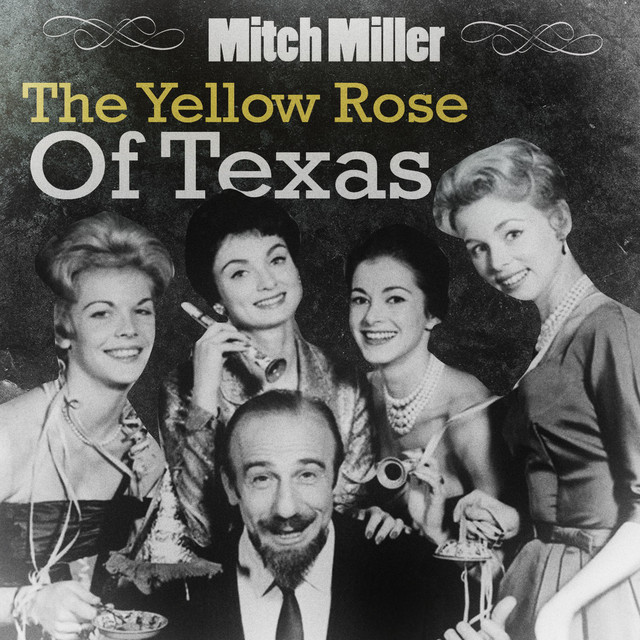
 | The Yellow Rose of TexasMitch Miller |
Writer(s): Don George, traditional (see lyrics here) Released: July 11, 1955 First Charted: July 25, 1955 Peak: 16 US, 16 BA, 16 DJ, 16 JB, 19 HP, 17 CB, 17 HR, 2 UK, 16 AU (Click for codes to charts.) Sales (in millions): 1.0 US Airplay/Streaming (in millions): -- radio, 53.40 video, 8.36 streaming (multiple versions) |
Awards (overall):Click on award for more details. 


Awards (Mitch Miller):


|
About the Song:“The Yellow Rose of Texas” was a century old when Mitch Miller took his rendition to the top of the charts. The song was first published in Philadlephia in 1853 in the songbook Christy’s Plantation Melodies No. 2, a collection of songs performed by the Christy’s Minstrels, a blackface minstrel show founded by Edwin Pearce Christy. The song was originally uncredited and had not sheet music. WK In 1858, someone known only as “J.K.” revised the lyrics and added piano accompaniment. In 2010, research uncovered that “J.K.” was John Kelly, a member of Christy’s Minstrels. It may be that he was the original writer as well. WK The song is written from the perspective of an African-American singer referring to himself as a “darkey.” He wants to go home to a “yellow girl,” a term for a light-skinned or biracial woman with African-American and European-American heritage. WK The 1858 version of the song changed the words “yellow girl” to “yellow rose.” WK It later became “a popular Confederate marching song during the Civil War.” DJ Gene Autry and Jimmie Long recorded the song in 1933 as a cowboy song with some changes to the lyrics, namely removing racial references. Roy Rogers performed it in the 1944 film of the same name. WK In 1955, composer and arranger Don George gave it “an exciting march beat.” TY2 His version appeared on a collection of Civil War songs, which is how it came to the attention of Miller. He was an orchestra conductor and record company executive at Columbia who was born in 1911 in Rochester, New York. He’d provided the back-up orchestra for some hits by Guy Mitchelland Frankie Laine. “Yellow Rose,” however, was done under his own name. He gave the song a new arrangement with an “exciting snare drum part.” T2 The song might never have seen release if it weren’t for Miller’s status with the record company. He ordered 100,000 copies of the single, promising to buy back all copies at cost if they didn’t sell. WK It sold more than a million copies and topped multiple U.S. pop charts and ranked in the top five on Billboard, Cash Box, and Variety year-end lists. TY2 That same year, Johnny Desmond (#3), Ernest Tubb (#7), and Stan Freberg (#16) also charted with the song. It was used in the 1956 James Dean Texas-based movie Giant. Elvis Presley included it as part of a medley in his 1964 film Viva Las Vegas. Hoyt Axton, Pat Boone, Bing Crosby, Mantovani, Willie Nelson and others also recorded versions. WK The Western Writers of America chose “Yellow Rose” as one of the Top 100 Western songs of all time. WK It is an unofficial state song of Texas (the official song is “Texas, Our Texas”). WK Resources:
Related Links:
First posted 8/12/2023; last updated 12/2/2025. |


