Showing posts with label top Laurel Canyon songs. Show all posts

Monday, March 14, 2016

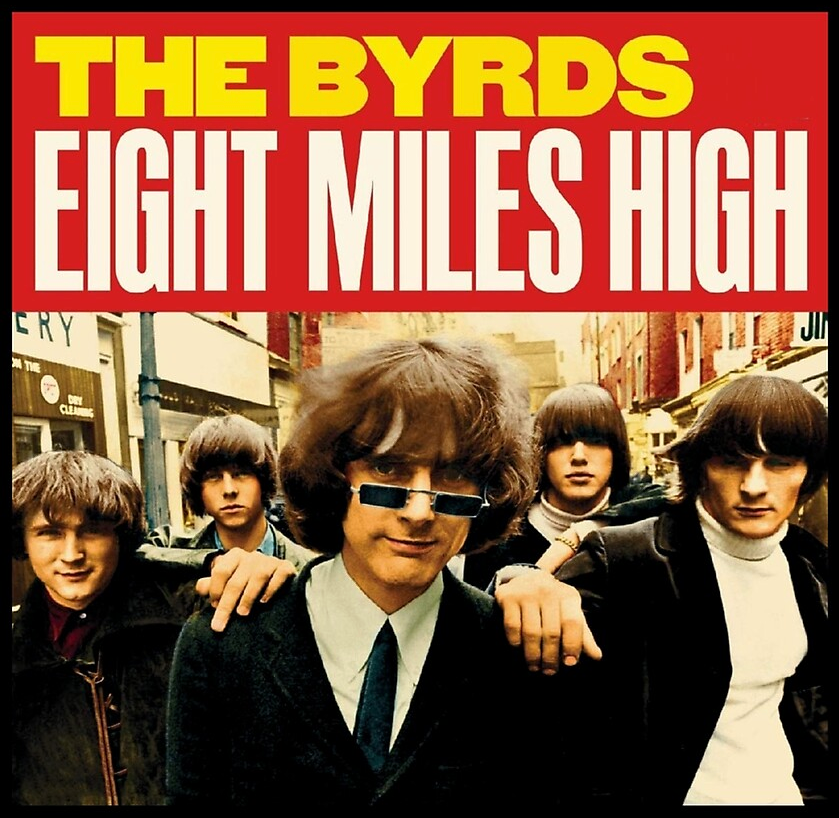
Today in Music (1966): The Byrds “Eight Miles High” released

Eight Miles High

The Byrds

Writer(s): Roger McGuinn, David Crosby, Gene Clark (see lyrics here)


Released: March 14, 1966


First Charted: April 2, 1966


Peak: 14 BB, 12 CB, 13 GR, 15 HR, 2 CL, 24 UK, 4 DF (Click for codes to charts.)


Sales (in millions): --


Airplay/Streaming (in millions): -- radio, 9.70 video, 32.58 streaming

Awards:

Click on award for more details.

About the Song:

The Byrds formed in 1964 in Los Angeles. Their 1965 cover of Bob Dylan’s “Mr. Tambourine Man” got the group “lauded as the harbingers of a whole new genre – folk-rock.” LW With 1966’s “Eight Miles High” they were celebrated for another song “that was also heralded as a groundbreaking event.” LW It is considered “a classic of the counterculture era” WK and “one of the masterpieces of the psychedelic era,” TC even being held up by many critics as “the first bona fide psychedelic rock song.” WK

Band member Roger McGuinn said “this nugget of proto-psychedia” DT was not about drugs, as everyone assumed, “but in the ‘60s, anything with abstract imagery was automatically considered a psychedelic song.” SJ It was about the band’s impressions of touring in England. He said, “it’s about the altitude of the airplane – eight miles high – and when you land over there, when you touch down, you find culture shock.” SJ

The protests didn’t keep radio from banning it for what regarded as “perceived drug connotations in its lyrics.” WK Band members Gene Clark and David Crosby would admit later that the song “was at least partially inspired by their drug use” WK and McGuinn would acknowledge that “high” had a double meaning. SS In addition, “the Byrds’ harmonies were never more ghostly and uplifting,” SS which enhanced the psychedelic effect of the song.

“The amazing guitar solo is McGuinn playing live – and alone!” SJ He said, “There’s no overdubs on that; it’s one straightforward guitar part on a twelve-string. The reason it sounds like that is because I was influenced by John Coltrane,” SJ specifically his song “India.” It was McGuinn’s attempt to replicate “the saxophonist’s repetitive line in that song.” SS Music historian Steve Sullivan said McGuinn’s work here was “no doubt in turn also inspiring an up-and-coming virtuoso named Jim Hendrix.” SS


Resources:


Related Links:


First posted 4/24/2024.

Monday, February 14, 1972

Neil Young “The Needle and the Damage Done” released on Harvest

The Needle and the Damage Done

Neil Young

Writer(s): Neil Young (see lyrics here)


Released: February 14, 1972 (album cut on Harvest)


Released: April 17, 1972 (B-side of “Old Man”)


First Charted: July 17, 1993


Peak: 7 CL, 75 UK, 3 DF (Click for codes to charts.)


Sales (in millions): --


Airplay/Streaming (in millions): -- radio, 36.37 video, 47.68 streaming

Awards:

Click on award for more details.

About the Song:

Neil Young’s fourth solo album, Harvest, was his best seller, hitting four million in sales in the U.S. and topping the Billboard album chart. In addition to the #1 song “Heart of Gold,” the album featured “Old Man” and “The Needle and the Damage Done.” The latter wasn’t released as a single, but was the B-side for “Old Man” and would eventually chart in 1993 when it was featured on Young’s Unplugged album. It was also featured on the 1977 Decade compilation and 2004’s Greatest Hits.

“The Needle” is “one of his most powerful songs to date.” AS Musician Debra Devi called it “one of the most perfect songs ever written.” DD It deals with Young’s first-hand observation of drug abuse, painting a "picture of the destructive patterns he witnessed.” AS “The song is one of the most famous anti-heroin songs because it is so simple and direct.” TC “Young was not used to being so prosaic in his lyrics, but when he does he’s very forceful.” TC

Young recorded a live version of the song in January 1971 at the University of California SF which featured him singing and playing acoustic guitar. This was the version featured on Harvest. WK He wrote it about Danny Whitten, his friend and bandmate in Crazy Horse, who was “spiraling from the effects of heroin addiction.” AS Young had to fire him when the band went on tour in 1971 because Whitten was so high he couldn’t hold up his guitar during rehearsals. SF

Whitten died from a drug overdose that year, although it was after the song was released. Young said, “I felt responsible. But really there was nothing I could do. I mean, he was responsible. But I thought I was for a long time. Danny just wasn't happy. It just all came down on him. He was engulfed by this drug. That was too bad. Because Danny had a lot to give.” SF

Gregg Allman, Tori Amos, Jake Bugg, Pete Doherty, Duran Duran, Green River, Dave Matthews, Our Lady Peace, the Pretenders, Red Hot Chili Peppers’ Flea, Seether, Simple Minds, and Eddie Vedder of Pearl Jam are among those who have covered the song.


Resources:


Related Links:


First posted 4/28/2024.

Saturday, June 6, 1970

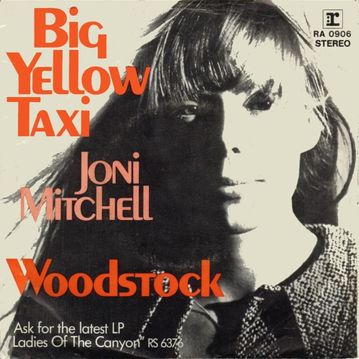
Joni Mitchell “Big Yellow Taxi” charted

Big Yellow Taxi

Joni Mitchell

Writer(s): Joni Mitchell (see lyrics here)


First Charted: June 6, 1970


Peak: 24 BB, 100 CB, 35 GR, 32 HR, 33 AC, 3 CL, 11 UK, 14 CN, 6 AU, 3 DF (Click for codes to charts.)


Sales (in millions): -- US, 0.4 UK, 0.48 world (includes US + UK)


Airplay/Streaming (in millions): 1.0 radio, 18.5 video, 170.30 streaming

Awards:

Click on award for more details.

About the Song:

Folk singer/songwriter Joni Mitchell was born Roberta Joan Anderson in Alberta, Canada, in 1943. She moved to the United States in 1965, eventually settling in Laurel Canyon, a Los Angeles neighborhood which became known as a haven for the counterculture movement and a launching pad for multiple musicians in the mid-‘60s through the mid-‘70s. She released her first album, Song to a Seagull, in 1968.

Joni’s third album, 1970’s Ladies of the Canyon, reached the top 30 on the Billboard album chart and went platinum. The title was a reference to Laurel Canyon and included some of her most notable songs such as “Woodstock,” “The Circle Game,” and “Big Yellow Taxi.” The latter “combines the global and the personal in a playful, jaunty song that nonetheless makes its point.” TC

She explained how the song was inspired by a visit to Hawaii. She said, “The hotel room was quite high up so in the distance I could see the blue Pacific Ocean. I walked over to the balcony and there was the picturebook scenery, palm tree swaying in the breeze and all. Then I looked down and there was this ugly concrete car park,” TC which, as she said in another interview, “as far as the ey could see…and it broke my heart…this blight on paradise.” DT She came up with the line “They paved paradise and put up a parking lot” and the song was born.

Another famous line from the song was “They took all the trees, and put ‘em in a tree museum / And charged the people a dollar and a half just to see ‘em.” It was inspired by Foster Botanical Garden, a living museum of tropical plants in Honolulu. WK The song takes a personal turn toward then end when Mitchell refers to a loved one leaving in a a big yellow taxi. Some have interpreted it as him walking out on her while others think it could mean he was being taken away by the authorities. WK

The studio version of the song was released as a single in 1970, but peaked at #67 on the Billboard Hot 100. Four years later, a live version outdid the original, climbing to #24. The song would also be a hit for the Neighborhood (#29 BB, 1970), Amy Grant (1994, #67 BB, 18 AC, 20 UK, 25 CN), and the Counting Crows with Vanessa Carlton (2002, #42 BB, 5 AC, 16 UK, 12 CN, 3 AU).


Resources:


Related Links:


First posted 4/25/2024.

Saturday, April 11, 1970

The Doors “Roadhouse Blues” charted

Roadhouse Blues

The Doors

Writer(s): John Densmore, Robbie Krieger, Ray Manzarek, Jim Morrison (see lyrics here)


First Charted: April 11, 1970


Peak: 50 BB, 76 CB, 41 CN, 1 CL, 1 DF (Click for codes to charts.)


Sales (in millions): -- US, -- UK, 0.04 world (includes US + UK)


Airplay/Streaming (in millions): -- radio, 192.90 video, 273.25 streaming

Awards:

Click on award for more details.

About the Song:

Morrison Hotel (also known as Hard Rock Café) was the fifth studio album released by the Doors. Like its predecessors, it was a million-selling, top-ten album. Each of the four previous albums produced at least one top-40 hit, among them “Light My Fire” (#1 BB), “People Are Strange” (#12 BB), “Love Me Two Times” (#25 BB), “Hello, I Love You” (#1 BB), and “Touch Me” (#3 BB).

This marked the first time the Doors didn’t produce a top-40 hit from an album. “Roadhouse Blues” (technically the B-side of “You Make Me Real”) only reached #50 on the Billboard Hot 100. Even so, it became a staple on album rock radio. In 2022, Time Out ranked it the #11 classic rock song of all time. WK Sound engineer Bruce Botnick called it “the all-time American bar band song.” WK

While the Doors fit in more “with the psychedelic denizens of Jefferson Starship and Donovan” TO “Roadhouse Blues” showed that “when they let loose on the blues, they made a massive crater in the soundscape.” TO It is “a droning, repetitive, swampy wallow through 12-bar debauchery in which Jim Morrison…screams gleefully about roadhouses. Behind him, bandmates Ray Manzarek and Robby Krieger fill the empty spaces with so much sonic bravado it almost feels like getting hit by a truck on a lost highway.” TO

Morrison apparently came up with this song during a drunken jam session. SF The roadhouse in the song may be the Topanga Corral, a nightclub in Topanga Canyon where Morrison lived. SF Alice Cooper said he was the inspiration for the line “Woke up this morning and I got myself a beer.” He said he was hanging out with Jim, said that line, and Jim wrote it down. Alice said, “So they go in and they’re doing the song and the next thing I hear is ‘woke up this morning and I got myself a beer’ and I went ‘I just said that a second ago!’” WK


Resources:


Related Links:


First posted 4/28/2024.