 | Alone Again OrLove |
This post has been moved here. |

DavesMusicDatabase.com is devoted to ranking, rating, and reviewing music of all genres and eras. The DMDB blog serves up album and song reviews, best-of lists, music history snapshots, and music-related essays.

|

|

|

|

|

|

|

|

|

|

|

|
|
| Alone Again OrLove |
This post has been moved here. |
 | Jimmy Crack Corntraditional |
Writer(s): traditional/credited to Daniel Decatur Emmett (see lyrics here) First Published: January 20, 1846 First Charted: July 31, 1948 Peak: 24 BB (Burl Ives) (Click for codes to charts.) Sales (in millions): -- Airplay/Streaming (in millions): -- radio, 3.71 video, 0.73 streaming (multiple versions) |
Awards:Click on award for more details. 


|
About the Song:“Jimmy Crack Corn,” also known as “The Blue Tail Fly,” was first published by F.D. Benteen of Baltimore on January 20, 1846. JF It became popular as a blackface minstrel song performed by Daniel Decatur Emmett’s Virginia Minstrels. WK Emmett is generally credited with the song, although he may have simply arranged and published an African-American song that already existed. WK The opening notes are similar to “Miss Lucy Long,” published in 1842. JF The song grew out of the experience of slaves in the American South and their use of music and storytelling to connect and express emotions. AN It “reflects the hostility of slave towards master in Southern plantation society.” BA It “is a lively and spirited song that has endured over time as a testament to the creativity and resilience of African American culture.” AN “Cracking corn” was a phrase that referred to sitting around and gossiping. AN The song starts out with the singer, a house slave, being expected to protect his master and his horse from a blue-tailed fly. When he fails, the master is thrown from the horse and killed. The singer is charged with the death but eventually gains his freedom when the death is blamed on the blue-tail fly. WK The song isn’t without controversy as it is perceived as offering a simplistic view of slavery and that slaves were happy and carefree despite the oppression against them. AN The song has been viewed both as the slave lamenting over his master’s death and celebrating it. WK Abraham Lincoln is said to have requested the song be played at Gettysburg, where he delivered his famous address in November 1863. WS It was reportedly a favorite of his that he may have even played on harmonica. TR The song experienced a revival in the 1940s as a folk song and Burl Ives charted with it in 1948. It became a popular children’s song and campfire favorite. Big Bill Broonzy, Bob Dylan, Lead Belly, Tom Lehrer, and Pete Seeger are among those to record and perform the song. WK In 1959, Johnny & the Hurricanes recorded a instrumental version of the song called “Beatnik Fly” and reached #15 in the US and #8 in the UK. Resources:
Related Links:
First posted 12/18/2025. |
 | Turn! Turn! Turn! (To Everything There Is a Season)The Byrds |
This post has been moved here. |
 | The Times They Are A-Changin’Bob Dylan |
Writer(s): Bob Dylan (see lyrics here) First Recorded: October 24, 1963 Released (album cut): January 13, 1964 Released (single): March 8, 1965 First Charted: March 27, 1965 Peak: 2 CL, 9 UK, 1 DF (Click for codes to charts.) Sales (in millions): 0.2 UK Airplay/Streaming (in millions): -- radio, 24.80 video, 220.05 streaming |
Awards:Click on award for more details. 


|
About the Song:Bob Dylan’s 1962 self-titled debut didn’t make waves, but his second album, 1963’s The Freewheelin’ Bob Dylan, featured early classics like “A Hard Rain’s A-Gonna Fall,” “Masters of War,” “Don’t Think Twice, It’s All Right,” and -most significantly – “Blowin’ in the Wind.” A cover of the latter by Peter, Paul & Mary reached #2 and “cast Bob Dylan into the …role of a spokesman for his generation.” SS Dylan said, “one man, the lone balladeer with the guitar, could blow an entire amry off the stage if he knew what he was doing.” SS The follow-up album, The Times They Are A-Changin’, wasn’t quite as loaded, but still featured “such socially conscious songs as ‘With God on Our Side’ and ‘The Ballad of Hollis Brown’” SS and, of course, the title song. It was “a song designed as an anthem.” SS He said “I wanted to write a big song, some kind of theme song…This is definitely a song with purpose.” TC Critic Michael Gray called it “the archetypical protest song.” WK “The phrase ’the times they are a-changin’ went quickly into the vernacular as one of the catch-phrases of that decade.” TC It was “a manifesto that implicated his elders in slowing the progress of the world.” TC “Not only is Dylan anticipating the coming troubles, he lays the blame on the shoulders of the older generation.” TC It “was inspired in part by U.S. Senate filibusters over civil rights legislation, and expanded in scope with Biblical allusions including a phrase adapted from the Serom on the Mount.” SS The song’s melody was partly adapted from “The Dreary Black Hills,” an 1872 song warning about the hard life of South Dakota. SS The song was influence by Irish and Scottish ballads. WK Resources:
Related Links:

First posted 5/23/2024. |
 | The Banana Boat Song (Day-O)Harry Belafonte |
Writer(s): traditional, arranged: Harry Belafonte, William Attaway, Lord Burgess (see lyrics here) First Charted: January 12, 1957 Peak: 5 US, 11 HP, 3 CB, 2 HR, 7 RB, 2 UK, 1 DF (Click for codes to charts.) Sales (in millions): 1.0 US Airplay/Streaming (in millions): 1.0 radio, 57.2 video, 116.51 streaming |
Awards:Click on award for more details.


|
About the Song:The music of “The Banana Boat Song” is “so light and airy” LS that it is easy to overlook that lyrically it is about hired people or even slaves being overworked. They will “do everything possible to earn money and feed their families.” LS Dock workers are loading bananas on a ship. They do the work at night to avoid the hot, tropical, daytime sun. LS They also sing to develop cohesive teamwork. Trinidadian singer Edric Connor was the first to record the Jamaican folk song (originally known as “Day Dah Light”) in 1932. LS In 1954, Jamaican singer Louise Bennett recorded the song. LS The Tarriers recorded the song in 1956 and took it to #4. Harry Belafonte also recorded the song in 1956 as part of his Calypso album. It was very different from his “folk-based debut.” TB He recorded it as a tribute to his childhood and the Caribbean musical style. LS He was born in Harlem, New York, but at eight years old, his family returned to Jamaica, his mother’s homeland, for five years. LS His timing was perfect – by the end of 1957, calypso music accounted for 25% of all American record sales. TB He specifically chose “The Banana Boat Song” because of the stereotypes at the time that people in the Caribbean were “lazy, constantly drinking rum, and having sex” LS so he wanted to sing “a classic work song about a man who works all night for the equivalent of a sip of beer.” LS The song gained another measure of fame when it was used in the 1988 film Beetlejuice. It has also become popular to sing at baseball games. SS
Resources:
Related Links:
First posted 3/25/2023. |
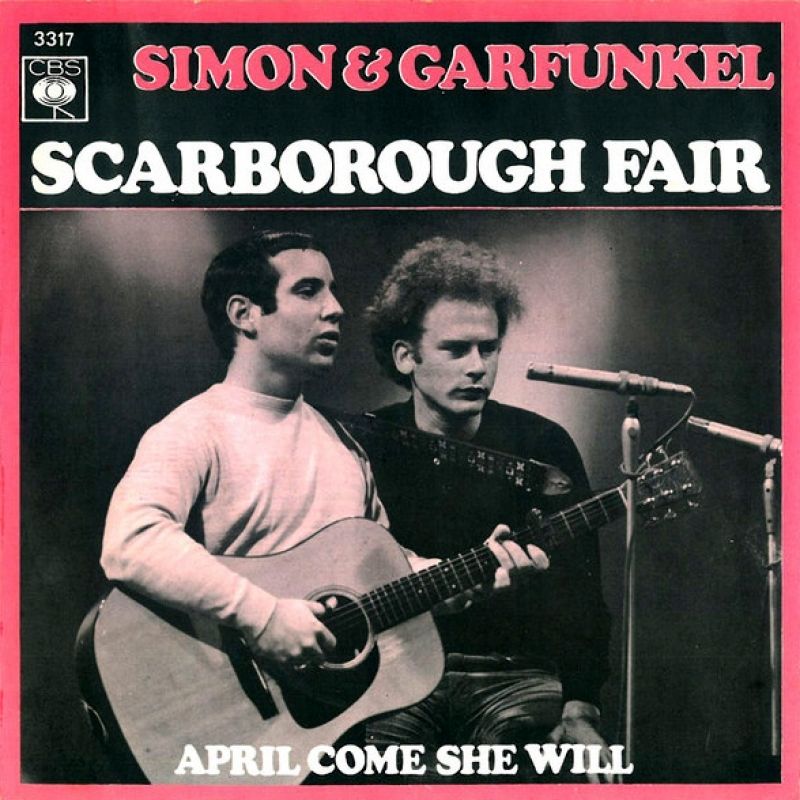 | Scarborough Fair/CanticleSimon & Garfunkel |
Writer(s): traditional/Paul Simon/Art Garfunkel (see lyrics here) Released: October 10, 1966 (album cut) First Charted: February 23, 1968 Peak: 11 BB, 19 CB, 5 GR, 14 HR, 5 AC, 2 CL, 49 AU, 1 DF (Click for codes to charts.) Sales (in millions): -- US, 0.2 UK Airplay/Streaming (in millions): 6.0 radio, 40.57 video, 52.92 streaming |
Awards:Click on award for more details.

|
About the Song:“Scarborough Fair/Canticle” was originally featured on Simon & Garfunkel’s third album, Parsley, Sage, Rosemary, and Thyme. It was then also featured on 1968’s The Graduate, a soundtrack comprised of Dave Grusin instrumentals alongside mostly previously-released Simon & Garfunkel songs. The one new song from S&G was “Mrs. Robinson,” which would go all the way to #1. However, the soundtrack also spurred “Scarborough Fair” to be released as a single. The tune for the song dates back all the way to 1670. It was called “The Elfin Knight” and also known as “The Lovers’ Tasks.” SS An elf tells a woman he will abduct her unless she performs an impossible task. WK A version from 1810 offered the text, “Can you make me a cambric shirt / Parsley, sage, rosemary, and thyme / Without any seam or needlework? / And you shall be a true lover of mine.” SS The folk song became associated with the Scarborough Fair in the mid-19th century. It was an annual event held in Scarborough, a small town on the coast of England. SS It became a song in which a former lover who lives in Scarborough is given a series of impossible tasks. WK The herbs symbolize “desired virtues; parsley represented comfort, sage was strength, rosemary was love, and thyme was courage.” SS One account suggests Art Garfunkel learned the tune from a female friend while in London, but it also been reported that while on tour in England, Paul Simon heard folk singer and guitarist Martin Carthy perform the song. Carthy also taught the song to Bob Dylan when he visited London in 1962. Dylan used the melody for “Girl from the North Country” and “Boots of Spanish Leather.” SS Simon incorporated the line “Remember me to one who lives there / She once was a true love of mine” from “Girl from the North Country.” SS Meanwhile, the “Canticle” part of the song was largely adapted from Simon’s own “The Side of a Hill” which he recorded in 1965. SS Resources:
Related Links:


First posted 10/11/2023; last updated 10/16/2023. |


