Showing posts with label Daniel Decatur Emmett. Show all posts

Wednesday, March 16, 2016

Today in Music (1916): “Old Dan Tucker” recorded for the first time

Old Dan Tucker

Daniel Decatur Emmett

Writer(s): Daniel Decatur Emmett (words), unknown (music) (see lyrics here)


First Published: 1843


First Recorded: March 16, 1916 (Harry C. Browne)


First Charted: April 4, 1925 (Fiddlin’ John Carson)


Peak: 10 PM (Click for codes to charts.)


Sales (in millions): --


Airplay/Streaming (in millions): -- radio, 4.62 video, 7.74 streaming (multiple versions)

Awards (Emmett):

Click on award for more details.


Awards (Uncle Dave Macon):

About the Song:

Music historian and author Steve Sullivan says, “This is where American music begins.” SS He asserts that Daniel Decatur Emmett, also known for writing “Dixie” and “Polly Wolly Doodle (All the Day),” launched the American minstrel movement in 1843 with this song in which he added lyrics to an existing folk song. SS The titular Tucker is an “ugly, unrefined, and unintelligent” WK “animalistic character driven by sex, violence, and strong drink.” WK It may be a reference to “the notorious Daniel Tucker (1575-1625) of Jamestown Colony, Virginia and Bermuda” WK or a Georgia farmer (1744-1818) who became well liked by slaves because of his ministry to them. WK

The song has been credited to Emmett, J.R. Jenkins, and Henry Russell. Emmett, however, asserted that he wrote the song in 1830 or 1831 as a teenager. WK Regardless of its authorship, it was Emmett and his group the Virginia Minstrels who made “Old Dan Tucker” into a minstrel hit. It was a song intended for stage performance in which the verses were acted out and danced to but became a song that stood on its own as well. WK Musicologist Dale Cockrell asserts that “the song represents a transition between early minstrel music and the more European-style songs of minstrelsy’s later years.” WK Today it is a standard of bluegrass and country music. WK

The song was first recorded commercially by Harry C. Browne on March 16, 1916. Fiddlin’ John Carson recorded it in 1924 and Uncle Dave Macon put his spin on the classic in 1925. “This is pure hillbilly entertainment with no holding back, furious banjo thrashing and enthusiastic vocal…One imagines it’s not too different from the way Dan Emmett and the Virginina Minstrels put the number over generations earlier.” SS

Macon “personifies better than anyone the deeply rooted traditions of old-time country or hillbilly music in the 1920s.” SS He was born in Tennessee in 1870 but didn’t begin his recording career until 53 years old. He performed in minstrel and vaudeville shows and for the Grand Ole Opry. Ralph Rinzer said, “With the exception of the Carter Family, Uncle Dave preserved more valuable American folklore through his recodings than any other folk or country music performer.” SS


Resources:


Related Links:


First posted 12/2/2025.

Wednesday, January 20, 2016

Today in Music (1846): “Jimmy Crack Corn” published

Jimmy Crack Corn

traditional

Writer(s): traditional/credited to Daniel Decatur Emmett (see lyrics here)


First Published: January 20, 1846


First Charted: July 31, 1948


Peak: 24 BB (Burl Ives) (Click for codes to charts.)


Sales (in millions): --


Airplay/Streaming (in millions): -- radio, 3.71 video, 0.73 streaming (multiple versions)

Awards:

Click on award for more details.

About the Song:

“Jimmy Crack Corn,” also known as “The Blue Tail Fly,” was first published by F.D. Benteen of Baltimore on January 20, 1846. JF It became popular as a blackface minstrel song performed by Daniel Decatur Emmett’s Virginia Minstrels. WK Emmett is generally credited with the song, although he may have simply arranged and published an African-American song that already existed. WK The opening notes are similar to “Miss Lucy Long,” published in 1842. JF

The song grew out of the experience of slaves in the American South and their use of music and storytelling to connect and express emotions. AN It “reflects the hostility of slave towards master in Southern plantation society.” BA It “is a lively and spirited song that has endured over time as a testament to the creativity and resilience of African American culture.” AN “Cracking corn” was a phrase that referred to sitting around and gossiping. AN

The song starts out with the singer, a house slave, being expected to protect his master and his horse from a blue-tailed fly. When he fails, the master is thrown from the horse and killed. The singer is charged with the death but eventually gains his freedom when the death is blamed on the blue-tail fly. WK

The song isn’t without controversy as it is perceived as offering a simplistic view of slavery and that slaves were happy and carefree despite the oppression against them. AN The song has been viewed both as the slave lamenting over his master’s death and celebrating it. WK

Abraham Lincoln is said to have requested the song be played at Gettysburg, where he delivered his famous address in November 1863. WS It was reportedly a favorite of his that he may have even played on harmonica. TR The song experienced a revival in the 1940s as a folk song and Burl Ives charted with it in 1948. It became a popular children’s song and campfire favorite. Big Bill Broonzy, Bob Dylan, Lead Belly, Tom Lehrer, and Pete Seeger are among those to record and perform the song. WK In 1959, Johnny & the Hurricanes recorded a instrumental version of the song called “Beatnik Fly” and reached #15 in the US and #8 in the UK.


Resources:


Related Links:


First posted 12/18/2025.


Saturday, April 4, 2009

On This Day in Music (1859): “Dixie” was performed for the first time

Dixie

Daniel Decatur Emmett (words and music)

Writer(s): Daniel Decatur Emmett (see lyrics here)


First Performed: April 4, 1859


Published: June 21, 1860


First Charted: --


Peak: -- (Click for codes to charts.)


Sales (in millions): --


Airplay/Streaming (in millions): -- radio, -- video, -- streaming

Awards (Emmett):

Click on award for more details.


Awards (Tanner):

About the Song:

“If the Confederacy and its memory had an accompanying anthem, it was ‘Dixie.’” NPR Pulitzer Prize-winning writer Tony Horowitz writes in his book Confederates in the Attic that the song “is sentimental and elegiac, recalling this land of cotton fields and buckwheat cakes and a kind of slow-moving world that can seem appealing through rose-colored glasses…[It] speaks to a bygone, slow-paced world that some white Southerners felt had been snuffed out by a brutish, industrial North.” NPR

The word “dixie” can refer to the land south of the Mason-Dixon line, but is thought to actually be a reference to a worthless ten dollar bill issued in New Orleans. They were called “dixies” because they had “dix,” the French word for “ten,” printed on them. CP

Surprisingly, the song was born in the North. Daniel Decatur Emmett, a Northerner born in Mount Vernon, Ohio, in 1815, was a founder of the Virginia Minstrels in 1843 SS and wrote the songs “Old Dan Tucker” and “Polly Wolly Doodle.” In 1858, he was hired as a songwriter for the Bryant’s Minstrels. “Dixie” had “strong echoes both of an old German hymn and an English music hall song he used to sing.” SS He wrote it on a Sunday night and, according to a playbill from the Mechanics’ Hall in New York City, it was performed at a minstrel show the next night on April 4, 1859. The song was published as “I Wish I Was in Dixie’s Land” on June 21, 1860, selling the publishing rights for $100. SS

Minstrel shows featured white men in blackface performing racial parodies. President Abraham Lincoln heard the song performed in 1860 in Chicago by the Rumsey and Newcomb Minstrels and reportedly clapped and shouted, “Let’s have it again! Let’s have it again!” BA At the end of the Civil War, Lincoln asked for a military band to play “Dixie” as a message that “That tune is now Federal property and it is good to show the rebels that, with us in power, they will be free to hear it again.” BA

However, Southern troops quickly adopted the song, marching into battle singing it. It was played with Confederate President Jefferson Davis took the oath of office in 1861. SA Emmett, who was a Union supporter, reportedly said, “If I had known to what use they were going to put my song, I’ll be damned if I’d have written it.” SA

While it face value “Dixie” is “simply a lovely, infectious regional anthem” SS it has sadly been tied to the 20th century revival of white supremacy. The song soundtracked Birth of a Nation the movie that helped revive the Ku Klux Klan. In the 1940s, it was embraced by segregationists. In the 1950s, white women sung it in protest of the integration of schools. Much like the Confederate flag, the song has become an anathema to African-Americans. NPR

Civil War historian Ed Ayers asks, “Why do those four years, out of the 400 years that people have lived on this landscape…why do they get to define us forever? Why can’t we claim new voices and new identities that embrace all Southern people?” NPR He acknowledges that it is impossible to hear “’Dixie’ as anything other than a song that’s accrued all this meaning over many generations.” NPR

The song has not charted but has been performed by Issler’s Orchestra (1895), Frank Stanley & Byron Harlan (1909), Gib Tanner & His Skillet Lickers (1927), and Tennessee Ernie Ford. It has been performed by numerous Southern university marching bands.


Resources:


First posted 8/29/2023.

Thursday, October 17, 1991

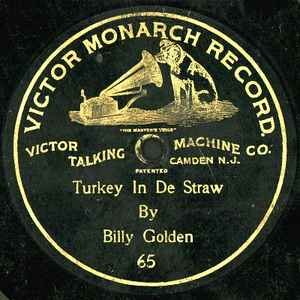
On This Day (1891): “Turkey in the Straw” hit #1

Turkey in the Straw

Billy Golden

Writer(s): authorship disputued (see lyrics here)


First Charted: October 17, 1891


Peak: 17 PM (Click for codes to charts.)


Sales (in millions): --


Airplay/Streaming (in millions): -- radio, 0.32 video, 0.01 streaming

Awards (1834 version):

Click on award for more details.


Awards (Billy Golden):

Click on award for more details.

About the Song:

“Turkey in the Straw” has a long and confusing history. Its earliest ties are to a British song “The Old Rose Tree,” which was published in 1795. The fiddle tune “Natchez Under the Hill” is then thought to have derived from “The Old Rose Tree” WK and may have been performed by Bob Farrell as early as August 11, 1834. WK

Farrell and another singer named George Washington Dixon also popularized a song in the 1930s called “Zip Coon” which was based on the same melody. Both of them, as well as George Nicholls, have laid claim to the song’s authorship, but that has never been resolved. WK

“Turkey in the Straw,” which used the same melody as “Zip Coon,” was published on March 29, 1834. On July 12, 1861, Dan Bryant copyrighted “Turkey in the Straw” with new lyrics set to “Zip Coon.” WK Daniel Decatur Emmett, known for writing “Dixie” and “Polly Wolly Doodle,” later gave the song new comic lyrics and it became popular in minstrel shows. SS

The song subsequently became associated with “stereotypes of rural southerners and westerners, mostly white, doing square dances on farms and in mountain hollers.” LC Unfortunately, it has also been marked by racist lyrics. LC Carl Sandburg called this “the classical American rural tune” in his 1927 book American Songbag. SS In a May 1979 article for the Journal of Country Music, Simon J. Bronner said it “should be considered as a significant part of the history of country music.” SS

In 1891, Billy Golden, a popular vaudeville comedian, was the first to chart with the song. His version was characterized by his “energetic delivery of the lyrics with a big guffawing, laugh.” SS He charted six times from 1891 to 1911, including a new version of the song which hit #4 in 1905. The 1891 recording was his only #1. PM There were also chart versions by Vess Ossman (#8, 1905), Gid Tanner & His Skillets (#14 PM, 1926) and Carson Robison (#22 PM, 1942). PM

“Turkey in the Straw” would also become the basis for Otto Bonnell’s “Ragtime Fantasy.” LC It was also famously used in the 1928 Disney animated short Steamboat Willie, which introduced the characters of Mickey and Minnie Mouse.


Resources:


First posted 9/6/2023.