Showing posts with label Scarborough Fair. Show all posts

Thursday, February 23, 1978

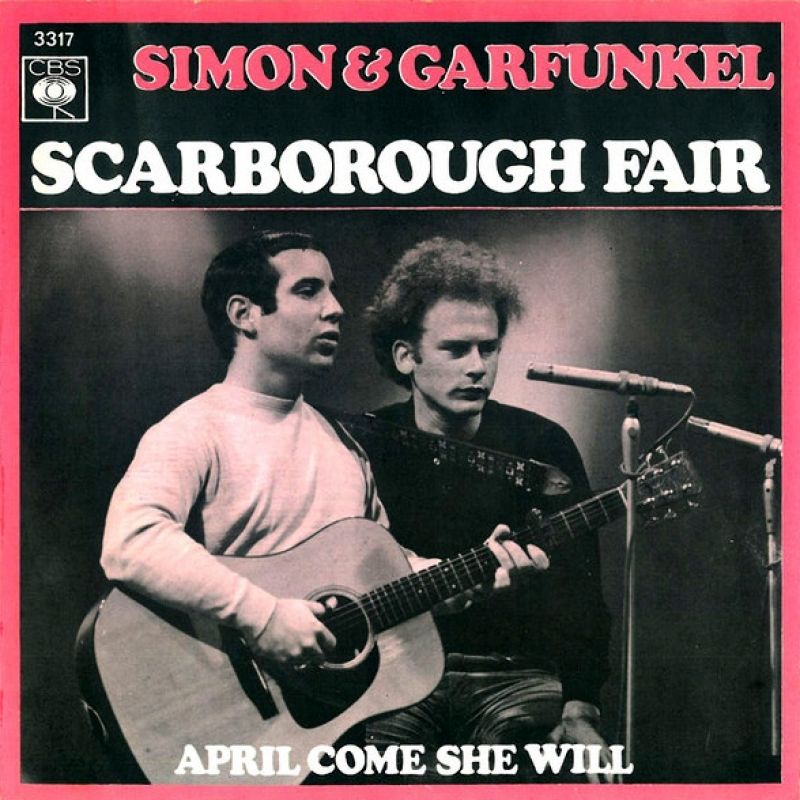
Today in Music (1968): Simon & Garfunkel “Scarborough Fair” charted

Scarborough Fair/Canticle

Simon & Garfunkel

Writer(s): traditional/Paul Simon/Art Garfunkel (see lyrics here)


Released: October 10, 1966 (album cut)


First Charted: February 23, 1968


Peak: 11 BB, 19 CB, 5 GR, 14 HR, 5 AC, 2 CL, 49 AU, 1 DF (Click for codes to charts.)


Sales (in millions): -- US, 0.2 UK


Airplay/Streaming (in millions): 6.0 radio, 40.57 video, 52.92 streaming

Awards:

Click on award for more details.

About the Song:

“Scarborough Fair/Canticle” was originally featured on Simon & Garfunkel’s third album, Parsley, Sage, Rosemary, and Thyme. It was then also featured on 1968’s The Graduate, a soundtrack comprised of Dave Grusin instrumentals alongside mostly previously-released Simon & Garfunkel songs. The one new song from S&G was “Mrs. Robinson,” which would go all the way to #1. However, the soundtrack also spurred “Scarborough Fair” to be released as a single.

The tune for the song dates back all the way to 1670. It was called “The Elfin Knight” and also known as “The Lovers’ Tasks.” SS An elf tells a woman he will abduct her unless she performs an impossible task. WK A version from 1810 offered the text, “Can you make me a cambric shirt / Parsley, sage, rosemary, and thyme / Without any seam or needlework? / And you shall be a true lover of mine.” SS

The folk song became associated with the Scarborough Fair in the mid-19th century. It was an annual event held in Scarborough, a small town on the coast of England. SS It became a song in which a former lover who lives in Scarborough is given a series of impossible tasks. WK The herbs symbolize “desired virtues; parsley represented comfort, sage was strength, rosemary was love, and thyme was courage.” SS

One account suggests Art Garfunkel learned the tune from a female friend while in London, but it also been reported that while on tour in England, Paul Simon heard folk singer and guitarist Martin Carthy perform the song. Carthy also taught the song to Bob Dylan when he visited London in 1962. Dylan used the melody for “Girl from the North Country” and “Boots of Spanish Leather.” SS Simon incorporated the line “Remember me to one who lives there / She once was a true love of mine” from “Girl from the North Country.” SS Meanwhile, the “Canticle” part of the song was largely adapted from Simon’s own “The Side of a Hill” which he recorded in 1965. SS


Resources:


Related Links:


First posted 10/11/2023; last updated 10/16/2023.

Sunday, October 10, 1976

Today in Music (1966): Simon & Garfunkel Parsley, Sage, Rosemary and Thyme released

Parsley, Sage, Rosemary and Thyme

Simon & Garfunkel


Released: October 10, 1966


Peak: 4 US, 15 UK, -- CN, 14 AU


Sales (in millions): 3.0 US, 0.06 UK, 7.0 world (includes US + UK)


Genre: folk rock


Tracks:

Song Title (date of single release, chart peaks) Click for codes to charts.

  1. Scarborough Fair (2/23/68, 11 BB, 19 CB, 5 GR, 14 HR, 5 AC, 2 CL, 49 AU, 1 DF)
  2. Patterns
  3. Cloudy
  4. Homeward Bound (2/11/66, 5 BB, 5 CB, 4 GR, 5 HR, 4 CL, 9 UK, 20 AU, 5 DF)
  5. The Big Bright Green Pleasure Machine
  6. The 59th Street Bridge Song (Feelin’ Groovy) (23 CL, 11 DF)
  7. The Dangling Conversation (8/6/66, 25 BB, 15 CB, 23 GR, 18 HR, 26 CL, 85 AU, 22 DF)
  8. Flowers Never Bend with the Rainfall
  9. A Simple Desultory Philippic (How How I Was Robert McNamara’d into Submission)
  10. For Emily, Whenever I May Find Her (8/26/72, 53 BB, 72 CB, 61 HR, 27 AC, 37 CL)
  11. A Poem on the Underground Wall
  12. 7 O’Clock News/Silent Night (11/11/66, 24 GR, 30 UK)


Total Running Time: 27:55

Rating:

4.093 out of 5.00 (average of 17 ratings)


Awards:

(Click on award to learn more).

About the Album:

“Simon & Garfunkel’s first masterpiece.” It “was the duo’s album about youthful exuberance and alienation, and it proved perennially popular among older, more thoughtful high-school students and legions of college audiences across generations.” “After the frantic rush to put together an LP in just three weeks that characterized the Sounds of Silence album early in 1966, Parsley, Sage, Rosemary and Thyme came together over a longer gestation period of about three months, an uncommonly extended period of recording in those days.” BE

“The album opens with one of the last vestiges of Paul Simon’s stay in England, Scarborough Fair/ Canticle — the latter was the duo’s adaptation of a centuries-old English folk song in an arrangement that Simon had learned from Martin Carthy. The two transformed the song into a daunting achievement in the studio, however, incorporating myriad vocal overdubs and utilizing a harpsichord, among other instruments, to embellish it, and also wove into its structure Simon’s ‘The Side of a Hill,’ a gentle antiwar song that he had previously recorded on The Paul Simon Songbook in England. The sonic results were startling on their face, a record that was every bit as challenging in its way as ‘Good Vibrations,’ but the subliminal effect was even more profound, mixing a hauntingly beautiful antique melody, and a song about love in a peaceful, domestic setting, with a message about war and death.” BE

“The rest of the album was less imposing but just as beguiling – audiences could revel in the play of Simon’s mind (and Simon & Garfunkel’s arranging skills) and his sense of wonder (and frustration) on Patterns and appreciate the sneering rock & roll-based social commentary The Big Bright Green Pleasure Machine. Two of the most beautiful songs ever written about the simple joys of living, the languid Cloudy and bouncy The 59th Street Bridge Song (Feelin’ Groovy), were no less seductive, and the album also included Homeward Bound.” BE

“No Simon & Garfunkel song elicits more difference of opinion than The Dangling Conversation…one camp regards it as hopelessly pretentious and precious in its literary name-dropping and rich string orchestra accompaniment, while another holds it as a finely articulate account of a couple grown distant and disconnected through their intellectual pretentions; emotionally, it is definitely the precursor to the more highly regarded ‘Overs’ off the next album, and it resonated well on college campuses at the time, evoking images of graduate school couples drifting apart, but for all the beauty of the singing and the arrangement, it also seemed far removed from the experience of teenagers or any listeners not living a life surrounded by literature.”

For Emily, Whenever I May Find Her was a romantic idyll that presented Art Garfunkel at his most vulnerable sounding…while Flowers Never Bend With the Rainfall was Simon at his most reflectively philosophical, dealing with age and its changes much as ‘Patterns’ dealt with the struggle to change.”

A Simple Desultory Philippic, which also started life in England more than a year earlier, was the team’s Dylanesque fuzz tone-laden jape at folk-rock, and a statement of who they weren’t, and remains, alongside Peter, Paul & Mary’s ‘I Dig Rock & Roll Music,’ one of the best satires of its kind.”

“The last of Simon’s English-period songs, A Poem on the Underground Wall, seemed to sum up the tightrope walk that the duo did at almost every turn on this record at this point in their career – built around a beautiful melody and gorgeous hooks, it was, nonetheless, a study in personal privation and desperation.”

The album concluded with “7 O’Clock News/ Silent Night, a conceptual work that was a grim and ironic (and prophetic) comment on the state of the United States in 1966. In retrospect, it dated the album somewhat, but that final track, among the darkest album-closers of the 1960s, also proved that Simon & Garfunkel weren’t afraid to get downbeat as well as serious for a purpose.”

Resources and Related Links:


Other Related DMDB Pages:


First posted 5/5/2011; last updated 10/9/2023.