Showing posts with label top psychedelic rock songs. Show all posts

Saturday, March 25, 2017

Today in Music (1967): The Turtles “Happy Together” hit #1

Happy Together

The Turtles

Writer(s): Gary Bonner, Alan Gordon (see lyrics here)


Released: January 1967


First Charted: Rebruary 3, 1967


Peak: 13 BB, 12 CB, 13 GR, 12 HR, 1 CL, 12 UK, 2 CN, 25 AU, 1 DF (Click for codes to charts.)


Sales (in millions): 3.0 US, 0.6 UK


Airplay/Streaming (in millions): 5.0 radio, 94.10 video, 467.65 streaming

Awards:

Click on award for more details.

About the Song:

The Turtles were only together from 1965 to 1970 and changed membership along the way, but Howard Kaylan and Mark Volman were constants. They were friends from high school days who sang in choir together. FB Their first chart entry in 1965 was a top-ten cover of Bob Dylan’s “It Ain’t Me Babe.” After a pair of top-30 hits, they had several songs that barely made the Billboard Hot 100 or missed it completely before moving “away from their earlier folk-rock material towards the richer sound of ‘Happy Together.’” TB It gave them their first and only chart-topper.

Gary Bonner and Alan Gordon, the bassist and drummer of the Boston area band the Magicians, wrote “Happy Together.” Gordon said the song grew out of an open string pattern that the Magicians’ guitarist, Jake Jacobs, used for tuning. Gordon asked Jacobs for help in co-writing the song, but Jacobs refused, thinking it was too simplistic. RC

Bonner and Gordon recorded a demo at Regent Sound Studio SF and shopped it around to different bands, including the Vogues and Gary Lewis & the Playboys. TB They played it so many times that the demo was worn out and practically unlistenable. FB They approached the Turtles with it when the latter were playing at the Phone Booth, a small club in New York City. SJ They added it to their set and decided to record it once they were off the road.

The “whimsical pop classic” TB has been misunderstood; even music author Dave Thompson called it “the ultimate romance.” DT However, it is actually about unrequited love. As Bonner said, it “is the fantasy of a guy obsessed with a woman who doesn’t love him.”< sup>SJ

Other versions of the song to reach the chart included Tony Orlando & Dawn (#79 BB as part of a medley, 1972), T.G. Sheppard (#8 CW, 1979), Captain & Tennille (#53 BB, 1980), the Nylons (#75 BB, 1987), and Jason Donovan (#10 UK, 1991). Others to record the song include Vikki Carr, Petula Clark, Percy Faith, Melba Moore, Donny Osmond, Mel Torme, the Ventures, the Vogues, Weezer, and Frank Zappa. SF


Resources:


First posted 9/16/2023; last updated 4/25/2024.

Monday, March 14, 2016

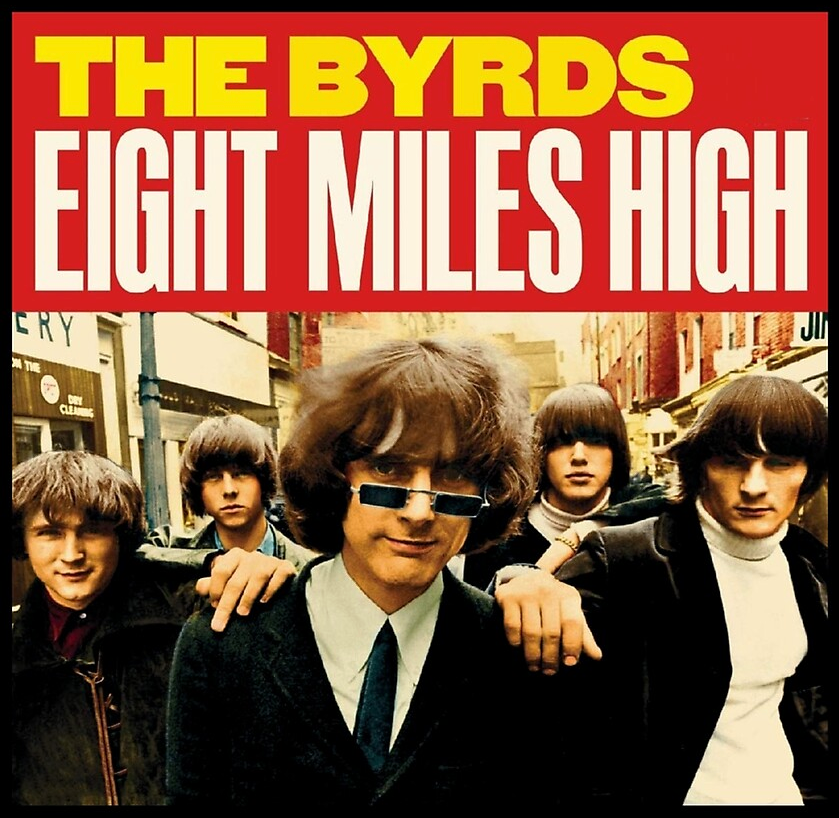
Today in Music (1966): The Byrds “Eight Miles High” released

Eight Miles High

The Byrds

Writer(s): Roger McGuinn, David Crosby, Gene Clark (see lyrics here)


Released: March 14, 1966


First Charted: April 2, 1966


Peak: 14 BB, 12 CB, 13 GR, 15 HR, 2 CL, 24 UK, 4 DF (Click for codes to charts.)


Sales (in millions): --


Airplay/Streaming (in millions): -- radio, 9.70 video, 32.58 streaming

Awards:

Click on award for more details.

About the Song:

The Byrds formed in 1964 in Los Angeles. Their 1965 cover of Bob Dylan’s “Mr. Tambourine Man” got the group “lauded as the harbingers of a whole new genre – folk-rock.” LW With 1966’s “Eight Miles High” they were celebrated for another song “that was also heralded as a groundbreaking event.” LW It is considered “a classic of the counterculture era” WK and “one of the masterpieces of the psychedelic era,” TC even being held up by many critics as “the first bona fide psychedelic rock song.” WK

Band member Roger McGuinn said “this nugget of proto-psychedia” DT was not about drugs, as everyone assumed, “but in the ‘60s, anything with abstract imagery was automatically considered a psychedelic song.” SJ It was about the band’s impressions of touring in England. He said, “it’s about the altitude of the airplane – eight miles high – and when you land over there, when you touch down, you find culture shock.” SJ

The protests didn’t keep radio from banning it for what regarded as “perceived drug connotations in its lyrics.” WK Band members Gene Clark and David Crosby would admit later that the song “was at least partially inspired by their drug use” WK and McGuinn would acknowledge that “high” had a double meaning. SS In addition, “the Byrds’ harmonies were never more ghostly and uplifting,” SS which enhanced the psychedelic effect of the song.

“The amazing guitar solo is McGuinn playing live – and alone!” SJ He said, “There’s no overdubs on that; it’s one straightforward guitar part on a twelve-string. The reason it sounds like that is because I was influenced by John Coltrane,” SJ specifically his song “India.” It was McGuinn’s attempt to replicate “the saxophonist’s repetitive line in that song.” SS Music historian Steve Sullivan said McGuinn’s work here was “no doubt in turn also inspiring an up-and-coming virtuoso named Jim Hendrix.” SS


Resources:


Related Links:


First posted 4/24/2024.

Saturday, June 6, 1987

"You Keep Me Hangin' On" hit #1 for the second time - 20 years after the first time

You Keep Me Hangin’ On

The Supremes

Writer(s): Brian Holland, Lamont Dozier, Eddie Holland (see lyrics here)


Released: October 12, 1966


First Charted: October 29, 1966


Peak: 12 BB, 11 CB, 11 GR, 12 HR, 14 RB, 8 UK, 3 CN, 11 AU, 1 DF (Click for codes to charts.)


Sales (in millions): 1.0 US, 0.08 UK


Airplay/Streaming (in millions): -- radio, 13.7 video, 52.05 streaming

You Keep Me Hangin’ On

Vanilla Fudge


Released: June 1967


First Charted: July 1, 1967


Peak: 6 BB, 7 CB, 12 GR, 7 HR, 6 CL 18 UK, 11 DF (Click for codes to charts.)


Sales (in millions): --


Airplay/Streaming (in millions): -- radio, 10.8 video, 22.10 streaming

You Keep Me Hangin’ On

Kim Wilde


Released: September 19, 1986


First Charted: October 25, 1986


Peak: 1 BB, 11 BA, 2 CB, 11 GR, 11 RR, 30 AC, 1 CO, 2 UK, 11 CN, 12 AU, 8 DF (Click for codes to charts.)


Sales (in millions): -- US, 0.25 UK


Airplay/Streaming (in millions): -- radio, 21.4 video, 82.43 streaming

Awards (Supremes):

Click on award for more details.


Awards (Vanilla Fudge):


Awards (Kim Wilde):

About the Song:

The Supremes were signed to Motown at the urging of Smokey Robinson, who was Diana Ross’ neighbor. RC In 1963, the trio were paired with the writing team of Holland-Dozier-Holland. It was one of the most successful matches in pop history, resulting in nine #1 songs. The Supremes would go on to reach the pinnacle three more times in their post H-D-H years.

“You Keep Me Hangin’ On” was the eighth of those #1 songs. “Lamont Dozier came up with the stuttering guitar part, inspired by radio signals for news flashes.” RC It also featured “one of the definitive Motown tambourine bits and a deep, dark drum and bass pattern” DM alongside Diana Ross’s “ultra-airhead vocal.” DM

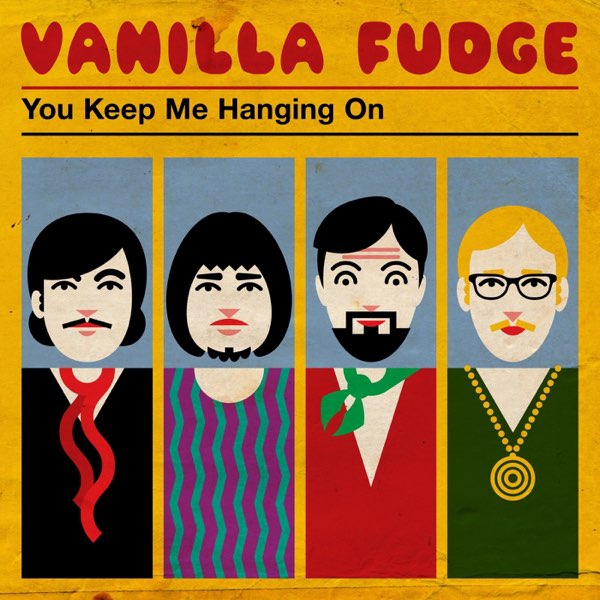
In 1967, Vanilla Fudge – who called their music “psychedelic-symphonic rock” TB – did what co-writer Brian Holland called “a brilliant re-adaption.” TB “Where Diana Ross was full of fire and life, the Fudge’s version was dark and desperate,” TC “imbiding it with kaleidoscopic moods” DT and creating the “inescapable blueprint for every Prog band of the next two or three years.” DT Organist Mark Stein reportedly came up with the “slow and soulful” TC version by playing the 45 record at 33 speed. TC

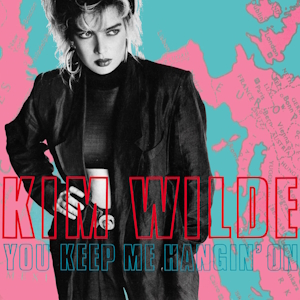
20 years after the Supremes took the song to the top of the charts, Kim Wilde’s cover went to #1. It marked only the sixth time in the history of the Billboard Hot 100 that two different artists took a song to #1. It was the first time three versions of a song reached the top 10. FB In the UK, the English dance/pop singer had charted eleven times before “You Keep Me Hangin’ On,” including her #2 hit “Kids in America,” which also reached the top 40 in the U.S. Surprisingly, Wilde was unaware of the previous success of “You Keep Me Hangin’ On” when she covered it. FB Lamont Dozier, one of the song’s co-writers, said he “liked the fresh sound.” FB


Resources:


Related Links:


First posted 1/21/2024.