Showing posts with label War. Show all posts

Thursday, October 9, 2014

The Rock and Roll Hall of Fame 2015 Nominees

image from fox8.com

The Rock and Roll Hall of Fame announced its 2015 nominees on the morning of October 9, 2014. Based on recent years, 6 of these 15 are likely to be voted in and inducted at the ceremony on April 18, 2015. At FutureRockLegends.com, fans could vote for five. Included below are those results (FRL followed by the % of fans who voted for the act). Also, acts which made the DMDB list of Rock and Roll Hall of Fame Snubs are noted (DMDB + rank). I’ve listed the 15 nominees in order of what I consider their likelihood of getting in.

  1. Green Day: First year eligible. FRL: 56%
  2. Nine Inch Nails: First year eligible. FRL: 43%
  3. Chic: Eligible since 2003. 9-time nominee. FRL: 21%. DMDB: #45
  4. N.W.A.: Eligible since 2013. 3-time nominee. FRL: 33%
  5. Kraftwerk: Eligible since 1996. 3-time nominee. FRL: 35%. DMDB: #30
  6. Stevie Ray Vaughan: Eligible since 2009. First-time nominee. FRL: 55%. DMDB: #8
  7. Lou Reed: Eligible since 1998. 2-time nominee. FRL: 49%
  8. The Smiths: Eligible since 2009. First-time nominee. FRL: 47%. DMDB: #19
  9. Joan Jett & the Blackhearts: Eligible since 2006. 3-time nominee. FRL: 39%. DMDB: #38
  10. Sting: Eligible since 2008. First-time nominee. FRL: 25%
  11. The Spinners: Eligible since 1987. Second-time nominee. FRL: 18%. DMDB: #98
  12. The Paul Butterfield Blues Band: Eligible since 1989. 4-time nominee. FRL: 10%
  13. War: Eligible since 1997. 3-time nominee. FRL: 23%
  14. The Marvelettes: Eligible since 1987. Second nomination. FRL: 18%
  15. Bill Withers: Eligible since 1997. First-time nominee. FRL: 29%

FlavorWire.com picks Green Day, Nine Inch Nails, Chic, N.W.A., and Kraftwerk. I also think these are the five best bets, although my personal picks would be for The Smiths and Lou Reed to get in over Nine Inch Nails and Chic.

Based on the Hall’s prior record, they want a big name, first-time nominee which makes Green Day a shoe-in. Nine Inch Nails is also a pretty decent bet, although I could see them getting held over for another year. The Smiths, Sting, and Stevie Ray Vaughan are also first-time nominees, although they’ve been eligible previously. SRV probably has the best shot of that batch, although I think all three deserve to be in. Bill Withers also got his first nod, but I think he’s the most unlikely of all 15 nominees to get in and I don’t personally think he’s Hall-worthy.

The Hall also likes to get someone in who they’ve backed for a long time. The Paul Butterfield Blues Band, Chic, Joan Jett & the Blackhearts, Kraftwerk, N.W.A., The Spinners, and War have all garnered at least three nominations. With 9 nominations, the Hall really wants to get Chic in. Personally, I think N.W.A. and Kraftwerk are more deserving, but all three could make the cut. Joan Jett would be the next most likely.


Resources and Related Links:

Saturday, November 29, 1986

Bruce Springsteen live box set debuted at #1

Live 1975/1985

Bruce Springsteen & the E Street Band


Released: November 10, 1986


Recorded: October 18, 1975 to September 30, 1985


Peak: 17 US, 4 UK, 17 CN, 3 AU


Sales (in millions): 4.0 US, 0.1 UK, 12.3 world (includes US and UK)


Genre: classic heartland rock


Tracks, Disc 1: Click on a song titled for more details.

  1. Thunder Road (recorded 10/18/75) 3
  2. Adam Raised a Cain (recorded 7/7/78) 4
  3. Spirit in the Night (recorded 7/7/78) 1
  4. 4th of July, Asbury Park (Sandy) (recorded 12/31/80) 2
  5. Paradise by the “C” (recorded 7/7/78)
  6. Fire (recorded 12/16/78)
  7. Growin’ Up (recorded 7/7/78) 1
  8. It’s Hard to Be a Saint in the City (recorded 7/7/78) 1
  9. Backstreets (recorded 7/7/78) 3
  10. Rosalita (Come Out Tonight) (recorded 7/7/78) 2
  11. Raise Your Hand (recorded 7/7/78)
  12. Hungry Heart (recorded 12/28/80) 5
  13. Two Hearts (recorded 7/8/81) 5

Tracks, Disc 2:

  1. Cadillac Ranch (recorded 7/6/81) 5
  2. You Can Look But You Better Not Touch (recorded 12/29/80) 5
  3. Independence Day (recorded 7/6/81) 5
  4. Badlands (recorded 11/5/80) 4
  5. Because the Night (recorded 12/28/80)
  6. Candy’s Room (recorded 7/8/81) 4
  7. Darkness on the Edge of Town (recorded 12/29/80) 4
  8. Racing in the Street (recorded 7/6/81) 4
  9. This Land Is Your Land (recorded 12/28/80)
  10. Nebraska (recorded 8/6/84) 6
  11. Johnny 99 (recorded 8/19/85) 6
  12. Reason to Believe (recorded 8/19/84) 6
  13. Born in the U.S.A. (recorded 9/30/85, released 6/23/84) 7
  14. Seeds (recorded 9/30/85)

Tracks, Disc 3:

  1. The River (recorded 9/30/85, released 6/13/81) 5
  2. War (recorded 9/30/85)
  3. Darlington County (recorded 9/30/85) 7
  4. Working on the Highway (recorded 8/19/85) 7
  5. The Promised Land (recorded 9/30/85, released 10/78) 4
  6. Cover Me (recorded 9/30/85, released 6/23/84) 7
  7. I’m on Fire (recorded 8/19/85, released 2/16/85) 7
  8. Bobby Jean (recorded 8/21/85, charted 6/23/84) 7
  9. My Hometown (recorded 9/30/85) 7
  10. Born to Run (recorded 8/19/85) 3
  11. No Surrender (recorded 8/6/84) 7
  12. Tenth Avenue Freeze-Out (recorded 8/20/84) 3
  13. Jersey Girl (recorded 7/9/81)

Footnotes above indicate the original studio album on which the song was released (if relevant).

1 Greetings from Asbury Park, NJ (1973)
2 The Wild, the Innocent, & the E Street Shuffle (1973)
3 Born to Run (1975)
4 Darkness on the Edge of Town (1978)
5 The River (1980)
6 Nebraska (1982)
7 Born in the U.S.A. (1984)


Total Running Time: 216:13


The Players:

  • Bruce Springsteen (vocals, guitar, harmonica)
  • Roy Bittan (piano, synthesizer, backing vocals)
  • Clarence Clemons (saxophone, percussion, backing vocals)
  • Danny Federici (organ, accordian, glockenspiel, piano, synthesizer, backing vocals)
  • Nils Lofgren (guitar, backing vocals)
  • Patti Scialfa (backing vocals, synthesizer)
  • Garry Tallent (bass, backing vocals)
  • Steve Van Zandt (guitar, backing vocals)
  • Max Weinberg (drums)

Rating:

4.084 out of 5.00 (average of 17 ratings)


Awards:

(Click on award to learn more).

How to Follow a Blockbuster

Following up a blockbuster album can be a tricky proposition. Fans want a sequel to the album they loved; critics demand new material that reflects an artist’s growth. The ‘80s are littered with classic albums with follow-ups that weren’t as well-received. Michael Jackson’s Thriller set him up for a lifetime of releases that were big sellers that were often well received, but they were simultaneously viewed as something less. Prince chose to soldier on as if Purple Rain hadn’t sold 25 million copies worldwide, releasing Around the World in a Day less than a year later. U2 didn’t seem to know what to do after The Joshua Tree, releasing the half-live, half-studio Rattle and Hum a year later. The Police flat out gave up after Synchronicity and never released another album.

The Boss chose a different tactic. Why compete with your previous work? Instead, he chose to celebrate it – and capitalize on the very quality that made him a legendary performer. “Long before he sold substantial numbers of records, Bruce Springsteen began to earn a reputation as the best live act in rock & roll. Fans had been clamoring for a live album for a long time, and with Live/1975-85 they got what they wanted, at least in terms of bulk. His concerts were marathons, and this box set, including 40 tracks and running over three and a half hours, was about the average length of a show.” AM

Another studio album would inevitably have suffered by comparison to Born in the U.S.A. Still, a triple-disc live box set (five records) seemed a risky career move that would test just how deep fans’ pockets were. The move paid off brilliantly.

Well Received

Anticipation was so high, the album generated over 1.5 million advance orders, the largest dollar-volume pre-order in record business history at that time. WK The album debuted at #1, a feat last seen a decade earlier with Stevie Wonder’s Songs in the Key of Life. It was the first five-record set to reach the top 10 and the first to sell more than a million copies. WK The album was certified for sales of 12 million; U.S. sales were actually 4 million, but the RIAA multiplies that figure by the number of discs in the collection. The only live album certified for more was Garth Brooks’ Double Live at 13 times platinum. WK

“In his brief liner notes, Springsteen spoke of the emergence of the album’s ‘story’ as he reviewed live tapes, and that story seems nothing less than a history of his life, his concerns, and his career. The first cuts present the Springsteen of the early to mid-‘70s; these performances, most of them drawn from a July 1978 show at the Roxy in Los Angeles, present the romantic, hopeful, earnest Springsteen.” AM

What We Get

“The second section begins with his first Top Ten hit, Hungry Heart – this is the Springsteen of the late ‘70s and early ‘80s, an arena rock star with working-class concerns. After an acoustic mini set given largely to material from Nebraska – songs of economic desperation and crime – comes a reshuffling of Born in the U.S.A., songs in which the artist and his characters start to fight back and rock out.” AM Surprisingly, “Dancing in the Dark,” his #2 hit from that album and highest-charting song of his career, doesn’t make the cut. He does, of course, include his most iconic song, Born to Run, the “unofficial state anthem” AM of New Jersey.

Reviews were “overwhelmingly positive,” WK but some critics cited the omission of concert highlights such as “Prove It All Night,” “The Fever,” and his cover of Creedence Clearwater Revival’s “Who’ll Stop the Rain.” WK “Fans could rejoice in the seven previously unreleased songs,” AM which included a cover of Edwin Starr’s War and Fire, a song written by Springsteen and a top-ten hit for the Pointer Sisters in 1979.

The Songs

Here’s a breakdown of songs from the live box set that aren’t highlighted on another page.

Raise Your Hand

Bruce Springsteen

Writer(s): Steve Cropper, Eddie Floyd Alvertis Isbell


Recorded: 7/7/1978 at Roxy Theatre in West Hollywood, CA


Released: Live 1975/1985


Charted: 12/10/1986


Peak: 44 AR, 30 DF Click for codes to charts.


Cover of: Eddie Floyd (1967, #79 BB, 16 RB 42 UK, 74 CN)


About the Song:

Eddie Floyd first recorded this song in 1967 for his debut album, Knock on Wood. While it was a top-20 R&B hit, it otherwise went pretty much unnoticed. It became a live favorite for a variety of rock acts, though, including Janis Joplin, the J. Geils Band, Ike & Tina Turner, and, of course, Bruce Springsteen, who performed it for the first time back in 1976. ESS He often used the song as an encore or show closer. ESS

“Even Bruce’s casual fans recognize Floyd’s importance as a musical influence–we’ve seen it evidenced in Bruce’s set lists over the years, from Floyd-penned staples like ‘634-5789’ on the Wrecking Ball Tour to memorable cameos like ‘Ninety-Nine and Half (Won’t Do)’ and ‘Knock on Wood’.” ESS

A decent chunk of Live 1975/1985 was recorded at the Roxy Theatre in West Hollywood on July 7, 1978. In addition to “Raise Your Hand,” the box set includes live recordings from this date and venue for “Adam Raised a Cain,” “Spirit in the Night,” “Paradise by the ‘C’,” “Growin’ Up,” “It’s Hard to Be a Saint in the City,” “Backstreets,” and “Rosalita (Come Out Tonight).”

This Land Is Your Land

Bruce Springsteen

Writer(s): Woody Guthrie


Recorded: 12/28/1980 live at Nassau Coliseum in Uniondale, New York


Released: Live 1975/1985


About the Song:

Woody Guthrie wrote “This Land Is Your Land” in 1939 as a reaction to the “saccharinely patriotic song” ESS “God Bless America.” “It irked Guthrie to hear Berlin’s blindly syrupy song coming out of every radio a full decade into the Great Depression while all around him were migrants and homeless struggling to find work and survive.” ESS Guthrie used “This Land” to point “out where America was falling short and failing its citizens.” ESS

However, “the version most of us are familiar with is the sanitized one he released in 1951,” ESS “minus its more progressive lyrics.” ESS “Even though the versions in print and on record excluded Guthrie’s sharpest lyrics, the folk music tradition kept them alive.” ESS Bruce Springsteen, for one, “always insisted on performing all the verses, starting with his first performance in 1980.” ESS He “was captivated with the beauty and poetry of Guthrie’s words, along with Guthrie’s ability to simultaneously hold his country accountable.” ESS

Seeds

Bruce Springsteen

Writer(s): Bruce Springsteen


Recorded: 9/30/1985 live at the Los Angeles Coliseum


Released: Live 1975/1985


About the Song:

This is “an original Springsteen song that Bruce has played live almost two hundred times, and yet it’s never seen an official studio release.” ESS It’s been done “in so many different arrangements…[one] can’t help but wonder if the reason Bruce never released it is that he’s never found a studio arrangement he’s comfortable memorializing.” ESS He would, however, release “Rockaway the Days”on the 1998 Tracks box set in which he paired the lyrics with completely different music.

This version was recorded live at the Los Angeles Coliseum on 9/30/1985 along with “Born in the U.S.A.,” “The River,” “War,” “Darlington County,” “The Promised Land,” “Cover Me,” and “My Hometown.”

The song is sung from the point of view of “an unemployed worker, lured from his home up north (probably working in the steel mills or coal mines) by the promise of plentiful and secure work in Texas. He heads south with nothing to his name other than his family, only to find that by the time he gets there, the price of oil had dropped and the jobs along with it. With no work to do and no place to go, he and his family find themselves homeless in Houston.” ESS The family sleeps in their car and the kids are sick. The narrator seethes over a passing limousine, presumably carrying an oil executive apathetic to the plight of his former workers. He just wants “to be seen and acknowledged for the economic injustice that’s been done him.” ESS

War

Bruce Springsteen

Writer(s): Norman Whitfield, Barrett Strong


Recorded: 9/30/1985 live at the Los Angeles Coliseum


Released: 11/10/1986 as a single, Live 1975/1985 (live box set, 1986)


B-Side: “Merry Christmas Baby”


Peak: 8 BB, 9 CB 9 GR, 12 RR, 4 AR, 18 UK, 11 CN, 38 AU, 1 DF Click for codes to charts.


Sales (in millions): --


Airplay/Streaming (in millions): -- radio, 2.5 video, 2.64 streaming


About the Song:

This song was originally recorded by the Temptations, but their “original 1970 recording never quite mustered the visceral power that Edwin Starr would bring to bear in his now-legendary single released just a few months later.” ESS It reached #1.

As Bruce was winding down his Born in the U.S.A. tour in 1985, he “introduced a few wild cards into the tour’s last stand in Los Angeles. One of them was a cover of “War,” introduced by a prescient plea to his young fans not to blindly trust their leaders. Bruce had never shied away from anti-war sentiment, but rarely had he embraced it quite so boldly.” ESS

Check out the DMDB page for more details about the original version of “War.”

Awards:

(Click on award to learn more).

Jersey Girl

Bruce Springsteen

Writer(s): Tom Waits


Recorded: 7/9/1981 live at Meadowlands Arena in East Rutherford, New Jersey


Released: 7/31/1984 as the B-side of “Cover Me,” Live 1975/1985 (live box set, 1986)

Cover of: Tom Waits (1980)


About the Song:

Tom Waits wrote this song for Kathleen Brennan, his future wife. It was released in 1980 on his Heartbreak and Vine album. Springsteen performed the song live and a recording of it was featured as the B-side of his 1984 single for “Cover Me.” The same performance was then used as the closing song for Bruce’s Live 1975/1985 box set. Because of his association with the state, people have mistakenly assumed Bruce wrote the song. ”Its lyrics absolutely reek of Bruce” ESS “because Waits’ songwriting on ‘Jersey Girl’ so closely resembles Bruce’s own style.” ESS

When Bruce debuted his performance of the song, he cleaned up the lyrics a bit and added a whole new verse that “perfectly matches the tone and heart of Waits’ original.” ESS It turns out he’d originally written the words for the song “Party Lights,” which wouldn’t surface until it was released on The Ties That Bind: The River Collection box set in 2015.


Resources/References:


Related DMDB Pages:


First posted 2/14/2011; last updated 8/3/2025.

Monday, March 21, 1983

U2 released “Sunday Bloody Sunday”

Sunday Bloody Sunday

U2

Writer(s): U2 (see lyrics here)


Released: March 21, 1983


First Charted: April 16, 1983


Peak: 7 AR, 1 DF (Click for codes to charts.)


Sales (in millions): -- US, 0.2 UK


Airplay/Streaming (in millions): -- radio, 78.9 video, 320.23 streaming

Awards:

Click on award for more details.

About the Song:

The Irish rock band U2 started building their following in the early ‘80s with songs like “I Will Follow” and “Gloria” from their Boy and October albums respectively. Their third album, War, was “a passionate, politically charged album” SS cemented the band’s place amongst college radio with “New Year’s Day,” “Two Hearts Beat As One,” and “Sunday Bloody Sunday.”

The latter was one of the band’s most overtly political songs, shining a light on the horror of the 1972 Bloody Sunday incident in Derry, North Ireland where unarmed civil rights protesters were shot and killed by British troops. There was also a Bloody Sunday in 1920 when troops fired into a crowd at a Dublin football match, but this song refers more to the 1972 incident. SF

Of the song, drummer Larry Mullen said, “People are dying every single day through bitterness and hate, and we’re saying why? What’s the point?” WK An early version of the song started with the lyric, “Don’t talk to me about the rights of the IRA, UDA” but was replaced with “I can’t believe the news today.” Bassist Adam Clayton said the band opted to remove the line because it was so politically charged and the “viewpoint became very human and non-sectarian…which is the only responsible position.” WK

A video shot at a performance on June 5, 1983, at the Red Rocks Ampitheatre in Colorado helped build the band’s reputation as a live act because of the energy and lead singer Bono’s charisma and stage presence in leading the audience in chanting “no more” and waving a white flag. He opens the song saying, “This song is not a rebel song. This song is ‘Sunday Bloody Sunday.’” All Music Guide’s JT Griffith considers it a strange comment because, “though it does not advocate violence, it is one of the most famous and moving rebel songs ever written.” AMG Time magazine expressed a similar sentiment in naming it one of the top 10 protest songs of all time. WK Bono, however, has explained that he introduced the song that way as a means of emphasizing the band’s non-partisan intentions. WK It has become a staple in U2’s live show and one of their signature tunes.


Resources:


Related Links:


First posted 8/13/2021; last updated 3/31/2023.

Monday, February 28, 1983

U2’s War released

War

U2


Released: February 28, 1983


Peak: 12 US, 11 UK, 4 CN, 9 AU


Sales (in millions): 4.0 US, 0.6 UK, 11.7 world (includes US and UK)


Genre: college rock


Tracks:

Song Title [time] (date of single release, chart peaks) Click for codes to singles charts.

  1. Sunday Bloody Sunday [4:38] (3/21/83, 7 AR)
  2. Seconds [3:24]
  3. New Year’s Day [5:38] (1/22/83, 53 US, 2 AR, 10 UK, 41 CN, 36 AU)
  4. Like a Song… [4:48]
  5. Drowning Man [4:12]
  6. The Refugee [3:40]
  7. Two Hearts Beat As One [5:00] (4/2/83, 12 AR, 18 UK, 53 AU)
  8. Red Light [4:09]
  9. Surrender [6:01] (7/16/83, 27 AR)
  10. 40 [2:08]

All songs written by U2.


Total Running Time: 42:03


The Players:

  • Bono (vocals, guitar)
  • The Edge (guitar, backing vocals, piano, bass)
  • Adam Clayton (bass)
  • Larry Mullen, Jr. (drums, percussion)

Rating:

4.207 out of 5.00 (average of 18 ratings)


Quotable: “U2 always aimed at greatness, but War was the first time they achieved it” – Stephen Thomas Erlewine, All Music Guide


Awards: (Click on award to learn more).

About the Album:

“The final album of U2’s early period, before the group broadened its sonic palette and lyrical vision, War is a brilliantly conflicted album, sounding martial and majestic while its very purpose is to tear down false idols propped up by politics.” DD “Blowing away the fuzzy, sonic indulgences of October with propulsive, martial rhythms and shards of guitar, War bristles with anger, despair, and above all, passion. Previously, Bono’s attempts at messages came across as grandstanding, but his vision becomes remarkably clear on this record.” STE

“Opening with the ominous, fiery protest of Sunday Bloody Sunday, War immediately announces itself as U2’s most focused and hardest-rocking album to date.” STE That song and "40" take the subject of Ireland’s troubles head-on.” DDNew Year's Day “is about a sundered love relationship symbolic of a greater division. ‘Torn in two, we can be one,’ Bono pleads, as Edge’s guitar scratches and snarls behind him.” DD

Anthems such as those and “Seconds are balanced by effective, surprisingly emotional love songs [such as] Two Hearts Beat as OneSTE “and the delicate Drowning Man,” DD “which are just as desperate and pleading as [Bono’s] protests.” STE Amazon.com’s Daniel Durchholz claims these “take a back seat here, but they help make War a compelling and well-rounded album.” DD Bono “performs the difficult task of making the universal sound personal, and the band helps him out by bringing the songs crashing home with muscular, forceful performances that reveal their varied, expressive textures upon repeated listens. U2 always aimed at greatness, but War was the first time they achieved it.” STE


Notes: A Deluxe Edition released in 2008 added a second disc of “b-sides, live tracks and rarities. Also includes a 32 page booklet with previously unseen photos, full lyrics, new liner notes by Niall Stokes, and explanatory notes on the bonus material by The Edge.” AZ

Tracks on second disc include “Endless Deep,” “Treasure (Whatever Happened to Pete the Chop),” “Angels Too Tied to the Ground,” four remixes of “New Year’s Day,” another three of “Two Hearts Beat As One,” and live versions of “I Threw a Brick Through a Window/ A Day Without Me” and “Fire.”

Resources and Related Links:


Other Related DMDB Pages:


First posted 3/23/2008; last updated 8/13/2021.

Saturday, January 1, 1983

U2 “New Year’s Day” released

New Year’s Day

U2

Writer(s): U2 (see lyrics here)


Released: January 1, 1983


First Charted: January 22, 1983


Peak: 53 US, 50 CB, 2 AR, 1 CO, 10 UK, 41 CN, 36 AU, 2 DF (Click for codes to singles charts.)

Sales (in millions): --


Airplay/Streaming (in millions): -- radio, 56.21 video, -- streaming

Awards:

Click on award for more details.

About the Song:

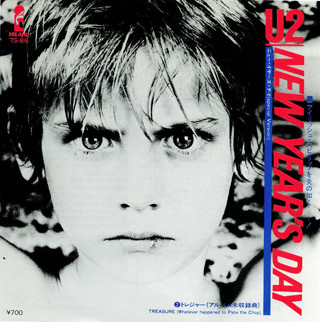
U2 formed in Dublin, Ireland, in 1976. They built a loyal following at college rock radio with their first two albums, 1980’s Boy and 1981’s October. Their third release, War proved to be a breakthrough, reaching #12 in the United States and eventually selling more than 11 million copies worldwide.

The album’s lead single, “New Year’s Day,” became a favorte at MTV. It was filmed in the dead of the Swedish winter. As such, the band only appears in the performance scenes of the video. They were too cold WK and weren’t experienced enough riders SF to do the horseback riding scenes so four Swedish teenage girls were disguised as the band with masks over their faces. There is also footage of Soviet troops advancing in winter during World War II. WK

The song soared all the way to #2 on the Billboard album rock track. It was also the group’s first top-10 hit in the UK and first entry on the Billboard Hot 100 in the United States. Cash Box called it an “AOR-slanted single by a thinking man’s rock ‘n’ roll band.” WK The band’s lead singer, Bono, said, “I don’t think ‘New Year’s Day’ was a pop single, certainly not in the way that [record producer] Mickie Most might define a pop single as something that lasts three minutes and three weeks in the chart. I don’t think we could have writte that kind of song.” WK

Lyrically, the song started as a love song by Bono for his wife, but it evolved into a commentary on the Polish Solidarity movement. WK Poland announced they would abolish martial law after this song was recorded; coincidentally the announcement came on New Year’s Day, 1983. SF The song’s distinct bassline was the result of Adam Clayton trying to figure out the chords for the song “Fade to Grey” by Visage. WK


Resources:


Related Links:


First posted 10/1/2022.