Showing posts with label best college rock songs. Show all posts

Friday, June 17, 2022

Kate Bush hit #1 with “Running Up That Hill” 37 years after release

Running Up That Hill (A Deal with God)

Kate Bush

Writer(s): Kate Bush (see lyrics here)


First Charted: August 5, 1985


Peak: 3 US, 14 BA, 13 ST, 28 CB, GR 36, 33 RR, 9 AC, 5 A40, 24 AA, 34 AR, 2 MR, 13 UK, 2 CN, 19 AU, 3 DF (Click for codes to charts.)


Sales (in millions): -- US, 2.05 UK, 2.75 world (includes US + UK)


Airplay/Streaming (in millions): -- radio, 265.68 video, 1018.47 streaming

Awards:

Click on award for more details.

About the Song:

“Running Up That Hill” was released as the lead single for Kate Bush’s fifth album, Hounds of Love. In her native UK, the song reached #3 on the charts, her fifth single to make the top 10. She’d had much less success in the United States where her only chart hit on the Billboard Hot 100 had been 1978’s “The Man with the Child in His Eyes” reaching #85. However, “Hill” gave Bush her solitary top 40 hit in the U.S., going to #30.

The song wasn’t done, though. 37 years later, it was prominently featured in the Netflix TV series Stranger Things as the favorite song of the character Max. This renewed interest in the song and it reached new chart peaks around the globe, hitting #1 in the United Kingdom, Australia, and other countries. In the United States the song climbed all the way to #4 and topped Billboard’s streaming and digital sales charts.

The song was originally called “A Deal with God,” but representatives at EMI Records hesitated to release a song with the word “God” in it. Bush changed the title, but subtitled the song “A Deal with God” on the Hounds of Love album. Executives were also more interested in releasing “Cloudbursting” as the first single but Bush pushed for “Hill” because it was the first song she wrote for the album and she thought it better represented the album. WK

Thematically, the “brutally truthful, painfully sensual song” AMG isn’t about religion, but the differences between men and women. Bush said, “If we could actually swap each others’ roles, if we could actually be in each other’s place for a while, I think we’d both be very surprised! And I think it would lead to a greater understanding.” WK She conceived the idea that “if they could make a deal with God to change places…they’d understand what it’s like to be the other person.” SF The “concept is a flip on the Faustian bargain where one makes a deal with the devil.” SF


Resources:


Related Links:


First posted 6/15/2022; last updated 7/28/2023.

Wednesday, April 13, 1983

Violent Femmes “Add It Up” released on debut album

Add It Up

Violent Femmes

Writer(s): Gordon Gano (see lyrics here)


Released: April 13, 1983 (on Violent Femmes album)


Peak: 2 CO, 1 DF (Click for codes to singles charts.)


Sales (in millions): --


Airplay/Streaming (in millions): -- radio, 7.7 video, 25.88 streaming

Awards:

Click on award for more details.

About the Song:

The punk band Violent Femmes formed in Madison, Wisconsin in 1979. The trio was comprised of singer and guitarist Gordon Gano, bassist Brian Ritchie, and drummer Victor DeLorenzo. In 1983, they released their self-titled debut album, “an early landmark of American alternative rock.” AMG While the song “Blister in the Sun” became the best known from the album by cementing itself as a staple of alternative rock radio in the ‘80s, the album also produced the popular “Add It Up.”

The song benefits from Gano’s “uncanny knack for clever, incessantly catchy lyrics.” AMG The song plays on his “yearning, hard-luck misfit role that dominated the album, but it’s even darker than usual, with its frank, edgy sexuality and intimations of gun violence.” AMG He sings “with such snarling abandon that, in spite of the obvious geekiness of his persona, there’s also an unsettling sense of menace.” AMG

“Opening with a free-form a cappella passage, the song quickly becomes a driving rocker, and Gano steadily escalates his sexual longings (‘why can’t I get just one...’) from ‘kiss’ to ‘screw’ to ‘fuck.’ Even the first scenario is far from romantic – I look at your pants and I need a kiss,’ Gano sings, giving the lie to the assumption that innocence and inexperience go hand in hand.” AMG

Gano discussed writing the song in his bedroom about feeling frustrated. As he said, “I had nowhere to go and nothing to do. It just happened to feel good lyrically…and it still does.” WK Despite the song’s irrestible drive to get up and move, the subject matter is dark. It isn’t just about sexual frustration, but a young man who buys a gun, offering “evidence that misfit rage had long been something of a powder keg in American high schools” more than 15 years before Columbine. AMG The lines “The day is in my sights / When I’ll take a bow / And say good night” suggests the narrator may have turned that rage inward to suicidal thoughts. AMG


Resources:


Related Links:


First posted 6/10/2022; last updated 10/1/2022.

Saturday, January 1, 1983

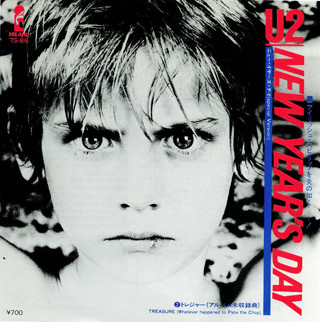
U2 “New Year’s Day” released

New Year’s Day

U2

Writer(s): U2 (see lyrics here)


Released: January 1, 1983


First Charted: January 22, 1983


Peak: 53 US, 50 CB, 2 AR, 1 CO, 10 UK, 41 CN, 36 AU, 2 DF (Click for codes to singles charts.)


Sales (in millions): --


Airplay/Streaming (in millions): -- radio, 56.21 video, -- streaming

Awards:

Click on award for more details.

About the Song:

U2 formed in Dublin, Ireland, in 1976. They built a loyal following at college rock radio with their first two albums, 1980’s Boy and 1981’s October. Their third release, War proved to be a breakthrough, reaching #12 in the United States and eventually selling more than 11 million copies worldwide.

The album’s lead single, “New Year’s Day,” became a favorte at MTV. It was filmed in the dead of the Swedish winter. As such, the band only appears in the performance scenes of the video. They were too cold WK and weren’t experienced enough riders SF to do the horseback riding scenes so four Swedish teenage girls were disguised as the band with masks over their faces. There is also footage of Soviet troops advancing in winter during World War II. WK

The song soared all the way to #2 on the Billboard album rock track. It was also the group’s first top-10 hit in the UK and first entry on the Billboard Hot 100 in the United States. Cash Box called it an “AOR-slanted single by a thinking man’s rock ‘n’ roll band.” WK The band’s lead singer, Bono, said, “I don’t think ‘New Year’s Day’ was a pop single, certainly not in the way that [record producer] Mickie Most might define a pop single as something that lasts three minutes and three weeks in the chart. I don’t think we could have writte that kind of song.” WK

Lyrically, the song started as a love song by Bono for his wife, but it evolved into a commentary on the Polish Solidarity movement. WK Poland announced they would abolish martial law after this song was recorded; coincidentally the announcement came on New Year’s Day, 1983. SF The song’s distinct bassline was the result of Adam Clayton trying to figure out the chords for the song “Fade to Grey” by Visage. WK


Resources:


Related Links:


First posted 10/1/2022.

Friday, June 11, 1982

The Clash “Rock the Casbah” released

Rock the Casbah

The Clash

Writer(s): Topper Headon, Mick Jones, Joe Strummer (see lyrics here)


Released: June 11, 1982


First Charted: June 26, 1982


Peak: 8 US, 13 CB, 14 RR, 6 AR, 1 CO, 15 UK, 17 CN, 3 AU, 8 DF (Click for codes to singles charts.)


Sales (in millions): 2.0 US, 0.6 UK


Airplay/Streaming (in millions): -- radio, 84.26 video, 214.63 streaming

Awards:

Click on award for more details.

About the Song:

The Clash formed in London in 1976. They were one of the pillars of British punk rock, “revered for breaking new ground as rock rebels.” SF Their self-titled debut album hit #12 in the UK. 1978’s Give ‘Em Enough Rope hit #2, 1979’s London Calling hit #9, and the 1980 triple album Sandinista! reached #19. Their peak came in 1982 with Combat Rock. It got to #2 in the UK, but became the group’s only top-10 album in the United States, also reaching double platinum status.

Prior to Combat Rock, the Clash had racked up 13 chart hits in the UK, but their only success in the United States had been with 1980’s “Train in Vain,” a #23 hit on the Billboard Hot 100. “Know Your Rights,” the lead single from Combat Rock, was nother miss on the U.S. charts, but got to #43 in the UK. The second single, “Rock the Casbah,” proved to be the breakthrough for the Clash in the U.S., going all the way to #8. Vulture writer Bill Wyman called it “one of the greatest rock singles of all time.” WK

While most Clash songs grew out of the songwriting partnership between Joe Strummer and Mick Jones, this song came from the drummer, Topper Headon. He composed the song based on a piano part. Without his bandmates around, he taped parts for the drum, piano, and bass. When Strummer saw Headon’s lyrics about missing his girlfriend, Strummer “screwed the piece of paper into a ball and chucked it backwards over his head.” WK Different reports suggest the original lyrics were either really sappy WK or downright pornographic. SF By the time the song was a hit, Headon had been fired from the band for drug problems. SF

Strummer rewrote the words in the bathroom to tell a story of a ban on Western music by a Middle Eastern king. WK The king goes to extreme measure, even order jet fighters to bomb people violating the ban. The pilots ignore the orders, playing rock music on the radios in their cockpits. Strummer was inspired by Iran’s ban on Western music after the 1979 Islamic Revolution. WK


Resources:


Related Links:


First posted 10/2/2022.

Saturday, June 5, 1982

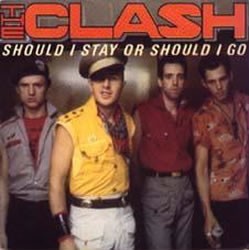
The Clash “Should I Stay Or Should I Go” charted

Should I Stay Or Should I Go

The Clash

Writer(s): Topper Headon, Mick Jones, Paul Simonon, Joe Strummer (see lyrics here)


Released: May 1982


First Charted: June 5, 1982


Peak: 45 US, 63 CB, 13 AR, 1 CO, 12 UK, 40 CN, 37 AU, 5 DF (Click for codes to singles charts.)


Sales (in millions): -- US, 0.6 UK


Airplay/Streaming (in millions): -- radio, 127.35 video, 633.64 streaming

Awards:

Click on award for more details.

About the Song:

The Clash formed in London in 1976. They were one of the pillars of British punk rock, touted early on as “the most important rock group in Britain.” KL Their self-titled debut album hit #12 in the UK. 1978’s Give ‘Em Enough Rope hit #2, 1979’s London Calling hit #9, and the 1980 triple album Sandinista! reached #19. Their peak came in 1982 with Combat Rock. It got to #2 in the UK, but became the group’s only top-10 album in the United States, also reaching double platinum status.

Prior to Combat Rock, the Clash had racked up 13 chart hits in the UK, but their only success in the United States had been with 1980’s “Train in Vain,” a #23 hit on the Billboard Hot 100. “Know Your Rights,” the lead single from Combat Rock, was nother miss on the U.S. charts, but got to #43 in the UK. The second single, “Rock the Casbah,” proved to be the breakthrough for the Clash in the U.S., going all the way to #8. The follow-up, “Should I Stay Or Should I Go,” hit #45.

“Should I Stay” wasn’t done, though. Originally it peaked at #17 in the UK, but in 1991 the song saw a resurgence because of its appearance in a Levi jeans commercial. It was re-released and hit #1 in the UK. Not only was it their only chart-topper, but their only song to hit the top 10 in the UK.

When the song initially came out, some interpreted it as a sign that singer and guitarist Mick Jones was leaving the band. He was, in fact, fired in 1983. In 2009, Rolling Stone SF said it was about “the tempestuous personal relationship between Jones and American singer Ellen Foley,” WK who sang backing vocals on Meat Loaf’s Bat Out of Hell. Jones said, “it wasn’t about anything specific and it wasn’t pre-empting my leaving The Clash. It was just a good rockin’ song, our attempt at writing a classic.” KL


Resources:

  • AMG All Music Guide
  • KL Jon Kutner and Spencer Leigh (2005). 1000 UK Number One Hits: The Stories Behind Every Number One Single Since 1952. London, Great Britain: Omnibus Press. Pages 366-7.
  • SF Songfacts
  • WK Wikipedia


Related Links:


First posted 10/2/2022.